
The Script Worked on 36 Hosts and Failed the Interview
Picture a mid-level Systems Administrator interview where you are asked to replace manual SSH with a tool that pushes a config and restarts a service across hundreds of Linux hosts. A prepared candidate, Dana, writes a clean loop and feels good. Then the interviewer asks what happens when host 37 refuses to come back, and the points start leaking. This walkthrough is a dramatized mock built on one real interview blueprint, so you can see where those points go before you are in the chair.
Key Findings
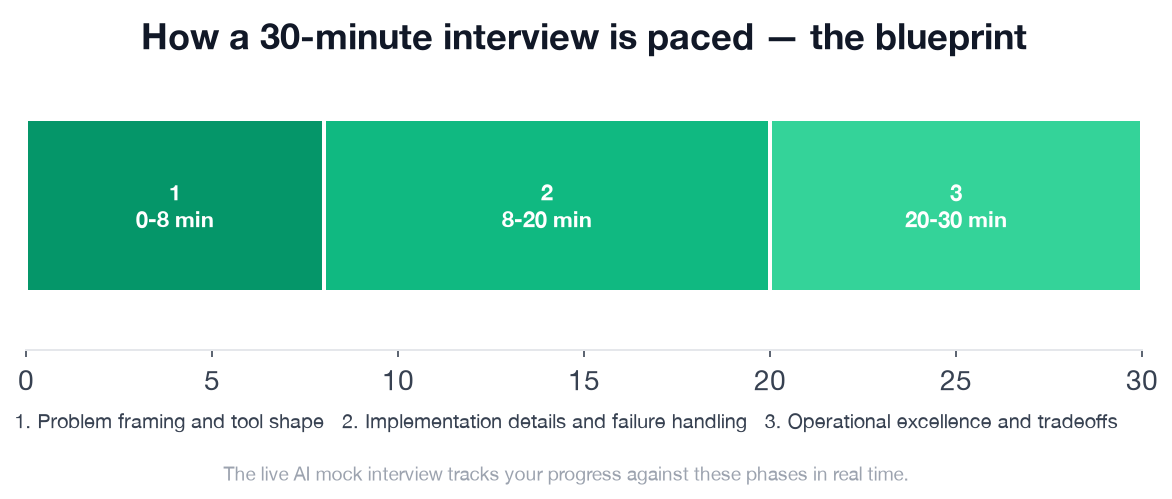
- The interview runs 30 minutes in 3 phases: 0-8, 8-20, and 20-30 minutes.
- The rubric totals 100 points; Technical Proficiency is only 20 of them.
- Safety reasoning and level judgment (Objectives Alignment 30 plus Level-Specific Expectations 30) carry 60 points.
- The middle phase is the longest at 12 minutes and holds 7 checklist items, the most of any phase.
- The per-host flow has 4 steps in a fixed order: validate, copy, restart, confirm healthy.
- The scenario spans several hundred hosts across 2 environments, staging and production.
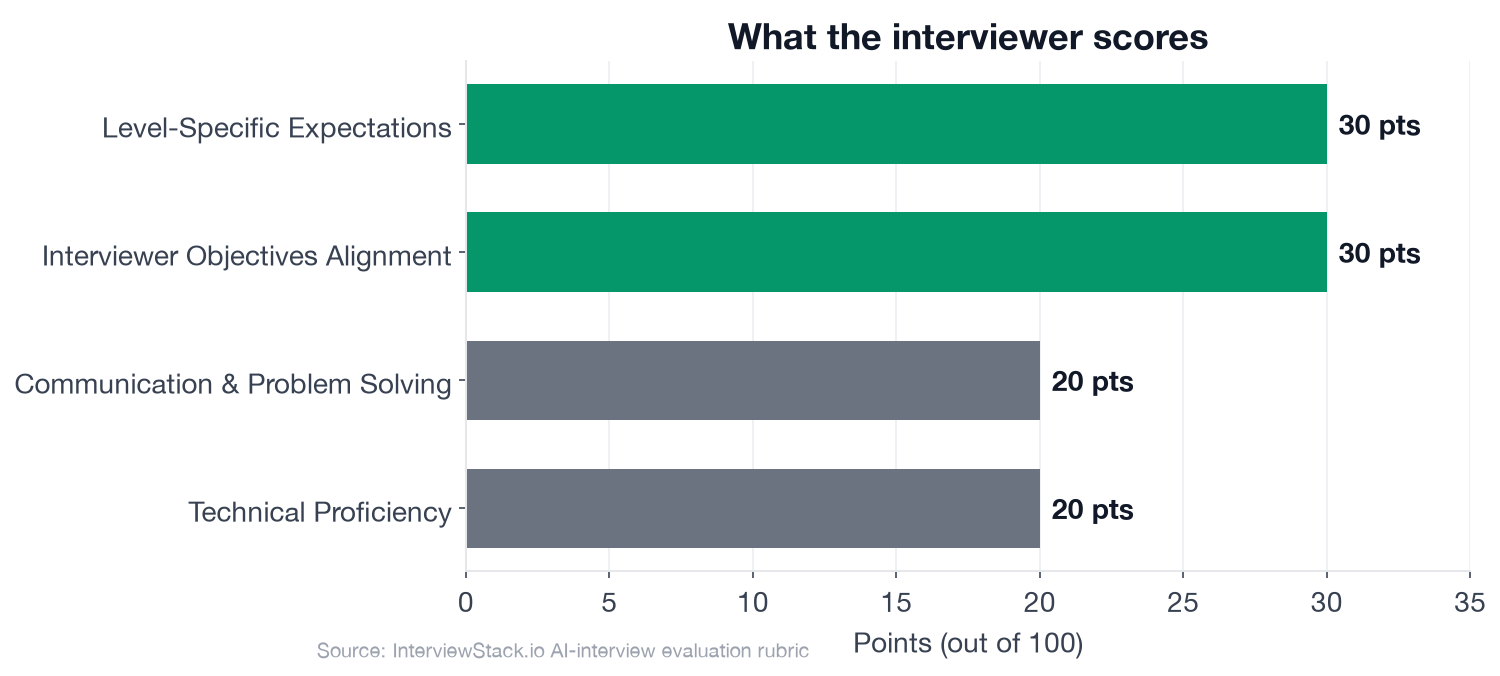
How a Systems Administrator Scripting Interview Is Scored
Four dimensions, 100 points. The weights say what the interviewer cares about: whether you solved the operational problem safely, and whether you show mid-level judgment. Code quality is a fifth of the grade. A candidate who writes elegant Python but never mentions dry-run, batching, or reruns has spent the strongest part of the interview on the weakest-weighted dimension.
What Does the Interviewer Actually Ask?
The interview question
Your team owns several hundred Linux application hosts across staging and production. During deploy windows, operators sometimes need to roll out a small configuration update and restart a service on a selected set of hosts. Today this is done manually over SSH, which is slow and error-prone. You have been asked to build an internal command-line tool operators can use to do this safely across many hosts.
Assume:
- Hosts are reachable over SSH.
- The tool runs from a bastion or admin workstation.
- Per host: validate the target config, copy it into place,
  restart the service, confirm the service is healthy.
- A plain text inventory of target hosts is available.
How would you design and implement this tool so it is safe and practical for a systems team to use in production?
What Is the Interviewer Really Probing?
Not whether you know SSH. The objectives are judgment under production risk: breaking down an ambiguous ask, defining safe execution and rollback, handling partial completion, and keeping the tool usable by someone else at 3 a.m. Notice the guardrail in the level bar too: a mid-level candidate is not expected to build a company-wide deployment framework. Over-engineering costs points just as under-engineering does.
The Walkthrough, Turn by Turn
Turn 1: The Operator Experience
Interviewer: "What would the operator experience look like from the command line, and what inputs or flags would you require before allowing a production run?"
Turn 2: Host Failure Policy
Interviewer: "If one host fails validation or doesn't come back healthy after restart, how should the tool behave for the rest of the fleet?"
Turn 3: Limits on Parallelism
Interviewer: "What limits would you place on parallelism or rollout batching, and how would you decide those defaults for staging versus production?"
Turn 4: Credentials and Wrong Targets
Interviewer: "How would you protect credentials, avoid risky shell usage, and reduce the chance that an operator targets the wrong hosts or wrong environment?"
Why Isn't Reading This Enough?
Every mistake above is obvious on the page. Live, you are typing a design while the interviewer interrupts with 'and if it crashes halfway?', and the answer that felt complete at minute 6 develops a hole at minute 14. Spotting errors is recognition. Avoiding them under a clock, with unscripted follow-ups, is recall, and recall only improves with reps.
The Complete Blueprint
This is what a strong 30-minute run covers. It is also what the AI mock interview tracks you against in real time, phase by phase.
- ✓Clarifies what 'safe for production' means in practice
- ✓Defines the high-level per-host workflow in the correct order
- ✓Identifies key inputs such as inventory, environment, config artifact, service name, and rollout scope
- ✓Chooses a reasonable implementation approach such as Python CLI with SSH/SCP wrappers or structured shell plus helper functions
- ✓Distinguishes between staging and production behavior at least at the level of confirmations or rollout limits
- ✓Describes how the tool reads and validates host inventory before execution
- ✓Explains how remote commands are executed safely without fragile string concatenation or unsafe shell interpolation
- ✓Includes backup of existing config or atomic write pattern before restart
- ✓Defines health check behavior and timeout handling after restart
- ✓Explains whether failures stop the rollout, skip the host, or stop the current batch, with a rationale
- ✓Shows a retry policy that avoids blind repeated restarts or repeated destructive actions
- ✓Accounts for reruns by checking current state or recording prior outcomes
- ✓Provides structured logs or per-host status output plus an end-of-run summary
- ✓Adds operator safety features such as dry-run, explicit environment targeting, host preview, or confirmation prompts
- ✓Sets a sensible concurrency or batching strategy and justifies defaults
- ✓Handles credentials appropriately by relying on existing SSH mechanisms or least-privilege execution rather than embedding secrets
- ✓Keeps the solution scoped as a maintainable internal tool rather than introducing unnecessary platform complexity
Run It Live Before It Counts
Start the AI mock interview for this exact scenario and answer the host-37 question out loud, on the clock. When you want more variety, drill the automation and scripting question bank, skim the Systems Administrator preparation guides, or see what employers ask for on the Systems Administrator job board.
FAQ
What does a mid-level Systems Administrator scripting interview test?
It tests whether you can design a safe operator-facing tool: per-host flow (validate, copy, restart, health check), idempotent reruns, failure policy, bounded concurrency, and credential hygiene. It rewards judgment over clever code.
How is the AI mock interview scored?
Out of 100 points: Interviewer Objectives Alignment 30, Level-Specific Expectations 30, Technical Proficiency 20, and Communication & Problem Solving 20. Syntax is a small slice; the safety reasoning carries most of the score.
How long is the interview and how is it paced?
30 minutes in three phases: problem framing and tool shape (0-8 minutes), implementation details and failure handling (8-20), and operational excellence and tradeoffs (20-30).
Should I use shell or Python for a fleet rollout tool?
Either can be justified. Python with a structured SSH wrapper is easier to test and to report from; structured shell with helper functions is fine for a small tool. State the reason, and avoid building commands by concatenating strings.
What should the tool do when one host fails after the restart?
Stop and decide on purpose. A common strong policy is to halt the current batch, report the failed host, and leave the remaining batches untouched until an operator chooses to continue. Blind continue-and-hope is the weak answer.
Do I need to design a full orchestration platform?
No. The mid-level bar is a maintainable internal tool that reduces toil. Drifting into infrastructure-as-code frameworks or controllers is explicitly outside this interview's scope and can read as poor judgment.
Are these the real questions a specific company asks?
No. The blueprint is illustrative of how a strong scripting interview runs. The dramatized answers are common patterns, not transcripts of real candidates.
One Rerun Beats Ten Reads
The tool that gets hired is the one that is boring when things break. Practice saying how yours stops, reports, and resumes, and the rest of the rubric tends to follow.
Topics
Ready to practice?
Put what you've learned into practice with AI mock interviews and structured preparation guides.