
The Systems Administrator Linux System Administration Interview Rewards Proof Over the Obvious Suspect
A host just got pulled from rotation. Users saw slow responses for about 20 minutes, health checks started failing, and the timing lines up almost exactly with a maintenance window that ran earlier the same day. The application team swears they didn't deploy anything. Every instinct says: it was the maintenance window.
That instinct is usually right, and that's exactly the trap. This walkthrough follows a mid-level Systems Administrator, Wes, through a simulated 30-minute Linux system administration interview built on a real AI-interview blueprint. Wes has the right suspect from minute one. What costs points is what happens between suspecting it and proving it.
Key Findings
- The rubric splits 100 points across four dimensions: 30 for Interviewer Objectives Alignment, 30 for Level-Specific Expectations, 20 for Technical Proficiency, and 20 for Communication and Problem Solving.
- The interview runs 30 minutes across three timed phases: minutes 0-8, 8-20, and 20-30.
- Phase one (minutes 0-8) alone carries five expected moves, all before disk or package logs come up.
- Phase two (minutes 8-20) is the longest stretch at 12 minutes and packs five checklist items spanning disk, packages, and service reachability.
- The scenario reports about 20 minutes of elevated latency before the host was pulled from rotation, the same window a strong candidate reconstructs from logs.
- Four topics are explicitly out of scope for this interview: Kubernetes administration, infrastructure-as-code implementation, kernel or driver internals, and application feature design.
- Level-Specific Expectations (30 of 100 points) require proposing sensible Linux commands independently, without heavy prompting.
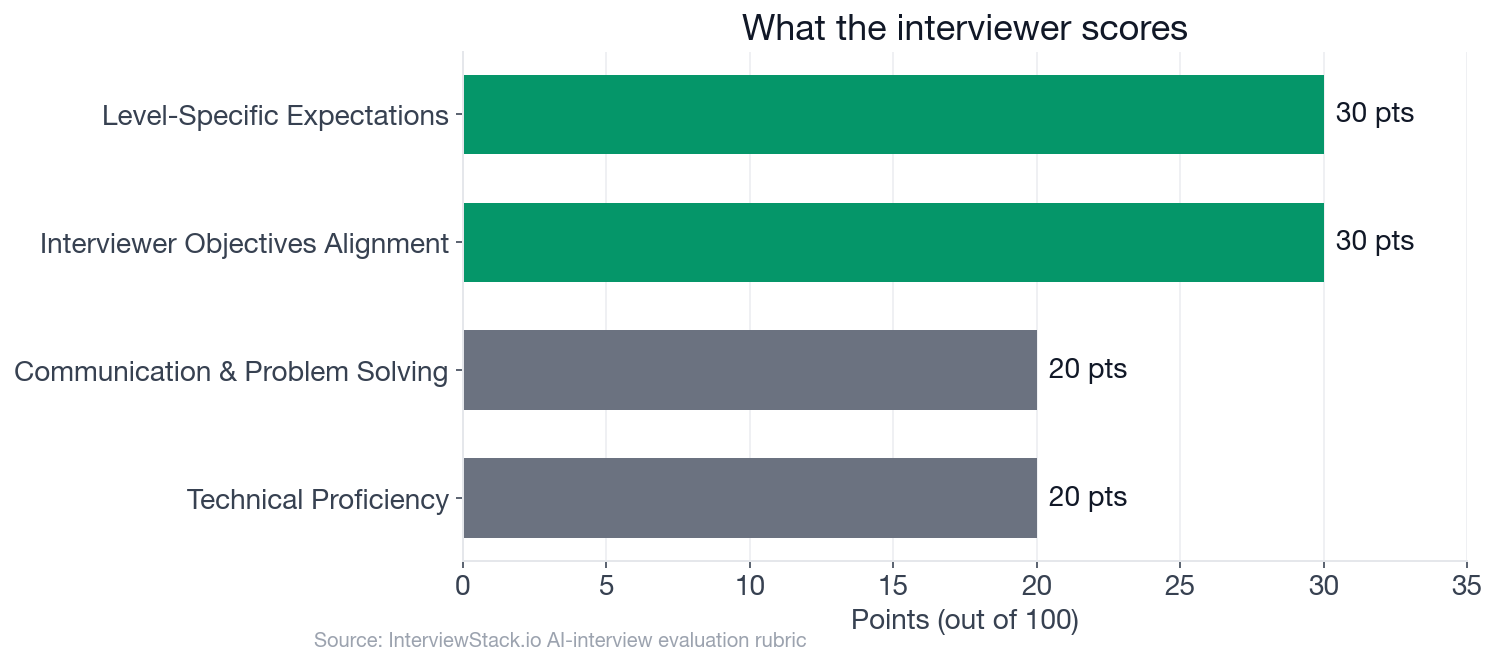 The 100-point rubric weighs judgment as heavily as knowledge: Interviewer Objectives Alignment and Level-Specific Expectations together account for 60 of the 100 points, one and a half times the combined weight of Technical Proficiency and Communication and Problem Solving (60 vs. 40).
Can You Stabilize This Host Before You Explain It?
Before the first follow-up question, the candidate has to sit with the scenario itself. Here is what Wes is handed on the incident bridge.
The interview question
You are the primary systems administrator on call for a small fleet of Ubuntu-based application servers behind a load balancer. One production host has just been removed from rotation because it became slow and intermittently failed health checks after a routine maintenance window earlier today. Users reported elevated latency for about 20 minutes, and the application team says they did not deploy a new app version. Assume you have SSH access to the affected host, standard Linux admin tools, sudo privileges, and the ability to coordinate with the application team if needed.
You have just joined the incident bridge for this host. Walk through how you would investigate the problem, stabilize the server, and decide what to do before returning it to service.
The interviewer isn't grading whether Wes eventually names a plausible cause. The scenario practically hands that to him. What's actually being evaluated is whether he can run a safe, structured investigation under real time pressure: reasoning through processes, services, filesystems, storage, logs, and package state; verifying findings instead of guessing; and making sound calls about restarting, cleaning up, rolling back, or rebooting a production host.
Turn by Turn: Where Wes Loses and Gains Points
Four follow-ups from the real interview blueprint show where a prepared mid-level candidate still gives away points, and what the stronger version of each answer looks like.
Turn 1: First Commands, First Signal
Interviewer: "What commands would you run first, and in what order, to distinguish between CPU, memory, disk, and network-related causes?"
Turn 2: The Maintenance Window Trap
Interviewer: "If you discover the root filesystem is nearly full, how would you determine what changed during the maintenance window and remediate safely?"
Turn 3: Active but Unreachable
Interviewer: "Suppose systemd shows the application service is active, but health checks are still failing intermittently. How would you narrow the issue further from the Linux host side?"
Turn 4: The Return-to-Service Call
Interviewer: "What would make you keep the host out of rotation, reboot it, or return it to service with monitoring in place?"
Why Watching This Isn't the Same as Doing It
Every mistake above reads as obvious once it's laid out with the fix right next to it. None of them feel obvious inside a live 30-minute clock, with an actual incident bridge waiting on you and follow-up questions you didn't get to prepare for. The gap between recognizing a mistake on a page and not making it live under pressure is the entire skill this interview measures, and reading about it doesn't close that gap. Reps do.
What Does a Strong 30-Minute Answer Actually Look Like?
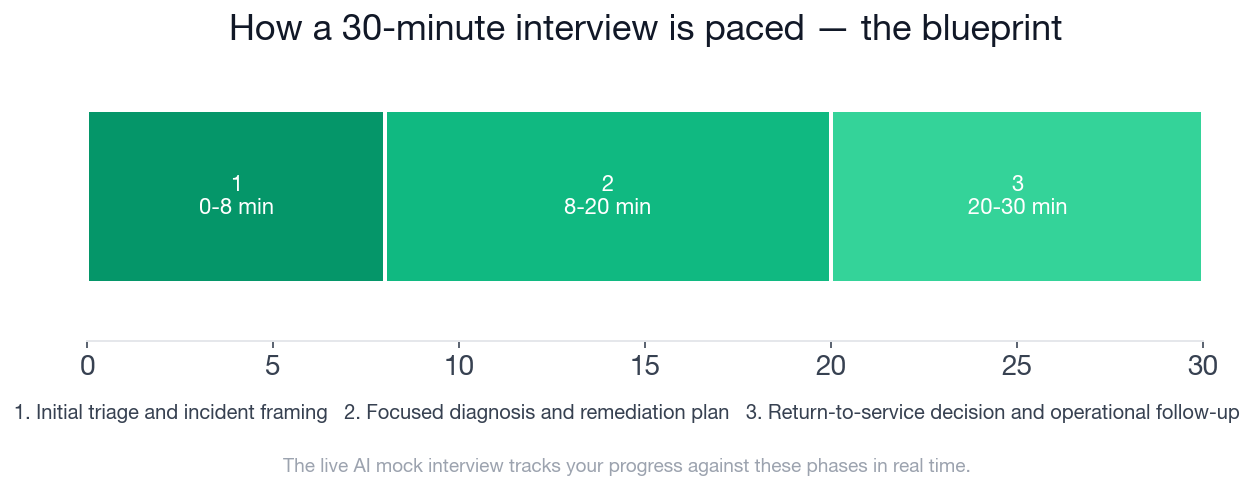 Minutes 0-8 secure the host, minutes 8-20 do the actual diagnosis, and the last 10 minutes turn findings into a return-to-service decision and concrete follow-ups.
- ✓States an immediate goal of stabilizing the host before deep root-cause work
- ✓Mentions confirming whether the host should remain out of rotation while investigating
- ✓Checks uptime/load, CPU, memory, and process state using realistic commands such as uptime, top, ps, free, vmstat, or similar
- ✓Checks service state and recent logs with systemctl and journalctl or equivalent
- ✓Asks or states intent to correlate symptoms with the maintenance window or recent changes
- ✓Checks disk capacity/inodes with df and, if needed, identifies growth with du or log/file inspection
- ✓Mentions reviewing package update history, unattended-upgrades, apt/dpkg logs, or post-install failures if maintenance is implicated
- ✓Validates whether the expected process is listening and reachable locally using ss, curl, or similar host-side checks
- ✓Differentiates between restarting a single service, cleaning space, reverting a change, and rebooting, with rationale
- ✓Notes safeguards such as avoiding blind deletion, preserving evidence, and verifying dependencies before restarting
- ✓Defines explicit checks before reintroducing the host, such as stable resource usage, healthy local checks, clean logs, and successful load balancer health checks
- ✓Explains conditions that would require keeping the host drained or escalating
- ✓Suggests concrete follow-ups such as logrotate verification, disk/inode alerting, package maintenance review, service restart policies, or better change tracking
- ✓Communicates a concise incident summary including suspected cause, mitigation, remaining risk, and next actions
This is the blueprint a strong candidate hits, phase by phase, and it's the exact structure the AI mock interview tracks you against in real time as you talk, not just at the end.
Practice This Exact Incident
Spotting Wes's mistakes on a page is easy because the mistake and the fix sit three inches apart. A live interview doesn't give you that. The AI mock interview puts you on the same incident bridge, running the same 30-minute clock against the same rubric, with turn-by-turn feedback on where you held the line and where you guessed. If you'd rather build up the individual checks first, the Linux System Administration question bank breaks the same material into focused drills, and our preparation guides cover structured prep beyond this one scenario.
FAQ
Q. What does the Systems Administrator Linux System Administration interview actually evaluate?
It evaluates whether a mid-level admin can run a safe, structured investigation during a live production incident: diagnosing host-level performance and availability issues across processes, services, filesystems, storage, logs, package state, and basic network checks, then communicating a stabilize-first plan and making sound trade-offs for a Linux fleet in production.
Q. How is this 30-minute Linux interview scored?
A 100-point rubric splits into four dimensions: 30 points for Interviewer Objectives Alignment, 30 for Level-Specific Expectations, 20 for Technical Proficiency, and 20 for Communication and Problem Solving, tracked across three timed phases (minutes 0-8, 8-20, and 20-30).
Q. If systemd shows a service as active, does that mean the host is healthy?
No. Active only confirms the process has not crashed, not that it is reachable or responding correctly. A strong answer checks that the expected port is actually listening (with a tool like ss) and that a local request actually succeeds, before ruling the host side out.
Q. Does a maintenance window that lines up with an incident confirm the cause?
Timing is a lead worth stating out loud, not a confirmed cause. A strong candidate correlates the timing against actual evidence (disk usage, package and update logs, service state) before proposing a fix, rather than jumping straight to remediation based on the calendar alone.
Q. What happens in the first 8 minutes of this interview?
The opening phase rewards a fast, low-risk sweep: checking load, memory, and process state; checking service status and recent logs with systemctl and journalctl; and stating an explicit goal of stabilizing the host before deep investigation, all before you propose a single fix.
Q. What topics are out of scope for this interview?
Kubernetes cluster administration, infrastructure-as-code implementation details, deep kernel or driver development, and application feature design are all explicitly out of scope. The focus stays on host-level Linux administration.
Q. How can candidates practice this exact scenario before a real interview?
The AI mock interview runs this same incident live, with the same 30-minute clock and rubric, and gives turn-by-turn feedback. You can also drill individual checks first in the Linux System Administration question bank.
The Timeline Is a Clue, Not a Verdict
A maintenance window that lines up with an incident is a genuinely useful clue, not a substitute for checking disk usage, package logs, and service reachability before deciding what happened. The candidates who score well treat the obvious answer as a hypothesis to test, not a conclusion to report. That habit is worth building before it costs you in front of a real interviewer.
Topics
Ready to practice?
Put what you've learned into practice with AI mock interviews and structured preparation guides.