
The Systems Engineer IP Addressing and Subnetting Interview Is Won on Grouping, Not Math
You have 30 minutes, a /20 block, and seven segments to place inside it. The arithmetic is almost insultingly easy: 10.42.16.0/20 holds 4,096 addresses, and the biggest segment on the list needs about 220 of them. Any candidate who has studied CIDR can compute a subnet mask. What separates a plan operations can actually implement from one that gets handed back for rework is something else: whether the candidate groups that address space by function and growth trajectory, isolates guest traffic into a block a firewall rule can reference in one line, and leaves room to expand a segment without renumbering the rest of the office.
This walkthrough runs on a real interview blueprint, generated by the same production prompt InterviewStack.io's AI interviewer uses for a mid-level Systems Engineer interview on IP addressing and subnetting, scored across four rubric dimensions worth 100 points. Watch a candidate work through it, see where the plan cracks, then get the complete graded blueprint to practice against yourself.
Key Findings
- The /20 block holds 4,096 addresses against roughly 695 total devices across all seven segments, more than 5x headroom before capacity is even a real constraint.
- Interviewer Objectives Alignment and Level-Specific Expectations each carry 30 of 100 points, 60 combined, weighted toward structural judgment over raw calculation.
- Technical Proficiency (CIDR accuracy) is worth 20 points; Communication and Problem Solving is worth another 20.
- The interview runs 30 minutes across 4 phases: 6 minutes on requirements synthesis, 11 minutes on IPv4 subnet design, 8 minutes on IPv6 and operational trade-offs, and a 5-minute stress test.
- Guest Wi-Fi (about 180 devices) needs its own contiguous block, distinct from the plan's internal segments, which is the real overlap risk, since the new /20 already avoids the existing 10.42.0.0/21 and 10.42.8.0/22 ranges by assignment.
- The site's IPv6 /56 allocation yields 256 available /64 subnets, more than enough for one per segment with room to spare.
- Phase 2 alone (IPv4 subnet design) packs 6 expected checklist items into its 11-minute window.
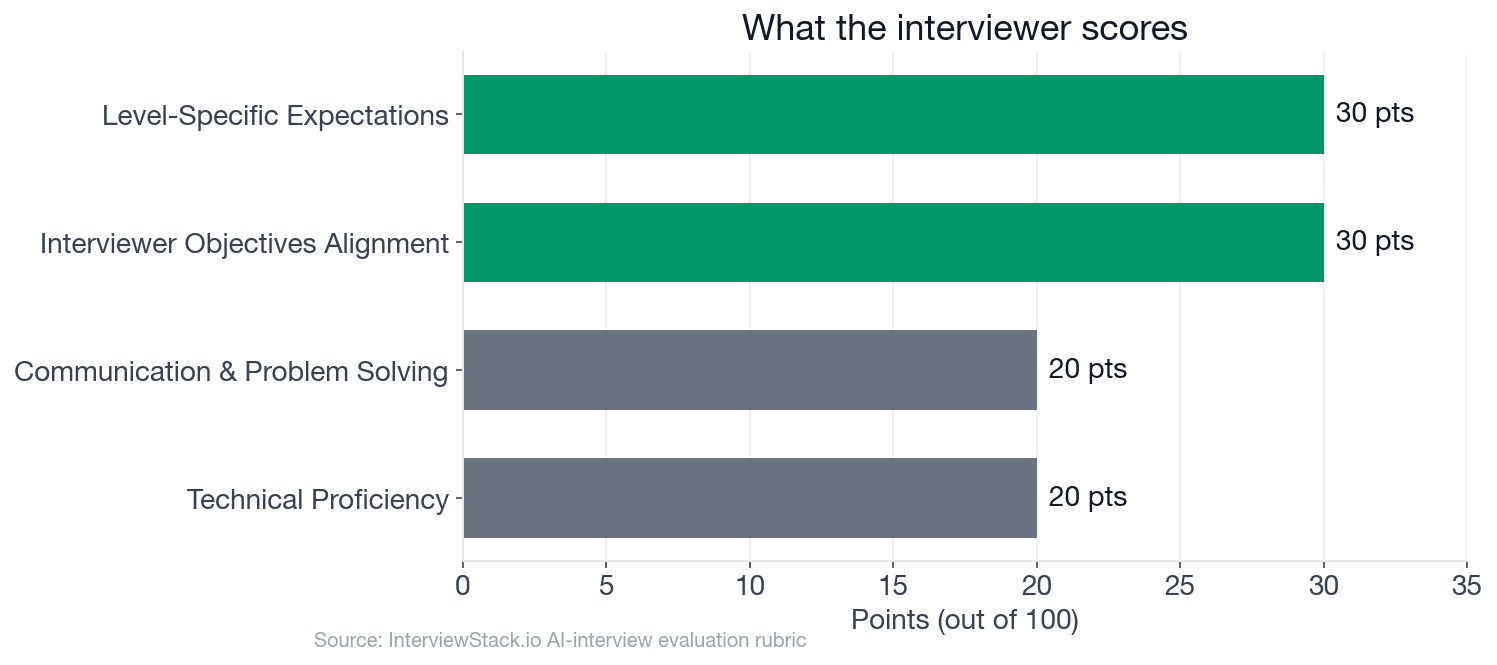
Technical Proficiency and Communication each hold 20 points; the interviewer-objectives and level-specific dimensions hold the other 60, and both reward structure over arithmetic.
What Does the Interview Actually Ask You to Design?
The interview question
You are supporting a new regional office rollout for a large tech company. The site connects back to existing corporate networks over VPN/SD-WAN and must be ready for growth over the next 18 months.
Segments needed:
Corporate users: about 220 devices
Engineering lab: about 90 devices
VoIP phones: about 140 devices
Printers and IoT: about 45 devices
Network management: about 20 devices
Guest Wi-Fi: about 180 devices
Point-to-point WAN/transit links to two upstream devices
Constraints:
Assigned IPv4 block: 10.42.16.0/20
Existing corporate networks already use: 10.42.0.0/21 and 10.42.8.0/22
Guest Wi-Fi must not overlap internal addressing and must summarize cleanly for firewall policy
Core infrastructure devices require static IPs
IPv6 is enabled for internal segments using a /56 allocation for this site
Design an IP addressing plan for this office that you would feel comfortable handing to implementation and operations teams, and walk me through how you arrived at it.
The interviewer isn't grading a lucky guess at subnet sizes. The goal is production-grade reasoning: allocate CIDR correctly, check for overlap against the two existing ranges, separate guest traffic for policy reasons rather than just capacity, plan a consistent IPv6 layer from the /56, and state assumptions clearly enough that someone else could implement the plan.
Where a Prepared Candidate Still Loses Points
Meet Ivan, a mid-level candidate working through this scenario live. He knows CIDR cold and never miscalculates a subnet mask. What costs him points is the layer above the math: how he organizes the block, what he assumes NAT can fix, and whether his plan survives the interviewer changing one requirement partway through.
Turn 1: Splitting Off the Guest Network
Interviewer: "How would you divide the IPv4 space so that the guest network is easy to identify and summarize separately while still leaving room for growth?"
Turn 2: Mapping the /56 Into Consistent /64s
Interviewer: "What would your IPv6 subnetting approach look like for these segments, and how would you map the /56 into something operators can use consistently?"
Turn 3: Where NAT Actually Belongs
Interviewer: "Would you place NAT anywhere in this design, and what problem would it solve or not solve here?"
Turn 4: The Lab Doubles in Size
Interviewer: "If the engineering lab suddenly needed to double in size without renumbering the rest of the office, what in your plan would help or hurt?"
Why Spotting These Mistakes on the Page Isn't the Same as Avoiding Them Live
Reading Ivan's turns, each mistake looks obvious in hindsight. That is the trap of watching from the outside: you have time to notice the guest block is misplaced, that a /120 breaks autoconfiguration, that NAT is being asked to do a routing job. In a live interview you get none of that distance. You are doing CIDR arithmetic, tracking which ranges are spoken for, and fielding a follow-up that changes one requirement, all inside a 30-minute clock with someone watching. The gap between spotting a mistake on the page and not making it under pressure is exactly what repetition closes.
What Does a Complete, Gradeable Plan Look Like?
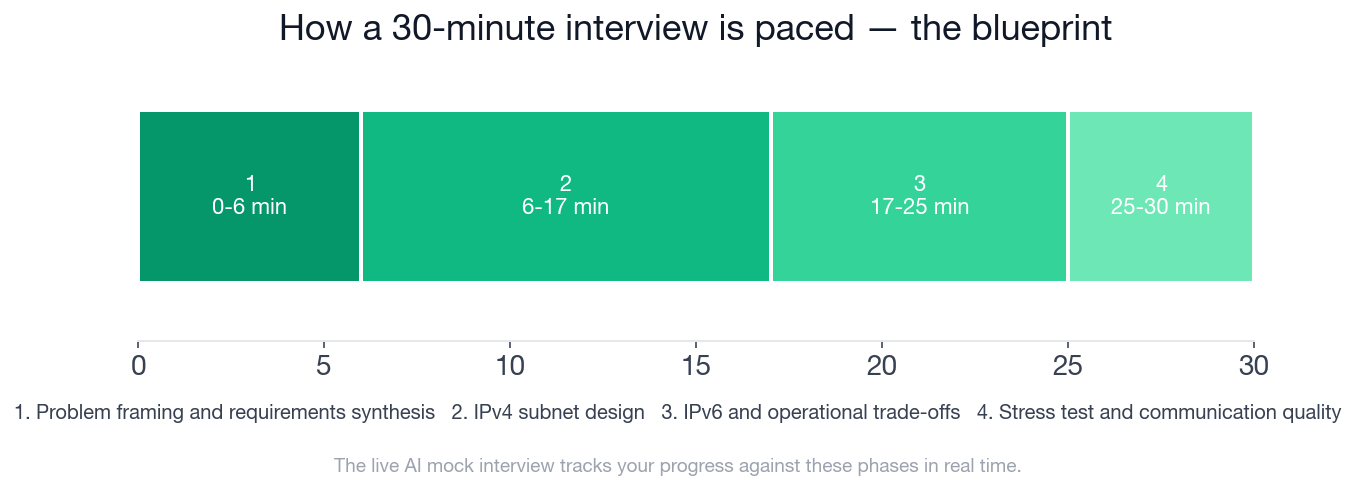
The timeline above shows how the 30 minutes are paced: 6 minutes to synthesize requirements, 11 on IPv4 subnet design, 8 on IPv6 and operational trade-offs, and a 5-minute stress test to close. Below is the full blueprint, phase by phase, with every checklist item a strong candidate hits. This is the exact structure InterviewStack.io's AI interviewer tracks you against in real time during the live mock interview.
- ✓Restates the available IPv4 and IPv6 space correctly
- ✓Identifies all required segments and approximate host counts
- ✓Calls out the non-overlap requirement with existing corporate ranges
- ✓Recognizes guest isolation/summarization as a policy and routing concern, not just a math exercise
- ✓Mentions need for growth buffer rather than sizing every subnet to the exact current count
- ✓Chooses plausible subnet sizes for each segment, such as /24, /25, /26, /27, /30 or /31 where appropriate
- ✓Allocates ranges that fit inside 10.42.16.0/20 without overlap
- ✓Avoids conflict with 10.42.0.0/21 and 10.42.8.0/22
- ✓Groups guest space into a distinct contiguous block that could be summarized cleanly
- ✓Leaves some contiguous free space or explains reserved ranges for future expansion
- ✓Describes where gateway addresses, DHCP pools, exclusions, and static ranges would live
- ✓Allocates IPv6 /64s per segment from the site /56 in a consistent, supportable pattern
- ✓Distinguishes infrastructure static addressing from endpoint dynamic assignment appropriately
- ✓Explains NAT as address conservation or boundary translation, not as a fix for poor internal address planning
- ✓Offers a reasonable approach for overlapping remote space, such as renumbering, VRF isolation, or translation at boundaries depending on constraints
- ✓Shows awareness of documentation/IPAM needs even if no specific product is named
- ✓Can adjust the plan when asked about growth or overlap without breaking earlier allocations
- ✓Explains trade-offs of the chosen structure in clear operational terms
- ✓Summarizes the final design in a way an implementation team could follow
- ✓Acknowledges any assumptions or remaining risks explicitly
Put This Plan to the Test
Reading Ivan's four turns is not the same as producing your own plan against a live clock, with the interviewer changing a constraint the moment you feel settled. Close that gap by running the scenario yourself: start a live AI mock interview on IP addressing and subnetting and get scored against this exact rubric in real time, phase by phase. To build individual concepts first, the IP addressing and subnetting question bank breaks the topic into focused drills, and the preparation guides cover what to expect in company-specific systems engineering interviews.
FAQ
Q. What does a mid-level Systems Engineer interview on IP addressing and subnetting actually test?
It tests whether you can turn segment requirements and an existing address block into a plan operations could implement without rework: correct CIDR sizing, no overlap with existing ranges, a guest network firewall policy can reference as one block, and a consistent IPv6 approach from the site's /56. Interviewer Objectives Alignment and Level-Specific Expectations together hold 60 of the interview's 100 points, rewarding that structural judgment over arithmetic.
Q. How much of the score depends on getting the subnet math right?
Technical Proficiency, the dimension covering CIDR accuracy, is worth 20 of 100 points. The other 80 reward decisions the math alone doesn't make: whether the guest network is grouped for clean summarization, whether the plan leaves growth headroom instead of sizing every subnet to the exact device count, and whether the candidate can adjust it later without breaking earlier allocations.
Q. Why does the guest Wi-Fi network need its own address block instead of just another subnet in the plan?
Because a firewall policy that isolates guest traffic is far simpler to write and audit against one contiguous block, a single CIDR line, than against several scattered subnets that happen to add up to the right device count. The interview's early checklist items call this out separately from the sizing math: treat it as a policy and routing concern, then actually group guest addresses into a block that summarizes cleanly.
Q. Do I need to memorize exact IPv6 subnetting rules for this interview?
You need the practical pattern, not memorization: allocate a /64 to each segment from the site's /56 (256 available /64 blocks), with a consistent, documented numbering scheme so operators can map IPv4 and IPv6 segments at a glance. Subdividing below /64 to save space, the way you would with scarce IPv4 addresses, is a common and costly mistake: it can break standard address autoconfiguration and buys nothing given how much room a /56 already provides.
Q. What's the most common mistake candidates make when the interviewer asks about NAT?
Reaching for NAT as a fix for messy internal address planning, such as papering over a potential overlap with another site instead of designing non-overlapping ranges up front. The rubric expects NAT to be framed as address conservation or boundary translation, not a substitute for routing design, and misapplying it concedes points on both Interviewer Objectives Alignment and Level-Specific Expectations.
Q. How long is the actual interview and how is it paced?
30 minutes across four phases: 6 minutes to synthesize the requirements, 11 minutes on the core IPv4 subnet design, 8 minutes on IPv6 and operational trade-offs like static addressing and NAT, and a final 5-minute stress test where the interviewer changes a constraint to see if the plan holds up.
Q. Where can I practice this exact scenario?
Start a live AI mock interview built on this blueprint. It runs the same 30-minute, four-phase structure and scores you against the same rubric in real time, or drill individual questions first in the IP addressing and subnetting question bank.
Grouping Beats the Calculator
The candidates who walk out of this interview with a plan operations can trust are not the ones who compute subnet masks fastest. They are the ones who reserve structure before they reach for a calculator: a supernet for guest, headroom for growth, a consistent /64 pattern for IPv6, and NAT kept in its lane. Run the live mock interview and find out whether your plan holds up once the interviewer starts changing the requirements.
Topics
Ready to practice?
Put what you've learned into practice with AI mock interviews and structured preparation guides.