
Reliability Math Is Not the Point Here
You have a service launching next month, six engineers, no pager, and login and checkout riding on it. The interviewer asks how you would get the team ready. It is tempting to lead with reliability math and tooling names, but the blueprint weights something else. This mid-level Systems Engineer interview is built on a different premise: can a tired stranger act on what you wrote at 3 a.m.?
This walkthrough is a dramatized simulation anchored on one AI mock interview blueprint. The mistakes are illustrative, not a transcript of a real candidate.
Key Findings
- The rubric totals 100 points: 30 for Interviewer Objectives Alignment, 30 for Level-Specific Expectations, 20 for Technical Proficiency, 20 for Communication and Problem Solving.
- 60 of 100 points reward judgment and level-appropriate scope; only 20 reward technical accuracy.
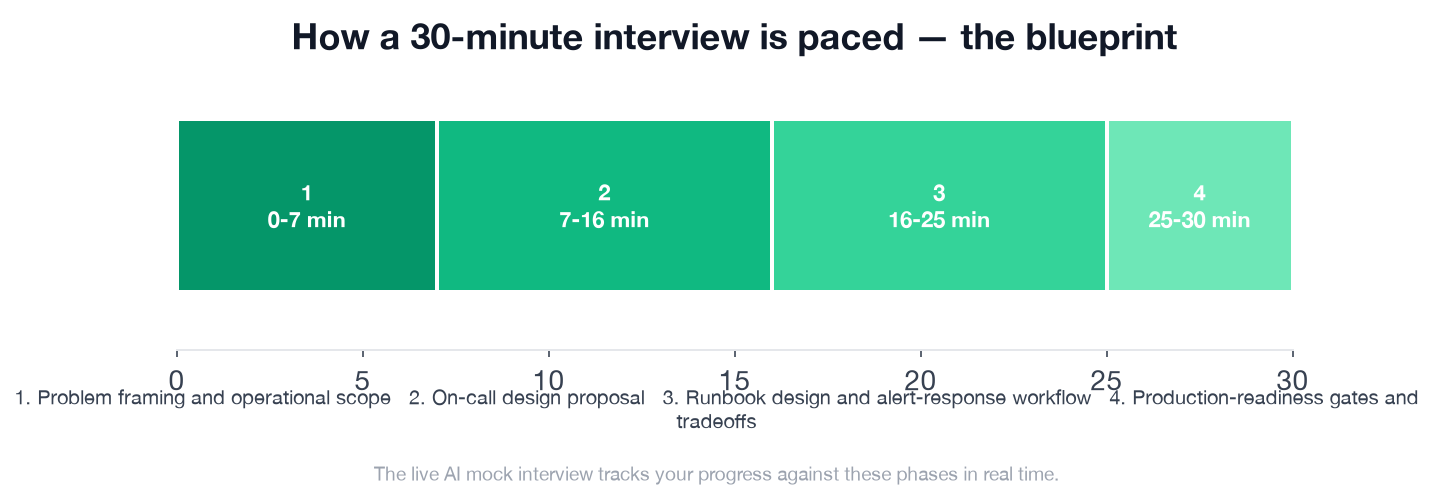
- The interview runs 30 minutes in 4 phases: 0-7, 7-16, 16-25, and 25-30 minutes.
- Rotation design and runbook design get 9 minutes each; the readiness-gates phase gets just 5.
- The scenario is a 6-engineer team with 3 dependencies (datastore, message queue, upstream identity service).
- The blueprint carries 18 expected checklist items across the 4 phases.
- 4 skills are explicitly out of scope, including hands-on coding and company-wide policy design.
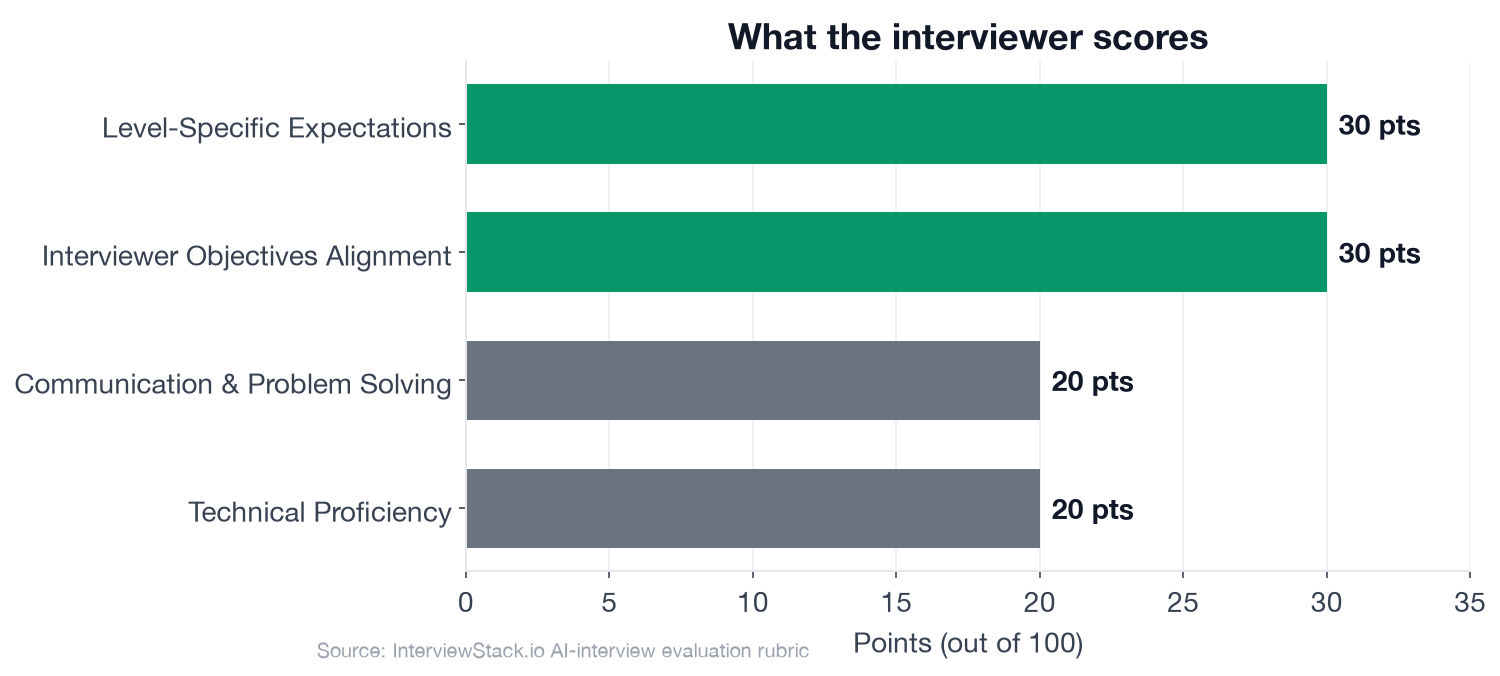
The weights tell you where to spend your words: explain trade-offs and scope, not tooling trivia.
What Does a Systems Engineer On-Call Interview Actually Test?
It tests operational preparedness: whether you can design a sustainable rotation and a first runbook that cuts time to acknowledge and time to mitigate, without over-engineering. Here is the question.
The interview question
You are joining the infrastructure team that is preparing an internal API service to take production traffic for a customer-facing product. The service is owned by 6 engineers across two nearby time zones. It depends on a datastore, a message queue, and an upstream identity service owned by another team. The service launches next month with moderate traffic, but incidents would be user-visible and could affect login and checkout flows.
The team has basic dashboards and logs, but no formal on-call rotation and only partial operational documentation.
How would you design the on-call setup and first version of the runbook for this service so the team is ready to safely take production traffic?
Behind the question, the interviewer probes four things: how you reason about production readiness, alert quality, escalation paths, and ownership boundaries; and whether you balance human response against automation. Note what is absent: no code, no kernel internals, no company-wide policy. Candidates who drift there are spending time on skills the blueprint marks forbidden.
Four Follow-Ups, Four Places Runbooks Fail
After your opening design, the interviewer pushes on the weak joints. In this dramatization the candidate is Marcus; a common answer is shown, then the stronger move.
Turn 1: Noisy, Unactionable Pages
Interviewer: "If alerts are firing frequently but most pages are not actionable, how would you change the alerting and runbook approach?"
Turn 2: A Dependency You Don't Own
Interviewer: "How would your runbook handle a dependency outage in the identity service that your team does not own?"
Turn 3: The Handoff Under Pressure
Interviewer: "What information would you include so that a secondary responder or incident commander can quickly take over during an escalation?"
Turn 4: The Launch Gate
Interviewer: "What would you require before declaring this service production-ready enough to join the on-call rotation?"
Could You Say This Out Loud at Minute 22?
You just watched four mistakes, and every one is obvious on the page. Live, it is different. The clock is running, the interviewer interrupts, and the follow-up is not the one you rehearsed. Knowing that a runbook needs an ownership boundary is easy; saying it cleanly while the interviewer asks about burnout next is the skill. That only comes from reps, ideally against something that pushes back.
What Does the 30-Minute Blueprint Check Off?
This is the blueprint a strong candidate hits: 7 minutes of framing, 9 on rotation design, 9 on runbook and alerts, 5 on readiness gates. It is also what the AI mock interview tracks you against in real time.
- ✓Asks or states reasonable assumptions about service criticality, traffic pattern, support hours, and incident severity
- ✓Identifies that dependencies and cross-team ownership affect both runbook content and escalation design
- ✓Recognizes that a 6-engineer team needs a lightweight but sustainable rotation rather than a heavy process
- ✓Frames success in terms of responder effectiveness and safe launch readiness, not just document completeness
- ✓Proposes a clear primary and backup model appropriate for 6 engineers
- ✓Includes escalation triggers and when to involve dependencies, management, or incident command
- ✓Mentions handoff expectations between shifts or weeks, including unresolved issues and temporary mitigations
- ✓Considers burnout reducers such as limiting alert load, compensating after severe incidents, or using follow-the-sun only if team shape supports it
- ✓Defines ownership boundaries for service issues versus dependency issues
- ✓Describes a runbook format with incident symptom, customer impact, immediate checks, diagnosis steps, mitigation, rollback or degradation options, and escalation contacts
- ✓Connects specific alerts to concrete responder actions rather than vague advice
- ✓Includes links or references a responder would need such as dashboards, logs, recent deploys, feature flags, dependency status, and access tools
- ✓Differentiates high-confidence paging alerts from ticket or dashboard-only signals
- ✓Identifies candidate automations such as log collection, dependency health checks, or safe restarts, while flagging risky actions that should require approval or human review
- ✓Names a concise set of must-have launch gates such as alerting, dashboards, rollback path, access, ownership, and documented mitigations
- ✓Can distinguish blockers from items that can be improved after launch
- ✓Mentions a feedback loop after incidents or pages to keep the runbook and alerts current
- ✓Shows reasonable judgment about what to ship now versus defer for a next iteration
Rehearse the Page Before You Get It
Start with the AI mock interview for this exact Systems Engineer on-call topic. You get the same four phases, unscripted follow-ups, and feedback scored against the same four rubric dimensions. If you would rather drill one concept at a time first, the on-call and runbook question bank is the next stop, and the preparation guides cover company-specific loops.
FAQ
Q. What does a Systems Engineer on-call and runbook interview test?
It tests whether you can turn an ambiguous launch into a usable responder workflow: a realistic rotation, an actionable runbook, quality alerts, and a short list of readiness gates. In this blueprint, 60 of 100 rubric points go to objectives alignment and level-specific expectations, and only 20 go to technical proficiency.
Q. How is a mid-level on-call interview different from a senior one?
A mid-level candidate should independently propose a workable first-pass operational design and focus on responder usability. The blueprint explicitly does not expect a company-wide incident management program or complex reliability math.
Q. How long is the interview and how is it paced?
30 minutes in four phases: problem framing (0-7 minutes), on-call design (7-16), runbook and alert-response workflow (16-25), and production-readiness gates (25-30). The two middle phases get 9 minutes each.
Q. What should a good runbook contain?
A responder-oriented format: symptom, customer impact, immediate checks, diagnosis steps, mitigation, rollback or degradation options, and escalation contacts, plus links to dashboards, logs, recent deploys, feature flags, and dependency status.
Q. How do you decide what to automate in a runbook?
Automate repetitive, low-risk steps such as log collection, dependency health checks, or safe restarts. Keep risky actions behind human approval or review. The interview rewards naming the boundary and explaining why.
Q. Do I need to write code in this interview?
No. Hands-on coding exercises are listed as out of scope for this blueprint, along with deep distributed systems design, kernel or networking internals, and company-wide compensation policy.
Q. How can I practice this interview live?
Start an AI mock interview on this exact topic and level. It tracks you against the same four-phase blueprint in real time and asks unscripted follow-ups.
A Runbook Is a Promise to a Tired Stranger
The candidates who score well are not the ones with the cleverest reliability model. They write for the person who will be paged at 3 a.m., cannot ask the author a question, and needs the next step in one glance. Practice saying that out loud, and the rest of the rubric follows.
Topics
Ready to practice?
Put what you've learned into practice with AI mock interviews and structured preparation guides.