
What Does "Systems Engineer" Actually Mean in 2026?
"Systems Engineer" is one of the most elastically-titled jobs in tech. The same two words appear on avionics integration specs at Boeing and Kubernetes deployment plans at a cloud startup. That breadth is not a data problem; it is the defining characteristic of the role. When we analyzed 9,179 active Systems Engineer postings on the InterviewStack.io job board as of June 2026, no individual skill cleared 50% of listings. The closest is Automation at 26.7%, followed by Python at 23.3% and Monitoring at 21.3%.
Below those three common-tier skills, the role splits into two engineering cultures. A cloud-native track (Linux, Kubernetes, Terraform, CI/CD, Bash) tends toward tech employers, higher salaries, and occasional remote roles. A traditional IT track (Windows, VMware, PowerShell, Active Directory) tends toward enterprise and defense employers, more compressed salary ranges, and near-universal onsite work. The employer side of the data makes this concrete: the top ten hiring organizations are all aerospace, defense, or government-adjacent firms, which also explains why Systems Engineering is one of the most onsite-heavy tech roles we have analyzed, with only 10.7% of postings tagged remote.
Key Findings
- 9,179 active Systems Engineer postings analyzed across the InterviewStack.io job board as of June 2026.
- No skill clears the 50% table-stakes threshold. Automation leads at 26.7% (2,454 postings), Python at 23.3%, and Monitoring at 21.3%.
- Median US base salary is $113,100 (n=3,242 US postings with disclosed salary). Equity, bonuses, and sign-on are excluded from posting data.
- Cloud-native skills add $17K to $42K above the baseline: Distributed Systems ($155,000), Observability ($150,000), Machine Learning ($144,000), and Kubernetes ($140,000) lead.
- Traditional IT skills pay below baseline. Active Directory and PowerShell each median around $100,700, about $12,400 below the role median.
- Only 3.1% of postings are entry-level (282 of 9,179). Mid-level dominates at 58.9%.
- The US is 59.4% of all postings (5,451), a much higher concentration than most tech roles.
- Onsite dominates at 57.9%, with only 10.7% tagged remote, reflecting aerospace and defense's physical-presence requirements.
What Skill Families Define a Systems Engineer in 2026?
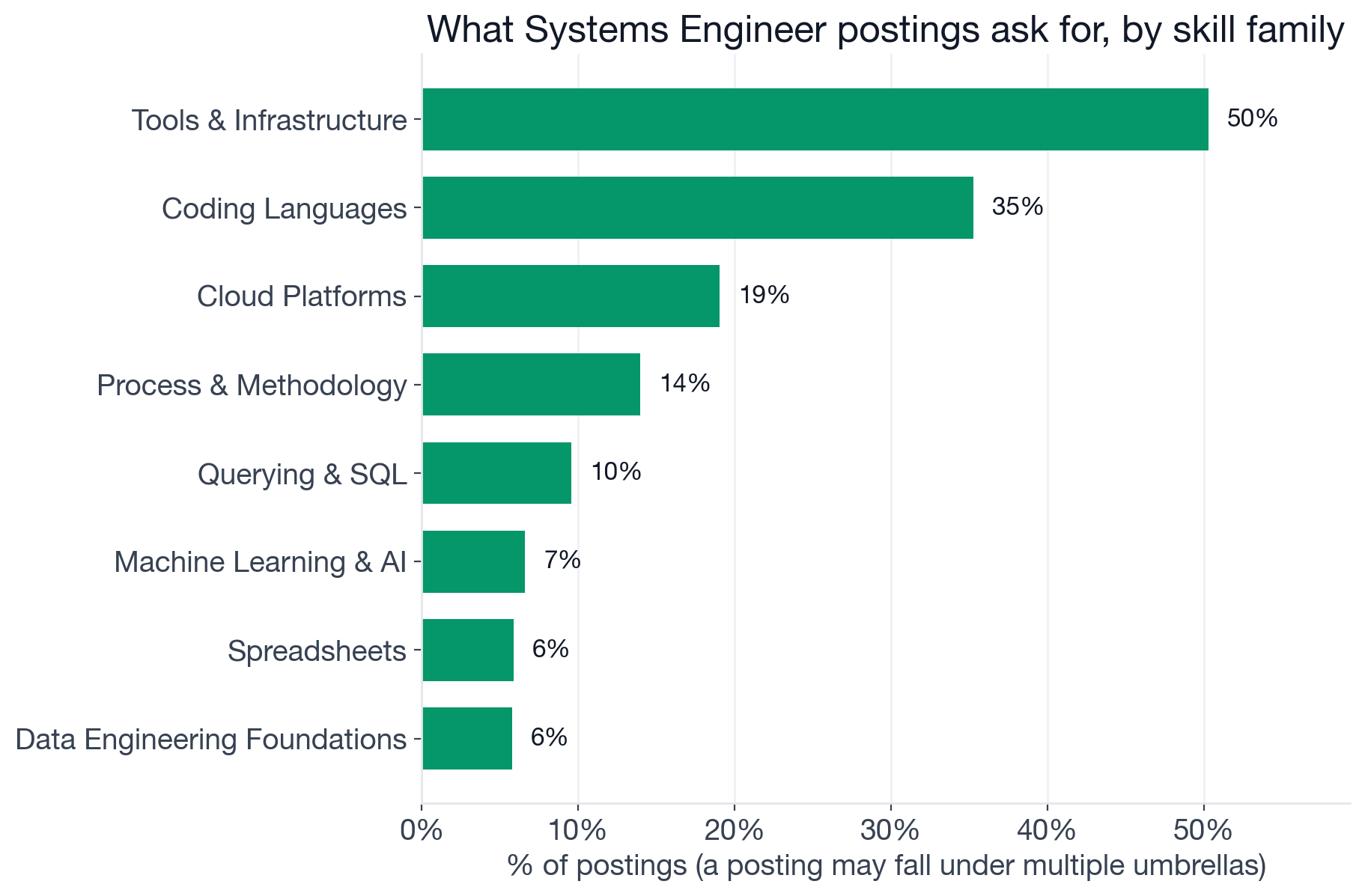
Share of Systems Engineer postings that ask for at least one skill in each family. A posting mentioning both Linux and Kubernetes counts once under "Tools and Infrastructure."
The skill-family picture organizes what would otherwise look like an incoherent mix of requirements. The four families with material share:
- Tools and Infrastructure (50.3%): Automation, Monitoring, Linux, Kubernetes, Terraform, Ansible, Docker, Git. Half of all postings demand explicit tool or infrastructure competency beyond generic engineering language.
- Coding Languages (35.3%): Python, TypeScript, Bash, Java, C++. High for an infrastructure role. Python and Bash dominate, which signals automation scripting, not software product development.
- Cloud Platforms (19.0%): AWS, Azure, Google Cloud. Lower than DevOps or ML Engineer roles, consistent with the large aerospace and defense employer base that is not cloud-native.
- Process and Methodology (14.0%): Agile, Scrum. Cross-industry baseline.
A crosscutting bucket of skills including System Design (13.9%), Windows (11.7%), CI/CD (8.7%), VMware (8.7%), and PowerShell (7.6%) shows up in 62.4% of postings. These are real requirements, but they span both engineering tracks rather than belonging to one family.
The Machine Learning and AI family at 6.6% measures postings where the engineer is explicitly hired to build or integrate AI systems. That is the floor, not the ceiling. The 2025 JetBrains Developer Ecosystem Survey found 85% of engineers across all roles now use AI tools regularly, and GitHub Copilot increasingly handles infrastructure-specific tasks: CI pipeline updates, Terraform automation, and log diagnosis. For a role where Automation is the leading skill, AI-assisted scripting is a rising baseline expectation regardless of whether it appears in the job description.
What Are the Three Tiers of Individual Systems Engineer Skills?
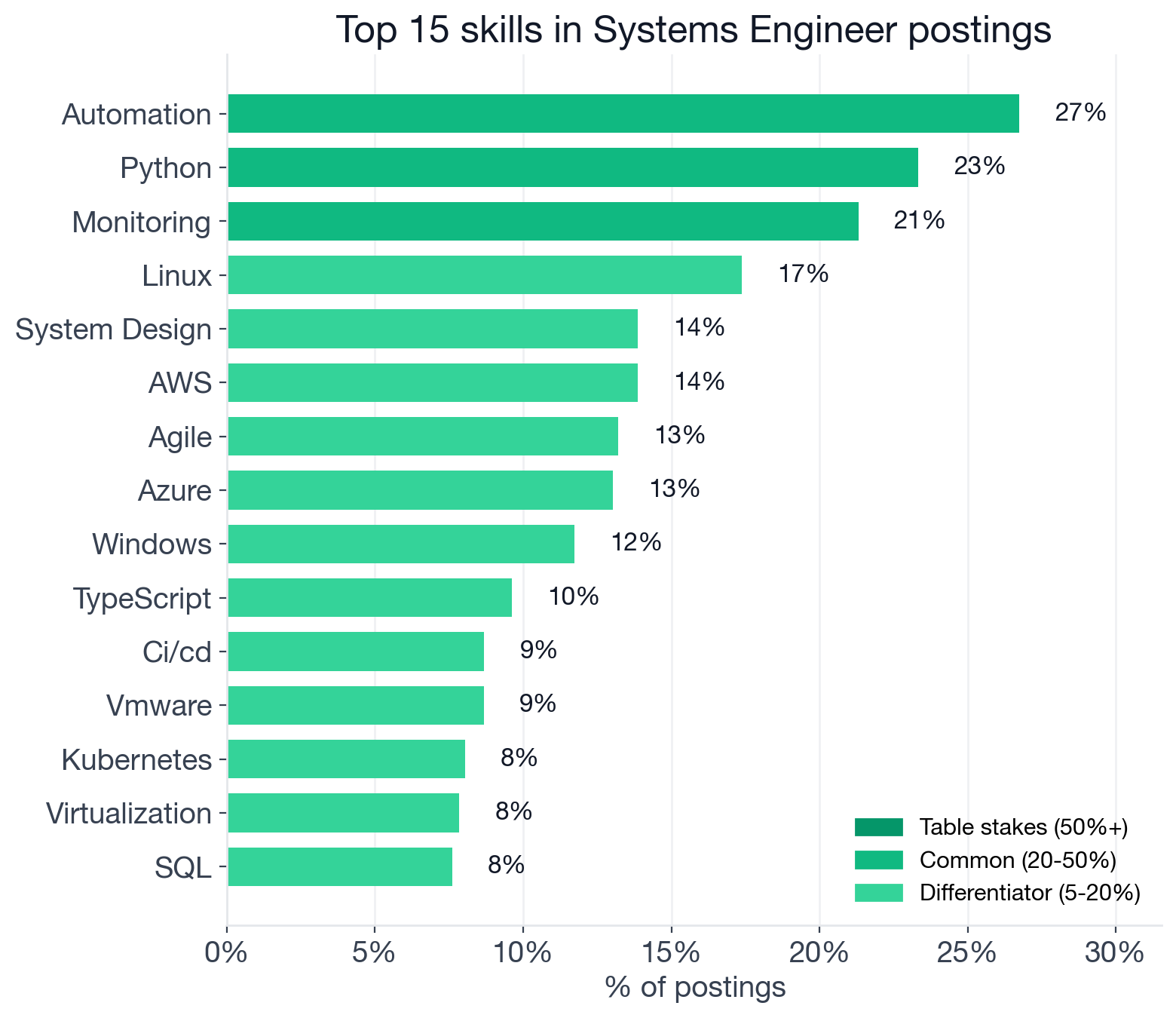
Top individual skills by share of Systems Engineer postings. No skills exceed 50% (table stakes); 20-50% are common; 5-20% are differentiators.
Unlike most tech roles, the Systems Engineer has no table-stakes tier. No skill is so universal that more than half of all postings require it.
Common Expectations (20-50% of postings)
Three skills sit in the common band:
- Automation: 26.7% (browse Systems Engineer + Automation openings)
- Python: 23.3% (Systems Engineer + Python openings)
- Monitoring: 21.3%
These appear across both employer tracks: a defense contractor integrating avionics and a cloud team managing Kubernetes both need engineers who script automation, write Python, and instrument systems health. Python's 23.3% rate is particularly significant for engineers coming from hardware or Windows-only backgrounds. It has become the default language for configuration, test frameworks, and internal tooling. Treating it as optional means filtering yourself out of nearly a quarter of the market.
Differentiators (5-20% of postings)
The differentiator tier is where the two tracks diverge:
Cloud-native/DevOps track: Linux (17.4%), System Design (13.9%), AWS (13.9%), Azure (13.0%), CI/CD (8.7%), Kubernetes (8.0%), Bash (7.2%), Terraform (6.6%, an infrastructure-as-code tool for provisioning cloud and on-premise resources), Ansible (6.6%, an open-source configuration-management tool for automating server fleet deployments), Docker (5.1%), Git (5.0%)
Traditional IT/enterprise track: Windows (11.7%), VMware (8.7%), Virtualization (7.8%), PowerShell (7.6%), Active Directory (6.0%), Windows Server (5.2%)
Cross-track: Agile (13.2%), TypeScript (9.6%), SQL (7.6%), Jira (6.4%), Scalability (5.8%), Infrastructure as Code (5.2%)
TypeScript's appearance at 9.6% is higher than most pure infrastructure roles and reflects the elastic definition of "Systems Engineer" in 2026. It most likely signals cloud-native SE positions at tech companies where TypeScript-first IaC tools (AWS CDK, Pulumi) are the norm, not web or application development. Engineers targeting aerospace, defense, or traditional enterprise IT are unlikely to encounter TypeScript requirements.
The salary data, covered next, makes the stakes of this split explicit: the cloud-native track pays a meaningful premium over the traditional IT track at every skill level.
Which Skills Pay More Than the Systems Engineer Baseline?
Among US postings where wage-transparency laws produce consistent disclosure, the median Systems Engineer US base salary is $113,100 (n=3,242 postings). These figures are base pay only: equity, bonuses, RSUs, and sign-on are excluded, so total compensation at top tech and aerospace employers is meaningfully higher than what we report here.
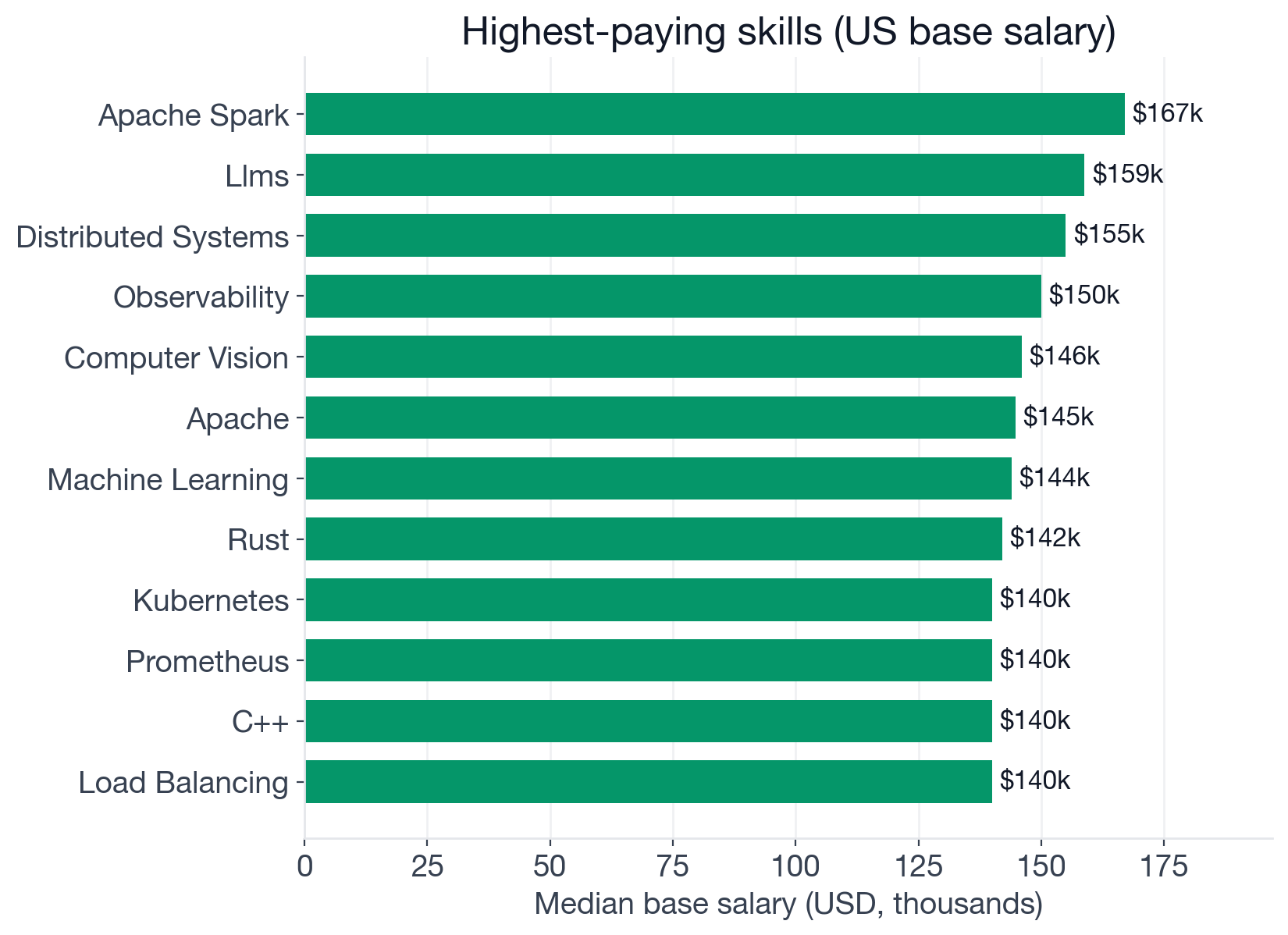
Median US base salary in USD for Systems Engineer postings that mention each skill. US-only postings with disclosed salary data.
The salary data draws a clear line between the two engineering tracks. Cloud-native and ML skills pay well above baseline; traditional IT skills pay below it.
Large premiums ($17K to $42K above the $113,100 baseline):
| Skill | US Median | Premium | n |
|---|---|---|---|
| Distributed Systems | $155,000 | +$41,900 | 101 |
| Observability | $150,000 | +$36,900 | 111 |
| Machine Learning | $144,000 | +$30,900 | 126 |
| Kubernetes | $140,000 | +$26,900 | 215 |
| C++ | $140,000 | +$26,900 | 129 |
| Google Cloud | $136,800 | +$23,700 | 133 |
| Scalability | $130,900 | +$17,800 | 206 |
Distributed Systems, Observability, and Machine Learning sit at the top because they signal engineers who architect and operate complex multi-node systems under production load: work that demands deep, hard-to-hire expertise. Kubernetes at $140,000 reflects the platform-engineering segment of the role. C++ at the same level reflects the embedded and safety-critical aerospace segment, where low-level programming for flight systems or defense hardware commands comparable pay through a completely different mechanism.
Google Cloud ($136,800) outpacing AWS ($112,000) by roughly $24,800 likely reflects employer composition: GCP is preferred by AI labs, cloud-native companies, and high-growth SaaS, pulling the median up for GCP-fluent Systems Engineers compared with the broader, more defense-heavy AWS population.
Moderate premiums ($4K to $10K): Docker ($120,500), System Design ($120,000), Terraform ($120,000), Python ($119,000), Automation ($117,800)
Near or below baseline:
| Skill | US Median | Gap from baseline |
|---|---|---|
| Monitoring | $115,000 | +$1,900 |
| Linux | $112,900 | flat |
| CI/CD | $110,000 | -$3,100 |
| Ansible | $109,800 | -$3,300 |
| Azure | $109,000 | -$4,100 |
| VMware | $107,500 | -$5,600 |
| Windows | $104,000 | -$9,100 |
| Active Directory | $100,700 | -$12,400 |
| PowerShell | $100,700 | -$12,400 |
The below-baseline skills map almost exactly to the traditional IT track. Windows administration, PowerShell scripting, and Active Directory management are real competencies, but they concentrate in enterprise IT and defense environments where salary ranges are more compressed. If salary trajectory is a priority, the data gives a clear answer: invest in cloud-native architecture, container orchestration, and observability, not in deepening Windows administration skills.
What Does the Dominant Systems Engineer Skill Stack Look Like?
Skill co-occurrence lift measures how much more often two skills appear together than their individual frequencies would predict. Lift above 1 means the pair clusters; higher lift signals a tighter, more distinctive combination.
| Skill pair | Postings | % of total | Lift |
|---|---|---|---|
| AWS + Google Cloud | 433 | 4.7% | 6.36 |
| AWS + Azure | 767 | 8.4% | 4.63 |
| AWS + CI/CD | 468 | 5.1% | 4.24 |
| Bash + Linux | 483 | 5.3% | 4.22 |
| Ansible + Linux | 432 | 4.7% | 4.11 |
| Bash + Python | 577 | 6.3% | 3.75 |
| Linux + Windows | 650 | 7.1% | 3.47 |
| Ansible + Automation | 488 | 5.3% | 3.02 |
| Automation + Python | 1,083 | 11.8% | 1.89 |
What each pair signals:
AWS + Google Cloud (lift 6.36) is rare at 4.7% of postings but the most over-represented combination in the dataset. A posting requiring both GCP and AWS is a multi-cloud architect role: the most demanding and best-compensated Systems Engineer variant.
AWS + Azure (lift 4.63) is more common (8.4%) and tells you that multi-cloud breadth is expected in nearly 1 in 12 openings. Fluency in only one cloud excludes you from that slice.
Bash + Linux (lift 4.22) is the scripting-plus-OS foundation. Postings that require Linux almost always also want Bash: you cannot administer a Linux environment without scripting.
Linux + Windows (lift 3.47) is the cross-OS profile, common in heterogeneous infrastructure environments that need engineers who can operate across both ecosystems.
Automation + Python (lift 1.89) is the highest-volume pair at 11.8% of all postings. It is the universal base: a Systems Engineer who scripts automation in Python covers the most ground regardless of industry. Systems Engineer roles combining Python and Linux skew cloud-native; roles combining Windows and PowerShell skew enterprise IT.
Who's Hiring at Which Seniority Level?
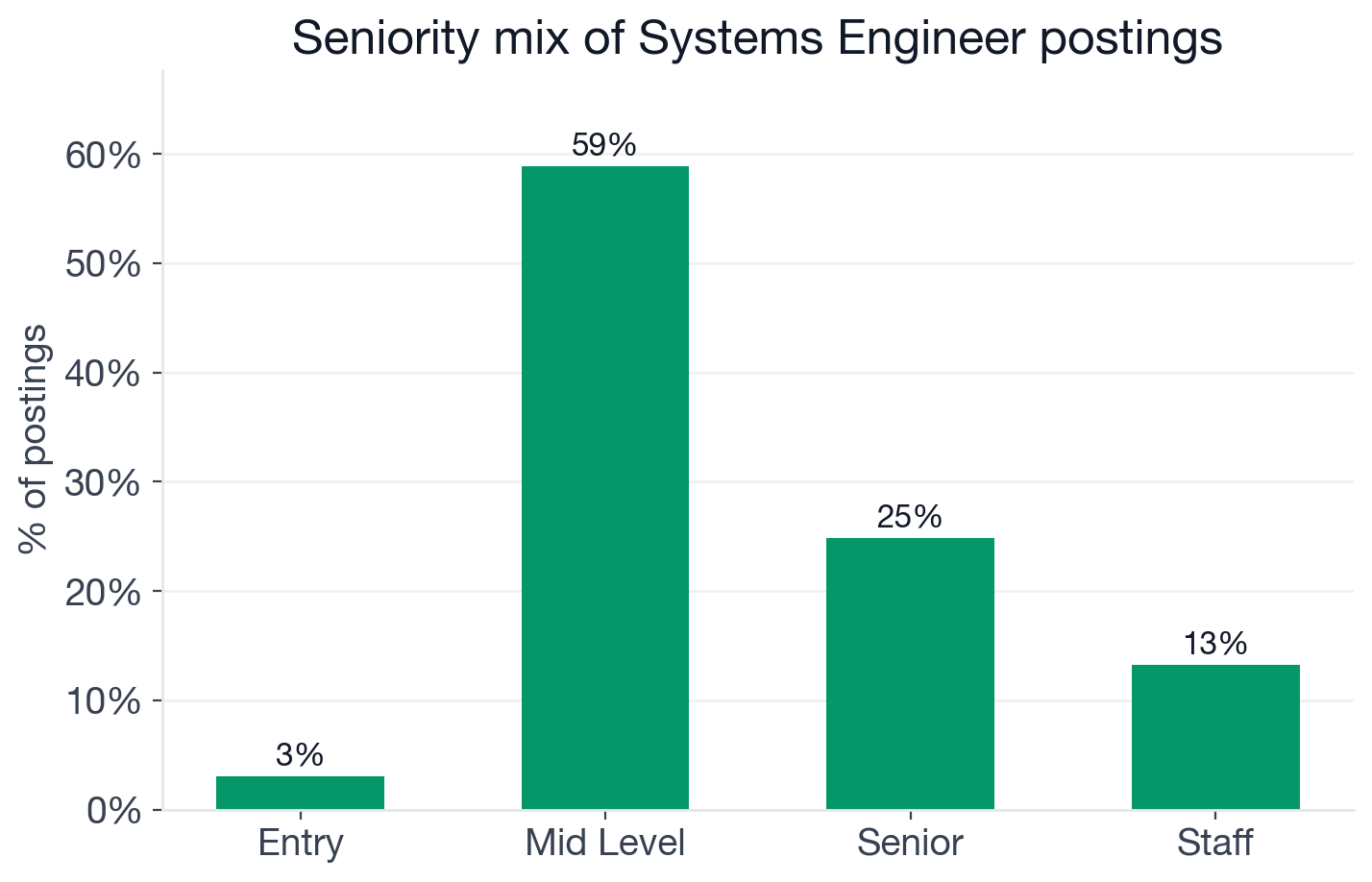
Seniority distribution of Systems Engineer postings, inferred from title keywords. Postings without an explicit signal default to mid-level.
- Mid-level: 58.9% (5,403 postings)
- Senior: 24.8% (2,280) (senior Systems Engineer openings)
- Staff: 13.2% (1,214)
- Entry: 3.1% (282)
Only 3 in 100 postings are explicitly entry-level. The aerospace and defense employers who dominate demand typically require prior systems integration or production engineering experience, and often a security clearance, before they will hire. Engineers who route in through DevOps, IT infrastructure, or software engineering roles, then build Linux and automation experience, find the transition significantly easier than direct applicants without domain background.
The staff tier at 13.2% is higher than many tech roles. In defense, staff-level Systems Engineers often own integration architectures, lead verification programs, or run platform-wide automation across programs with hundreds of engineers. If you are targeting the Data Engineer track for comparison, that role has a similar entry-level squeeze (3% there versus 3.1% here), but a higher concentration of demand in tech, which makes the career path somewhat less dependent on security clearances.
Where Are Systems Engineer Jobs Located, and How Remote-Friendly Are They?
The US share of 59.4% is the first number to absorb. For most tech roles, the US is one among several global markets. For Systems Engineers, it is the dominant market by a margin that reflects the aerospace and defense employer concentration.
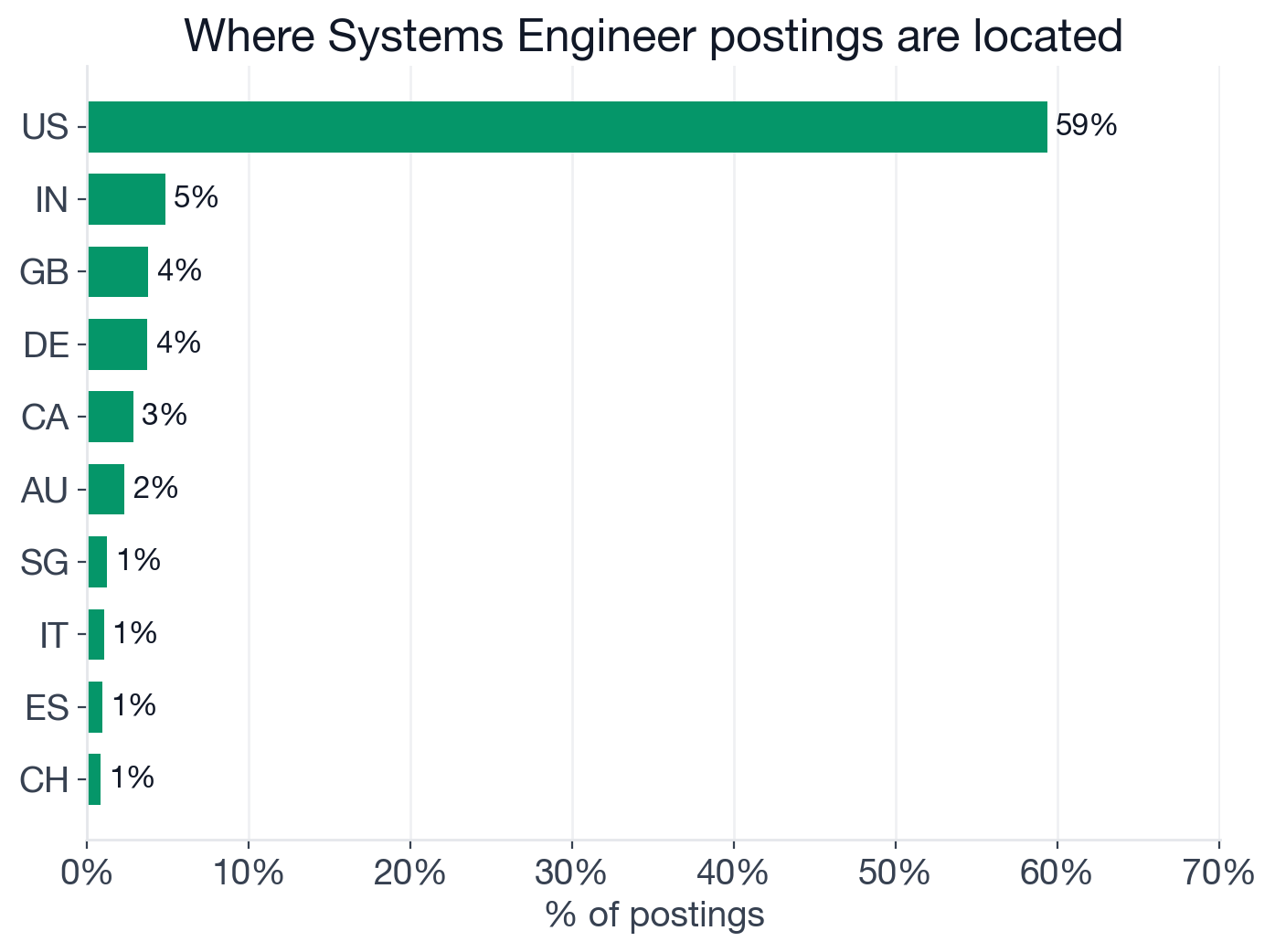
Top countries by share of active Systems Engineer postings.
- United States: 59.4% (US-only Systems Engineer openings)
- India: 4.9%
- United Kingdom: 3.8%
- Germany: 3.7%
- Canada: 2.9%
- Australia: 2.3%
India at 4.9% is notably low compared with software and data engineering roles, consistent with cleared defense work concentrating in US and allied-nation markets rather than global delivery centers.
Remote work is limited even by the standards of other infrastructure-adjacent roles:
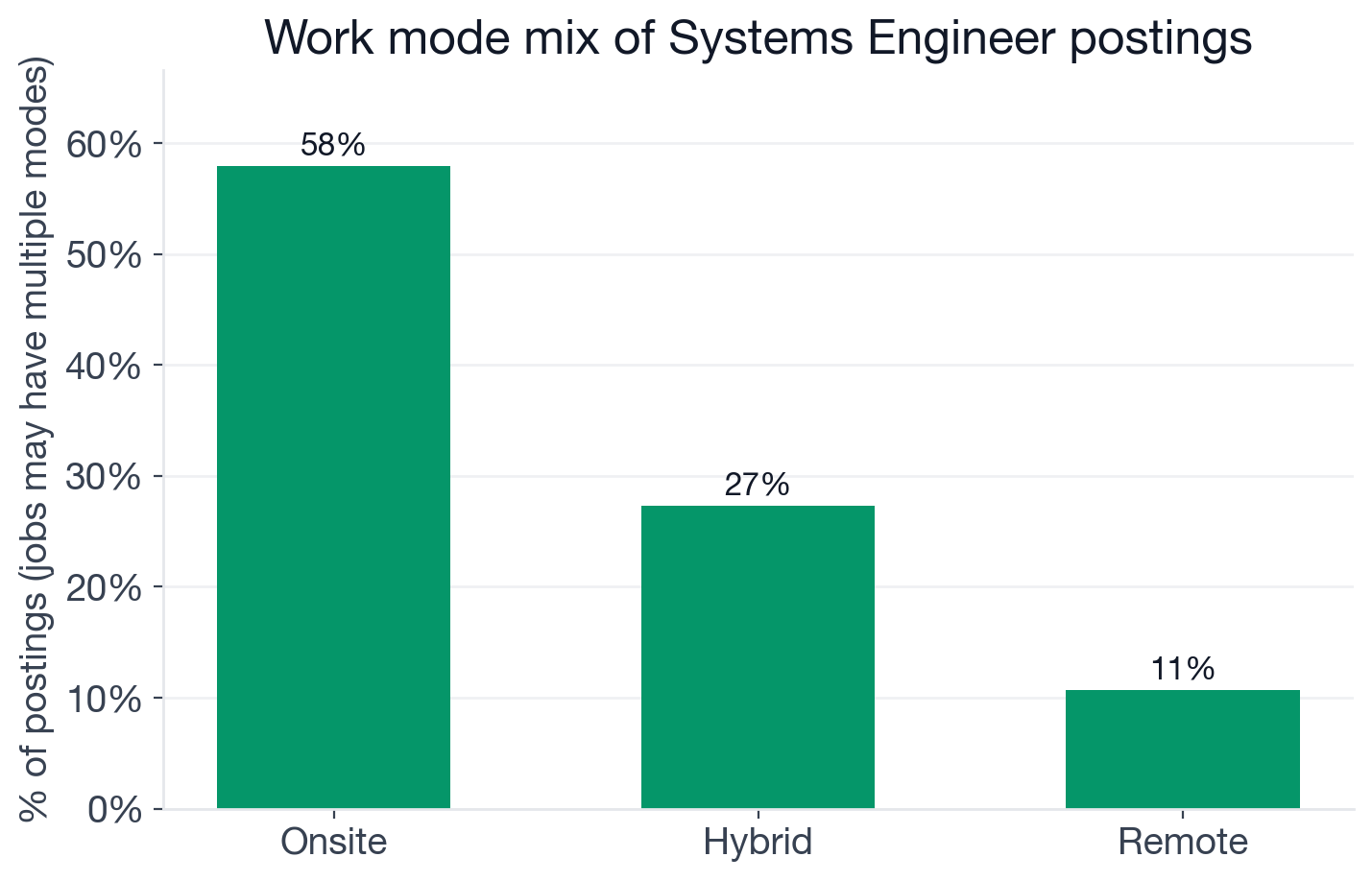
Work mode breakdown of Systems Engineer postings.
- Onsite: 57.9% (5,318 postings)
- Hybrid: 27.3% (2,507)
- Remote: 10.7% (978) (fully-remote Systems Engineer openings)
Just 1 in 10 postings tags remote. Aerospace and defense employers require physical presence for lab work, classified systems, and hardware integration. If a fully remote role is a priority, the search strategy should filter explicitly to cloud-native tech and SaaS employers rather than applying to the Systems Engineer title broadly; the remote-friendly segment is concentrated there.
Who's Hiring the Most Systems Engineers in 2026?
The employer roster tells the aerospace and defense story plainly. The table below excludes staffing and recruiting intermediaries, which represented several entries in the raw data.
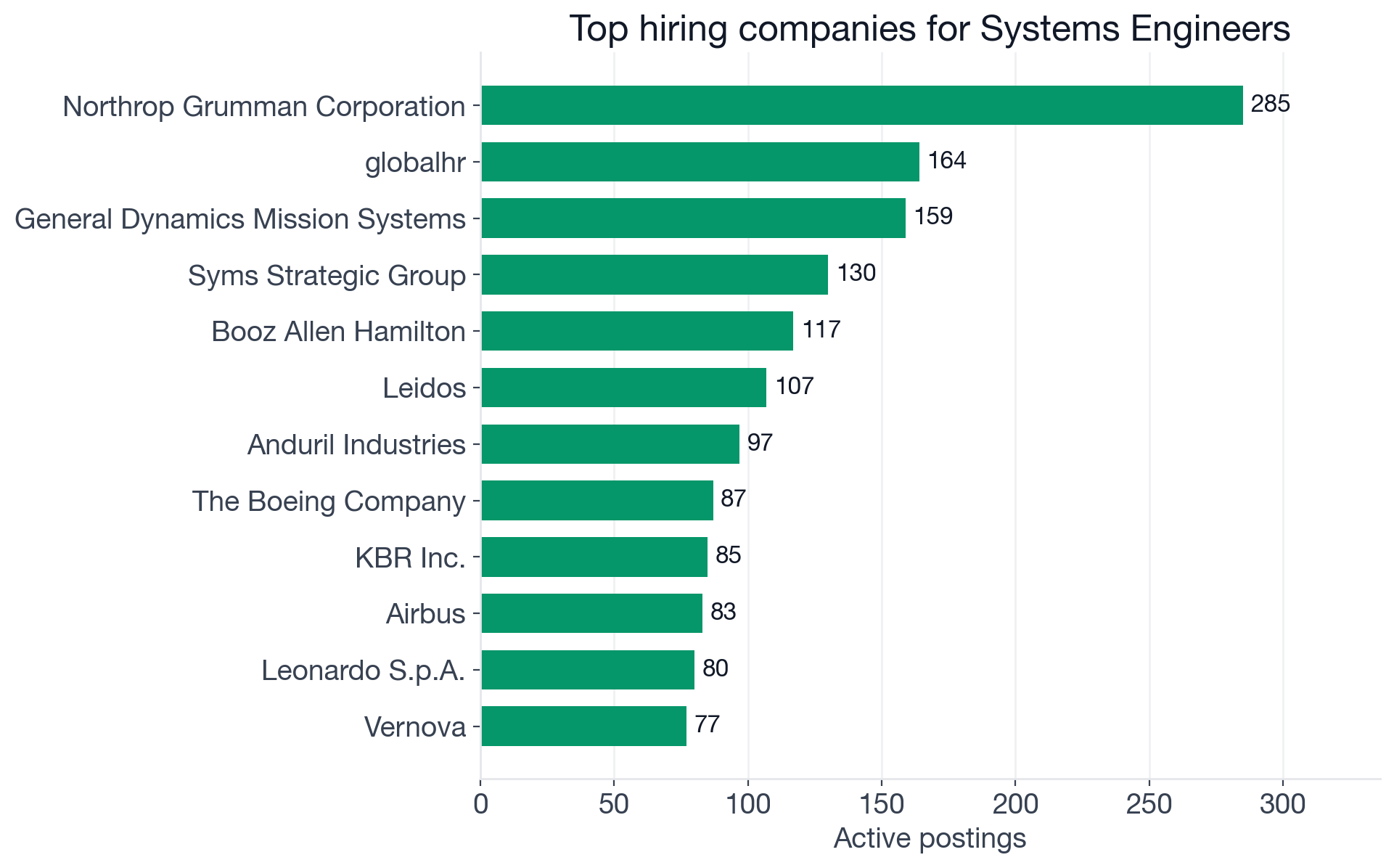
Top employers by active Systems Engineer postings. Staffing intermediaries excluded.
| Employer | Postings | Segment |
|---|---|---|
| Northrop Grumman | 285 | Aerospace and defense |
| General Dynamics Mission Systems | 159 | Defense systems |
| Booz Allen Hamilton | 117 | Defense consulting |
| Leidos | 107 | Defense and IT |
| Anduril Industries | 97 | Defense tech |
| Boeing | 87 | Aerospace |
| KBR Inc. | 85 | Engineering services |
| Airbus | 83 | Aerospace |
| Leonardo S.p.A. | 80 | Aerospace and defense |
| GE Vernova | 77 | Energy and engineering |
| Peraton | 67 | Defense IT |
| Blue Origin | 63 | Space |
| The Aerospace Corporation | 56 | FFRDC/space |
| General Dynamics IT | 53 | Defense IT |
There is no hyperscaler, no FAANG employer, and no cloud-native SaaS company in this top tier. The concentration is genuine: aerospace and combined defense/government-adjacent employers account for the vast majority of active Systems Engineer demand on the board. The implications are concrete: security clearances are frequently expected or required, work is onsite or hybrid, and salary ranges are more compressed than tech, often offset by strong benefits, stability, and mission-driven work.
For engineers targeting cloud-native Systems Engineer roles at tech companies, the title often overlaps with "Platform Engineer," "Infrastructure Engineer," or "Site Reliability Engineer." Running those searches in parallel surfaces a different employer set with different work-mode and salary profiles. For specific interview processes at companies like Northrop Grumman, Booz Allen Hamilton, or Leidos, our interview preparation guides break down the round structure and technical expectations.
How to Use This in Your Job Search
Pick a track before you apply. The cloud-native and traditional IT tracks have different skill requirements, employer types, salary trajectories, and work modes. Applying broadly without a track in mind wastes effort and produces a resume that is generic to both worlds and compelling to neither.
Build the automation baseline first. Automation (26.7%) and Python (23.3%) cross both tracks. Whatever employer segment you target, production-quality Python for scripting and automation is the single most transferable foundation. Practice the technical scenarios Systems Engineers face: infrastructure automation design, system integration challenges, and debugging exercises appear across both employer types.
Add one cloud-native specialization if salary is the priority. The salary gap between Kubernetes ($140,000) and Active Directory ($100,700) is nearly $40,000 on the same base role title. Kubernetes, Observability, Distributed Systems, and Google Cloud each move the median offer by $24,000 to $42,000 above baseline. The question bank covers distributed systems, Kubernetes architecture, and observability patterns at the depth hiring managers test in technical rounds.
Drill interview topics before you apply. Systems Engineer technical interviews, depending on the employer, cover system design, Linux administration, scripting and automation, networking fundamentals, and behavioral fit. Our interview-prep courses cover foundational system design, Python, and infrastructure concepts. AI mock interviews let you rehearse under realistic conditions with feedback on the architectural and behavioral questions that come up in Systems Engineer onsites.
Use skill filters on the job board. Browse current Systems Engineer openings and layer skill filters for your target track: Systems Engineer + Linux + Kubernetes for the cloud-native track, or Systems Engineer + Windows + VMware for the enterprise IT track. The board updates daily.
FAQ
Q. What skills do companies want for Systems Engineer roles in 2026?
No single skill clears 50% of postings, which makes this role more about breadth than any one technology. The common tier (20-50%) holds three skills: Automation (26.7%), Python (23.3%), and Monitoring (21.3%). Below that, the differentiator tier spans two tracks: a cloud-native side (Linux, Kubernetes, Terraform, CI/CD, Bash, Docker) and a traditional IT side (Windows, PowerShell, VMware, Active Directory). Most postings hire for one track or the other, so the skill set you build should match the employer type you are targeting.
Q. What is the median salary for a Systems Engineer in 2026?
The median US base salary for active Systems Engineer postings is $113,100 (n=3,242 US postings with salary disclosed as of June 2026). That figure covers base pay only; equity, bonuses, and sign-on are excluded from posting data, so total compensation at top employers in tech and aerospace is meaningfully higher.
Q. Which Systems Engineer skills pay the highest salary premium?
Among US postings, cloud-native and ML specialties command the largest premiums above the $113,100 baseline: Distributed Systems ($155,000, +$41,900), Observability ($150,000, +$36,900), Machine Learning ($144,000, +$30,900), Kubernetes ($140,000, +$26,900), and C++ ($140,000, +$26,900). Traditional IT skills like Active Directory and PowerShell actually sit below the role median at around $100,700, a $12,400 gap that signals the premium is entirely on the cloud and ML side of the role.
Q. Is Systems Engineer a good entry-level role to break into?
It is difficult. Only 3.1% of active Systems Engineer postings are explicitly entry-level (282 of 9,179 analyzed), a rate well below most software engineering roles. The aerospace and defense segment, which accounts for the majority of employer demand, also typically requires years of experience and often a security clearance. Engineers who route in via adjacent roles (DevOps, infrastructure, IT operations, or software engineering) with Linux and automation skills tend to find the transition easier.
Q. Where are Systems Engineer jobs located, and how remote-friendly are they?
The United States accounts for 59.4% of active Systems Engineer postings (5,451 of 9,179), a much higher US concentration than most tech roles. The UK (3.8%), Germany (3.7%), India (4.9%), and Canada (2.9%) follow. Remote work is limited: only 10.7% of postings are tagged remote, while 57.9% are onsite and 27.3% hybrid. The aerospace and defense concentration of employers, many of which require security clearances or physical presence, explains the low remote rate.
Q. Who hires the most Systems Engineers in 2026?
The employer roster is dominated by aerospace and defense primes: Northrop Grumman (285 postings), General Dynamics Mission Systems (159), Booz Allen Hamilton (117), Leidos (107), Anduril Industries (97), Boeing (87), KBR Inc. (85), Airbus (83), Leonardo (80), Peraton (67), Blue Origin (63), and The Aerospace Corporation (56). Technology employers, GE Vernova, and government contractors round out the top tier. Staffing and consulting intermediaries have been excluded from this ranking.
Q. What is the dominant Systems Engineer tech stack?
The most common pair in active postings is Automation + Python (1,083 postings, 11.8% of the market, lift 1.89), signaling that scripted automation is the baseline across most Systems Engineer roles regardless of industry. The strongest co-occurrence signal is AWS + Google Cloud (lift 6.36), showing that postings requiring both clouds are over-represented, a multi-cloud architect profile. The cloud-native DevOps stack (Automation + Linux + Kubernetes + Terraform + CI/CD + Bash) forms a coherent cluster, while the traditional IT stack (Windows + VMware + PowerShell + Active Directory) forms a separate one.
Final Thoughts
The Systems Engineer title covers two genuinely different jobs that share a common foundation: automation, Python scripting, and operational monitoring. The divergence is in cloud versus Windows, and the salary data makes the stakes clear. Cloud-native skills (Kubernetes, Observability, Distributed Systems) add $25,000 to $42,000 above the role baseline. Traditional IT skills (PowerShell, Active Directory, Windows Server) sit $9,000 to $12,000 below it. For engineers targeting aerospace and defense, the skills are largely the same automation and Python foundations, layered with domain-specific technical depth and, often, a security clearance. For engineers targeting salary trajectory in cloud-native environments, the investment is unambiguous. Pick the track that fits your goals, build the universal automation baseline, and go deep on one specialization.
Topics
Ready to practice?
Put what you've learned into practice with AI mock interviews and structured preparation guides.