
More Jobs, Lower Pay, Less Flexibility
Conventional logic says the larger job market is the safer bet. Systems Engineering defies that. There are nearly 5x as many active Systems Engineer postings as Cloud Architect postings (8,990 versus 1,898 on the InterviewStack.io job board as of June 2026), yet the median US base salary runs $25,000 lower ($140,000 versus $165,000). The flexibility picture inverts too: 68% of Systems Engineer roles require full onsite presence, compared to 44% for Cloud Architect.
The paradox dissolves once you look at who is actually hiring. Systems Engineer titles are dominated by Northrop Grumman, General Dynamics, Leidos, Anduril, and Boeing, defense and aerospace contractors where onsite presence is a given and salary bands reflect government contractor structures. Cloud Architect postings cluster around Kyndryl, NVIDIA, Red Hat, and Accenture, tech and consulting firms that compete for cloud talent globally and price accordingly. The roles share a 33% Jaccard skill overlap, enough common ground to move between them deliberately but enough divergence to make the paths feel genuinely different.
Key Findings
- 8,990 active Systems Engineer postings versus 1,898 Cloud Architect postings, a 4.7x volume gap.
- Median US base salary: $140,000 for Systems Engineers (n=3,580) versus $165,000 for Cloud Architects (n=399), a $25,000 (18%) gap.
- Skill overlap: 0.33 Jaccard similarity across top-30 skill sets; both roles share automation, Python, monitoring, and AWS/Azure.
- Work mode: Systems Engineers work onsite 68% of the time; Cloud Architects are onsite 44% and hybrid 43%.
- Entry-level share: 3.1% for Systems Engineer versus 0.9% for Cloud Architect; neither role has a genuine junior track.
- AI-adjacent skills command significant salary premiums in both roles: LLM skills reach $184,500 for Systems Engineers; Generative AI reaches $186,200 for Cloud Architects.
- Both roles are senior-skewed: combined senior and staff postings make up 37% of Systems Engineer and 32% of Cloud Architect openings.
| Systems Engineer | Cloud Architect | |
|---|---|---|
| Active postings | 8,990 | 1,898 |
| Median US base salary | $140,000 | $165,000 |
| Salary premium | (baseline) | +$25,000 (18%) |
| Remote share | 9% | 19% |
| Hybrid share | 27% | 43% |
| Entry-level share | 3.1% | 0.9% |
| Top skill | Automation (26%) | Azure (44%) |
| Skill overlap (Jaccard) | 33% shared | N/A |
Dataset note: Both classifiers capture adjacent roles: the Systems Engineer dataset includes security technicians, IT infrastructure engineers, and platform engineers (roughly one posting in five); the Cloud Architect dataset captures mechanical, facility, and hardware systems architects pulled in by the "Architect" keyword (roughly one in four). Skills and salary figures reflect the full blended pool and should be read as directionally accurate for the core role.
What Do Systems Engineers and Cloud Architects Actually Do?
Systems Engineers own the full lifecycle of complex systems: writing requirements, integrating hardware and software components, validating performance, and managing configuration through deployment. In practice this means living in requirements documents, integration test plans, and coordination meetings between hardware, software, and program management. The exclusive skills confirm the context: System Integration (13%), Windows (11%), VMware (8%), and MATLAB in the broader skill list all signal on-premises, embedded, or defense-platform work. These are not cloud-native roles.
Cloud Architects design and own cloud infrastructure at scale. A typical week involves translating product or business requirements into infrastructure designs, writing Terraform or CloudFormation to provision environments, tuning Kubernetes clusters, and advising stakeholders on cost and reliability trade-offs. The exclusive skills say it plainly: Cloud Architecture (22%), Scalability (22%), Infrastructure as Code (19%), Docker (13%), Observability (13%), IAM (11%), and Microservices (12%). This is a role defined by distributed systems design and cloud-native toolchain ownership.
What Skills Do Both Roles Share?
Both roles require automation, Python, monitoring, agile, and Linux as a working foundation. AWS and Azure appear in both, though at very different rates: AWS is in 12% of Systems Engineer postings versus 40% of Cloud Architect postings; Azure is in 11% versus 44%. Python is the closest thing to a true bridge, appearing in 23% of Systems Engineer postings and 22% of Cloud Architect postings, though what engineers do with it differs: automation scripting in SE, IaC tooling and pipeline work in CA.
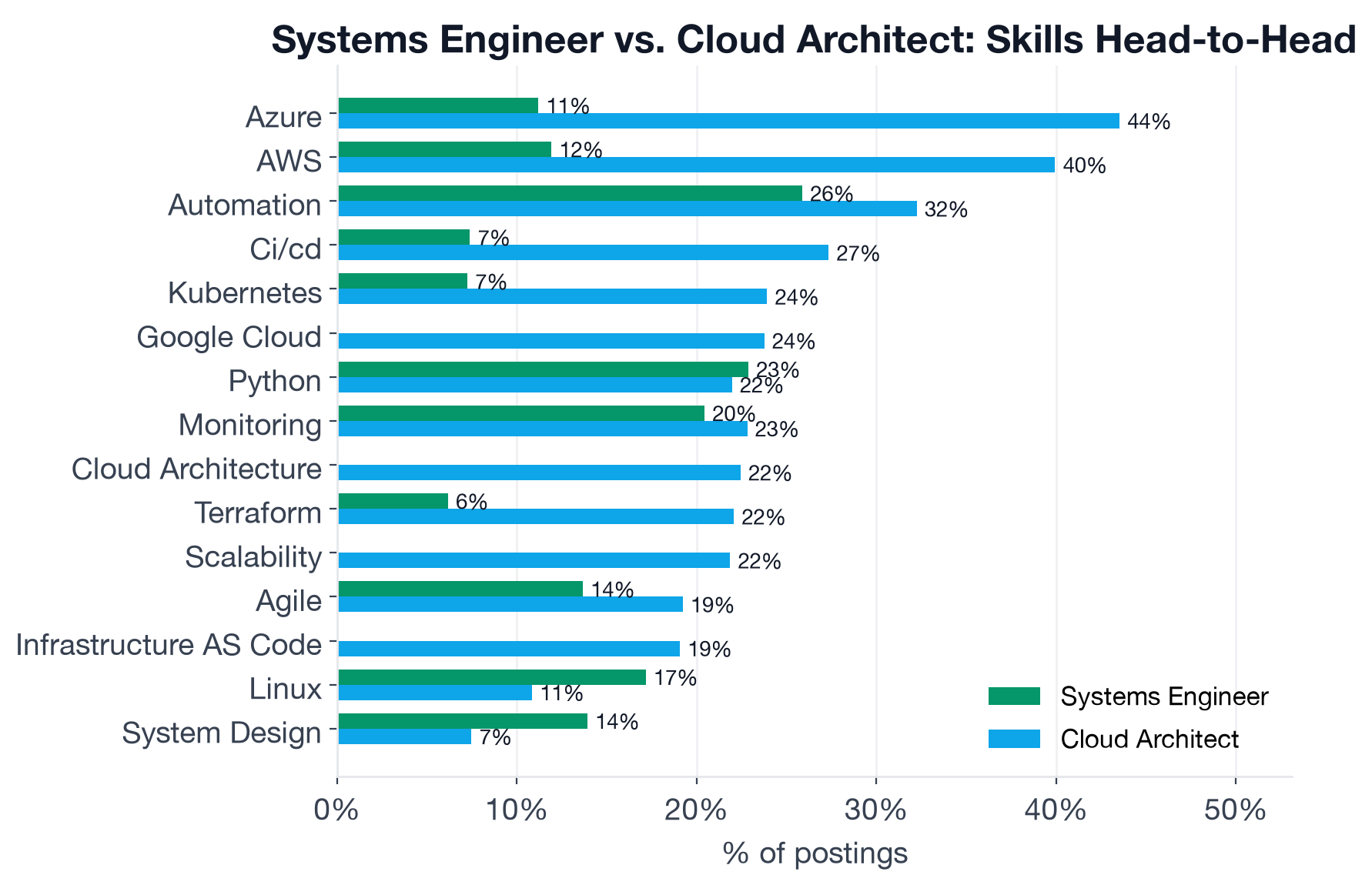
Top shared and role-exclusive skills for Systems Engineer (emerald) and Cloud Architect (sky). Frequency reflects share of active postings for each role on the InterviewStack.io job board, June 2026.
Browse Systems Engineer postings requiring Python or Cloud Architect postings requiring Terraform to see how the same skill surfaces in different work contexts.
Where Do the Roles Diverge?
Systems Engineer's exclusive skills cluster around on-premises and integration work: System Integration (13%), Windows (11%), TypeScript (11%), Technical Documentation (10%), Project Management (10%), and VMware (8%). The TypeScript signal is worth noting, though with a caveat: it likely reflects a mix of software-intensive SE work (platform engineers and DevOps-adjacent SEs) and software developers who use "Systems Engineer" in their titles, a known overlap in this dataset. This is not a single monolithic role; it spans from embedded firmware to enterprise IT systems to defense electronics.
Cloud Architect's exclusive skills reflect cloud-native design at every layer: Google Cloud (24%), Cloud Architecture (22%), Scalability (22%), Infrastructure as Code (19%), Docker (13%), Observability (13%), APIs (12%), Microservices (12%), Java (11%), and IAM (11%). The breadth here is deliberate. Cloud Architects are expected to own the entire infrastructure surface: compute, containers, networking, identity, observability, and API design are all in scope.
A 33% Jaccard overlap means you have a transferable foundation if you hold AWS or Azure, Python, and Kubernetes experience. Moving from SE to CA requires adding IaC fluency, scalability-first design thinking, and cloud-native toolchain depth. Moving the other direction means building familiarity with on-premises integration, systems requirements processes, and hardware-adjacent constraints that cloud-native engineers rarely encounter.
Which Role Pays More, and Why?
All salary figures below are US base salary only from postings with disclosed compensation. Equity, bonus, and sign-on are not included in posting data, so total compensation at top employers runs higher than these numbers reflect.
Cloud Architect has the higher baseline at $165,000 versus $140,000 for Systems Engineer. The counterintuitive finding: the commodity cloud skills that define Cloud Architect work sit at or below the role median. Azure postings at $165,000 are exactly at baseline. Terraform ($162,500) and Kubernetes ($165,200) are at or near the baseline. The real premiums in CA come from engineering depth: Generative AI ($186,200, n=26), Observability ($177,500), Python ($177,000), Scalability ($175,000), and Cloud Security ($174,100).
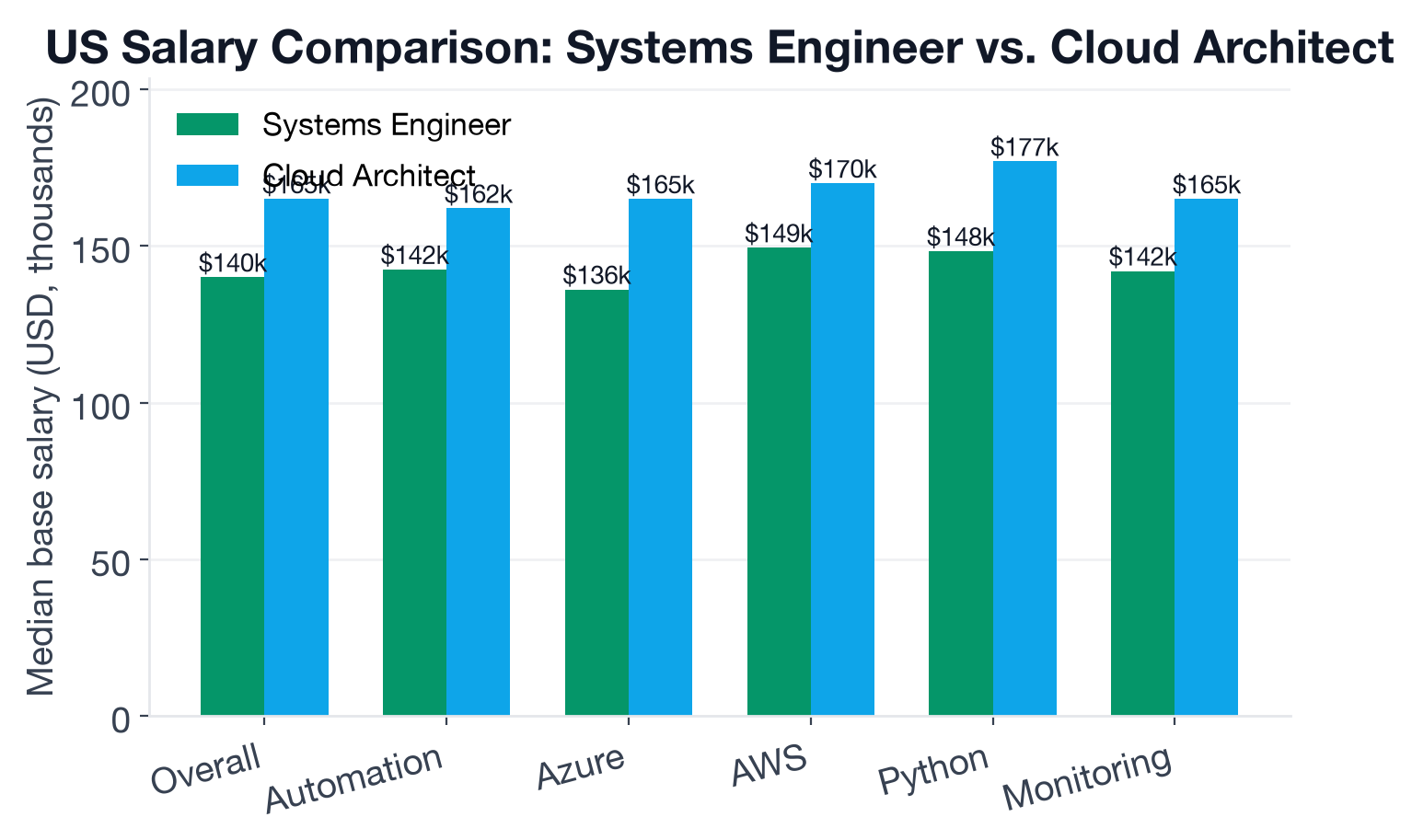
Median US base salary for selected skills. Base salary only; equity and bonus excluded. Cloud Architect baseline: $165,000 (n=399). Systems Engineer baseline: $140,000 (n=3,580).
For Systems Engineers, Kubernetes ($162,000, +$22K) and CI/CD ($160,000, +$20K) are the clearest premium signals in the common skill tier. AI-adjacent skills reach further: LLM-related skills range from $165,500 to $184,500 depending on the specific variant, and Generative AI with $167,000 above the $140K baseline. These premiums reflect a distinct sub-segment of Systems Engineers building AI-enabled platforms, not the traditional defense-contractor cohort.
Job postings rarely list AI tools as explicit requirements; Stack Overflow's 2025 Developer Survey found 84% of developers use AI tools regularly, but employers treat that as ambient. The salary data is more honest: in both roles, AI expertise commands a meaningful premium. For Cloud Architects specifically, the stakes are structural: Datadog's State of AI report found 69% of organizations run three or more AI models in production, and Cloud Architects are the engineers designing and operating that infrastructure.
How Accessible Is Each Role, and Where Are the Jobs?
Neither role has a genuine junior track. Systems Engineer has 3.1% of postings at entry level; Cloud Architect has just 0.9%. The practical signal: Cloud Architect titles go to engineers who already have 3-5 years of cloud infrastructure experience, typically from a DevOps, cloud engineer, or platform engineering background.
Volume shapes accessibility differently. Systems Engineer's 4.7x advantage is real but geographically concentrated: 62% of postings are in the United States, weighted toward defense-industrial hubs like Northern Virginia, Huntsville, and San Diego. Cloud Architect has a more global footprint: 37% US and 12% India, reflecting the distributed hiring model of global consulting and cloud-services firms. If you are outside the US, Cloud Architect has a proportionally larger market.
The work-mode gap is the sharpest practical difference. Systems Engineer is 9% remote and 68% onsite, consistent with defense-sector and hardware-lab requirements. Cloud Architect is 19% remote and 43% hybrid: roughly 1 in 5 roles is fully remote, and more than 2 in 5 offer hybrid arrangements. If workplace flexibility matters to your decision, browse remote Cloud Architect roles to gauge real-time demand in your region.
Which Role Should You Choose?
Choose Systems Engineer if you:
- Want to work with physical, embedded, or defense-platform systems rather than cloud infrastructure
- Are comfortable with (or open to) onsite work, including roles with security clearance requirements
- Need a larger raw job market: 8,990 active openings means more hiring cycles across more employers, including a small but real entry-level tier
- Come from an electrical, mechanical, or systems-software background and want to stay in that problem space
Choose Cloud Architect if you:
- Already have 3-5 years of cloud infrastructure or platform engineering experience and want to step into design ownership
- Prioritize workplace flexibility: Cloud Architect offers more than twice the remote-work share of Systems Engineer, and 43% hybrid
- Want the higher salary floor: the $165K median is the starting point, with observability, Python, scalability, and AI infrastructure skills adding $10-22K above that
- Are building toward a role at the center of AI production infrastructure; Cloud Architects are increasingly responsible for the platforms that run AI in production
How Should You Use This in Your Job Search?
Start with the live market on InterviewStack.io for Cloud Architect openings or Systems Engineer openings filtered to your target region and work mode. For interview preparation, AI mock interviews cover the system design and infrastructure architecture questions common to both pipelines. Drill cloud infrastructure, distributed systems, and systems design concepts through the question bank; the foundational topics overlap between both roles even when the specific toolchains do not.
FAQ
Q. What is the salary difference between Systems Engineers and Cloud Architects in 2026?
Cloud Architects earn a median $165,000 US base salary versus $140,000 for Systems Engineers, a $25,000 (18%) gap. All figures are US base salary only from postings with disclosed compensation; equity and bonus are not included. The gap is partly explained by employer type: Systems Engineers are concentrated in defense and aerospace (lower-paying, onsite employers), while Cloud Architects cluster in tech, consulting, and cloud-native firms.
Q. Which role is easier to break into as an entry-level candidate?
Systems Engineer is more accessible: 3.1% of its postings are entry-level versus just 0.9% for Cloud Architect. The absolute volume also helps: 8,990 Systems Engineer postings versus 1,898 Cloud Architect postings means more raw openings at every level. Cloud Architect is effectively a senior hire; the title implies architecture ownership that most employers treat as a mid-level-minimum bar.
Q. What skills do Systems Engineers and Cloud Architects share?
Both roles share automation, Python, monitoring, agile, and Linux as a common foundation, though frequencies differ sharply. Azure appears in 44% of Cloud Architect postings but only 11% of Systems Engineer postings. The Jaccard similarity across both roles' top-30 skill sets is 0.33, meaning they share about one-third of their skill profiles despite overlapping titles.
Q. Which role offers more remote work flexibility?
Cloud Architect is substantially more flexible: 19% of postings are fully remote and 43% are hybrid, versus Systems Engineer's 9% remote and 27% hybrid. The driver is employer type: Systems Engineer hiring is dominated by defense contractors and aerospace firms that require onsite presence, often with security clearances. Cloud Architect employers skew toward tech companies and consulting firms with distributed teams.
Q. What skills are exclusive to Cloud Architect versus Systems Engineer?
Cloud Architects require skills that rarely appear in Systems Engineer postings: Google Cloud (24%), Cloud Architecture (22%), Scalability (22%), Infrastructure as Code (19%), Docker (13%), Observability (13%), IAM (11%), and Microservices (12%). Systems Engineers have skills exclusive to on-premises and hardware-adjacent contexts: System Integration (13%), Windows (11%), TypeScript (11%), VMware (8%), and Technical Documentation (10%).
Q. Which skills pay the highest premium for Systems Engineers and Cloud Architects?
For Systems Engineers (baseline $140,000 US median), Kubernetes ($162,000) and CI/CD ($160,000) add the strongest premiums among common skills. AI-adjacent skills reach higher: LLM-related skills range from $165,500 to $184,500 depending on the specific variant, and Generative AI reaches $167,000. For Cloud Architects (baseline $165,000), Generative AI ($186,200), Observability ($177,500), and Python ($177,000) sit above the baseline; core cloud tools like Azure and Terraform sit at or below the role median.
Where Do Both Careers Lead?
Both roles are healthy and actively hiring, just in very different ecosystems. Systems Engineering offers scale, variety, and a lower barrier to entry, but the market is defense-heavy and largely onsite. Cloud Architect offers a higher pay floor, genuine flexibility, and a front-row seat to AI infrastructure buildout, but it is a senior-minimum track with a much smaller job pool. The decision comes down less to salary math and more to environment: defense-contractor onsite work versus cloud-native distributed teams. Explore live Systems Engineer and Cloud Architect openings on InterviewStack.io to see where real demand is in your market right now.
Topics
Ready to practice?
Put what you've learned into practice with AI mock interviews and structured preparation guides.