
The Shared Foundation Hides a $29,000 Divergence
Systems Engineer and Systems Administrator share enough vocabulary that they feel interchangeable from the outside: both work with Linux, both monitor infrastructure, both automate things. The 43% Jaccard overlap across their skill sets confirms that intuition is not entirely wrong. Nearly half the required skills transfer cleanly between the roles.
But the salary data separates them sharply. Systems Engineers earn a $137,000 median US base salary; Systems Administrators earn $107,700. That $29,300 gap (27%) is not driven by exotic specialization. It reflects a structural difference in what each role is asked to do: one designs and integrates systems, the other operates and maintains them. Across 8,895 active Systems Engineer postings and 4,073 Systems Administrator postings on the InterviewStack.io job board, the data makes that distinction concrete.
| Systems Engineer | Systems Administrator | |
|---|---|---|
| Median US base salary | $137,000 | $107,700 |
| Active postings | 8,895 | 4,073 |
| Top skill | Automation (25%) | Monitoring (37%) |
| Remote share | 10% | 9% |
| Entry-level share | 3% | 3% |
| Skill overlap | 43% Jaccard | (pairwise) |
Key Findings
- Systems Engineers earn a $137,000 median US base salary vs. $107,700 for Systems Administrators, a $29,300 (27%) gap (SE n=3,600; SysAdmin n=1,183 US postings with disclosed salary).
- The Jaccard overlap across the top-30 skill sets is 43%: substantial common ground, but the exclusive skills tell fundamentally different stories.
- Systems Engineer has 8,895 active postings versus 4,073 for Systems Administrator, a 2.19x volume advantage.
- Systems Administrator concentrates 76% of postings at mid-level with only 3.8% at staff; Systems Engineer is more distributed with 13.9% at staff.
- Both roles are predominantly onsite: 68% for Systems Engineer, 67% for Systems Administrator. Remote is 10% and 9% respectively.
- Systems Engineer exclusive skills: Agile (14%), system design (13%), system integration (13%), technical documentation (10%), project management (9%).
- Systems Administrator exclusive skills: Active Directory (22%), Windows Server (16%), firewalls (13%), DHCP (12%), disaster recovery (11%), Ansible (11%).
What Do These Roles Actually Do?
Systems Engineers design, validate, and integrate complex systems, often across hardware and software boundaries. The exclusive skills are revealing: system design, system integration, Agile, and project management all point toward scope management and delivery coordination rather than day-to-day operations. A Systems Engineer might own the architecture of a satellite communication link, define the requirements for an avionics subsystem, or design a cloud-native platform that a product team will build on. Notably, defense and aerospace contractors dominate the top of the employer list: Northrop Grumman, General Dynamics, Booz Allen Hamilton, Leidos, Boeing, Anduril, Airbus, and Blue Origin are all among the largest hirers. Many of these roles require security clearances and operate within long-horizon engineering programs rather than typical IT cycles. Worth noting: the "Systems Engineer" label is applied broadly across industries in job posting data. This dataset's 8,900 postings include defense and aerospace SE (the largest single concentration), software infrastructure SE at tech companies, embedded and hardware SE, and controls engineering. The $137,000 median reflects that blend: software-adjacent SE roles at tech companies tend to sit above the baseline, while government-contract and clearance-required roles vary with program type.
Systems Administrators manage the operational health of existing infrastructure. The exclusive skills describe a runtime environment: Active Directory for identity, Windows Server and DHCP for network services, firewalls for perimeter security, and disaster recovery for business continuity. A SysAdmin's week looks more like patching servers, managing user accounts, monitoring uptime, and triaging incidents. The customer service signal (14% of SysAdmin postings mention it, versus effectively zero for SE) reflects more direct end-user exposure. In short: SysAdmins own the environment that Systems Engineers design.
What Skills Do Both Roles Share?
Both roles run on a shared operational foundation. Monitoring (SE: 21%, SysAdmin: 37%), automation (SE: 25%, SysAdmin: 30%), and Linux (SE: 17%, SysAdmin: 34%) appear at meaningful rates in both. Windows, Python, AWS, Azure, VMware, PowerShell, Bash, DNS, and SQL also show up across both skill sets above the 5% threshold in each role.
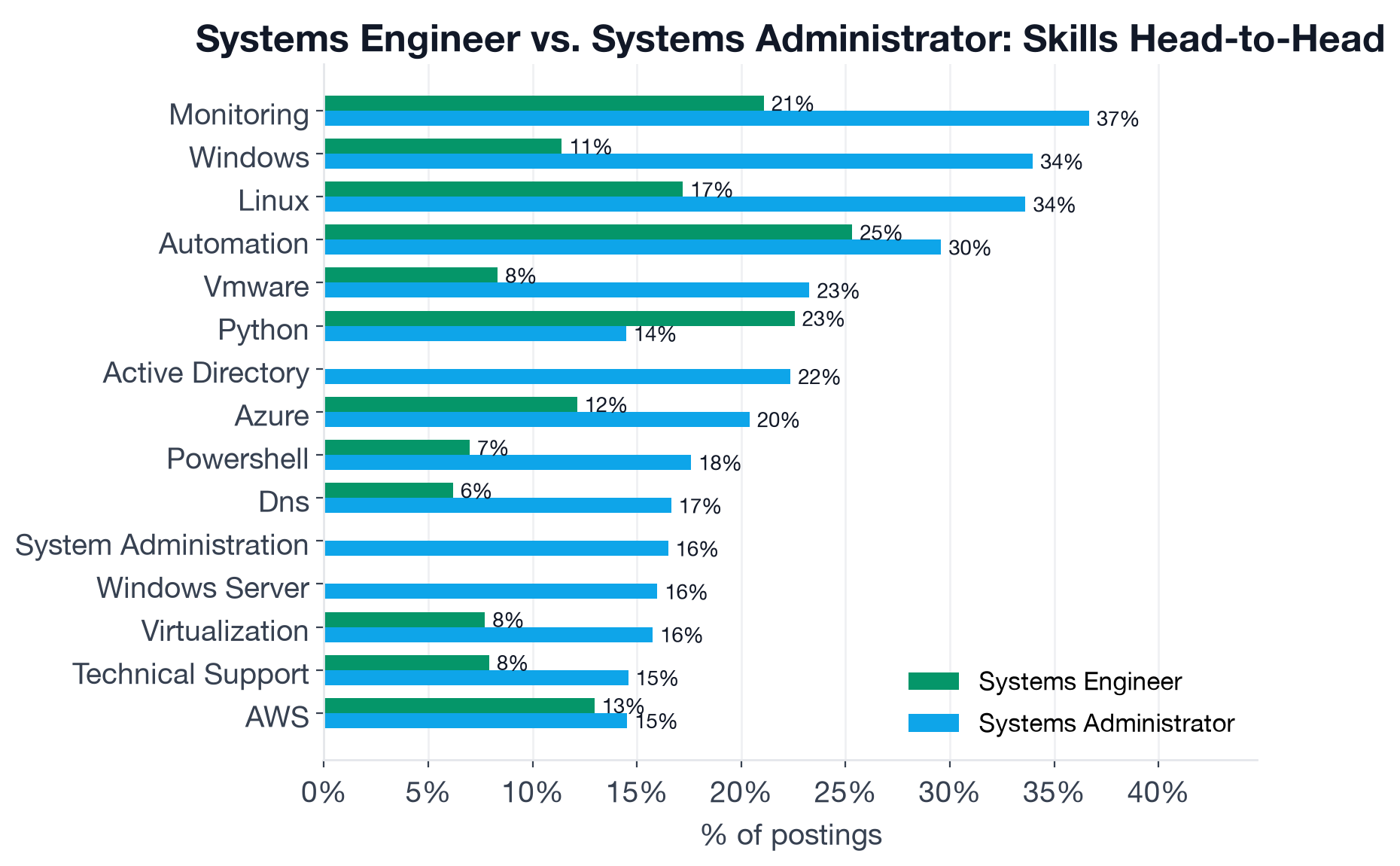
Skill frequency for Systems Engineer (emerald) and Systems Administrator (blue) across top shared and exclusive skills. Monitoring, automation, and Linux form the strongest common ground; Active Directory and system design are the clearest dividing lines.
That overlap is real and useful. Someone with a strong SysAdmin background already has the infrastructure layer, the cloud exposure, and the automation mindset that SE postings value. The question is whether they have also built the design, integration, and stakeholder-management skills that SE postings exclusively require.
Where the Roles Split Apart
The exclusive skill clusters signal two fundamentally different orientations.
For Systems Engineers, the differentiators are architectural and project-oriented: system design (13%), system integration (13%), Agile (14%), technical documentation (10%), and project management (9%). These skills describe the upstream phase of a system lifecycle, defining what gets built and how the pieces connect before deployment.
For Systems Administrators, the differentiators are operational and infrastructure-specific: Active Directory (22%), system administration (16%), Windows Server (16%), firewalls (13%), DHCP (12%), disaster recovery (11%), Ansible (11%), backups (9%). These describe the steady-state environment after deployment: identity management, network services, security perimeter, and continuity planning.
Neither cluster is inherently more technical. They reflect different specializations with different buyers. The SysAdmin stack is also evolving. Ansible appearing in 11% of postings signals that the role is absorbing more infrastructure-automation responsibility. AI is accelerating this shift without yet appearing in posting language: log analysis, incident correlation, and capacity forecasting are early candidates for AI assistance, but employers describe this layer through AIOps platform requirements rather than listing "AI" as a discrete skill. For Systems Engineers with Python-heavy automation work, the parallel shift is code-generation AI (Copilot, Claude Code, Cursor) that accelerates scripting and testing workflows. Neither role needs to BUILD AI to be affected by it.
Which Pays More: Systems Engineer vs Systems Administrator?
Systems Engineer pays more, with the premium widening significantly for software-adjacent specializations. All figures below are US base salary from postings with disclosed compensation; equity and bonuses are not reflected, so total compensation at top employers runs meaningfully higher than these numbers suggest.
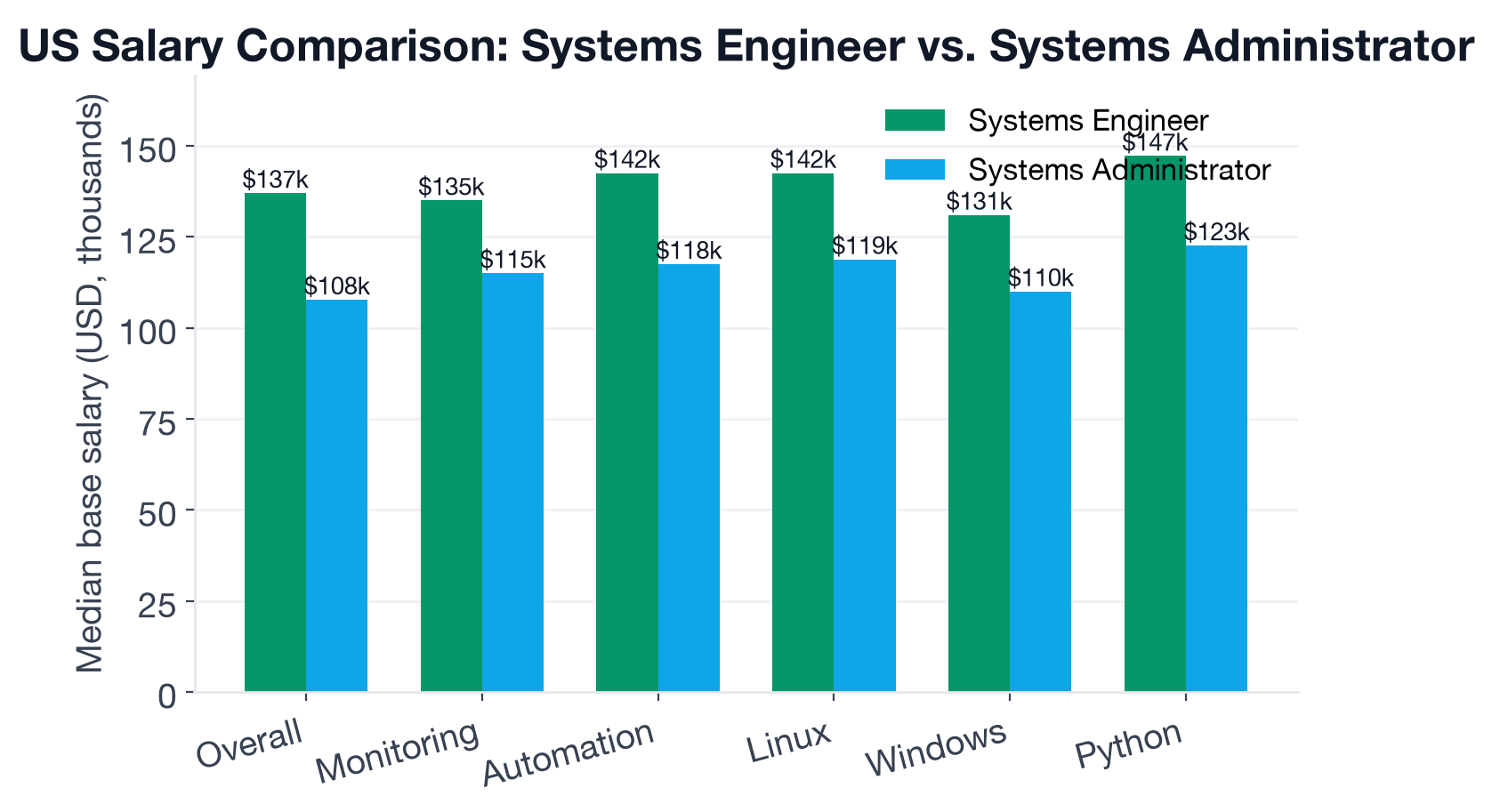
US base salary medians for Systems Engineer and Systems Administrator, overall and by selected shared skills. Source: postings with disclosed US salary data (SE n=3,600; SysAdmin n=1,183).
The $137,000 SE baseline is already strong. The highest premiums attach to distributed systems and AI-adjacent work: Systems Engineers who work with distributed systems earn a $183,800 median ($46,800 above baseline). Observability ($175,000), machine learning ($165,000), Kubernetes ($160,500), and CI/CD ($162,000) each add $23,000 or more. These figures come from a small sub-population within the SE market, specifically roles that sit at the intersection of systems engineering and modern software infrastructure. The broader SE population earns closer to the $137,000 baseline.
For Systems Administrators, the move-the-needle skills are cloud and DevOps tools. AWS pushes the SysAdmin median to $135,000 (+$27,300 above the $107,700 baseline), Docker to $131,900 (+$24,200), and Ansible to $131,000 (+$23,300). Terraform ($128,900) and CI/CD ($129,600) also add roughly $21,000. The pattern is consistent: SysAdmins who operate cloud infrastructure and write infrastructure-as-code command a significant premium over those managing traditional on-premise environments.
Which Role Has More Room to Grow?
Systems Engineer has more openings, a wider geographic footprint, and a more distributed seniority curve.
The seniority gap is the most consequential signal for anyone making a long-term career decision. Systems Administrator concentrates 76% of its postings at mid-level, with only 3.8% at staff. The ceiling is real and visible in the data. Systems Engineer is still mid-level-heavy (59%), but senior (24%) and staff (14%) roles are genuinely present in the market. Someone who starts as a Systems Engineer can find labeled paths to principal and staff-level technical roles based on what hiring managers are actively recruiting for.
Entry-level share is nearly identical (SE: 3.0%, SysAdmin: 3.4%), so neither role is more accessible to career changers at the starting line. The difference emerges later.
Geography and remote flexibility are similar for both: Systems Engineer postings are 63% US-based, Systems Administrator 52%. Both are predominantly onsite (68% and 67% respectively), with hybrid at 27% and remote at 10% for Systems Engineers and 9% for Systems Administrators. If location flexibility is a priority, neither role offers it reliably, and the geographic distribution suggests that international candidates in Germany and India have more relative opportunity in Systems Administrator (Germany is 10% of SysAdmin postings, vs. 4% for SE).
Which Should You Choose?
Choose Systems Engineer if you:
- Want to work on design, architecture, or integration rather than day-to-day operations
- Have or are building experience in Agile delivery, project management, or technical documentation
- Are interested in defense, aerospace, or complex engineering programs, where a large share of SE roles live
- Want a wider hiring market (2.19x more postings) and a career path that demonstrably extends to senior and staff levels
Choose Systems Administrator if you:
- Prefer operational depth over architectural breadth: managing identity, servers, and network services for existing environments
- Are already strong in Windows environments, Active Directory, and endpoint management
- Plan to use the SysAdmin role as a stepping stone toward cloud engineering or DevOps by layering in Ansible, Terraform, and CI/CD skills that carry $20,000+ premiums
- Are comfortable building expertise at mid-level depth before considering a pivot toward engineering roles
Both paths carry the same entry barrier: roughly 3% of postings are explicitly entry-level. The practical route into either role runs through hands-on infrastructure experience, whether via cloud certifications, homelab projects, or IT support and help desk work.
How to Use This in Your Job Search
Browse live Systems Engineer openings or Systems Administrator openings on the InterviewStack.io job board, filtered by role. Both filters surface only quality-gated active postings.
For interview prep, the AI mock interview tool lets you practice role-specific technical and behavioral questions with real-time feedback tailored to the role you select. The question bank covers systems design, infrastructure fundamentals, networking, and platform engineering topics relevant to both roles. For the skills that move the salary needle in each role (Kubernetes, CI/CD, Terraform, Ansible), interactive courses covering cloud, DevOps, and systems fundamentals provide structured paths to fill the gaps.
FAQ
Q. What is the salary difference between Systems Engineer and Systems Administrator in 2026?
Systems Engineers earn a median US base salary of $137,000 vs. $107,700 for Systems Administrators, a $29,300 (27%) gap. These are base figures from postings with disclosed US salary data; equity and bonuses are not included.
Q. How much skill overlap is there between Systems Engineer and Systems Administrator?
The Jaccard overlap coefficient across the top-30 skill sets is 43%. Both roles share monitoring, automation, Linux, Windows, Python, AWS, Azure, VMware, and more. Systems Engineers exclusively require system design, Agile, and system integration, while Systems Administrators focus on Active Directory, Windows Server, firewalls, and disaster recovery.
Q. Which role has more job openings in 2026?
Systems Engineer has 8,895 active postings versus 4,073 for Systems Administrator, a 2.19x volume advantage. Systems Engineer postings are 63% US-based; Systems Administrator postings are 52% US-based.
Q. What skills are unique to Systems Engineers vs. Systems Administrators?
Systems Engineers uniquely require Agile (14%), system design (13%), system integration (13%), technical documentation (10%), and project management (9%). Systems Administrators uniquely require Active Directory (22%), system administration (16%), Windows Server (16%), firewalls (13%), DHCP (12%), disaster recovery (11%), and Ansible (11%).
Q. Which role is easier to break into in 2026?
Both have almost identical entry-level shares: 3.0% for Systems Engineer and 3.4% for Systems Administrator. The key difference is career trajectory: Systems Administrator concentrates 76% of postings at mid-level with only 3.8% at staff, while Systems Engineer distributes more broadly with 13.9% at staff.
Q. How remote-friendly are Systems Engineer and Systems Administrator roles?
Both roles skew heavily onsite: 68% of Systems Engineer postings and 67% of Systems Administrator postings are tagged onsite. Remote share is low at 10% for Systems Engineers and 9% for Systems Administrators, with hybrid at 27% for both.
Q. Which skills pay the biggest premium for Systems Administrators?
Among US postings, Systems Administrators who work with AWS earn a $135,000 median, $27,300 above the $107,700 role baseline. Docker ($131,900), Ansible ($131,000), CI/CD ($129,600), and Terraform ($128,900) add $21,000-$24,000 to the baseline. These are all DevOps-adjacent tools that signal a move toward automation-first administration.
Where Each Role Takes You
The 43% skill overlap is real, and it means the infrastructure foundation you build in either role carries forward. But the career math diverges from there. Systems Engineer pays 27% more at median, has twice the open positions, and sustains a genuine senior and staff tier. Systems Administrator is a strong operational specialty, with a clear premium available for anyone who layers in cloud and automation skills, and a well-worn path into DevOps or cloud engineering for those who want to move. Browse Systems Engineer or Systems Administrator openings to see what the current market looks like for each.
Topics
Ready to practice?
Put what you've learned into practice with AI mock interviews and structured preparation guides.