
The Technical Product Manager Business Acumen and Strategy Alignment Interview Distrusts Growth Without Revenue
Picture a mid-level Technical Product Manager interview at a large streaming company. Watch time is up 12% over the last two quarters. Revenue hasn't moved. Leadership isn't asking which feature to ship next, they're asking why growth stopped meaning anything, and which of three funded initiatives actually fixes it. Answer with "let's keep the engagement trend going and revenue will catch up" and the interview is already over.
This walkthrough is built on one real InterviewStack.io AI-interview blueprint, the same interview_package structure that scores a live mock interview, evaluated across a 100-point rubric in four dimensions. It follows a candidate, Dana, through the mistakes a prepared but unpracticed Technical Product Manager actually makes on this business-acumen scenario, and what the stronger version of each answer looks like.
Key Findings
- The rubric totals 100 points: 30 for Interviewer Objectives Alignment, 30 for Level-Specific Expectations, 20 for Technical Proficiency, and 20 for Communication and Problem Solving.
- The interview runs 30 minutes across 3 phases: 0-7 minutes on problem framing, 7-20 minutes on option evaluation and trade-offs (the longest phase, 13 of 30 minutes), and 20-30 minutes on recommendation and metrics.
- The scenario forces a choice among 3 funded initiatives, ad load and targeting, a lower-priced annual Premium plan, or Live sports discovery, and the candidate can fund only 1.
- The starting fact pattern: watch time grew 12% over two quarters while total revenue stayed flat.
- Phase 2's checklist requires raising at least 2 meaningful risks or second-order effects across the options under consideration.
- This walkthrough dramatizes 4 of the blueprint's 6 interviewer follow-up prompts.
- 4 topics sit outside this blueprint's scope, including database schema design and system-design deep dives, keeping the interview focused on business judgment, not implementation.
The interview question
You are the Technical Product Manager for a video streaming platform with three major businesses: free ad-supported viewing, Premium subscriptions, and Live sports add-on packages. Over the last two quarters, watch time has grown 12%, but total revenue has been flat, and leadership is concerned that engagement is increasing without translating into business results.
Your team can fund only one major initiative this half: improving ad load and targeting for free users, launching a lower-priced annual Premium plan, or expanding recommendations for Live sports discovery. The company strategy this year is to grow sustainable revenue while improving user trust and avoiding heavy increases in infrastructure spend.
How would you decide which initiative to recommend, and how would you make the business case to leadership?
What Is This Interview Actually Scoring Beneath the Three Options?
The interviewer isn't grading which of the three initiatives gets picked; more than one can be defended with the right reasoning. They're testing whether a mid-level Technical Product Manager can connect a recommendation to explicit business drivers (incremental revenue, contribution margin, retention, payback period) instead of discussing features in isolation, build a structured comparison across upside, cost, risk, and strategic fit, and land on one clear call instead of keeping every option open through minute 30.
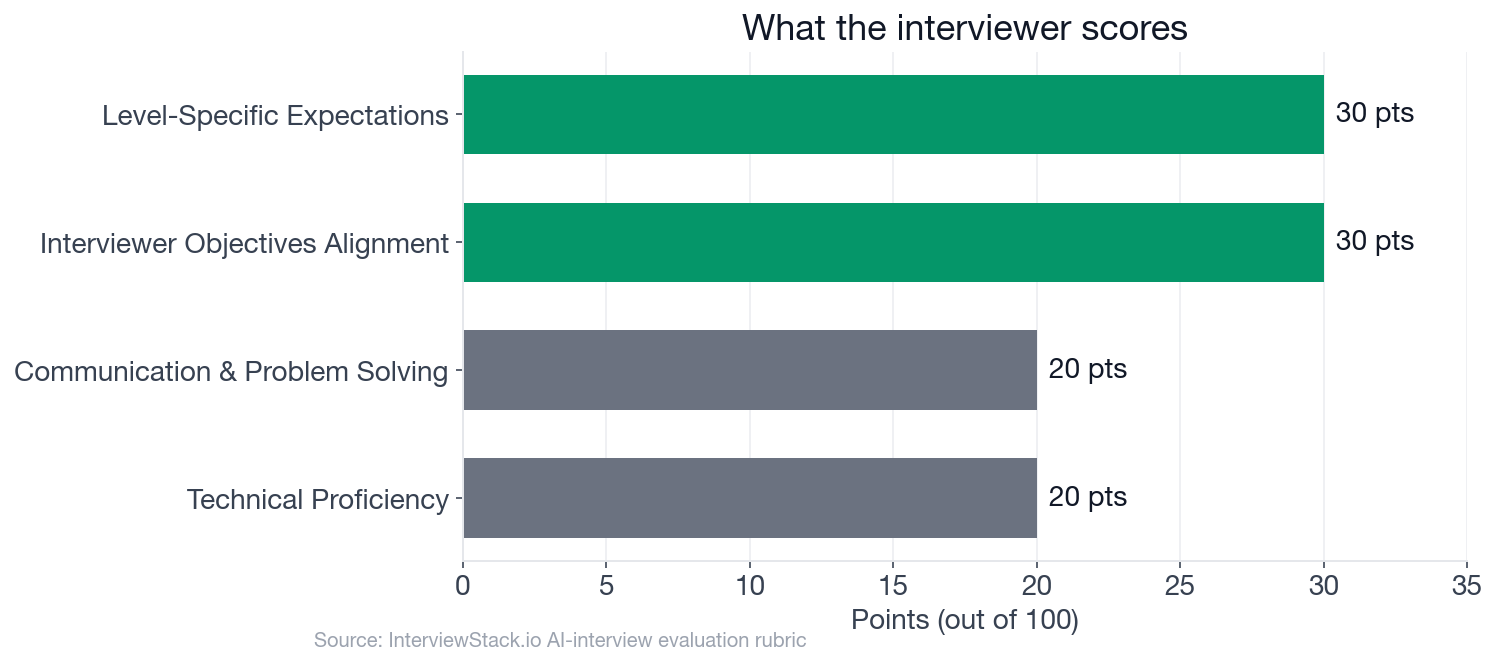
Notice how the rubric is weighted: 60 of the 100 points sit in Interviewer Objectives Alignment and Level-Specific Expectations combined, the two dimensions most sensitive to which business logic a candidate reaches for and how independently they build the case. Technical Proficiency, the financial-modeling polish, is worth only 20. This interview is decided by judgment, not spreadsheet precision.
Four Turns Where the Recommendation Gets Made or Lost
Turn 1: Naming the Data That Would Change the Call
Interviewer: "What additional data would you ask for first, and which few inputs would most change your recommendation?"
Turn 2: The ARPU Number That Isn't the Whole Story
Interviewer: "Suppose Live sports users have the highest ARPU but also the highest content and infrastructure costs. How would that affect your recommendation?"
Turn 3: The Downgrade Nobody Priced In
Interviewer: "How would you evaluate the risk that a lower-priced annual Premium plan improves conversion but hurts overall revenue through cannibalization?"
Turn 4: Choosing the Metric That Gets to Matter
Interviewer: "What north-star and guardrail metrics would you use to judge success in the first 90 days after launch?"
What Changes When the Clock Is Actually Running?
Reading Dana's mistakes above probably felt obvious. That's the trap. On the page you have unlimited time to notice that "12% more watch time" isn't a business case. Live, you have 30 minutes, a follow-up you didn't rehearse, and a VP who wants the number defended in real time. The gap between spotting a mistake in red text and not making it under pressure only closes with reps, ideally against a system that scores you the way this rubric actually scores.
What Does a Leadership-Ready Recommendation Actually Look Like?
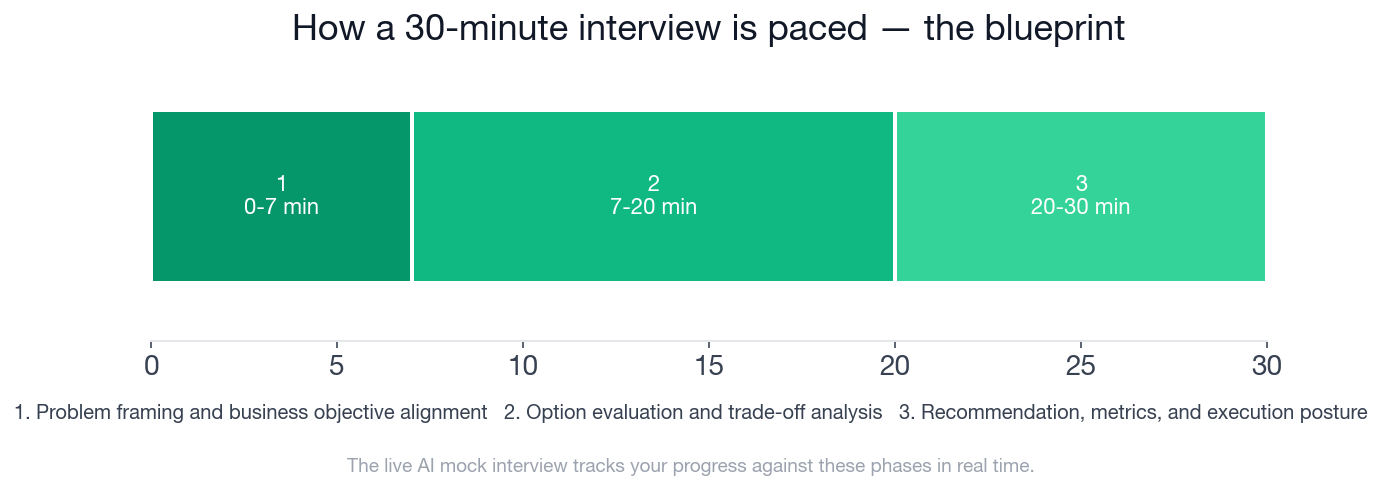
The chart above is the pacing a strong candidate actually hits: the business problem and strategy constraints framed by minute 7, the three-way option evaluation, the longest stretch of the interview, built out through minute 20, and the last 10 minutes spent on one clear recommendation with guardrail metrics, not more comparison. The card below is the same blueprint the AI mock interview tracks you against in real time, phase by phase, checklist item by checklist item.
- ✓Restates the core business problem in their own words
- ✓Separates engagement metrics from business outcome metrics
- ✓Mentions the company strategy constraints: sustainable revenue, user trust, and infrastructure discipline
- ✓Proposes a comparison framework for the three options before selecting one
- ✓Explains how each initiative could create value and for which user segment
- ✓Discusses likely costs or margin implications for each option, not just top-line revenue
- ✓Raises at least two meaningful risks or second-order effects across the options
- ✓Uses a practical prioritization lens such as impact versus confidence versus cost/time
- ✓Shows willingness to state assumptions where data is missing
- ✓Makes a clear recommendation instead of only comparing options
- ✓Supports recommendation with business rationale tied to strategy and constraints
- ✓Defines a small set of success metrics and guardrails
- ✓Describes what evidence in the first 90 days would confirm or challenge the decision
- ✓Communicates in a concise, leadership-appropriate way
Take This Scenario Live
Everything above is illustrative coaching built from a real interview blueprint, not a transcript to memorize. The exact numbers, the follow-up order, and even which initiative looks strongest on paper will differ in a live session, which is the point: you need to build a leadership-ready recommendation on the fly, not recall Dana's answers. Start the AI mock interview on Business Acumen and Strategy Alignment to run this exact blueprint live, scored phase by phase. To drill the underlying reasoning first, work through the Technical Product Manager question bank on business and product strategy alignment or build broader business-strategy fluency through interactive courses. For company-specific process notes, browse InterviewStack.io's preparation guides.
FAQ
Q. What does the Technical Product Manager Business Acumen and Strategy Alignment interview actually ask?
The blueprint used in this walkthrough puts a mid-level Technical Product Manager in charge of a video streaming platform's roadmap and asks them to recommend one of three funded initiatives (ad load and targeting, a lower-priced annual Premium plan, or Live sports discovery) after two quarters of rising engagement and flat revenue. Over 30 minutes, the interviewer probes business-objective framing, cost and risk trade-offs across the options, and a leadership-ready recommendation with success metrics.
Q. Why does 12% watch-time growth with flat revenue matter for this interview?
It is the scenario's central trap. The interview opens by handing the candidate a metric that looks like a win, watch time up 12% over two quarters, while total revenue stayed flat, and the phase-one checklist explicitly rewards separating that engagement number from an actual business outcome before proposing a fix. A candidate who treats rising watch time as evidence the business is on track answers the wrong question from minute one.
Q. How should ad revenue growth be weighed against user trust and long-term retention?
The company strategy in this scenario explicitly names user trust as a constraint alongside sustainable revenue, so a candidate cannot treat ad load and targeting purely as a monetization lever. A strong answer names a concrete trust cost, more ads per session risking complaints or churn, and proposes a guardrail, such as a cap on ad load or a trust metric tracked alongside revenue, rather than optimizing ad revenue in isolation.
Q. Why isn't Live sports' higher ARPU alone enough to justify recommending it?
Live sports users have the highest revenue per user in the scenario, but also the highest content and infrastructure costs, and the company strategy explicitly calls for avoiding heavy increases in infrastructure spend. A strong answer nets ARPU against that cost structure to talk about contribution margin, not top-line revenue per user, before treating Live sports as the default winner.
Q. How should the recommendation change if engineering capacity is fixed and finance wants payback within two quarters?
Both constraints shrink the option, not just the effort. A candidate should explicitly state what gets cut or descoped to fit fixed engineering capacity, and check that the recommended initiative can plausibly show incremental revenue within two quarters, which typically favors a fast-to-launch pricing or ad-targeting change over a build-heavy discovery feature. Naming the trade-off instead of promising to deliver everything is what a mid-level Technical Product Manager is expected to do here.
Q. How many rubric points does this interview weigh, and how are they split?
The rubric totals 100 points across four dimensions: Interviewer Objectives Alignment (30 points), Level-Specific Expectations (30 points), Technical Proficiency (20 points), and Communication and Problem Solving (20 points).
Q. How should someone prepare for a Technical Product Manager interview on business acumen and strategy alignment?
Practice building a one-page business case, problem framing, 2-3 option trade-offs, a recommendation, and guardrail metrics, out loud and under a 30-minute clock, since that structure is what most of the rubric scores. An AI mock interview built on this exact blueprint gives live, scored feedback on where the reasoning breaks down; a question bank drill helps sharpen individual answers first.
Engagement Is Not the Business Case
Every mistake in this walkthrough traces back to the same instinct: reaching for the number that already moved instead of the number leadership actually cares about. Watch time stood in for revenue, ARPU stood in for margin, conversion stood in for a clean win. A strong Technical Product Manager doesn't need a bigger initiative than anyone else in the room. They need to keep asking what the number they're excited about is actually measuring, and what it's quietly leaving out.
Topics
Ready to practice?
Put what you've learned into practice with AI mock interviews and structured preparation guides.