
You have the title Technical Product Manager, two to five years of experience, and a prepared answer built on a strategy framework you know cold. The interviewer drops a feature flag platform in front of you, three rivals, and a small sales team, then asks how you would win enterprise accounts. Within two minutes, a prepared candidate can say "enterprise" six times and lose the 30-point level-specific score without noticing. This walkthrough is an illustrative simulation of that interview, built on one AI mock interview blueprint, so you can see where the points leak before they leak on you.
Key Findings
- The rubric totals 100 points, and 60 of them (30 + 30) reward meeting the interviewer's objectives and showing mid-level depth, not recalling frameworks.
- Technical Proficiency and Communication each carry 20 points, so the two together (40) are worth less than the 60 points on objectives and level-specific depth.
- The 30-minute interview splits into 3 phases: 8 minutes of framing (0-8), 12 minutes of competitive analysis (8-20), and 10 minutes of trade-offs and metrics (20-30).
- The scenario gives you 3 named competitors and a 2-quarter engineering constraint; the checklist rewards using both, so ignoring either leaves checklist items unmet.
- Each of the 3 phases has 5 checklist items, 15 in total, and phase 1 includes "avoids treating enterprise as one homogeneous segment."
- A strong answer names 1 focused wedge and 1 or 2 investments, with at least 1 leading indicator and 1 outcome metric.
Enterprise Is Not a Segment, and That Is the Whole Trap
Every candidate hears "win more enterprise customers" and starts listing enterprise features. The interviewer is waiting to see whether you ask which enterprise. That single move shapes the next 25 minutes.
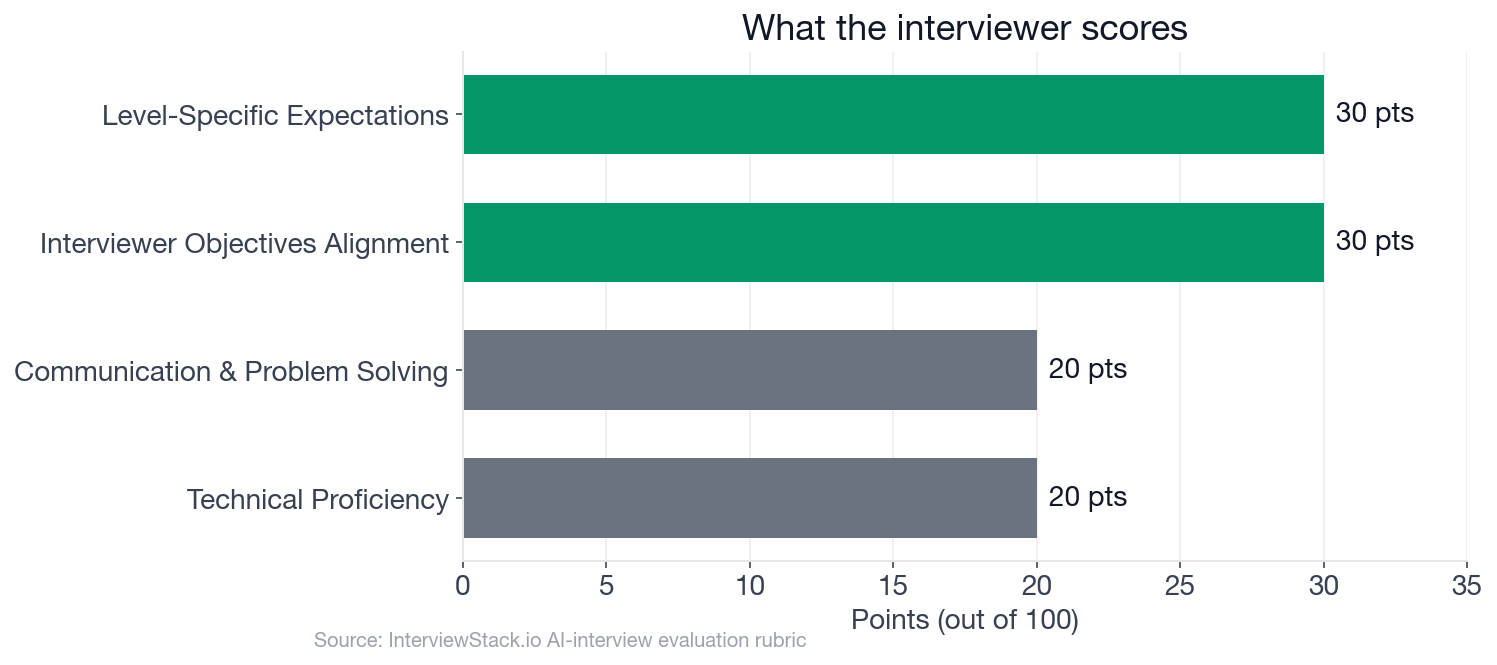
The chart shows where the 100 points sit. Notice that two dimensions worth 30 each are about judgment and seniority, which is why a framework recital scores worse than a narrower answer with real trade-offs.
What Is the Interviewer Really Grading in a Technical Product Manager Competitive Analysis Interview?
Here is the scenario, as the AI interviewer presents it.
The interview question
You are the TPM for a cloud-based feature flagging and experimentation platform used by product and engineering teams. It serves mid-market B2B SaaS companies and is trying to expand upmarket into enterprise accounts.
Competitor A: strong brand, broad experimentation suite, trusted by large enterprises, expensive and slower to implement.
Competitor B: developer-first feature flags, loved by startups, fast onboarding, weaker analytics and governance.
Competitor C: bundled into a larger observability platform, often wins through platform consolidation and existing procurement relationships.
Your platform: strong SDK performance and reliability, good role-based access control and audit logs, basic experimentation analysis, limited global scale references, a small sales team, and constrained engineering capacity for the next 2 quarters.
How would you position this product to win more enterprise customers over the next year?
The interviewer is probing four things: whether you can structure an ambiguous market problem, compare rivals on customer and technical dimensions, tie positioning to product choices and metrics, and defend a recommendation to engineering, go-to-market, and leadership. Writing code and full market-size modeling are out of scope, so skip them.
The Walkthrough: Four Turns Where Points Disappear
The answers below are dramatized. A common answer from a candidate we will call Dana is shown, not a real transcript.
Turn 1: Narrow the Segment
Interviewer: "Which customer segments within enterprise would you prioritize first, and which would you deliberately not target yet?"
Turn 2: Beyond the Feature Matrix
Interviewer: "How would you compare this product against the three competitors in a way that is useful for product and sales decision-making rather than just a feature matrix?"
Turn 3: One Bet for Two Quarters
Interviewer: "If engineering can only invest in one major area over the next two quarters, would you prioritize analytics depth, enterprise governance, platform integrations, or global scale work, and why?"
Turn 4: Metrics That Prove It
Interviewer: "What metrics would you use to determine whether this strategy is working, both leading indicators and business outcomes?"
Why Isn't Reading This Enough?
Spotting these four mistakes on a page is easy because the follow-up is written out for you. Live, you get one unscripted question at a time, a clock, and a pull toward saying everything you know. Avoiding the generic answer under that pressure is the actual skill, and it only comes from repetitions with someone pushing back. Try this scenario cold once and you will find a mistake you did not see here.
What Does a Strong 30-Minute Run Look Like?
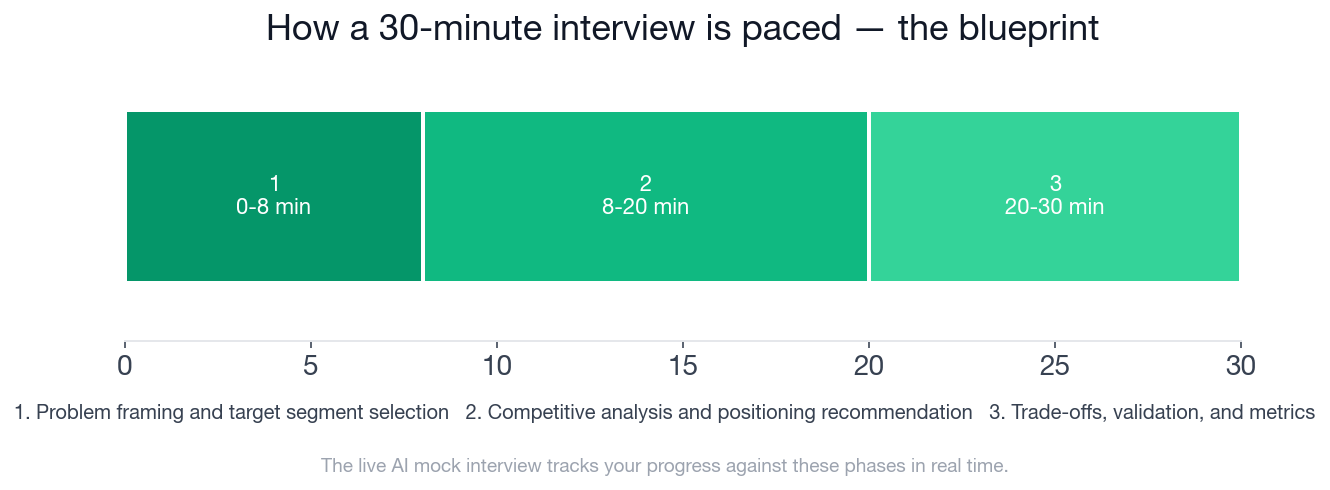
This is the blueprint a strong candidate hits, and exactly what the AI mock interview tracks you against in real time. Each Turn above maps to one of these checklist items: Turn 1 to phase 1, Turn 2 to phase 2, and Turns 3 and 4 to phase 3.
- ✓Clarifies or states assumptions about which enterprise buyers or use cases matter most
- ✓Avoids treating enterprise as one homogeneous segment
- ✓Identifies current product strengths that are relevant to enterprise adoption
- ✓Acknowledges constraints such as limited sales coverage, basic analytics, and limited scale proof points
- ✓Chooses a focused wedge rather than proposing a broad market attack
- ✓Compares named competitors on customer value, technical fit, and buying dynamics instead of only listing features
- ✓Explains where the product should win and where it should avoid direct competition
- ✓Articulates a clear value proposition tailored to a specific enterprise segment or job-to-be-done
- ✓Identifies at least one plausible moat or defensibility mechanism such as integration depth, governance trust, workflow adoption, or operational reliability
- ✓Connects positioning to sales narrative and roadmap implications
- ✓Selects one or two priority investments and justifies what is intentionally deprioritized
- ✓Defines leading indicators such as enterprise pipeline quality, POC conversion, win-loss reasons, or deployment time
- ✓Defines outcome metrics such as enterprise ARR, expansion, retention, or competitive win rate
- ✓Suggests a lightweight validation plan through customer interviews, sales testing, packaging experiments, or pilot launches
- ✓Shows awareness of failure modes such as overreaching into segments the product cannot yet credibly serve
Run It Live Before It Counts
Start the AI mock interview for this exact scenario and get 30 minutes of unscripted follow-ups, tracked against the blueprint above. When you want more reps on neighboring ideas, work through the Competitive Analysis and Positioning question bank, read the Technical Product Manager preparation guides, or see who is hiring on the Technical Product Manager job board.
FAQ
What does a Technical Product Manager competitive analysis interview test?
It tests whether you can pick a specific customer segment, compare named rivals on customer value, technical fit, and buying dynamics, and commit to a defensible position. Interviewers also check that your positioning connects to roadmap choices and measurable metrics, all under stated constraints.
How is a 30-minute competitive positioning interview structured?
A strong run has three phases: problem framing and segment selection (minutes 0-8), competitive analysis and positioning (8-20), then trade-offs, validation, and metrics (20-30). Each phase has five checklist items the interviewer listens for.
Is a feature comparison matrix enough for a competitive analysis answer?
No. A matrix lists what exists but does not say where to win. The stronger answer compares rivals on customer value, technical fit, and buying dynamics, then names where to compete and where to avoid competing.
How should a mid-level TPM handle limited engineering capacity in this answer?
State the constraint early, pick one or two investments, and say what you are deliberately deprioritizing. Mid-level candidates are expected to make reasonable one-year trade-offs, not redesign the whole business.
Which metrics should a positioning strategy include?
Pair leading indicators such as enterprise pipeline quality, proof-of-concept conversion, win-loss reasons, and deployment time with outcome metrics such as enterprise ARR, expansion, retention, and competitive win rate.
How do I respond when a competitor bundles aggressively?
Do not chase their price. Retreat to the segment where your reliability, governance trust, or integration depth matters more than consolidation savings, and sharpen the story for that buyer.
Can I practice this exact scenario live?
Yes. The AI mock interview runs this competitive positioning scenario for a mid-level Technical Product Manager, asks unscripted follow-ups, and tracks you against the same three-phase blueprint.
One Wedge, One Bet, One Metric
Strong positioning answers are small on purpose: a focused segment, a clear place to win, a single investment, and a number that tells you early whether it is working. Practice saying that out loud, and the 100 points start to look reachable.
Topics
Ready to practice?
Put what you've learned into practice with AI mock interviews and structured preparation guides.