
The Technical Product Manager Motivation Interview Tests a Boundary, Not a Preference
Picture a mid-level Technical Product Manager (TPM) interview, 30 minutes, one question: why this role, and why not engineering or a general product management job instead. Almost every candidate can answer with enthusiasm. Almost none can prove it. The interviewer isn't checking whether you like the intersection of tech and business, they're checking whether you already operate at the exact boundary a TPM lives on: close enough to engineering to influence architecture and API decisions, far enough from it to never own the implementation.
This walkthrough follows one candidate through a realistic version of that interview, scored against InterviewStack.io's production AI-interview rubric for this role and topic. The scenario, mistakes, and coaching below mirror how the Technical Product Manager motivation mock interview actually runs.
Key Findings
- The rubric weighs 100 points across 4 dimensions: 30 for Interviewer Objectives Alignment, 30 for Level-Specific Expectations, 20 for Technical Proficiency, 20 for Communication and Problem Solving.
- The interview runs 30 minutes across 3 phases; the 10-minute middle phase (minutes 8-18) carries 5 of the 13 total checklist items, more than either other phase.
- Phase 1 (minutes 0-8) holds 4 checklist items, all scored before the candidate tells a single anecdote.
- Phase 3 (minutes 18-30) tests self-awareness and forward-looking fit across 4 checklist items in the interview's final 12 minutes.
- 4 topic areas are explicitly out of scope (live coding, staff-plus system design depth, machine learning theory, financial modeling), so the bar is judgment about role boundaries, not technical trivia.
- 6 follow-up prompts probe the same underlying question from different angles: is this candidate playing TPM, or defaulting to engineer or generic-PM instincts?
- Candidates are expected to ground every claim in 2 to 5 years of real experience, not abstract aspiration, per the rubric's Level-Specific Expectations.
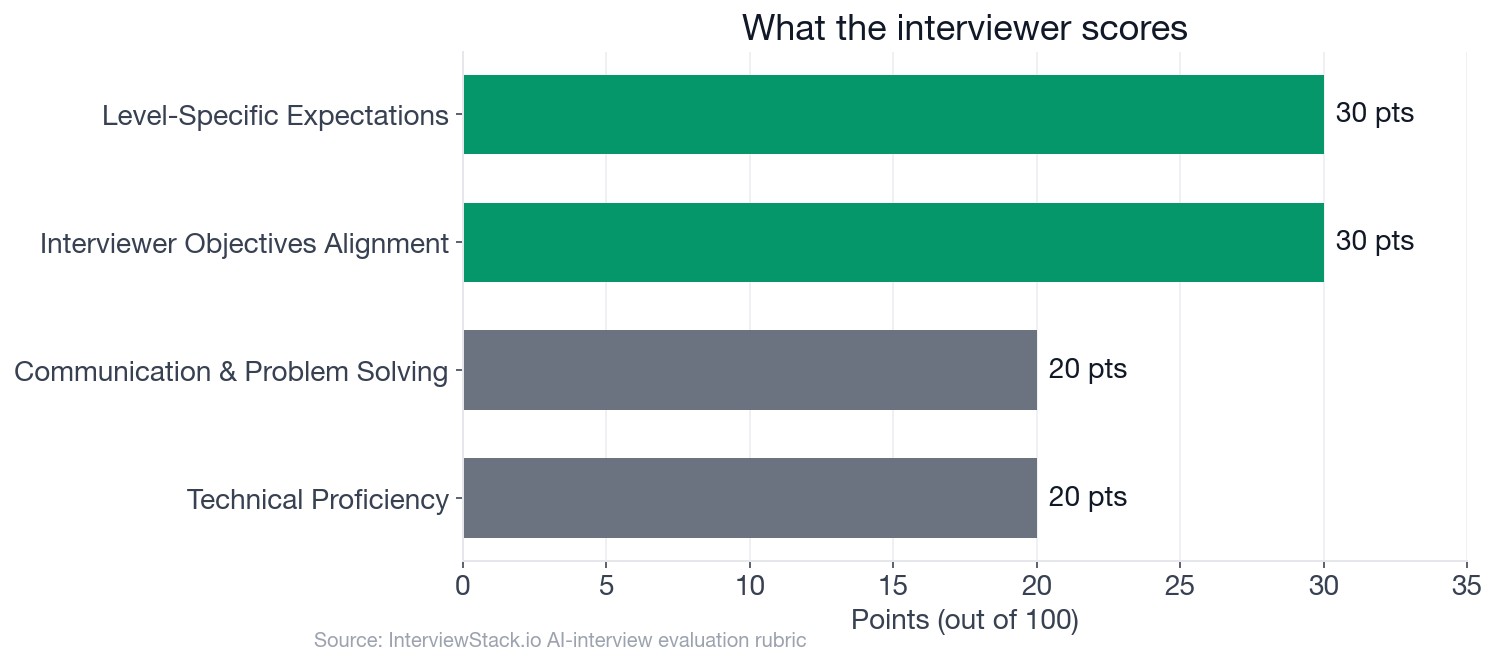 Interviewer Objectives Alignment and Level-Specific Expectations together hold 60 of the 100 points, and both hinge on whether the candidate's motivation survives contact with a specific, provable example.
Meet the Question
The interview question
You're interviewing for a mid-level Technical Product Manager role on a platform team at a leading tech company that builds internal developer tools and APIs used by multiple product engineering teams.
Why do you want this role, and what makes Technical Product Management the right path for you instead of engineering or a more general product management role?
The interviewer isn't grading a rehearsed values statement here. They're evaluating whether the candidate's motivation is specific and role-appropriate: excitement for platform and API work in particular, not technology in general, backed by real experience partnering with engineers, and self-aware about where TPM influence ends and engineering ownership begins.
Watching Riley Answer, Turn by Turn
The candidate in this walkthrough, we'll call her Riley, opens reasonably well. She says she wants to work at the intersection of product and technology and mentions she likes developer-facing products. It's a fine start, and it's also exactly where most candidates stop. The follow-ups are where the interview actually separates a provable answer from a pleasant one.
Turn 1: The Invisible Impact Test
Interviewer: "When you think about internal platforms or developer-facing products, what do you find genuinely motivating about them, given that their impact can be less visible than consumer features?"
Turn 2: Prove the TPM Instinct
Interviewer: "Tell me about a recent experience that convinced you you're strongest in a Technical Product Manager role rather than as an engineer or a non-technical PM."
Turn 3: Translate the Investment
Interviewer: "Describe a situation where you had to translate a technical investment or platform capability into business value for non-technical stakeholders."
Turn 4: Add Value, Don't Own It
Interviewer: "If you joined a team responsible for APIs used across several product areas, how would you add value in your first six months without overstepping into engineering execution?"
Reading This Isn't the Hard Part
Every mistake above is obvious once it's printed with the fix sitting right next to it. Under real interview conditions, with the clock running and follow-ups you haven't seen coming, catching yourself mid-sentence before you drift into a generic PM answer or an engineer's architecture pitch is a different skill entirely. That's the skill this interview actually measures, and it's the one that only gets sharper with reps.
The Blueprint This Interview Is Scored Against
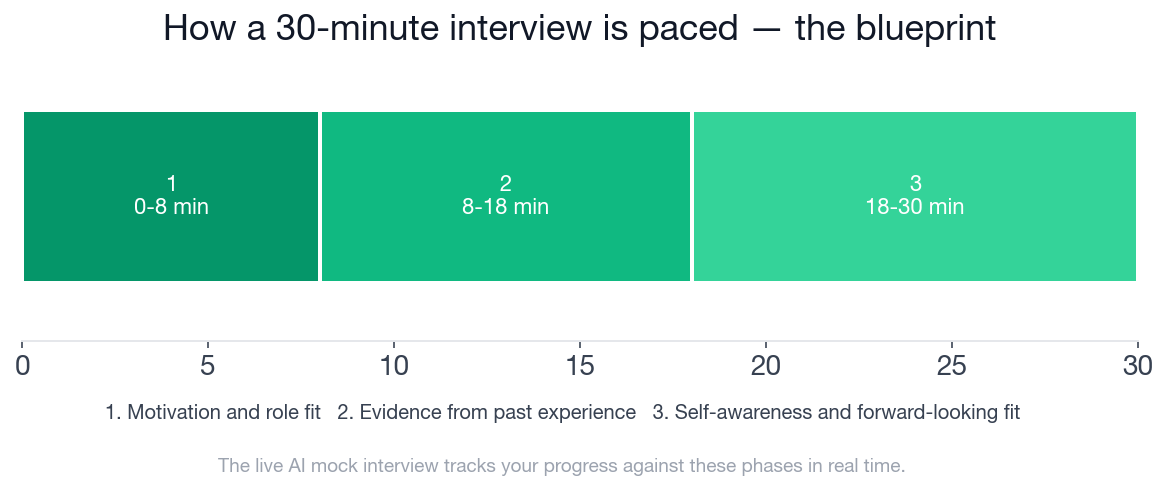
This is the blueprint a strong candidate hits, phase by phase, and it's the exact structure the AI mock interview tracks you against in real time as you talk.
- ✓Gives a direct answer to why this role appeals to them without drifting into a generic autobiography
- ✓Distinguishes TPM from engineering and general PM with concrete responsibilities, not buzzwords
- ✓Connects motivation to technical products such as platforms, APIs, infra-adjacent tooling, or developer workflows
- ✓Shows enthusiasm grounded in real experiences rather than only prestige or broad interest in tech
- ✓Provides at least one specific example involving engineers, technical constraints, or platform-like work
- ✓Clearly states their own role, decisions, and actions rather than only describing team outcomes
- ✓Explains the technical problem at an appropriate level for a TPM, such as architecture implications, API design considerations, system dependencies, reliability, or scalability trade-offs
- ✓Connects technical decisions to measurable user, developer, operational, or business outcomes
- ✓Demonstrates credible ownership appropriate for a mid-level candidate
- ✓Acknowledges at least one real challenge of TPM work, such as indirect impact, balancing platform versus feature priorities, or navigating technical depth gaps
- ✓Articulates how they would contribute in the first six months through discovery, stakeholder mapping, technical learning, and prioritization
- ✓Shows appropriate boundaries between influencing technical direction and owning implementation details
- ✓Frames their unique value as bridging technical possibilities with product and business needs
Rehearse the Boundary Line
Spotting Riley's mistakes on the page is easy. Catching yourself before you make the same one, live, with a real interviewer waiting on your next sentence, is the actual test. Start the Technical Product Manager motivation mock interview and get scored against this exact blueprint in real time, with feedback on which checklist items you hit and which you conceded.
If you want to sharpen individual anecdotes before the full simulation, the Technical Product Manager motivation question bank breaks the topic into focused practice questions, and the Technical Product Manager preparation guides cover the rest of the interview loop around it.
FAQ
Q. What does a Technical Product Manager motivation interview actually test?
It tests whether a candidate's reason for wanting the TPM role is specific and provable, not whether they can describe liking both technology and business. The rubric rewards candidates who show, with a concrete example, that they already operate at the boundary between influencing technical direction and owning engineering execution, the actual scope of a mid-level TPM.
Q. How is Technical Product Management different from Product Management or engineering in this interview?
Interviewers expect concrete responsibilities, not buzzwords: a TPM partners closely with engineers on architecture and API tradeoffs, translates those tradeoffs into roadmap and business decisions, but does not write the implementation or own it the way an engineer does, and goes deeper on technical detail than a general PM typically needs to.
Q. What is the format of this Technical Product Manager mock interview?
It runs 30 minutes across three phases: motivation and role fit (minutes 0-8), evidence from past experience (minutes 8-18), and self-awareness and forward-looking fit (minutes 18-30). It targets a mid-level (2-5 years) candidate on a platform or API team.
Q. What should a mid-level candidate say when asked what's hardest about this role?
Name one real, specific challenge, such as the indirect and less visible impact of platform work, or balancing platform investment against feature requests, then pair it with a credible plan for the first six months. Brushing off the question with generic optimism costs points under Level-Specific Expectations.
Q. Why do interviewers penalize candidates who say they'd start making architecture decisions themselves?
Because it overshoots mid-level TPM scope. The rubric expects a candidate to drive a problem area, align stakeholders, and influence technical direction with guidance from engineering leads, not to independently own implementation decisions the way an engineer or an architect would.
Q. Is this a real company's interview question?
No. The scenario, a platform team building internal developer tools and APIs at a leading tech company, is illustrative of how a mid-level Technical Product Manager motivation interview typically runs, not a leaked question from any specific employer.
Q. How should I practice for a Technical Product Manager motivation interview?
Write down two or three specific anecdotes involving engineers, technical tradeoffs, or platform work, then rehearse delivering them out loud under time pressure with unscripted follow-up questions, since that live pressure, not the anecdote itself, is where most candidates lose points.
The Boundary Is the Job
Wanting the role was never the hard part. Proving, with a specific example, that you already work the way a TPM works: close enough to engineering to shape the call, disciplined enough not to own it, is what the score actually measures. That boundary is the job, and it's worth rehearsing before it's live.
Topics
Ready to practice?
Put what you've learned into practice with AI mock interviews and structured preparation guides.