
The Agile Resume Line Won't Move Your Offer
Most Technical Product Manager job descriptions read like a checklist: Product Strategy, Roadmapping, Agile, Scrum, Jira, Stakeholder Management. It looks like a role with a well-defined skill set. The salary data tells a different story.
Across 997 active Technical Product Manager postings on the InterviewStack.io job board as of June 2026, Agile appears in nearly 1 in 3 postings. Scrum shows up in roughly 1 in 8. Project Management in 1 in 10. All three pay below the $148,000 US median base salary. The gap between the lowest-paying documented skills (Project Management at $137,000, Scrum at $137,700) and the highest (Program Management at $187,500, Machine Learning at $182,500) is nearly $50,000.
What you put on a TPM resume signals something specific about the kind of role you are targeting. Process-heavy listings attract execution-focused, lower-budget roles. Technical and strategic listings attract the ones near the top of the pay scale.
Key Findings
- 997 active Technical Product Manager postings analyzed on the InterviewStack.io job board as of June 2026; no individual skill exceeds 50%, making this one of the most fragmented role definitions in tech hiring.
- Median US base salary is $148,000 (n=293 postings with disclosed salary). Equity and bonuses are excluded from all figures.
- Agile ($140,000 US), Scrum ($137,700), and Project Management ($137,000) all sit below the $148,000 baseline, the lowest-paying tier of documented TPM skills.
- Program Management leads pay at $187,500 (+$39,500 above baseline), followed by Machine Learning ($182,500), Go-to-Market ($175,000), and Prioritization ($171,500).
- APIs appear in 1 in 4 postings (245 of 997) and pay a $170,000 US median, the clearest signal of where "technical" in the title translates directly into comp.
- Only 4% of postings are explicitly entry-level (39 of 997). Mid-level makes up 58%, senior 26%, staff 12%.
- 17.4% of postings explicitly require an ML or AI skill, but AI tool adoption in product management has outpaced what job descriptions capture, a baseline expectation that applies regardless of what the job description says.
- 47% of postings are onsite, 33% hybrid, 29% remote (some postings carry multiple work-mode tags), less remote-friendly than the PM category's reputation implies.
What Does the Salary Table Say About the "Technical" in TPM?
The salary figures below are US-only base salary from postings with structured salary data (n=293 postings). Equity, RSUs, bonuses, and sign-on are not captured in job postings and not in this data. Total compensation at top tech employers is meaningfully higher, especially in AI infrastructure, aerospace, and finance.
The overall US median is $148,000. What lands above or below it reveals what companies are actually paying for when they write "technical" into the title.
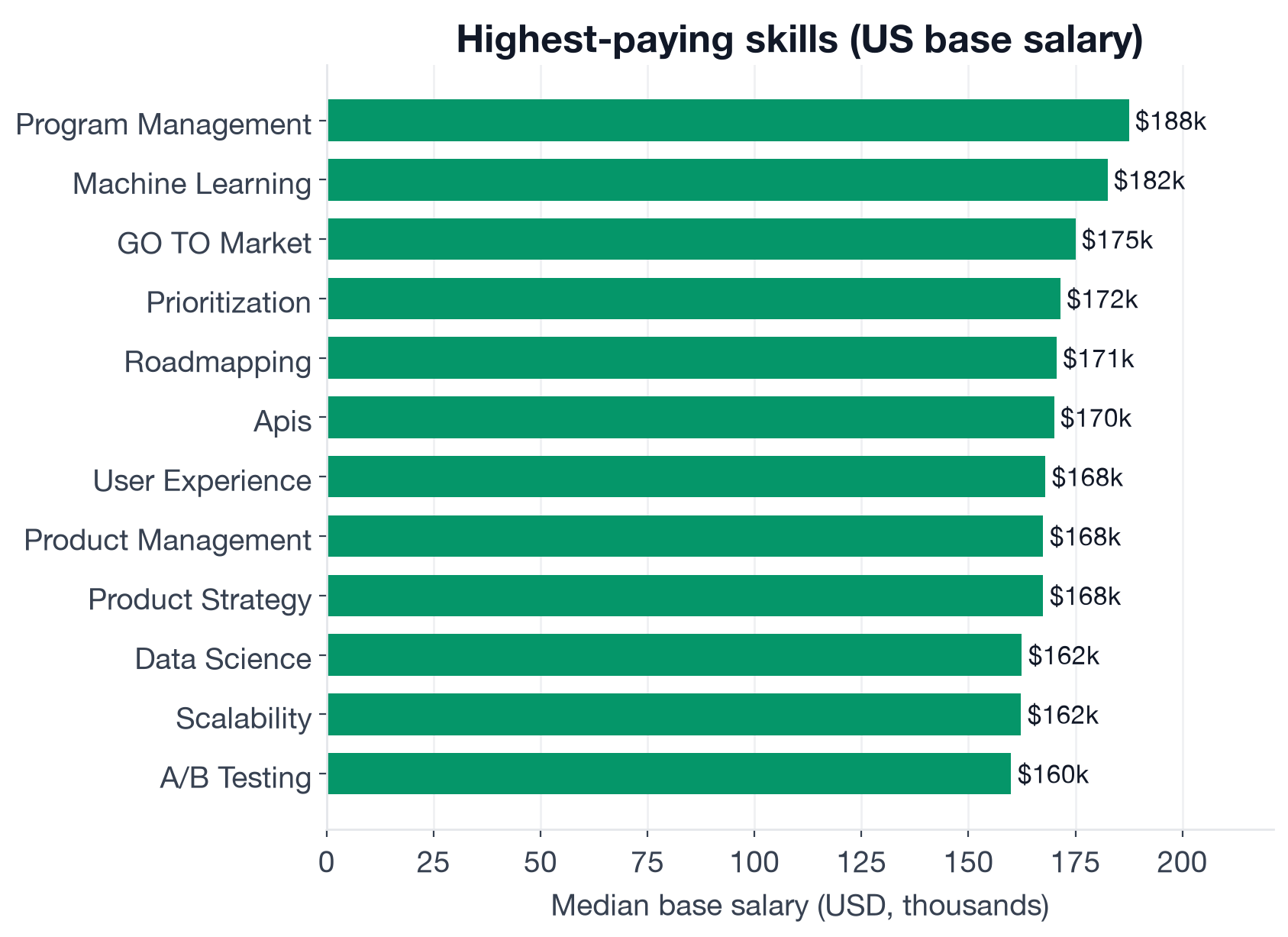
Median US base salary for Technical Product Manager postings that mention each skill. Base salary only, US postings with disclosed compensation data.
Skills commanding significant premiums above the $148,000 baseline:
| Skill | US Median | Premium | Sample |
|---|---|---|---|
| Program Management | $187,500 | +$39,500 | n=26 |
| Machine Learning | $182,500 | +$34,500 | n=29 |
| Go-to-Market | $175,000 | +$27,000 | n=33 |
| Prioritization | $171,500 | +$23,500 | n=44 |
| Roadmapping | $170,600 | +$22,600 | n=145 |
| APIs | $170,000 | +$22,000 | n=65 |
| User Experience | $168,000 | +$20,000 | n=43 |
| Product Management | $167,500 | +$19,500 | n=153 |
| Product Strategy | $167,500 | +$19,500 | n=159 |
| Data Science | $162,500 | +$14,500 | n=32 |
| Scalability | $162,300 | +$14,300 | n=34 |
| A/B Testing | $160,000 | +$12,000 | n=30 |
| SQL | $155,000 | +$7,000 | n=36 |
Skills below the baseline:
| Skill | US Median | vs. Baseline | Sample |
|---|---|---|---|
| Agile | $140,000 | -$8,000 | n=79 |
| Scrum | $137,700 | -$10,300 | n=35 |
| Project Management | $137,000 | -$11,000 | n=30 |
The $50,000 spread from top to bottom is not random noise. It reflects two structurally different hiring profiles wearing the same job title. Postings that lead with Agile, Scrum, and Project Management are typically coordinating existing products in enterprise or operations contexts. Postings that lead with ML, Program Management, APIs, or Go-to-Market are typically building new technical products or scaling platforms from the ground up. The second profile pays more because the scope, accountability, and technical bar are higher.
Program Management at $187,500 is worth separating from Product Management explicitly. Program Management (coordinating multiple interdependent technical projects, common in aerospace, defense, and large platform builds) is a distinct discipline from product ownership, and it commands the dataset's highest pay. If your experience includes cross-program coordination at scale, that framing is worth surfacing on your resume. Browse Technical Product Manager openings that emphasize Machine Learning to see what the AI-product tier of the market looks like in practice.
What Skill Families Define the TPM Role?
Group individual skills into families and the role's actual shape becomes legible. Technical Product Manager sits at the intersection of product practice, process methodology, and technical awareness rather than deep inside any one domain.
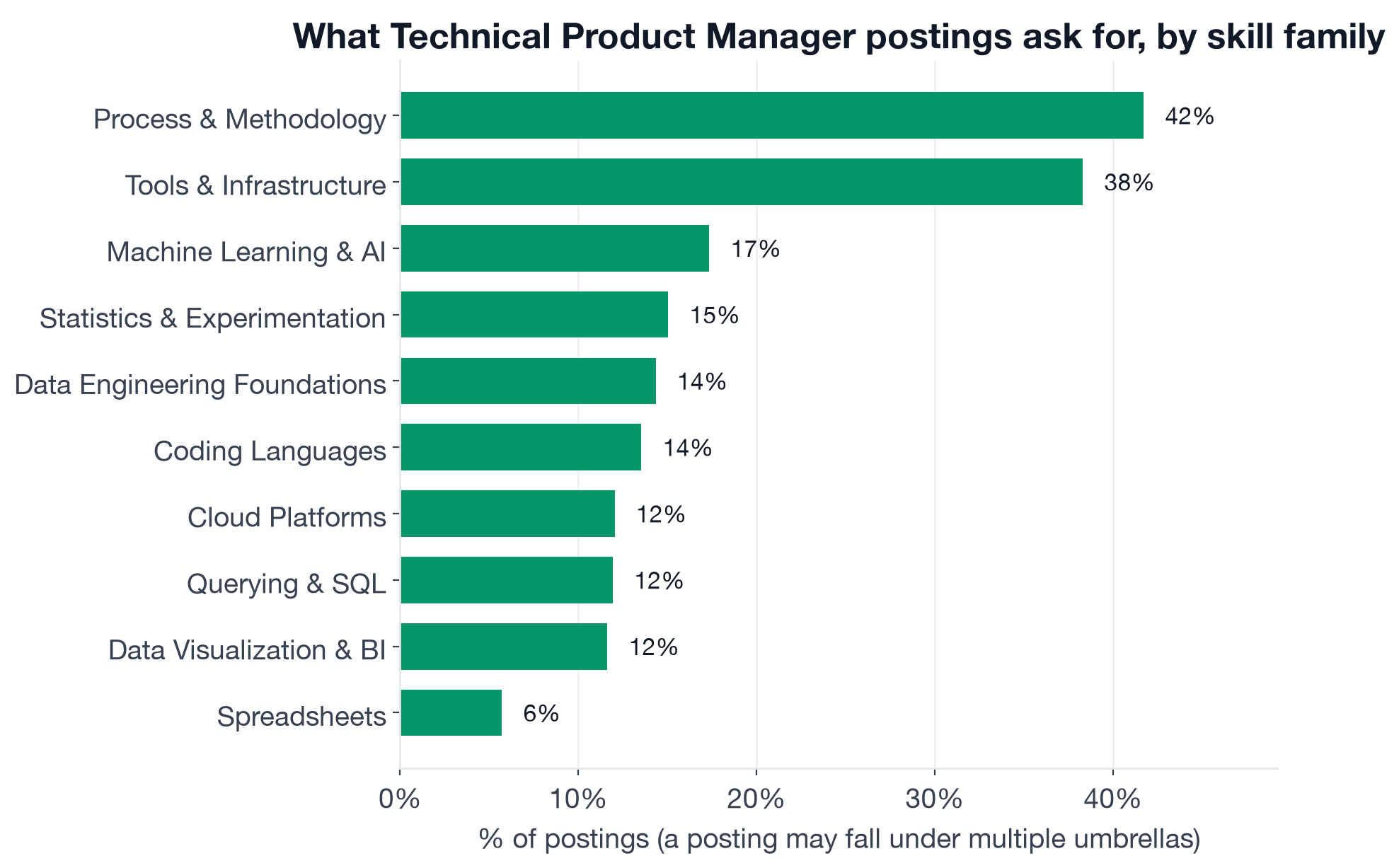
Share of Technical Product Manager postings asking for at least one skill in each family. A posting mentioning both AWS and Azure counts once under Cloud Platforms.
The breakdown:
- Process & Methodology: 42% (Agile, Scrum, Stakeholder Management, Project Management)
- Tools & Infrastructure: 38% (Automation, Jira, Monitoring, Confluence)
- Machine Learning & AI: 17% (Machine Learning, Generative AI, LLMs)
- Statistics & Experimentation: 15% (primarily A/B Testing)
- Coding Languages: 14% (mostly Python)
- Cloud Platforms: 12% (AWS, Azure, Google Cloud)
- Querying & SQL: 12% (SQL)
No single family dominates. Process & Methodology at 42% is the largest, but process fluency alone doesn't make the role. Most postings pull from at least two other families on top of it. Companies want someone who can navigate technical conversations (APIs, cloud, ML), build and execute a roadmap, and coordinate across multiple teams simultaneously. That is three distinct disciplines compressed into one title, which explains both the breadth of the differentiator tier and the role's salary variance.
The Machine Learning & AI family at 17% deserves careful reading. These postings hire TPMs to own AI product development: defining requirements for ML features, managing LLM-powered roadmaps, writing PRDs for AI systems. That is a specific mandate, not ambient tool use. The 17.4% figure is a hard floor, not a ceiling (see the AI skills section in the FAQ for the full picture).
Which Skills Are Common vs. Which Differentiate You?
With no skill exceeding 50%, the standard "table stakes" tier is empty for this role. Skills break into two tiers:
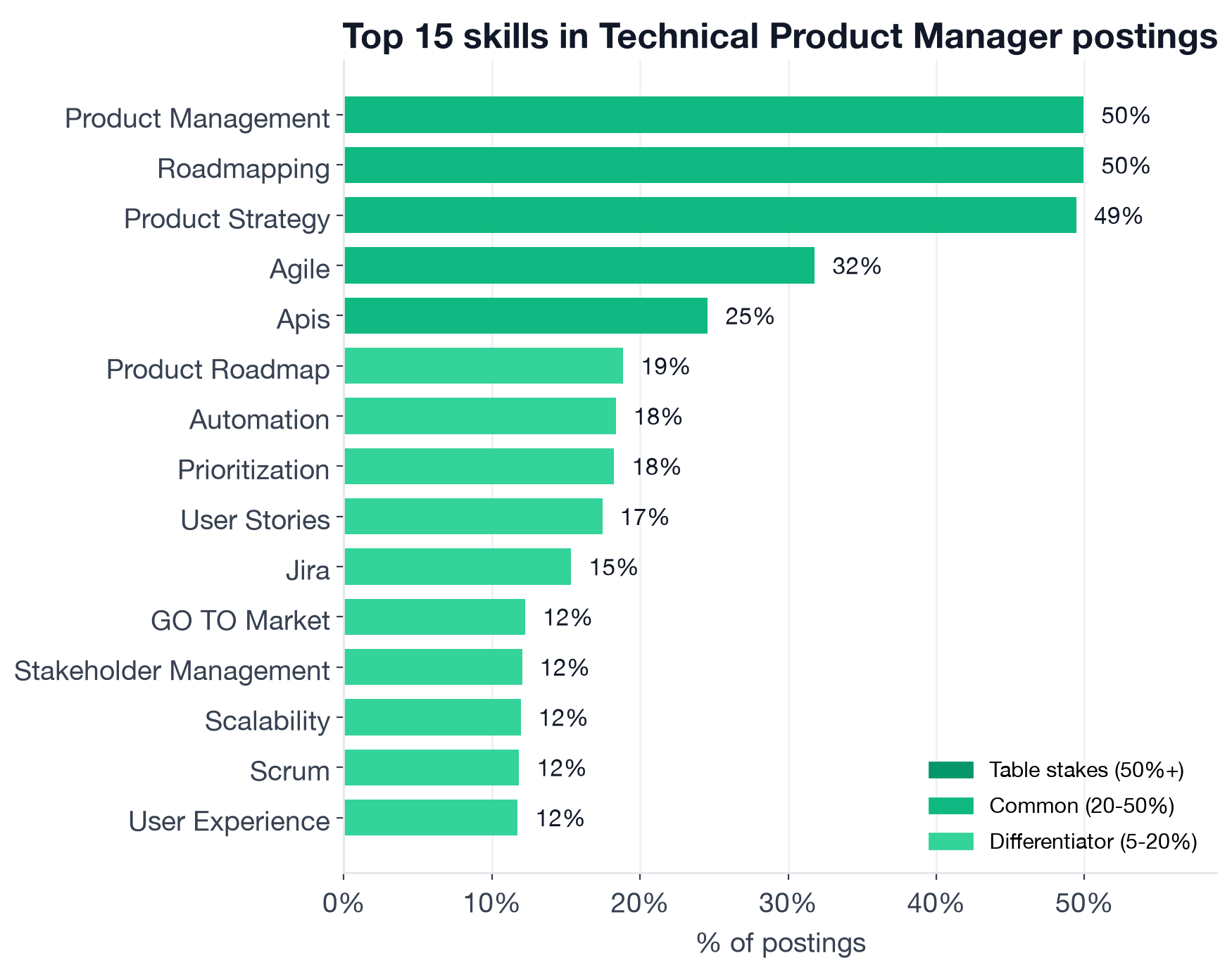
Top individual skills in Technical Product Manager postings by share of listings that mention them. Skills in the 20-50% range are common expectations; 5-20% are differentiators.
Common expectations (20-50% of postings): Five skills cluster here. Product Management (50%), Roadmapping (50%), and Product Strategy (49%) appear in roughly half of all postings. Agile (32%) and APIs (25%) round out the tier. The APIs entry is worth pausing on: 1 in 4 postings explicitly names API knowledge, and postings that require APIs pay a $170,000 US median, second only to Roadmapping ($170,600) at the top of the common tier. That is the clearest sign of where the "technical" ceiling starts.
Differentiators (5-20% of postings): This tier is unusually large: 39 skills fall in the 5-20% range. A representative selection: Product Roadmap (19%), Automation (18%), Prioritization (18%), User Stories (17%), Jira (15%), Go-to-Market (12%), Stakeholder Management (12%), Scalability (12%), Scrum (12%), SQL (11%), A/B Testing (11%), Data Visualization (10%), Monitoring (9%), AWS (9%), Python (8%), Machine Learning (7%), Generative AI (6%).
The ML/AI cluster (ML 7%, Generative AI 6%, LLMs 5%) lives at the lower end of the differentiator tier by frequency, but sits at the top of the salary table by compensation. Frequency and pay tell two very different stories for this role: a skill that appears in 7% of postings can command a $34,500 salary premium, while a skill that appears in 32% can sit $8,000 below baseline. Targeting the small AI-product tier means competing for fewer roles at meaningfully higher pay.
How Do TPM Skills Cluster Together?
High-lift skill pairs reveal two distinct hiring profiles beneath the TPM label:
| Skill pair | Co-occurrence | Lift |
|---|---|---|
| Agile + Scrum | 11% of postings | 3.04 |
| Agile + User Stories | 14% of postings | 2.46 |
| Agile + Jira | 11% of postings | 2.28 |
| Go-to-Market + Roadmapping | 9% of postings | 1.51 |
| APIs + Roadmapping | 18% of postings | 1.44 |
| Product Management + Product Roadmap | 14% of postings | 1.46 |
Lift above 1 means the pair appears together more often than their individual frequencies would predict. The Agile-Scrum pair at 3.04 is the highest in the dataset: when a posting names Agile, it is three times more likely than chance to also require Scrum. Together with User Stories (2.46x) and Jira (2.28x), these form a recognizable process cluster that maps to enterprise product ownership, coordination-heavy roles, and operational PM work. As the salary table shows, that cluster pays below the median.
The contrasting clusters: Go-to-Market with Roadmapping (1.51x) and APIs with Roadmapping (1.44x) signal more strategic or technical postings. GTM-plus-roadmapping is a commercial product signal (closer to the revenue side); APIs-plus-roadmapping is a platform or integration signal (closer to the engineering side). Both clusters pay above baseline. Identifying which cluster your target postings belong to is a more reliable targeting signal than trying to match every skill in the job description.
Who Gets In, and at What Level?
Technical Product Manager is not a beginner-friendly role. Only 1 in 25 postings is explicitly entry-level.
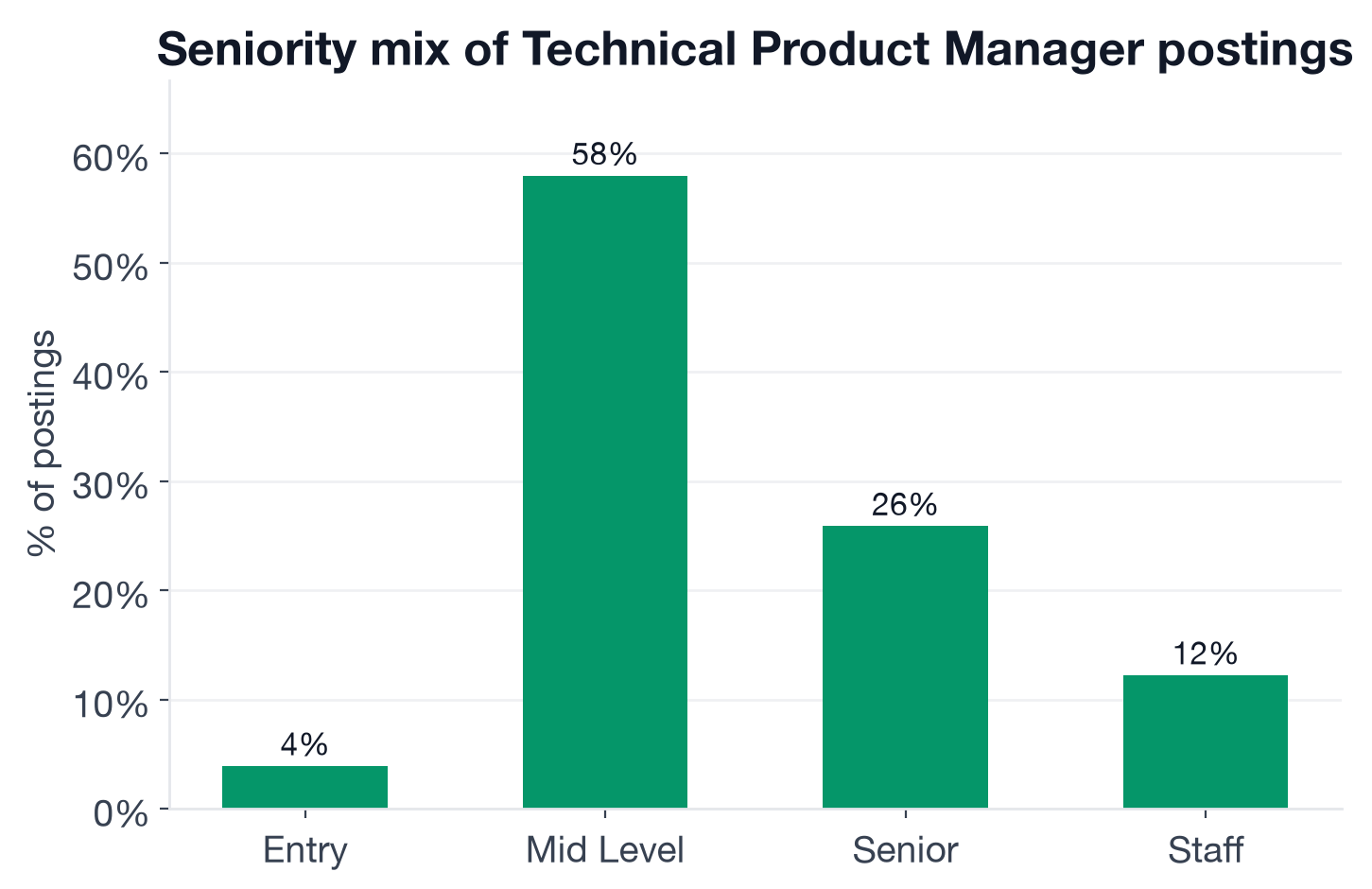
Seniority distribution of Technical Product Manager postings. Entry-level includes intern, junior, and explicitly entry-tagged titles.
- Mid-level: 58% (578 postings)
- Senior: 26% (258 postings): browse senior Technical Product Manager openings
- Staff / Principal: 12% (122 postings)
- Entry-level: 4% (39 postings)
Companies consistently assume production experience when hiring for this role: shipping technical products, navigating engineering tradeoffs, driving alignment across multiple stakeholder functions. Without those reps, the filtering happens at the screen stage, before any conversation.
The staff tier at 12% is substantial. TPM is a real IC career path with demand for principal and staff-level PMs who set technical direction across a platform. The differentiator skills (ML, Program Management, APIs) signal which direction that IC path skews: toward AI product leadership, platform ownership, or cross-program coordination.
Where Are TPM Jobs, and How Remote-Friendly Are They?
The United States dominates at 51% of postings, a larger home-market share than most tech roles. Senior and staff roles concentrate where product headquarters are, and the US is still where most TPM leadership sits.
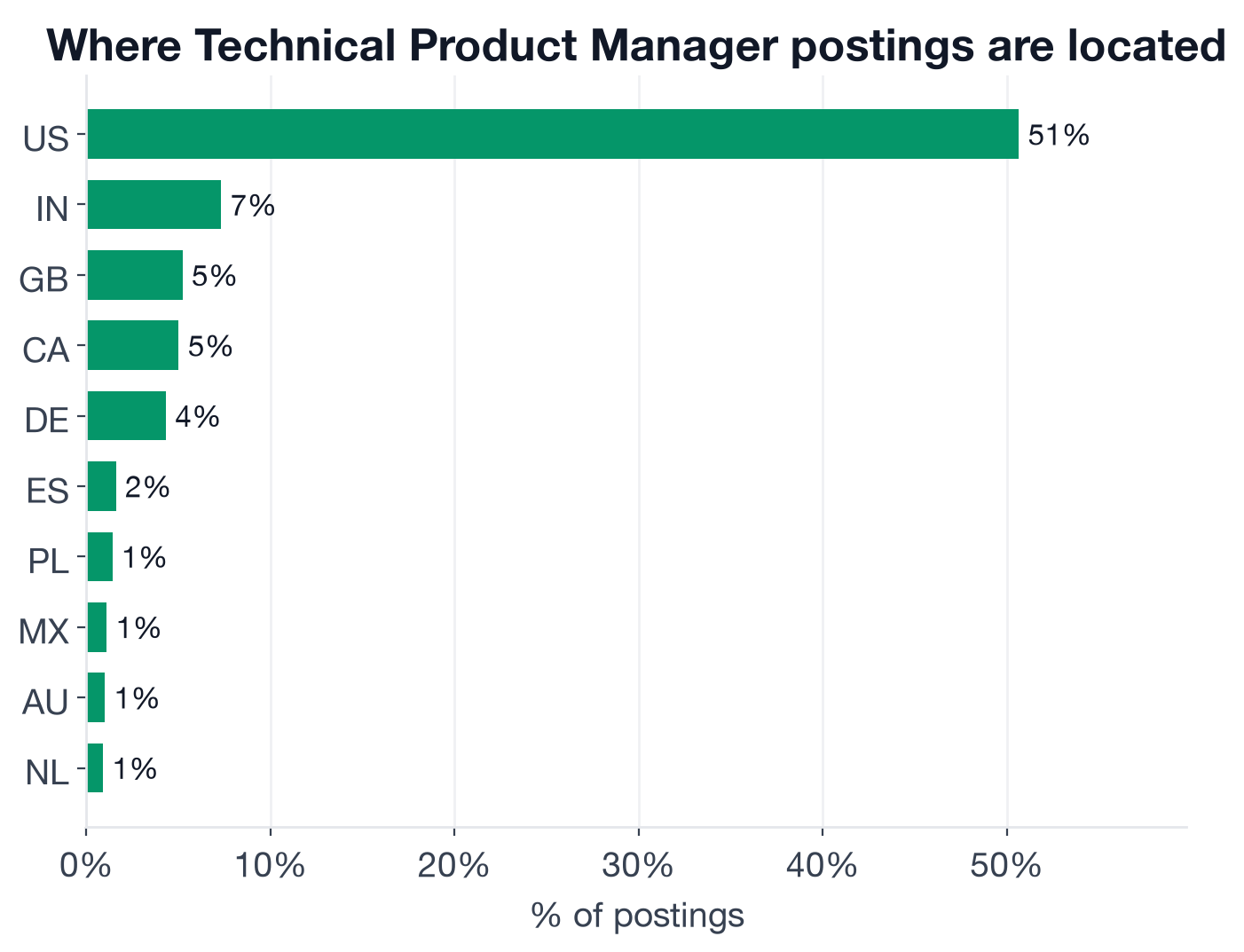
Top countries by share of Technical Product Manager postings.
India at 7% is notably lower than its share in engineering roles like Data Engineer (23%), which reflects where TPM work sits on the org chart: closer to product leadership and technical strategy than to execution centers. The UK (5%), Canada (5%), and Germany (4%) round out the next tier.
On work mode, the role is less remote-friendly than the PM category's reputation suggests:
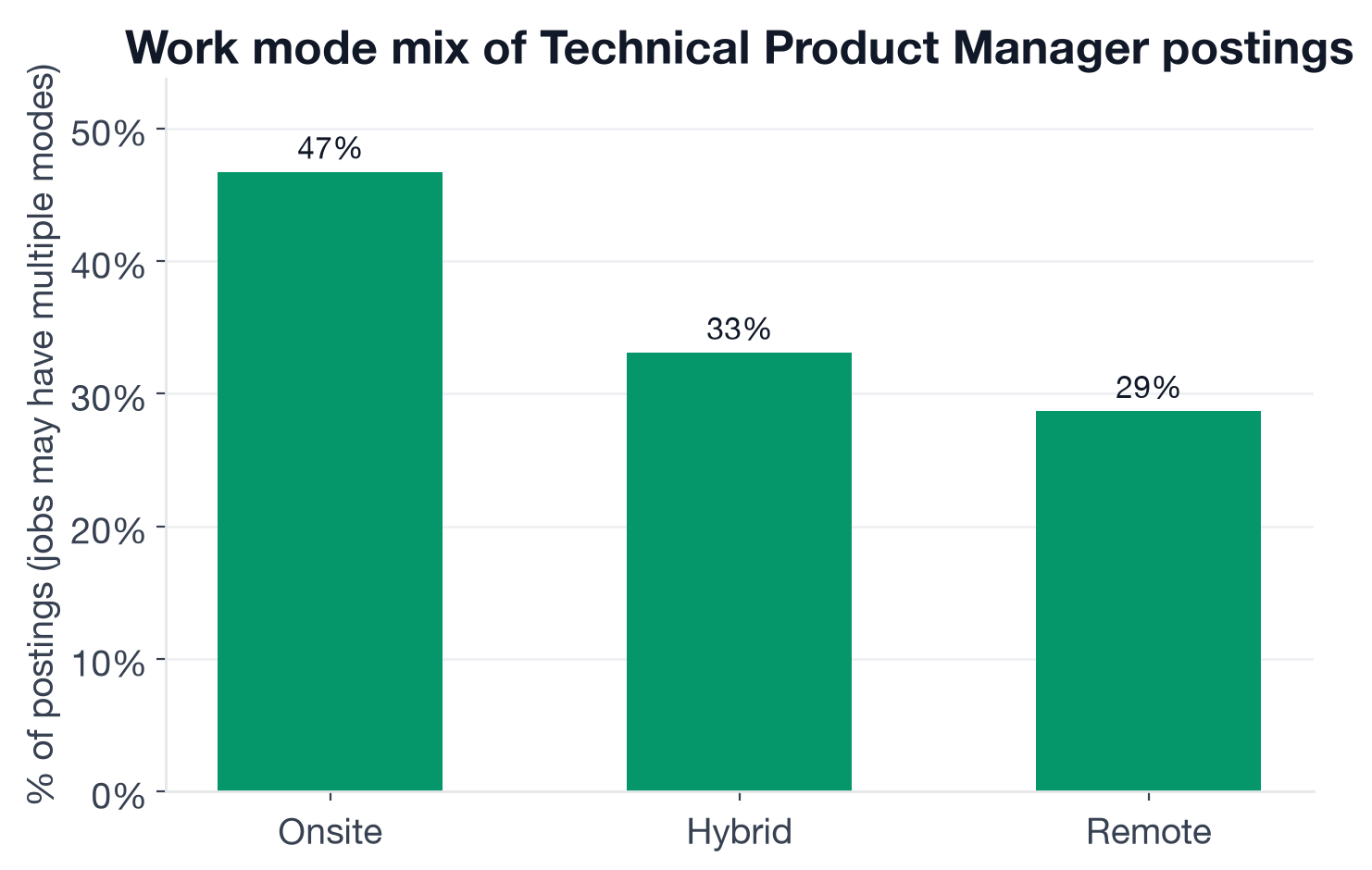
Work mode for Technical Product Manager postings. Some postings carry multiple tags, so percentages can sum above 100%.
- Onsite: 47% (466 postings)
- Hybrid: 33% (330 postings)
- Remote: 29% (286 postings): browse fully-remote Technical Product Manager openings
Fully remote TPM roles exist at 29%, but they are not the norm. The collaborative demand of the role (aligning engineering, design, business, and data teams in real time) still drives a preference for onsite or hybrid access at most companies.
Who's Hiring Technical Product Managers in 2026?
The employer mix is one of the more sector-diverse in our dataset. The TPM title spans aerospace, healthcare, energy, gaming, AI, crypto, and media, not just consumer-product tech. One dataset-breadth note: Gensler, a global architecture and design firm, appeared first in the raw employer data with 47 postings: those are Technical Designer openings in architecture, not software product management, and are excluded from the table below. The title sample confirms a small portion of the dataset (roughly 5%) reflects similar non-software Technical Designer contamination, consistent with the architecture industry bucket (52 postings, 5.2% of the dataset); it does not materially affect the skill or salary figures, which key on product-management vocabulary.
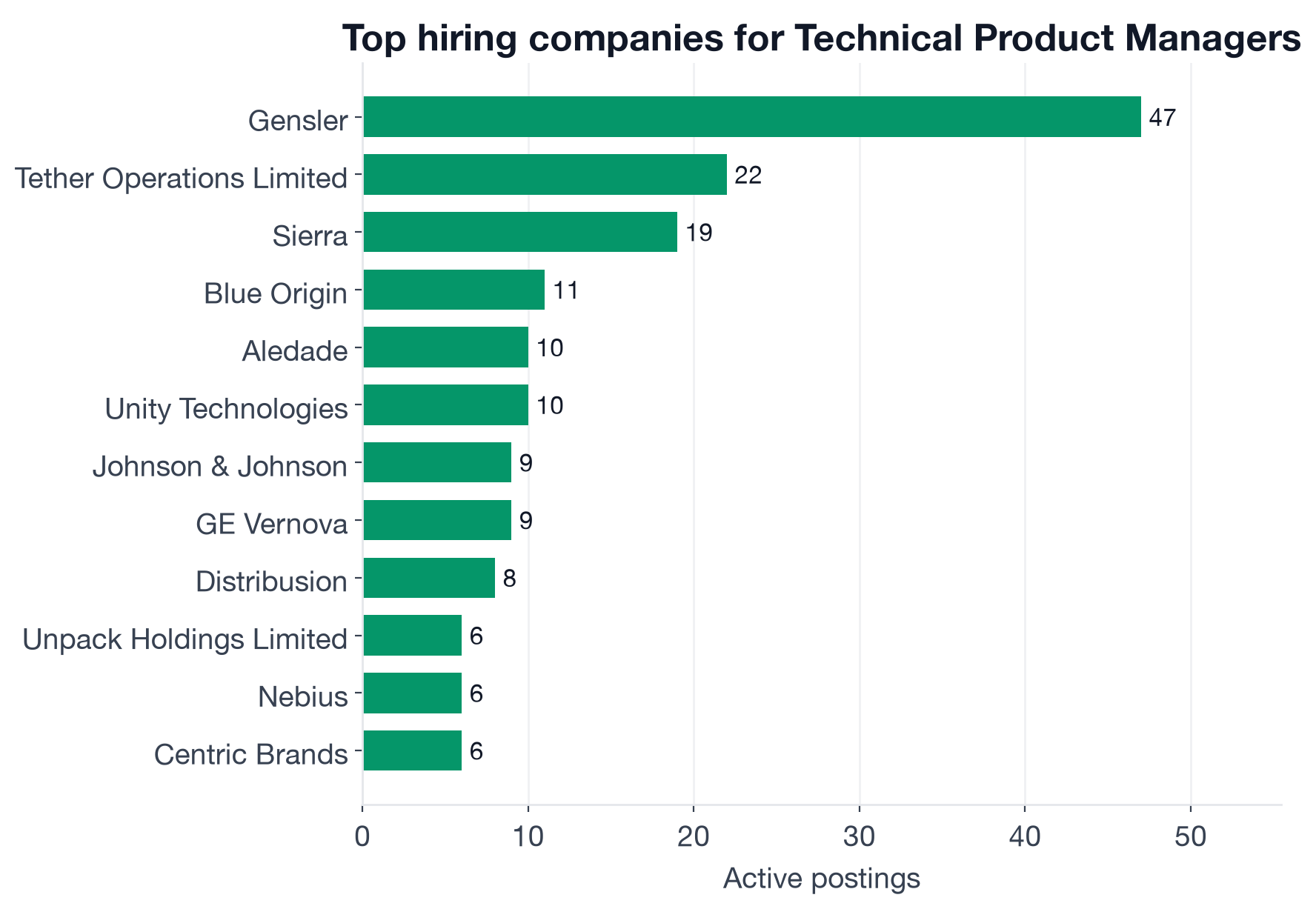
Top companies by distinct active Technical Product Manager postings (Gensler excluded; see dataset note above).
- Tether Operations Limited: 22 (stablecoin and crypto infrastructure)
- Sierra: 19 (AI-powered customer service agents)
- Blue Origin: 11 (aerospace and orbital launch)
- Aledade: 10 (value-based care, healthcare)
- Unity Technologies: 10 (real-time 3D platform and gaming)
- Johnson & Johnson: 9 (pharmaceuticals and medtech)
- GE Vernova: 9 (energy technology)
- Distribusion: 8 (ground transportation platform)
- Nebius: 6 (AI compute infrastructure)
- Databricks: 6 (data and AI platform)
- Roche: 6 (pharma and diagnostics)
- NVIDIA Corporation: 5 (AI/compute infrastructure)
- The New York Times: 5 (digital media and subscriptions)
The sector spread makes a practical point: a meaningful share of TPM demand sits outside consumer tech. Aerospace, pharma, energy, and medtech hire PMs who can navigate complex technical domains with long regulatory and integration timelines, which is why Program Management and stakeholder coordination score so high in salary there. If your background involves hardware, clinical systems, industrial infrastructure, or regulated environments, those sectors are actively hiring for it. Our interview prep guides cover company-specific hiring processes and the topic priorities that vary by sector.
How Should You Use This in Your TPM Job Search?
1. Let the salary table guide your positioning. Agile, Scrum, and Project Management belong on the resume for operational roles; Machine Learning, APIs, Go-to-Market, and Program Management belong on the resume for the roles that pay $20-40K more. They are not mutually exclusive, but leading with process skills anchors your positioning toward the lower-paying segment of the market. If you have technical depth, lead with it.
2. The APIs bar is the clearest screen for the technical tier. APIs appear in 1 in 4 postings and pay a $170,000 US median. Being able to discuss API design, versioning, integration tradeoffs, and data contracts in an interview distinguishes a technical PM from a general PM. Pair it with cloud familiarity and you cover the technical fluency most TPM panels test. The question bank covers API design and system architecture topics used in TPM technical screens.
3. The ML/AI tier has two distinct bars. 17.4% of postings explicitly require ML skills; those roles need someone who understands model development, data requirements, latency constraints, and what goes wrong when an ML system fails in production. But separately, AI tool adoption in product management has moved well ahead of what job descriptions say: most teams now use ChatGPT for PRD drafting, AI for stakeholder synthesis, and LLM-assisted research as standard practice. Regardless of whether your job description mentions AI, expect AI-tool fluency to be assumed on day one. The interactive courses cover both the product strategy fundamentals and the technical grounding (system design, data foundations) that TPM interviews test.
4. Practice the stakeholder and system rounds together. TPM interviews typically combine product sense, technical design, and cross-functional leadership scenarios. AI mock interviews let you simulate full rounds with on-demand feedback on product reasoning and technical judgment specifically. The process cluster (Agile, Scrum) rarely shows up in panels as a tested skill; the technical and strategic clusters (APIs, scalability, ML tradeoffs, GTM) almost always do.
5. Filter for your actual target market. Browse current Technical Product Manager openings and use skill filters to cut through the volume. TPM postings that require Machine Learning reveal the AI-product tier. Postings that require Agile reveal the process-heavy tier. They draw from the same job title but represent meaningfully different roles, team cultures, and pay bands.
FAQ
Q. What skills do companies want for Technical Product Manager roles in 2026?
No single skill is required by a majority of postings. The most common skills sit in the 25-50% range: Product Management (50%), Roadmapping (50%), Product Strategy (49%), Agile (32%), and APIs (25%). The differentiator tier is enormous, spanning SQL, A/B Testing, Machine Learning, Generative AI, Jira, Stakeholder Management, and cloud platforms, among 40 others.
Q. What is the median salary for a Technical Product Manager in 2026?
The median US base salary across 293 Technical Product Manager postings with disclosed salary data is $148,000. That figure is base only: equity, bonuses, and sign-on are not included. Total compensation at top tech employers runs meaningfully higher.
Q. Which Technical Product Manager skills pay the highest premium in 2026?
Among US postings, Program Management leads at $187,500 (a $39,500 premium over the $148,000 baseline), followed by Machine Learning at $182,500 (+$34,500), Go-to-Market at $175,000 (+$27,000), Prioritization at $171,500 (+$23,500), and Roadmapping at $170,600 (+$22,600). APIs ($170,000), User Experience ($168,000), and the core PM skills (Product Management and Product Strategy at $167,500 each) also sit well above baseline.
Q. Do Agile and Scrum skills help Technical Product Managers earn more?
The data suggests the opposite. Agile-listed postings show a US median of $140,000, Scrum-listed postings $137,700, and Project Management-listed postings $137,000, all below the $148,000 baseline. This does not mean Agile skills are unwanted (Agile appears in 32% of postings), but they are associated with more process-focused, lower-budget roles rather than the technical or strategic ones that pay premiums.
Q. How hard is it to break into Technical Product Manager roles in 2026?
Very hard. Only 4% of Technical Product Manager postings are explicitly entry-level (39 of 997). Mid-level dominates at 58%, senior at 26%, staff at 12%. Most postings assume prior experience shipping technical products, typically 3-5 years as a PM or in an adjacent engineering or strategy role.
Q. Where are most Technical Product Manager jobs, and is the role remote-friendly?
The US is the largest market at 51% of postings. Remote is available in 29% of postings, less than the role's reputation suggests. Hybrid accounts for 33% and onsite for 47%.
Q. How important are AI skills for Technical Product Managers in 2026?
Two distinct layers: 17.4% of postings explicitly require an ML or AI skill, covering TPMs hired to define roadmaps for AI products. Separately, AI tool adoption in product management has moved well ahead of what job descriptions capture, with ChatGPT for PRD drafting, AI for stakeholder synthesis, and LLM-assisted research now standard practice at most product teams. AI tool fluency is now an ambient expectation, not a stated requirement.
Make the Tech Side Count
Technical Product Manager is not a role with a single required skill set. It is a market with two structurally different compensation tiers: the process-heavy tier (Agile, Scrum, classic project management), which clusters around $137-140K in the US, and the technical-strategic tier (ML, Program Management, APIs, Go-to-Market), which clusters around $167-187K. The data does not say one tier is more legitimate than the other. It says they pay differently, and your positioning determines which one you land in. The clearest move in 2026 is to be explicit about your technical depth: fluency with APIs and system constraints, a track record on at least one technically complex product, and a working understanding of the ML and AI systems your engineers are building. That last part applies whether or not it appears in your job description.
Topics
Ready to practice?
Put what you've learned into practice with AI mock interviews and structured preparation guides.