
The Test Automation Engineer Data-Driven Testing Interview Rewards Counting the Combinations Before You Automate
The moment a mid-level Test Automation Engineer interview starts, the interviewer hands you a checkout platform scenario and five variables to cover: user type, region, payment method, promotion type, and inventory state. Do the arithmetic and that's 48 distinct combinations before anyone mentions growth. You get eight minutes to frame the problem before the interviewer moves into data management design. Most candidates hear "expand coverage" and start sketching a parameterized test per combination. The ones who score well pause and ask what 48 actually costs to provision, isolate, and keep reliable in a staging environment multiple other teams are also hammering on at the same time.
This walkthrough runs on the real interview package InterviewStack.io's AI interviewer uses for a mid-level Test Automation Engineer interview on data-driven testing and test data management, the same blueprint scored by the Test Automation Engineer question bank if you want to drill the underlying concepts first.
48 isn't a large number by itself. What trips candidates up is that it sits inside a scenario already describing hard-coded accounts, stale test data, and parallel runs stepping on each other, so the same design decision that handles combination count also has to handle isolation, provisioning speed, and reproducibility at once. A candidate who treats those as four separate problems ends up patching each one reactively as the interviewer asks about it. A candidate who recognizes them as one problem, structured test data at scale, gets ahead of every follow-up before it lands.
Key Findings
- Five independent test dimensions (user type, region, payment method, promotion type, inventory state) multiply to 48 distinct checkout combinations in this scenario alone.
- The interview runs 30 minutes across 3 phases: 0-8 min on problem framing, 8-20 min (12 minutes, the longest phase) on data management and isolation, and 20-30 min on trade-offs and coverage control.
- 100 rubric points split 30/30/20/20 across Interviewer Objectives Alignment, Level-Specific Expectations, Technical Proficiency, and Communication and Problem Solving.
- Phase 2 alone packs 5 checklist items into its 12 minutes: provisioning, unique namespaces, cleanup, mutable-versus-immutable handling, and reproducibility artifacts.
- Phase 1 gives just 8 minutes to hit 4 checklist items before the interviewer moves on to data design.
- Phase 3's final 10 minutes explicitly score whether a candidate proposes a selection strategy for combinatorial growth, not just whether tests pass.
- This walkthrough dramatizes 4 of the interview's 6 follow-up prompts, spanning both the data-management and trade-off phases.
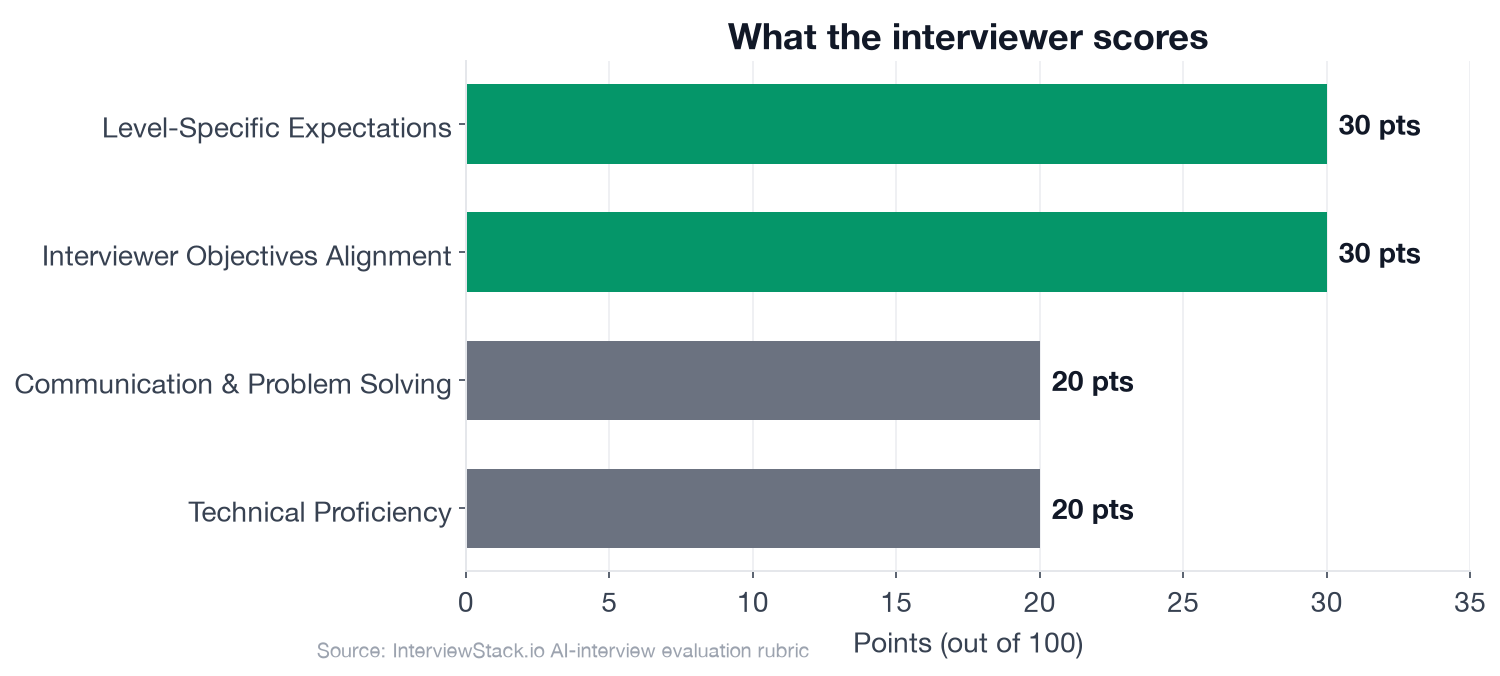
The two highest-weighted dimensions, worth 60 of the 100 points, score how you frame the problem and calibrate your design to a mid-level, team-owned scope, not how many tools you can name.
What Is the Interviewer Actually Testing With This Checkout Scenario?
Here's the scenario as it appears in the live blueprint:
The interview question
You support a product team that owns a checkout platform used by web and mobile clients, spanning pricing, promotions, payment authorization, and order placement. The team runs API-level regression tests and a smaller set of end-to-end UI tests against shared staging and pre-production environments used by multiple teams. Tests depend on hard-coded accounts, carts, and promo codes; failures are often caused by stale or mutated test data rather than real product bugs; parallel runs sometimes interfere with each other; and reproducing a failure locally is difficult because the original data state is unclear. New scenarios are slow to add because data setup is mostly manual.
The team wants to expand coverage across five dimensions: user type (guest, signed-in), region (US, EU), payment method (card, wallet), promotion type (none, percentage discount, fixed discount), and inventory state (in stock, low stock). How would you design a data-driven test strategy for this checkout platform that improves coverage while keeping test data reliable, isolated, and reproducible in shared environments?
The interviewer is scoring whether you can design and reason about a practical data-driven test approach for a shared environment: how you structure parameterized tests, generate and provision data, keep it isolated and reproducible, and make pragmatic trade-offs sized for a mid-level engineer working on one team's suite, not a platform-wide testing architecture.
Four Follow-Ups, Four Places the Combination Count Bites Back
The candidate below, Marcus, is dramatized to show where mid-level answers commonly lose points on this scenario, not a transcript of a real session. These four follow-ups, in the order a strong candidate would actually build toward them, move from keeping runs from colliding, to provisioning data fast, to deciding what's even worth automating as combinations grow, to handling the one dependency that won't cooperate.
Turn 1: Naming the Collision Risk
Interviewer: "Suppose multiple teams run tests in the same staging environment all day. How would you prevent collisions and data pollution between runs?"
Turn 2: Provisioning Without Manual Setup
Interviewer: "How would you generate or provision the accounts, carts, promo codes, and inventory state needed for tests without making the suite too slow or brittle?"
Turn 3: Deciding What Stays Parameterized
Interviewer: "If the number of scenario combinations grows quickly, how would you decide what stays in a parameterized suite versus what should be covered another way?"
Turn 4: When You Can't Reset the Downstream System
Interviewer: "If some downstream systems, like payment or promotions, cannot always be reset cleanly, how would you adapt your test data strategy?"
Why Doesn't Seeing the Fix Here Stop You From Missing It Live?
Every mistake above is easy to catch on the page, the fix is sitting right below it. Under real interview conditions there is no fix sitting below the question. You get 30 minutes, an interviewer who follows up on whatever you just proposed, and a checklist you cannot see. Noticing "that's the shared-fixture mistake" while reading an article is a different skill than not reaching for a shared test account mid-sentence, live, with the clock running and three more follow-ups coming. The only way to build that instinct is reps in the AI mock interview itself.
How Do the Interview's Three Phases Actually Score You?
The chart below maps how the interview's 13 checklist items are distributed across framing, data design, and trade-offs.
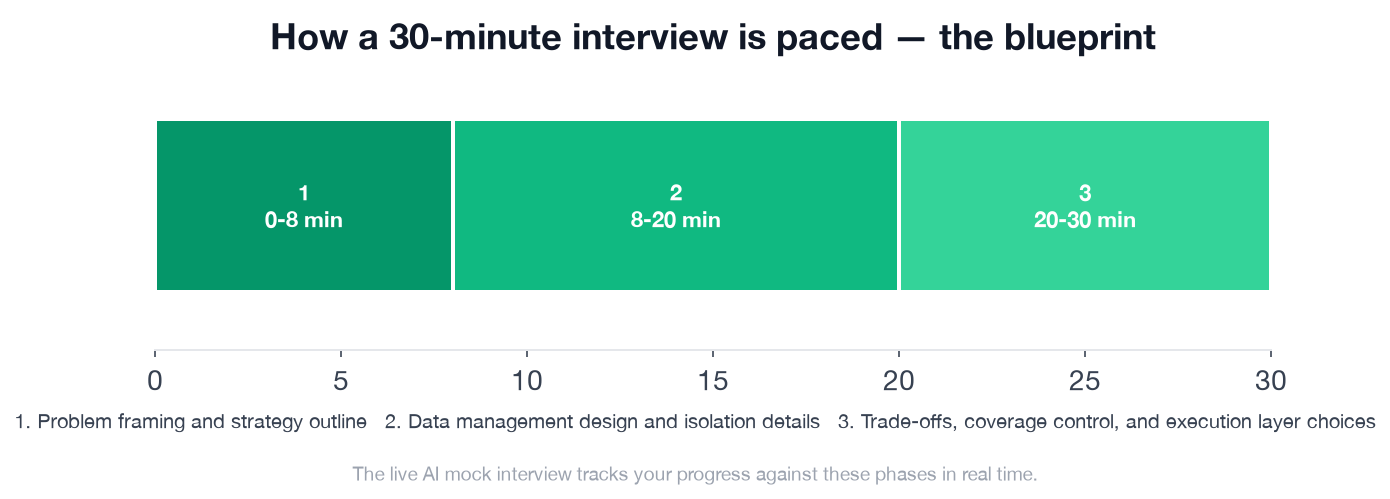
Phase 2, data management design and isolation details, is both the longest phase and the densest: 12 minutes carrying 5 of the interview's 13 checklist items.
This is the blueprint a strong candidate hits, phase by phase, and the exact structure the AI mock interview tracks you against while you're answering, not after:
- ✓Clarifies key assumptions about environment behavior, system ownership, and test layers
- ✓Separates scenario coverage concerns from test data lifecycle concerns
- ✓Suggests organizing tests around reusable scenario inputs or datasets instead of hard-coded fixtures
- ✓Mentions shared-environment risks such as collisions, stale state, or parallel-run interference
- ✓Describes how test data would be created or provisioned, such as setup APIs, factories, seeded templates, or controlled fixtures
- ✓Explains how each run or test would get unique identifiers or namespaces to avoid collisions
- ✓Addresses cleanup or expiration strategy for created data, including cases where cleanup fails
- ✓Distinguishes mutable versus immutable data and assigns an appropriate handling strategy
- ✓Explains what metadata or artifacts would be logged to make failures reproducible, such as run IDs, request payloads, entity IDs, and environment version
- ✓Acknowledges combinatorial explosion and proposes a selection strategy such as risk-based combinations or pairwise coverage
- ✓Explains which scenarios belong at API level versus UI level and why
- ✓Offers a practical plan for handling unreliable downstream dependencies, such as selective stubbing, contract coverage, or quarantined flows
- ✓Makes trade-offs that fit a 2-5 year engineer scope: implementable, maintainable, and team-oriented
Put the 48 Combinations in Front of a Real Interviewer
Reading the four mistakes above is the easy part. The AI mock interview for Test Automation Engineer data-driven testing asks this checkout scenario, follows up based on what you actually propose, and scores you across all four rubric dimensions the moment the 30 minutes end. That's the only way to find out whether you'd actually namespace your test data live, not on a re-read of this post. For focused drilling first, the question bank for data-driven testing covers provisioning, isolation, and coverage selection with worked answers, and the InterviewStack.io preparation guide maps how this topic fits into the broader Test Automation Engineer prep path.
FAQ
Q. What does a mid-level Test Automation Engineer data-driven testing interview actually test?
The interview runs 30 minutes across 3 phases: problem framing and strategy outline (0-8 min), data management design and isolation details (8-20 min), and trade-offs, coverage control, and execution layer choices (20-30 min). The rubric weights Interviewer Objectives Alignment and Level-Specific Expectations at 30 points each, so framing and judgment account for 60 of 100 points, with Technical Proficiency and Communication and Problem Solving worth 20 points each.
Q. How many checkout scenario combinations does this interview's scenario actually have?
- The scenario crosses five independent dimensions: user type (guest, signed-in), region (US, EU), payment method (card, wallet), promotion type (none, percentage discount, fixed discount), and inventory state (in stock, low stock). Two times two times two times three times two equals 48 distinct combinations, and the interview's Phase 3 checklist explicitly rewards a selection strategy for that count rather than automating every one.
Q. What's the difference between testing this at the API level versus the UI level?
The blueprint expects a candidate to keep the bulk of the 48 combinations at the API level, where a run is fast and cheap, and reserve the UI layer for a small number of representative end-to-end paths that confirm checkout actually works from a user's perspective. Running every combination through the UI would make the suite too slow to run on every change, working against the level-specific expectation to prioritize maintainability over exhaustive coverage.
Q. What should I capture when a data-driven test fails in CI so someone else can reproduce it?
The blueprint's Phase 2 checklist expects concrete artifacts: the run ID or namespace used for that execution, the exact request payloads and entity IDs involved, and the environment version the test ran against. Without those, an engineer debugging a failure the next day is reconstructing an unknown data state from scratch, the exact pain point the interview scenario opens with.
Q. What level of test data architecture is expected at the mid-level (2-5 years) bar?
A workable, team-owned solution, not a platform-wide framework. The level-specific expectations call for sound judgment on when to use seeded data, generated data, or mocks and stubs, concrete reasoning about parallelism, naming, and cleanup rather than only high-level principles, and a preference for maintainable, implementable designs over exhaustive coverage. The blueprint also keeps the interview scoped to testing: machine learning model design and low-level browser internals sit outside what's evaluated here.
Q. How is the interview scored?
Four dimensions totaling 100 points: Interviewer Objectives Alignment (30 points), Level-Specific Expectations (30 points), Technical Proficiency (20 points), and Communication and Problem Solving (20 points). The two highest-weighted dimensions reward strategy and judgment, not just correct syntax.
Q. How should I prepare for a Test Automation Engineer data-driven testing interview?
Practice naming the combinatorics of a scenario before proposing a design, describing concrete data provisioning and isolation mechanisms rather than general principles, and adapting your strategy when a downstream system cannot reset cleanly. The InterviewStack.io AI mock interview for Test Automation Engineer data-driven testing tracks you against the live blueprint in real time.
One Design Decision, Forty-Eight Combinations
The checkout scenario hands out 48 combinations up front. Scoring well isn't about writing 48 parameterized tests, it's about treating isolation, provisioning, reproducibility, and coverage selection as one design decision made early, rather than four separate fires the interviewer lights one at a time. That instinct is exactly what a live mock interview builds, turn by turn, under a clock that doesn't pause while you reconsider.
Topics
Ready to practice?
Put what you've learned into practice with AI mock interviews and structured preparation guides.