
Naming the Pattern Isn't the Design
There is a trap in test automation framework architecture interviews that costs candidates 60 points before the first follow-up arrives. They hear "design a new framework" and immediately name Playwright, then Page Object Model, then stop. Naming the tool answers one checklist item. Naming the pattern answers another. The remaining 12 items are about WHY the current suite fails, how the layers separate, which trade-offs you make for a mixed-experience team, and whether your CI reliability thinking goes further than retries.
This walkthrough illustrates how a strong 30-minute mid-level Test Automation Engineer interview on framework architecture runs. It is not a transcript of any specific company's process. The blueprint at the end is the exact structure the AI mock interview tracks you against in real time.
Key Findings
- 60 of 100 rubric points go to Interviewer Objectives Alignment (30 pts) and Level-Specific Expectations (30 pts), the two framing dimensions.
- Phase 2 (8-20 min) contains 5 distinct checklist items to cover in 12 minutes; spending all 12 minutes on one pattern misses the other 4.
- The level-specific bar explicitly requires identifying at least 1 anti-pattern in the existing suite: assertions inside page objects, duplicated waits/selectors, overly coupled tests, or global shared state.
- A passing design names at least 5 distinct layers: locators/selectors, action wrappers, domain abstractions, test flow layer, and assertion utilities.
- Phase 3 (20-30 min) requires at least 1 explicit trade-off to earn full marks: simpler Page Objects vs more flexible Screenplay, or shared framework consistency vs team autonomy.
- Phase 1 (0-8 min) holds 4 checklist items, all about framing constraints before any architecture is proposed.
- A "full rewrite" answer fails Phase 3's explicit checklist item requiring a realistic migration path from the current suite.
What Does the Test Automation Framework Architecture Interview Actually Test?
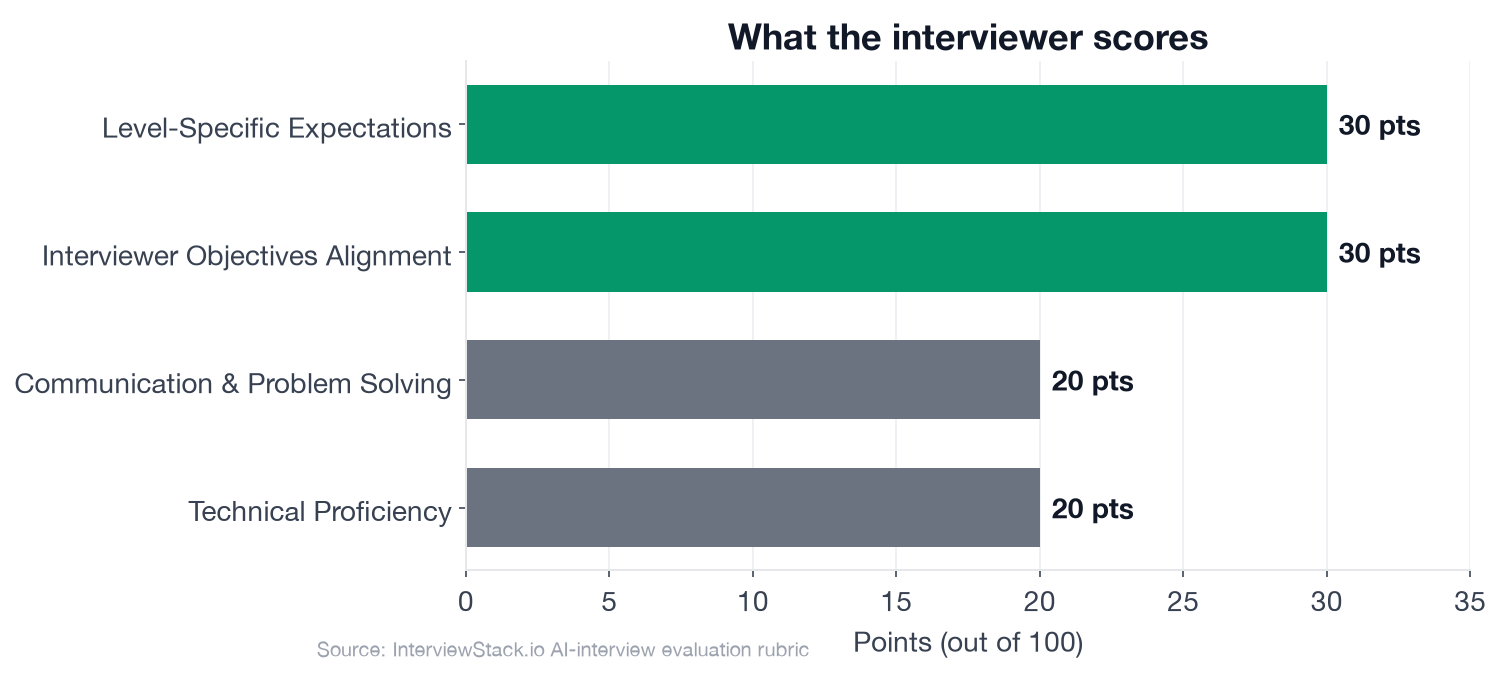
Interviewer Objectives Alignment (30 pts) and Level-Specific Expectations (30 pts) together account for 60% of the score. Here is the scenario that unlocks or forfeits those points.
The interview question
You are joining a team that owns automation for a large consumer web product with:
- a React-based web UI used by millions of users
- backend services exposed through REST APIs
- frequent releases through CI/CD
- about 8 product squads contributing tests
- an existing automation suite that is slow, flaky, and hard to extend
The team wants a framework that can be used for UI and API automation, works well in parallel CI execution, and is maintainable by engineers with mixed automation experience.
How would you design the next version of this test automation framework so that it is maintainable, scalable across teams, and reliable in CI?
The interviewer is probing three things: whether you structure layers before committing to tools, whether your pattern choices are defensible for a mixed-experience team, and whether your reliability thinking addresses root causes rather than symptoms.
Which Turns Decide the Score?
The four follow-up turns below were selected from six available because they each map directly to checklist items the rubric scores. A strong candidate covers all four areas; a common candidate answers one well and runs out of time on the rest.
Turn 1: Defining the Layers
Interviewer: "How would you separate responsibilities between selectors, interaction logic, test flow, assertions, and environment configuration in your design?"
Turn 2: Reducing Flakiness at the Architecture Level
Interviewer: "If the current suite has a lot of flaky UI tests, what changes in the framework architecture would you make to reduce flakiness rather than just adding retries?"
Turn 3: Patterns Without Over-Engineering
Interviewer: "What design patterns would you use in this framework, and where would you avoid over-engineering?"
Turn 4: CI Integration at Scale
Interviewer: "How would you integrate this framework into CI so that execution time stays reasonable as the test suite grows?"
Why Reading This Isn't Enough
You just watched Jamie give answers that cost points across every rubric dimension. Spotting the mistakes here, with the label printed above each one, takes about 30 seconds per turn. Avoiding them live, while holding the architecture in your head, fielding follow-ups you have not seen, and signaling trade-off reasoning at the same time, is a different skill entirely. That skill only comes from reps under interview conditions.
The Test Automation Engineer question bank has every framework architecture topic organized for focused drilling. When you are ready to practice the full 30-minute conversation, the AI mock interview scores each turn against the same blueprint you are about to read.
The Complete Blueprint
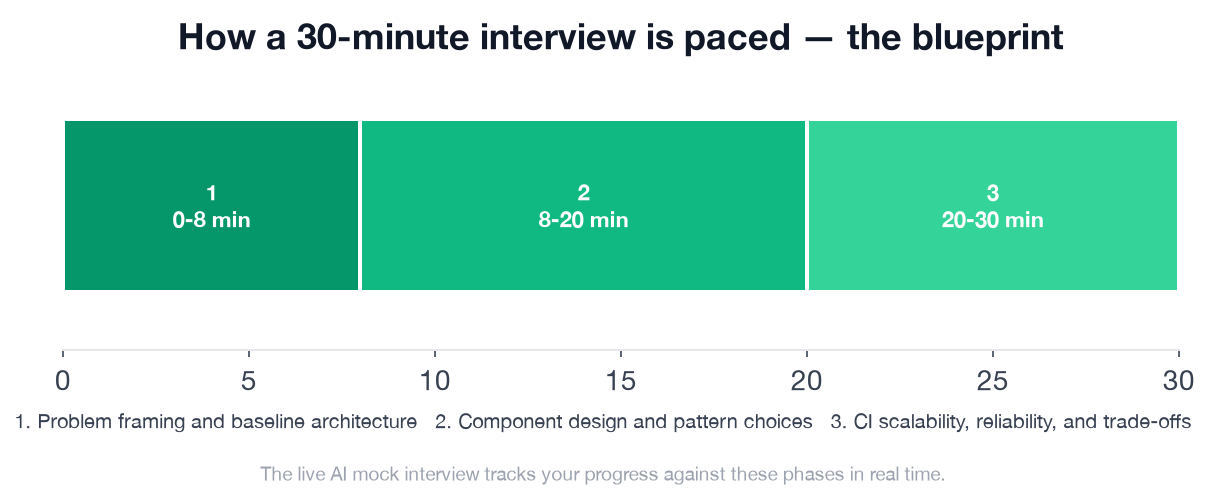
The chart above shows how the 30-minute interview paces across three phases. Below is the full blueprint a strong candidate hits, and the exact structure the AI mock interview tracks in real time.
- ✓Clarifies at least 2-3 meaningful assumptions such as test types, ownership model, CI expectations, or current pain points
- ✓Identifies maintainability, scalability, and reliability as primary design drivers
- ✓Sketches a layered architecture instead of jumping directly into tools
- ✓Recognizes need to support both UI and API automation in a shared but not overly coupled design
- ✓Defines distinct layers such as locators/selectors, action wrappers, domain/page/screen abstractions, test flow layer, and assertion utilities
- ✓Explains at least one appropriate pattern choice with concrete placement in the framework
- ✓Avoids or calls out common anti-patterns like monolithic base classes, hardcoded test data, brittle selectors, or excessive shared state
- ✓Describes how configuration, environments, credentials, and test data are managed cleanly
- ✓Shows how the framework could be extended by multiple squads with reusable conventions or libraries
- ✓Explains how tests are grouped or selected for CI, such as smoke vs broader suites or parallel partitioning
- ✓Discusses reliability mechanisms beyond retries, such as synchronization strategy, environment isolation, deterministic data setup, or better observability
- ✓Includes reporting/logging/artifact capture useful for debugging failures in CI
- ✓Makes at least one explicit trade-off, for example simpler Page Objects vs more flexible Screenplay, or shared framework consistency vs team autonomy
- ✓Outlines a realistic migration or adoption path from the current flaky suite rather than assuming a full rewrite
FAQ
Q. What does a layered test automation framework look like at the mid-level bar?
A mid-level candidate is expected to define at least 5 distinct layers: locators/selectors, action wrappers, domain/page abstractions, a test flow layer, and assertion utilities. Each layer has a single responsibility. Assertions do not live inside page objects; selectors do not scatter across tests. The design must support both UI and API automation without tightly coupling the two.
Q. What are the most common mistakes in a test automation framework architecture interview?
The most common mistakes are naming a tool without explaining the architecture around it, proposing Page Object Model without defining where assertions and test data live, treating retries as a flakiness fix instead of addressing synchronization and data isolation, and assuming a full rewrite rather than outlining an incremental migration path from the existing suite.
Q. How should a mid-level Test Automation Engineer handle the flakiness question?
Flakiness is an architectural problem, not a retry problem. A strong answer identifies root causes: brittle selectors, mixed wait strategies, shared mutable test data between parallel runs, and environment instability. The framework response is per-test deterministic data setup, a consistent synchronization strategy, environment isolation per runner, and observability via screenshots and logs so flakes can be diagnosed rather than just retried.
Q. What design patterns are expected in a framework architecture interview for a Test Automation Engineer?
The interviewer expects at least one pattern explained with concrete placement in the layer stack: Page Object Model for domain abstractions, Factory or Builder for test data, Strategy for pluggable execution, or Dependency Injection for environment and config. The key signal is WHERE the pattern lives and why it improves maintainability for mixed-experience teams. Proposing Screenplay for a codebase that needs occasional product-engineer contributions is a negative signal.
Q. How do you answer the CI integration question for a large test suite?
Cover three areas: test selection (smoke suite on every commit, broader suite on merge, parallel partitioning by module); execution infrastructure (containerized runners with isolated test data); and observability (artifact capture, failure screenshots, test timing metrics). Name at least one explicit trade-off, such as parallel execution speed vs runner cost vs flakiness introduced by shared infrastructure.
Q. What does the Level-Specific Expectations dimension test in this interview?
At mid-level, the 30-point Level-Specific Expectations dimension checks that the candidate can identify at least one anti-pattern in the existing suite (assertions inside page objects, duplicated waits, hardcoded selectors, global shared state), make a sensible trade-off favoring adoptability over complexity, and propose a framework that engineers with mixed automation experience can actually contribute to.
Q. How long should Phase 1 (problem framing) take in a 30-minute interview?
Phase 1 runs from minute 0 to minute 8 and has 4 checklist items, all about framing before any architecture is proposed. The candidate should spend 3-4 minutes clarifying at least 2-3 assumptions (test types, CI trigger model, squad ownership model, current pain points) and 2-3 minutes sketching the top-level layer structure. Jumping to a tool or pattern in minute 2 concedes Phase 1 points before the first follow-up arrives.
The Layers Are the Argument
The blueprint above carries 14 checklist items across 3 phases. Naming a tool satisfies one. The other 13 are answered by how clearly you separate layers, how precisely you name an anti-pattern in the existing suite, and whether your migration path is incremental enough that a team of 8 squads could actually adopt it. That precision is what the interview is measuring, and it is exactly the gap between reading a walkthrough and practicing one live. Browse open Test Automation Engineer roles or start with the preparation guide to see which companies hire for this topic.
Topics
Ready to practice?
Put what you've learned into practice with AI mock interviews and structured preparation guides.