
Your team owns checkout. Line coverage sits at 82%, the dashboard is green, and yet a promo code recently stacked wrongly with free shipping. Now you are in a mid-level Test Automation Engineer interview on test coverage, and the interviewer asks whether that number means anything. A prepared candidate is about to lose points they never see coming.
This post walks one realistic 30-minute mock interview, built from a real InterviewStack.io AI mock interview blueprint. The answers below are illustrative ("a common answer here is..."), not a transcript of a real person or any specific company's questions.
Key Findings
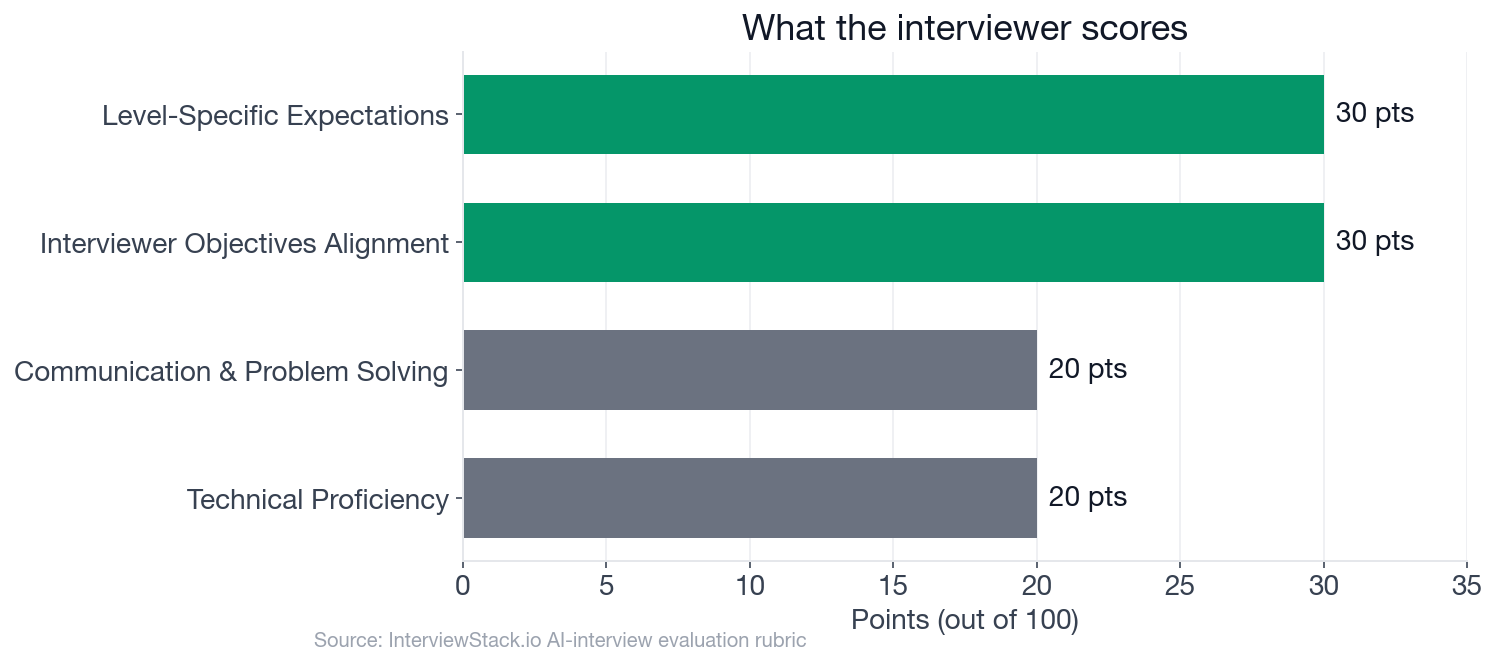
- The interview is scored out of 100 points across 4 dimensions; Interviewer Objectives Alignment and Level-Specific Expectations are 30 points each, so 60 points reward judgment over tool trivia.
- Technical Proficiency is only 20 of 100 points; Communication & Problem Solving carries the other 20.
- The 30 minutes split into 3 phases: framing (0-8 min), gap analysis and test placement (8-20 min, the longest at 12 minutes), and optimization (20-30 min).
- The scenario pairs 82% line coverage with 3 recent escaped defects, so the coverage number is evidence to challenge, not a result to defend.
- The suite takes 45 minutes in CI, which makes every added test a trade-off the interviewer expects you to price.
- The blueprint lists 14 checklist items across the 3 phases, and a strong answer covers as many of them as the clock allows.
The Question You Get Asked
Here is the scenario, as the AI interviewer presents it.
The interview question
You are joining a team that owns checkout for a large consumer web and mobile commerce platform. The flow includes cart review, shipping selection, promo code application, tax calculation, payment authorization, order placement, and post-order confirmation.
The current automated suite has:
- unit tests for pricing, promo, and tax utilities
- API tests for cart, checkout, and payment orchestration
- a small number of end-to-end UI tests across web and mobile web
- line coverage around 82% for the checkout service, but recent production issues still escaped
- a 45-minute full suite, with the team wanting faster signal on pull requests
Recent escaped defects:
- a promo code that stacked incorrectly with free shipping
- an order that succeeded for guest checkout but failed for signed-in users with saved addresses
- a payment retry path that double-submitted analytics events but still placed the order
How would you evaluate the current test coverage for this checkout area and propose a plan to improve confidence while keeping the suite efficient?
The interviewer is probing whether you can judge coverage by risk and requirements rather than raw percentage, find meaningful gaps, and trade confidence against runtime, maintainability, and redundancy. The plan has to be phased so a small team could execute it over one or two quarters.
Where a Test Automation Engineer Coverage Interview Goes Wrong
Four turns, four rubric-costly mistakes. The candidate in each box is Marcus.
Turn 1: Is 82% Meaningful?
Interviewer: "If the team shows you 82% line coverage and says coverage is already good, how would you determine whether that number is actually meaningful?"
Turn 2: Choosing the Right Layer
Interviewer: "How would you decide which gaps should be covered by unit, API, or end-to-end tests in this checkout flow?"
Turn 3: Only a Few Tests
Interviewer: "Suppose you can only add a small number of tests this quarter because CI is already slow. How would you prioritize what to add or remove?"
Turn 4: Hard-to-Measure Behavior
Interviewer: "How would your approach change for hard-to-measure areas like analytics events, retry behavior, or third-party payment integrations?"
Why Isn't Reading This Enough?
Spotting these mistakes on the page is easy. Avoiding them live is the real skill: each answer is time-boxed, the interviewer asks follow-ups you have not rehearsed, and the instinct to defend a green dashboard kicks in under pressure. Candidates rarely lose points for not knowing the pyramid. They lose them for answering the percentage question instead of the confidence question, and that only gets fixed with reps.
What Does the Complete Blueprint Look Like?
The timeline below shows how 30 minutes are paced.
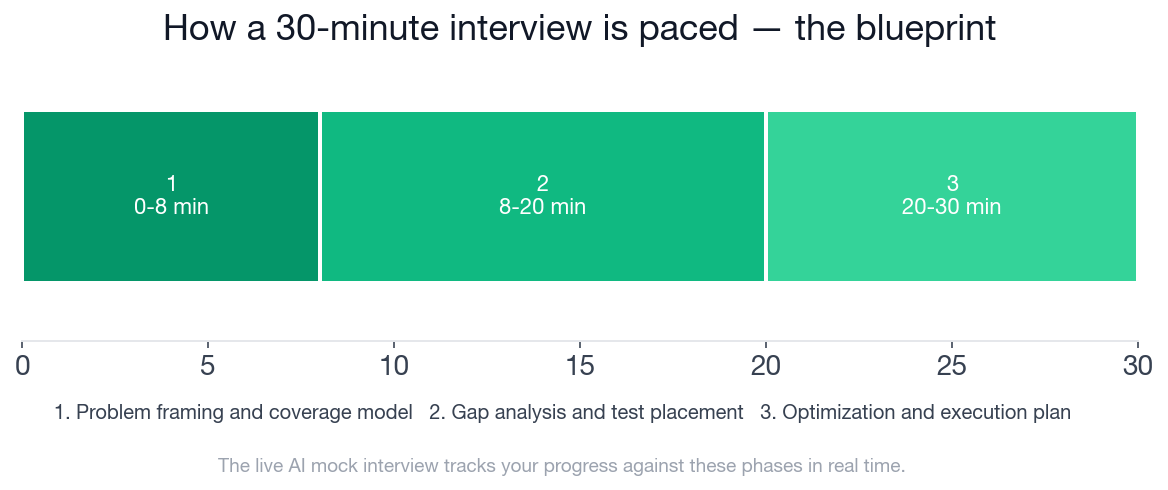
Pacing matters because the longest phase, gap analysis and test placement, gets 12 of the 30 minutes (and ties the optimization phase for the most checklist items, 5 of 14 apiece). This is the blueprint a strong candidate hits, and the exact thing the AI mock interview tracks you against in real time.
- ✓Clarifies what 'confidence' means for checkout in terms of business-critical outcomes such as successful order placement, correct pricing, and safe payment handling
- ✓Separates code coverage from scenario coverage, requirement coverage, and edge-case coverage
- ✓Identifies important dimensions such as user type, address state, promo combinations, payment outcomes, retries, and third-party boundaries
- ✓Uses recent escaped defects as evidence of missing coverage areas rather than treating them as isolated bugs
- ✓Proposes a simple matrix or model mapping critical flows and business rules to current tests
- ✓Calls out likely under-tested areas such as combinatorial discount logic, signed-in versus guest flows, saved-address state, retry/idempotency paths, and observability side effects
- ✓Places deterministic business-rule checks lower in the stack and reserves end-to-end coverage for a small set of critical user journeys
- ✓Explains how to validate third-party interactions and failure paths without overusing brittle UI tests
- ✓Recognizes that analytics/event duplication may require contract, integration, or observability-focused validation rather than only functional assertions
- ✓Prioritizes additions based on user impact, defect history, change frequency, and likelihood of regression
- ✓Suggests removing or consolidating redundant tests by identifying overlapping assertions or repeated end-to-end coverage of the same logic
- ✓Mentions practical CI tactics such as smoke versus full regression, pull request gating, parallelization, or targeted execution
- ✓Defines useful success metrics such as escaped defects by category, critical-flow pass rate, flaky test rate, execution time, and requirement/risk coverage status
- ✓Presents a phased plan with immediate wins and medium-term improvements rather than an all-at-once rewrite
The scoring weights behind it:
Run This Interview Live
Start the AI mock interview for this exact role and topic. It runs the same three phases, asks follow-ups you have not seen, and scores you against the four dimensions above. Want to warm up first? Drill the Test Coverage question bank before your session, and browse current Test Automation Engineer openings to see what teams actually ask for. For company-specific rounds, see the preparation guides.
FAQ
Q. What does a Test Automation Engineer test coverage interview actually test?
It tests whether you can separate code coverage from risk and requirement coverage. In this 30-minute mock interview, 60 of 100 rubric points go to objectives alignment and level-specific judgment, so reasoning about gaps and trade-offs outweighs naming tools.
Q. Is 82% line coverage good enough?
Not on its own. Line coverage only shows which lines executed, not whether assertions checked the right behavior or whether risky combinations such as promo stacking and guest versus signed-in flows were exercised. A strong answer treats it as a floor to investigate, then maps gaps to business rules and escaped defects.
Q. How should I decide between unit, API, and end-to-end tests?
Put deterministic business rules (pricing, promos, tax) low in the stack, use API tests for orchestration and state such as saved addresses and payment retries, and reserve a small set of end-to-end tests for critical user journeys. The cost is CI time and flakiness, so every UI test must justify itself.
Q. How do you cut a 45-minute CI suite without raising release risk?
Identify overlapping assertions and repeated end-to-end coverage of the same logic, then consolidate. Add pull request gating with a smoke tier, parallelization, and targeted execution, and keep the full regression running on a schedule. Roll out in phases with immediate wins first.
Q. Which metrics show coverage quality improving over time?
Track escaped defects by category, critical-flow pass rate, flaky test rate, suite execution time, and requirement or risk coverage status. These show whether confidence is rising, which a coverage percentage cannot.
Q. How do you test hard-to-measure areas like analytics events or payment retries?
Use contract, integration, or observability-focused checks instead of only functional assertions. A retry that places the order but double-sends an analytics event passes every functional test, so you need assertions on the emitted events and idempotency behavior.
Q. How can I practice this interview live?
Start an AI mock interview for this exact role and topic. It runs the same 30-minute, three-phase blueprint, asks unscripted follow-ups, and scores you against the same four rubric dimensions.
Your Next Rep
The gap between "82% covered" and "confident to ship" is the whole interview. Practice saying the second sentence out loud, with a clock running, before the real one starts.
Topics
Ready to practice?
Put what you've learned into practice with AI mock interviews and structured preparation guides.