
The Flexible API That Loses the Interview
Picture a mid-level UI Designer interview built around a real product problem: four surfaces (account settings, notifications, billing, admin tools) with inconsistent forms, tables, and navigation, and a mandate to build a shared component system that teams can adopt without a full rewrite. It's a 30-minute conversation, scored against a 100-point rubric, and one instinct sinks more candidates than any other: the belief that a "more flexible" component API is automatically the better answer.
It isn't. The interview's own scoring criteria name the opposite as the risk to watch for, and the candidate who defends unlimited flexibility when engineering pushes back is the one giving points away, not the one showing design maturity.
Key Findings
- The rubric splits 100 points across 4 dimensions: 30 for Interviewer Objectives Alignment, 30 for Level-Specific Expectations, 20 for Technical Proficiency, 20 for Communication & Problem Solving.
- Phase 1 (problem framing, minutes 0-8) holds 4 checklist items, all about scope and audit, before any component gets named.
- Phase 2 (component architecture, minutes 8-20) is the densest stretch: 5 checklist items packed into 12 minutes, covering hierarchy, variants, accessibility, and responsive behavior.
- Phase 3 (governance and trade-offs, minutes 20-30) closes with 5 checklist items in 10 minutes, including at least one concrete flexibility-versus-consistency example.
- Level-Specific Expectations explicitly lists component sprawl, inconsistent naming, and over-generalization as risks a mid-level candidate must recognize and mitigate.
- 4 skill areas sit entirely outside this rubric: frontend framework coding, machine learning or ranking system design, back-end infrastructure, and brand copywriting.
- The full interview runs 30 minutes across exactly 3 phases, with no phase dedicated to visual polish or a final mockup.
The interview question
You're joining a product team at a large consumer tech company that is redesigning an internal design system used by multiple surfaces: account settings, notifications, billing, and lightweight admin tools. Today, each team has slightly different patterns for forms, banners, tables, empty states, and navigation, which creates inconsistent UX and slows delivery. The team wants a reusable component foundation that can be adopted incrementally rather than through a full rewrite. You've been asked to lead the design approach for the first release in partnership with engineers.
How would you approach designing the first version of this component system so that it improves consistency across those product areas while still being practical for teams to adopt?
The interviewer is probing whether you can decompose these surfaces into reusable components, define their APIs and states without overbuilding, plan for accessibility and theming from the start, and think past the mockup into documentation, governance, and rollout. Four surfaces, one incremental system, real engineers on the other end of every trade-off. Here's where a well-prepared candidate still gives points away.
Turn 1: Deciding What Ships in V1
Interviewer: "How would you decide what should become a reusable component in v1 versus what should stay product-specific for now?"
Turn 2: The Flexible API Pushback
Interviewer: "If engineering pushes back that a highly flexible component API will be hard to maintain, how would you respond and adjust the design?"
Turn 3: Variants Without Sprawl
Interviewer: "How would you handle component states, variants, and responsive behavior for something like forms or tables without making the system overly complex?"
Turn 4: The One-Off Exception Request
Interviewer: "Suppose one product team needs a one-off pattern that doesn't fit the system cleanly. How would you evaluate whether to extend the system or allow an exception?"
Why Reading This Isn't Enough
Spotting the flexibility trap on the page, after the mistake is already labeled in a red box, is easy. Catching yourself reaching for "let's make it configurable" in the middle of a live 30-minute conversation, with an interviewer who just pushed back and is waiting on your next sentence, is a different skill entirely. That gap between recognizing a mistake and not making it under time pressure is exactly what live practice closes and reading alone cannot.
What UI Designer Design Systems and Component Architecture Interviews Actually Track
This is the blueprint a strong candidate hits phase by phase, and it's the same structure the AI mock interview scores you against in real time, checklist item by checklist item, as you talk.
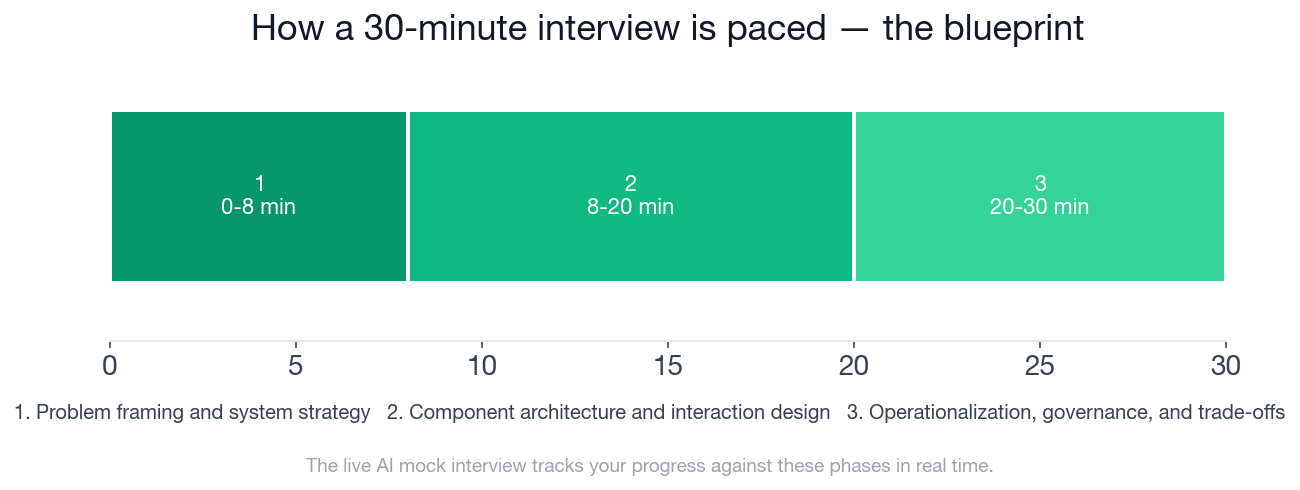 Framing gets 8 minutes, component architecture gets the longest stretch at 12 minutes, and governance closes the interview in the final 10.
- ✓Clarifies what products/surfaces are in scope and acknowledges incremental adoption as a constraint
- ✓Proposes an audit or inventory of existing patterns before defining components
- ✓Identifies likely high-leverage targets such as forms, feedback, navigation, or layout primitives
- ✓Defines success in practical terms such as consistency, speed of implementation, reduced duplication, or usability improvements
- ✓Describes a hierarchy from tokens/primitives to composed components or patterns
- ✓Explains component responsibilities and avoids overly coupled designs
- ✓Gives concrete examples of variants, states, and when to constrain options
- ✓Addresses accessibility needs such as labels, focus, contrast, keyboard behavior, or semantic structure
- ✓Considers responsive behavior or layout adaptation for shared components across surfaces
- ✓Mentions documentation or usage guidance for both designers and engineers
- ✓Describes a lightweight governance or review model for new components and exceptions
- ✓Discusses naming, organization, or versioning in a way that supports maintainability
- ✓Shows balanced judgment on flexibility versus consistency with at least one concrete example
- ✓Explains how they would partner with engineering on implementation and rollout rather than stopping at mockups
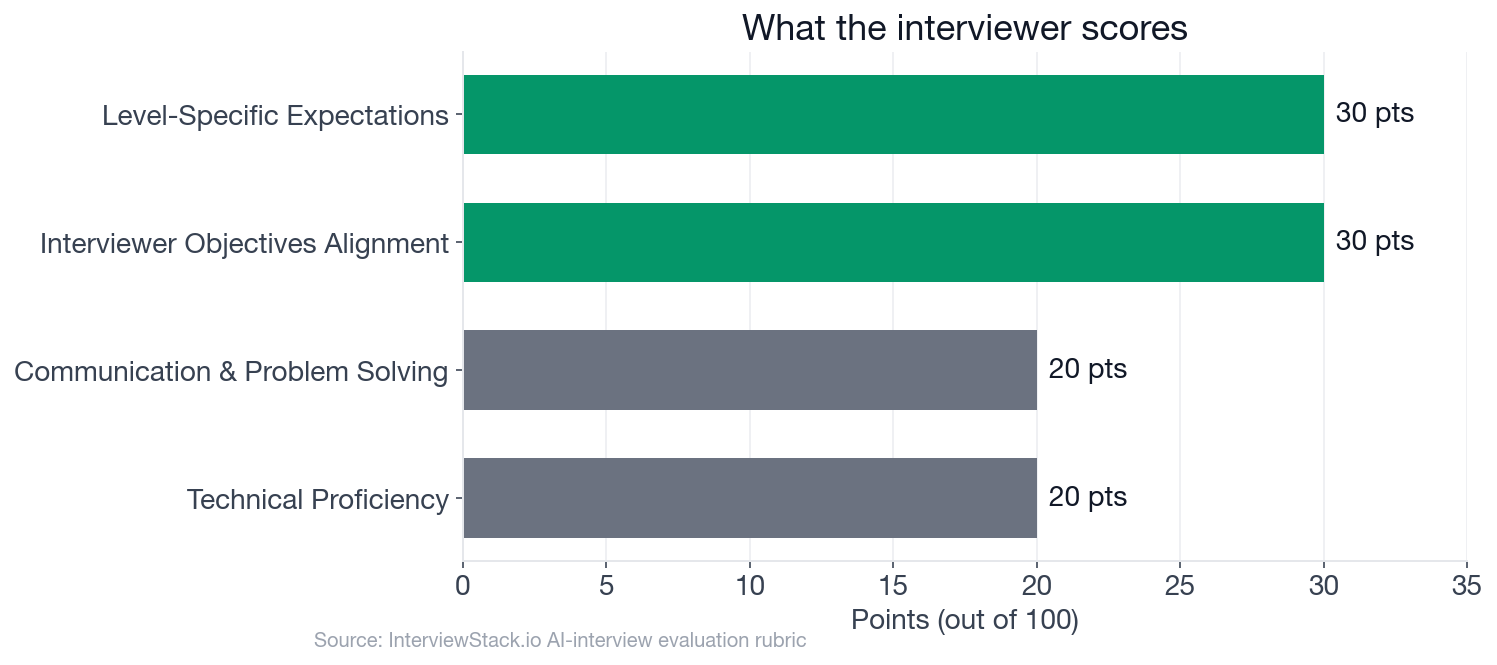 Interviewer Objectives Alignment and Level-Specific Expectations together hold 60 of the 100 points, more than Technical Proficiency and Communication combined.
Practice the Full 30 Minutes
Every mistake above is recoverable once you've seen it named. The harder version is catching it live, in your own words, while the interviewer is already waiting on your answer. That's what the AI mock interview is built for: it runs this exact scenario, asks unscripted follow-ups, and scores you against the same checklist item by item. If you want to warm up on individual concepts first, like variant constraints, tokenization, or governance models, the question bank breaks the topic into focused drills you can run before attempting the full simulation.
FAQ
Q. What does a mid-level UI Designer interview on design systems and component architecture actually test?
It tests whether you can scope an incremental v1 component system, define component hierarchy and variants with real constraints, and operationalize the system through documentation and governance. The 100-point rubric splits 30 points to Interviewer Objectives Alignment, 30 to Level-Specific Expectations, 20 to Technical Proficiency, and 20 to Communication & Problem Solving.
Q. Why does a highly flexible component API count against a candidate?
Because the level-specific bar for this interview explicitly names component sprawl, inconsistent naming, and over-generalization as risks a mid-level UI Designer must recognize and mitigate. Defending unlimited flexibility instead of constraining the API signals that judgment is missing, not that the design is more capable.
Q. How is the 30-minute mock interview structured?
Three phases: problem framing and system strategy from minute 0 to 8, component architecture and interaction design from minute 8 to 20, and operationalization, governance, and trade-offs from minute 20 to 30. Phase 2 is the densest, packing 5 checklist items into 12 minutes.
Q. What's out of scope for this interview?
Four areas are explicitly excluded from the rubric: frontend framework-specific coding implementation, machine learning or ranking system design, back-end infrastructure architecture, and pure brand marketing or copywriting strategy. The interview stays focused on design system strategy and component thinking.
Q. How should a candidate handle a request for a one-off pattern that doesn't fit the design system?
A strong answer proposes a lightweight review checkpoint (does the pattern recur elsewhere, does it violate a core token or primitive) rather than either auto-approving every exception or blocking all deviation. That balanced judgment on flexibility versus consistency is a named checklist item in the operationalization phase.
Q. What's the difference between reading this walkthrough and practicing it live?
Reading shows you the mistakes after the fact, with time to think. The live AI mock interview asks unscripted follow-ups in real time and scores you against the same rubric and checklist used here, so you find out whether you'd actually make the flexibility trade-off correctly under pressure, not just recognize it in hindsight.
Q. Where can I practice this exact interview?
Start a free AI mock interview scoped to UI Designer, mid-level, on Design Systems and Component Architecture, or drill individual questions first in the question bank before attempting the full 30-minute simulation.
Constraint Is the Design Decision
The candidates who score well here aren't the ones who propose the most capable component API. They're the ones who can say, out loud, why they're choosing not to build something more flexible than the product actually needs right now. That's a harder sentence to say live than it looks on the page, which is exactly why it's worth rehearsing before the interview that counts.
Topics
Ready to practice?
Put what you've learned into practice with AI mock interviews and structured preparation guides.