
Why the AI Deployment Gap Needs a New Kind of Engineer
A 2025 MIT study called The GenAI Divide examined roughly 300 public enterprise AI initiatives and found that 95% produced little or no measurable P&L impact. MIT's own explanation centers on a learning gap: deployed AI systems that could not retain feedback or adapt to changing conditions over time. In the forward-deployed engineering community, the framing is adjacent but distinct: the models worked fine in the lab, but the deployment itself failed. Getting an AI system from a controlled demo to a production environment that clears enterprise authentication, satisfies data-residency requirements, integrates with legacy SQL databases never designed for LLM queries, and includes a monitoring layer that catches hallucinations before they reach real users is where the value evaporates. Whether you call it a learning gap or an integration wall, the effect is the same: enterprises invested in AI, and most of it did not produce measurable returns.
The Forward Deployed Engineer is the role that gap created. We analyzed 1,268 active FDE-titled engineer postings on the InterviewStack.io job board as of June 25, 2026, plus 1,444 total FDE-titled postings to map what canonical engineering roles these openings most closely resemble. What the data shows is a role that sits at the intersection of software engineering and AI, customer-embedded by design, senior-heavy by necessity, and now being institutionalized at scale by consulting firms that Palantir would never have predicted as competitors.
Key Findings
- 1,268 active FDE engineer-core postings analyzed on the InterviewStack.io job board as of June 25, 2026.
- FDE maps to the software-engineering family in 48% of postings and the AI/ML family in 26%: it is simultaneously a software role and an AI role, which is the point.
- Python (61%) is the only table-stakes skill. LLMs appear in 40% of postings, already a common expectation rather than a differentiator.
- Mid-level roles dominate at 77%; entry-level is under 1% (8 of 1,268 postings). This is not a junior-accessible role.
- Median US base salary is $184,700 across 286 US postings with disclosed salary (roughly 26% coverage). Among the largest premiums: vector databases ($241,500), LangGraph and HIPAA (tied at $236,500), and fine-tuning ($230,400), all $45K-$57K above the baseline.
- Onsite at 52% of postings: the embedded operating model skews heavily toward in-person work, with 34% hybrid and 34% remote also available (postings can carry multiple tags).
- Accenture leads the employer roster with 94 openings, ahead of OpenAI (35) and Palantir (25), marking the consulting industry's formal adoption of a model Palantir invented.
Production Code in the Customer's Stack
Before the numbers, the boundary the role is often confused across.
A sales engineer runs pre-sales demos. They show the product working in a controlled environment. They do not write customer-facing production code.
A solutions architect designs the system. They produce reference architectures and handoff documents. Implementation is someone else's problem.
A professional services consultant configures the product. They map fields, set up templates, and train users. They typically do not write new code that lives in the customer's production environment.
An FDE does the thing none of the above will: write production-grade code inside the client's environment, own the outcome, and stay until the system works and the customer's team can maintain it. Snowflake captures the distinction in a live posting: "When you complete an engagement, you don't just leave the customer with a slide deck; you leave them with a fully operational, production-hardened system."
Palantir, which pioneered the model under the title Forward Deployed Software Engineer (FDSE), describes it as "not just a job title, it's the blueprint": engineers embedded directly with customers to turn business-critical data and AI into deployed, operational solutions. The operative word is deployed. Not designed. Not demoed. Deployed.
Why 2026 Is the Inflection Point
The integration wall existed before generative AI. AI made it acute.
Deploying an LLM into a real enterprise environment means clearing IAM/SSO/SAML for authentication, satisfying HIPAA or SOC 2 for data handling, connecting to the customer's specific data sources and latency budgets, and building the observability layer to detect model drift before it causes a real problem. None of that is the model's responsibility. All of it is the FDE's.
The category crossed from niche to strategic in May 2026. Both OpenAI and Anthropic launched dedicated enterprise deployment ventures modeled explicitly on Palantir's FDE playbook. OpenAI's joint venture, called The Deployment Company, is majority-owned by OpenAI with a reported $4B+ initial investment; it includes the acquisition of AI consultancy Tomoro and roughly 150 of its engineers. Anthropic's parallel venture, backed by Blackstone, Hellman and Friedman, and Goldman Sachs at a reported $1.5B valuation, targets financial-services AI deployment. When the two largest AI labs both stand up dedicated deployment infrastructure in the same month, the role that infrastructure requires has arrived at scale.
Indeed data shows FDE posting volume growing roughly 700% year-over-year, from approximately 643 postings in April 2025 to more than 5,300 in April 2026. We present that as directional rather than precise, but it aligns with what we observe on our board: 1,444 distinct active FDE-titled postings from a role category that barely existed as a named title two years ago.
Is FDE a Software Job or an AI Job? Our Data Says Both
FDE has no canonical slot in our board's role classifier. So we asked the inverse question: if we force-classify each of the 1,444 live FDE-titled postings into the nearest canonical role, where do they land?
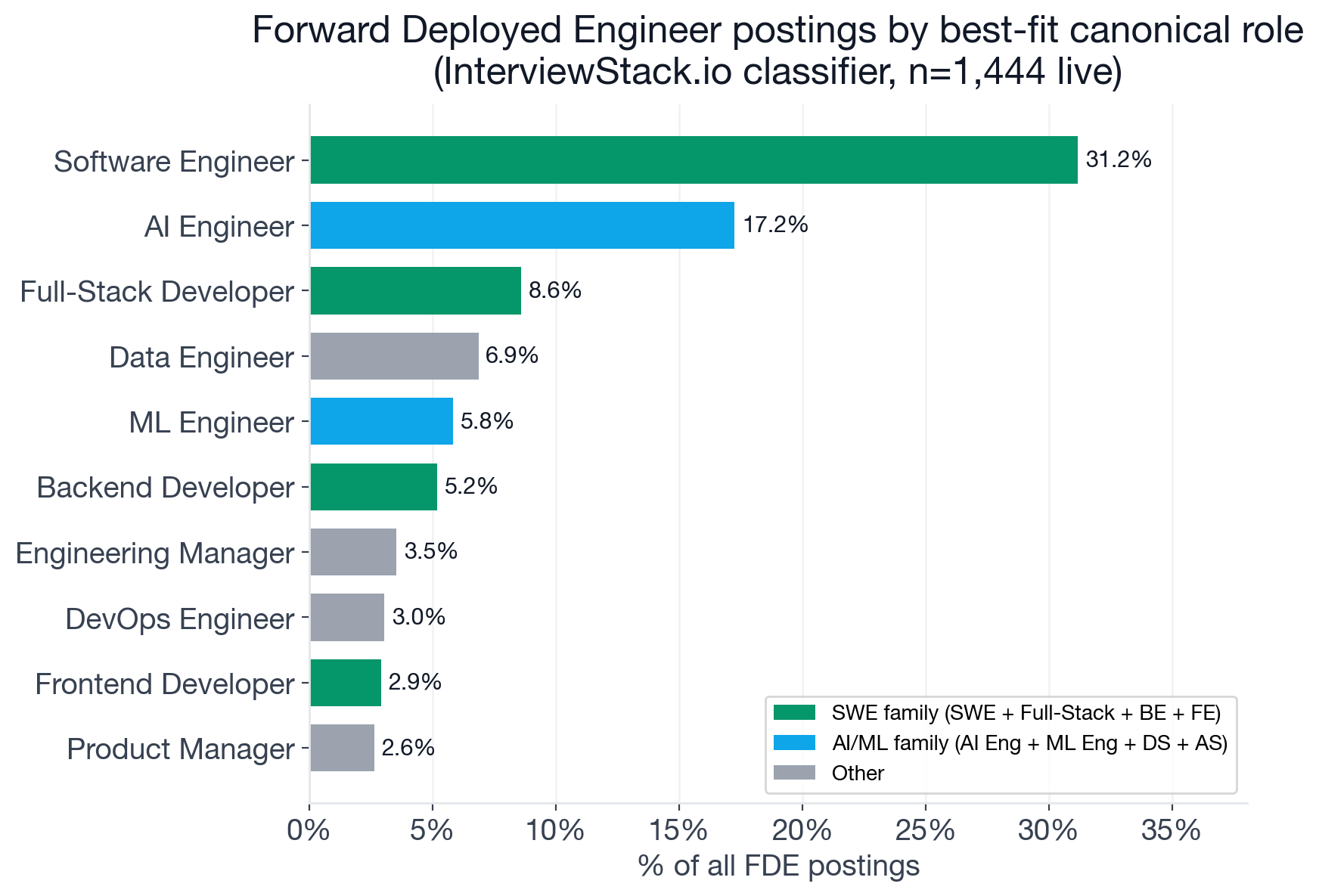
Best-fit primary role assigned by the InterviewStack.io classifier to each of 1,444 active FDE-titled postings as of June 25, 2026. Every posting received exactly one best-fit role (0 unclassified); the 1,444 span 47 distinct roles, and the long tail row aggregates the remaining ~35 smaller role categories. This is exploratory, showing which canonical role a posting most resembles, not strict role membership.
| Canonical role | Postings | Share |
|---|---|---|
| Software Engineer | 450 | 31% |
| AI Engineer | 249 | 17% |
| Fullstack Developer | 124 | 9% |
| Data Engineer | 99 | 7% |
| ML Engineer | 84 | 6% |
| Backend Developer | 75 | 5% |
| Engineering Manager | 51 | 4% |
| DevOps Engineer | 44 | 3% |
| Frontend Developer | 42 | 3% |
| Product Manager | 38 | 3% |
| Data Scientist / Applied Scientist | 44 | 3% |
| Long tail (cybersecurity, systems engineer, + ~35 smaller role categories) | 144 | 10% |
Group the roles into families and the structure becomes legible. The general software-engineering family (Software Engineer, Fullstack, Backend, Frontend) accounts for 48% of all FDE postings. The AI and ML family (AI Engineer, ML Engineer, Applied Scientist, Data Scientist) accounts for 26%. The remaining quarter spans Data Engineering, DevOps, Engineering Management, and Product.
The answer to "is FDE a software job or an AI job?" is: both, and that combination is the role's defining characteristic. About half the postings land nearest to a software engineer; a quarter land nearest to an AI or ML engineer. An FDE is a software engineer who also carries AI-native fluency, enterprise integration chops, and the customer-facing judgment to make all of it work inside a production environment designed for none of it.
What Does the FDE Skill Stack Actually Demand?
Map every individual skill into broader families first, to see the role's shape before the individual skill rankings pull attention to specifics.
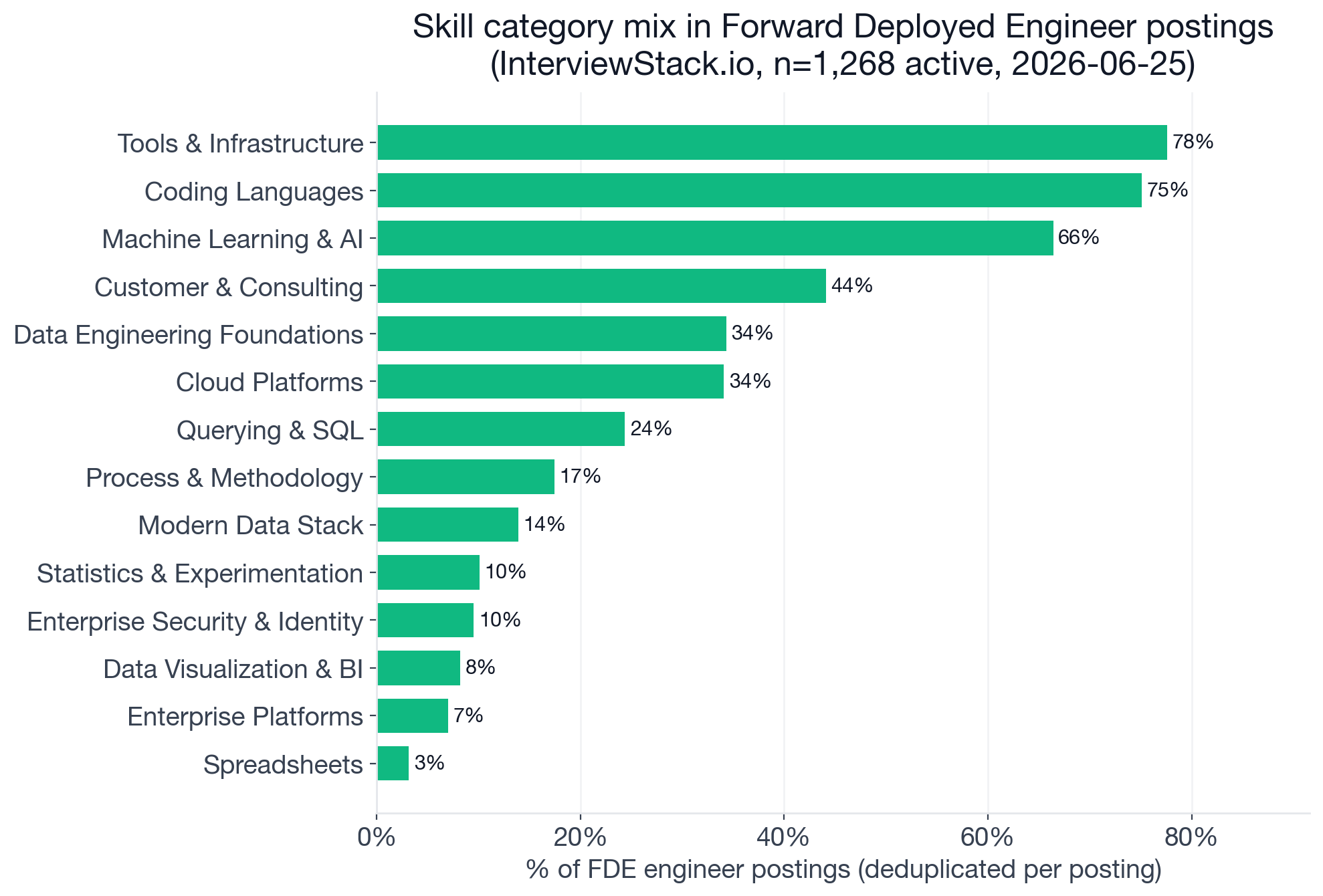
Share of 1,268 FDE engineer-core postings that ask for at least one skill in each family. A posting that mentions both AWS and Azure counts once under Cloud Platforms. "Other" is a catchall for residual technical skills (system design, containerization, and miscellaneous tooling) that don't map cleanly into a primary discipline.
Three families appear in roughly three-quarters of all postings: Tools and Infrastructure (78%), Coding Languages (75%), and Machine Learning and AI (66%). That triple presence at the same frequency is the signature. A standard software engineer posting leads with coding and infrastructure. A standard AI engineer posting leads with ML and AI. The FDE posting carries both at equal weight, plus a Customer and Consulting family (44%) that almost never appears in either.
The Customer and Consulting umbrella is the tell. Customer Success, Product Roadmap, Prototyping, and Product Management sit in 44% of FDE postings. These are skills more common in a PM or solutions-consulting posting. The role is not purely technical: it requires client-management and outcome-ownership that a typical engineering role never asks for.
Enterprise Security and Identity, including IAM, SSO, and SAML, appears across roughly 1 in 10 FDE postings (9.5%). That percentage understates the practical requirement: connecting an AI system to an enterprise auth stack is almost always the first blocker. The 9.5% reflects explicit listing in job descriptions; the real frequency in actual FDE work is higher.
The Three Skill Tiers
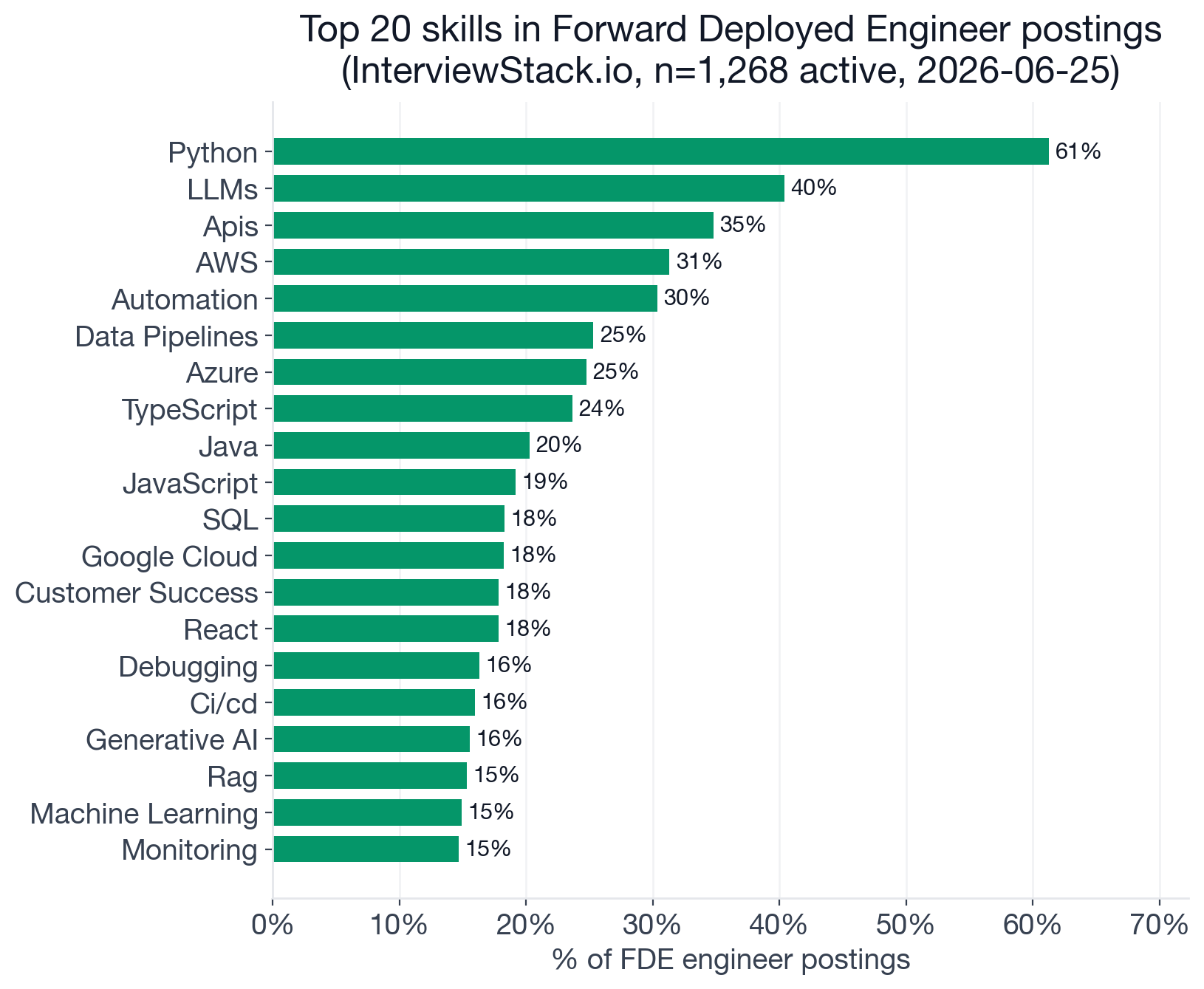
Top individual skills, color-coded by tier. Table stakes: 50%+; common: 20-50%; differentiator: 5-20%.
Table stakes (50%+): Only Python, at 61% of postings. No other skill clears the 50% threshold. That single-skill table-stakes layer is itself a signal: FDE spans so many specializations that no tool except Python is universal across the whole market. Compare this with Data Engineer (three table-stakes skills) or Software Engineer (several). The breadth of the role suppresses universality below the very first layer.
Common (20-50%): LLMs at 40% is the defining fact in this tier. LLMs are not a specialty skill for FDEs; they are an expected baseline, sitting ahead of AWS (31%) and Automation (30%). APIs (35%), Data Pipelines (25%), Azure (25%), TypeScript (24%), and Java (20%) complete the common tier. The multi-cloud presence of both AWS and Azure at roughly 25-31% is intentional: FDE postings regularly span multiple cloud environments because the customer's stack does not ask for the engineer's cloud preference.
Differentiators (5-20%): JavaScript, SQL, Google Cloud, Customer Success, React, CI/CD, RAG (retrieval-augmented generation, a technique for grounding LLM responses in customer-specific data), and Generative AI sit here. RAG at 15% is notable because it signals the dominant AI deployment pattern: build a retrieval pipeline that connects the LLM to the customer's internal documents and databases, so responses are accurate and auditable rather than hallucinated.
The Dominant Stacks
The co-occurrence data surfaces which skills cluster together most reliably:
| Skill pair | Share of postings | Lift |
|---|---|---|
| AWS + Azure | 23% | 3.0x |
| Azure + Google Cloud | 14% | 3.2x |
| AWS + Google Cloud | 17% | 3.0x |
| LLMs + RAG | 12% | 2.0x |
| AWS + CI/CD | 12% | 2.3x |
| LLMs + Automation | 18% | 1.5x |
| APIs + LLMs | 18% | 1.3x |
Lift = how much more likely the pair is to appear together than chance would predict given each skill's individual frequency. Only pairs within the top-25 skills are tracked.
The cloud pairs tell the story first. AWS and Azure co-appear at 3x the rate chance would predict. That is the multi-cloud reality of customer deployments: you arrive at a client running Azure and the AI vendor is on AWS, so you need both. The three-cloud combinations (AWS plus GCP and Azure plus GCP both at 3x lift) are even higher, reflecting postings that require genuine cloud-agnostic fluency.
LLMs and RAG pair at 2x lift: retrieval-augmented generation has become the standard AI deployment architecture, because it grounds the model's responses in the customer's own data rather than requiring fine-tuning for every new customer context.
LLMs plus Automation at 1.5x lift describes the core FDE workflow: building LLM-driven automation of customer business processes. LLMs plus APIs at 1.3x captures the plumbing: connecting the model to the customer's existing systems through API integrations.
Who Is Hiring, and Is This an Entry-Level Path?
The employer roster carries the most surprising finding in the dataset.
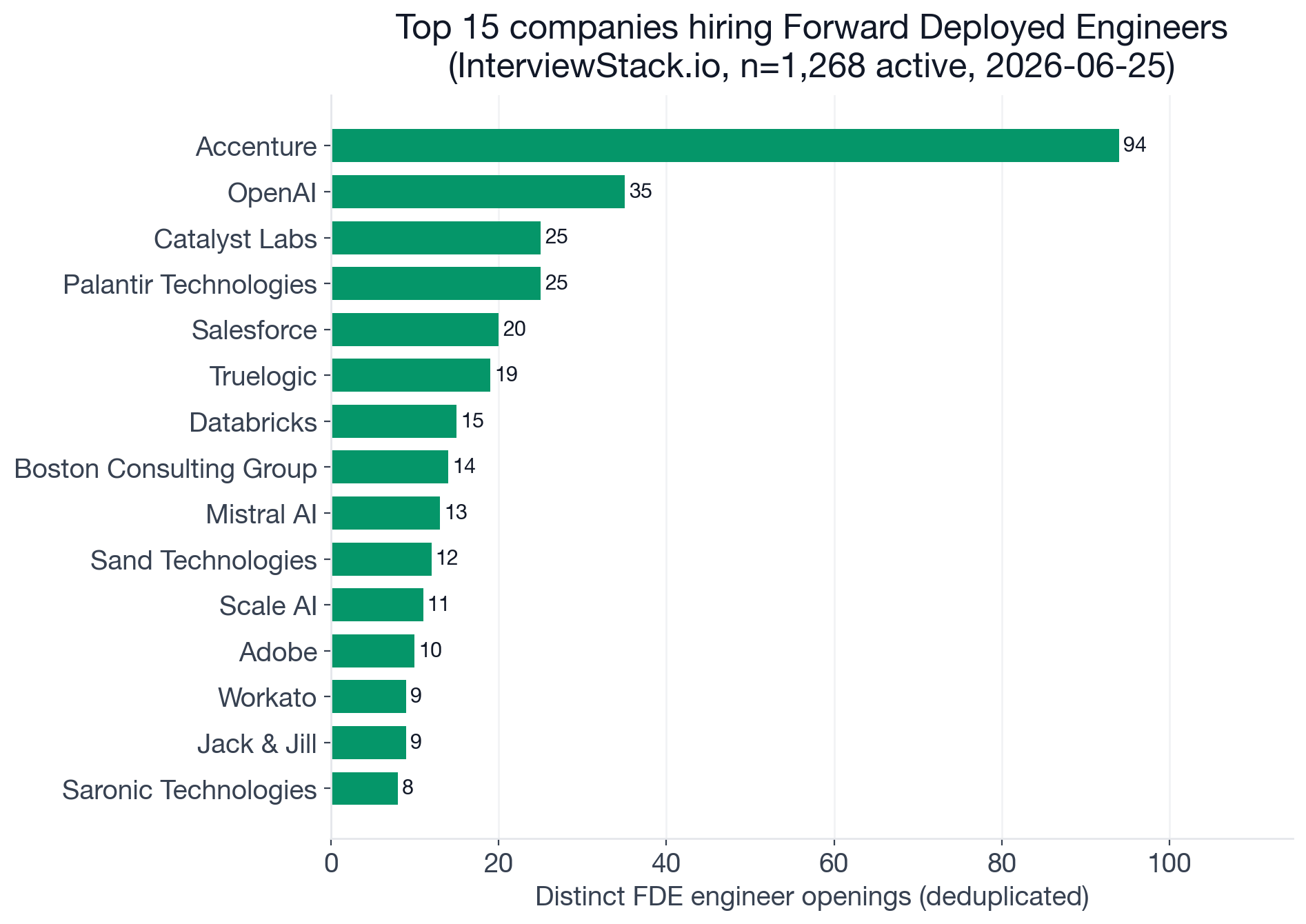
Active FDE engineer-core openings by company as of June 25, 2026. Table shows selected recognizable employers. Staffing aggregators (Truelogic, 19 openings) and one additional employer tied with Palantir at 25 openings (Catalyst Labs, a lesser-known AI services entity) are excluded from this curated view. Counts reflect distinct requisitions; repost ratios are 1.0 for all employers listed.
| Employer | Active openings | Role share |
|---|---|---|
| Accenture | 94 | 7.4% |
| OpenAI | 35 | 2.8% |
| Palantir Technologies | 25 | 2.0% |
| Salesforce | 20 | 1.6% |
| Databricks | 15 | 1.2% |
| Boston Consulting Group | 14 | 1.1% |
| Mistral AI | 13 | 1.0% |
| Scale AI | 11 | 0.9% |
| Adobe | 10 | 0.8% |
| Cohere | 8 | 0.6% |
| Novartis | 8 | 0.6% |
| ElevenLabs | 7 | 0.6% |
Accenture at 94 openings outpaces every AI lab and every pure-play tech vendor on the list. More than OpenAI. More than Palantir, which invented the model (Catalyst Labs, a lesser-known AI services firm, is also at 25 openings, but Palantir is the landmark). That result would have seemed strange two years ago; now it reflects a deliberate consulting-firm strategy. If you can embed an FDE in a client's environment and own their AI deployment outcome, that is a repeatable, billable service model. Accenture and BCG are running that playbook at scale.
The AI labs (OpenAI, Mistral AI, Cohere, ElevenLabs) are on the list because getting their models deployed at enterprise scale requires exactly the integration work FDEs specialize in. The data platforms (Salesforce, Databricks) use FDEs to embed their tools inside customer data environments. And Novartis at 8 openings is the regulated-industry signal: pharma needs engineers who can manage HIPAA compliance, responsible-AI governance, and production LLM deployment simultaneously, all inside someone else's infrastructure.
Seniority: Not a Junior Role
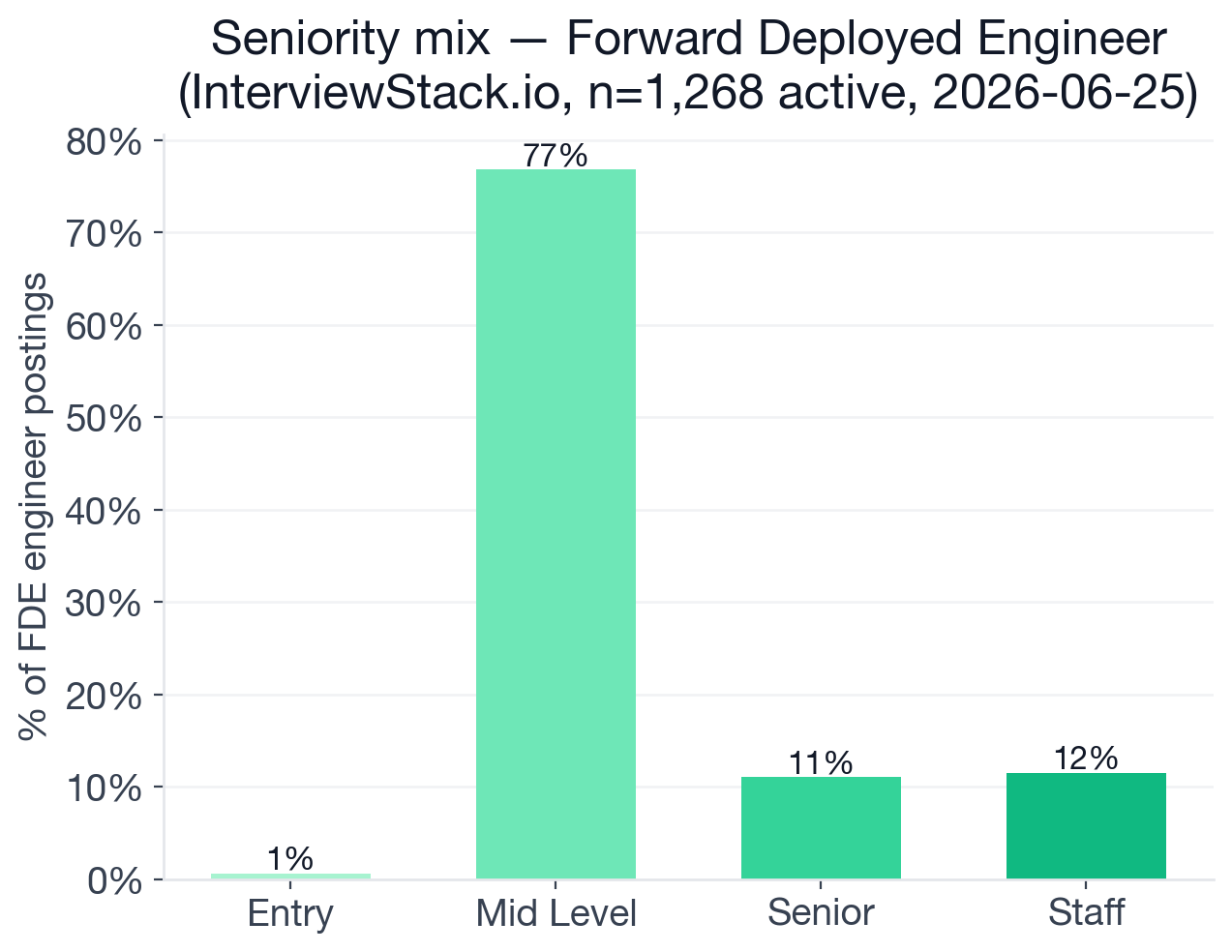
Seniority distribution inferred from title keywords across 1,268 FDE engineer-core postings.
Mid-level roles account for 77% of all FDE openings. Senior and staff titles together add another 22%. Entry-level is under 1%: only 8 of 1,268 postings are explicitly entry-level.
That near-zero entry share is not incidental. The FDE model requires an engineer who can be handed an unfamiliar client environment, diagnose problems they have never seen before, and ship working code without supervision. Those are not skills a new graduate arrives with. Career switchers and new graduates typically route through a software engineering or AI engineering role first, build two or three years of production experience, and transition into FDE from a position of demonstrated independence.
Geography: Where the Jobs Are, and How They Work
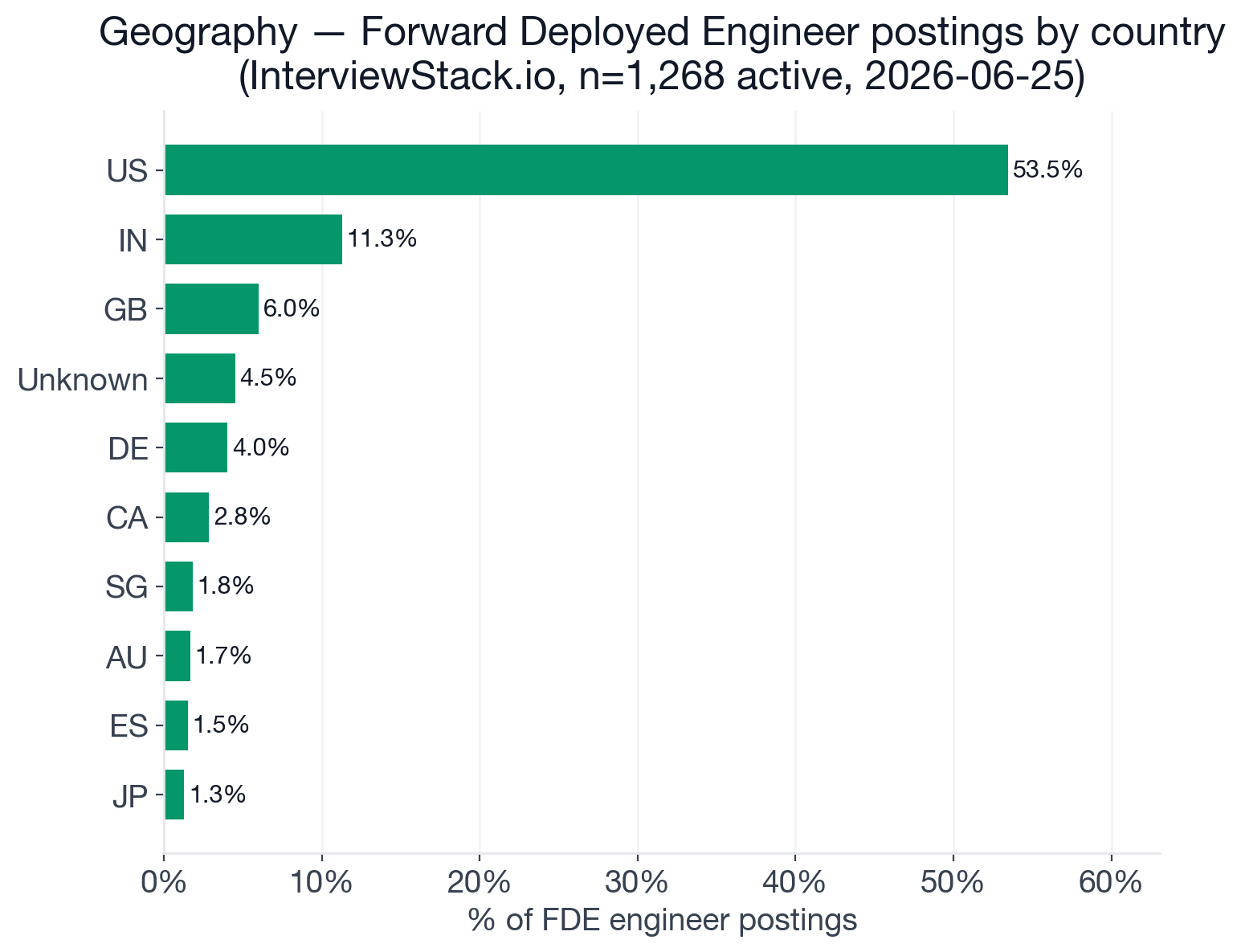
Country distribution of 1,268 FDE engineer-core postings as of June 25, 2026.
The US accounts for 53% of all FDE postings, a higher US concentration than most engineering roles. Within the US, San Francisco leads at 11% of the global total (136 postings), followed by the New York area at roughly 9%, then Washington DC (largely government and defense-adjacent), Austin, and Seattle. The concentration in Bay Area and New York reflects the density of AI vendors and their enterprise clients in those markets.
India (11%) and the UK (6%) are the next-largest markets, followed by Germany (4%) and Canada (3%).
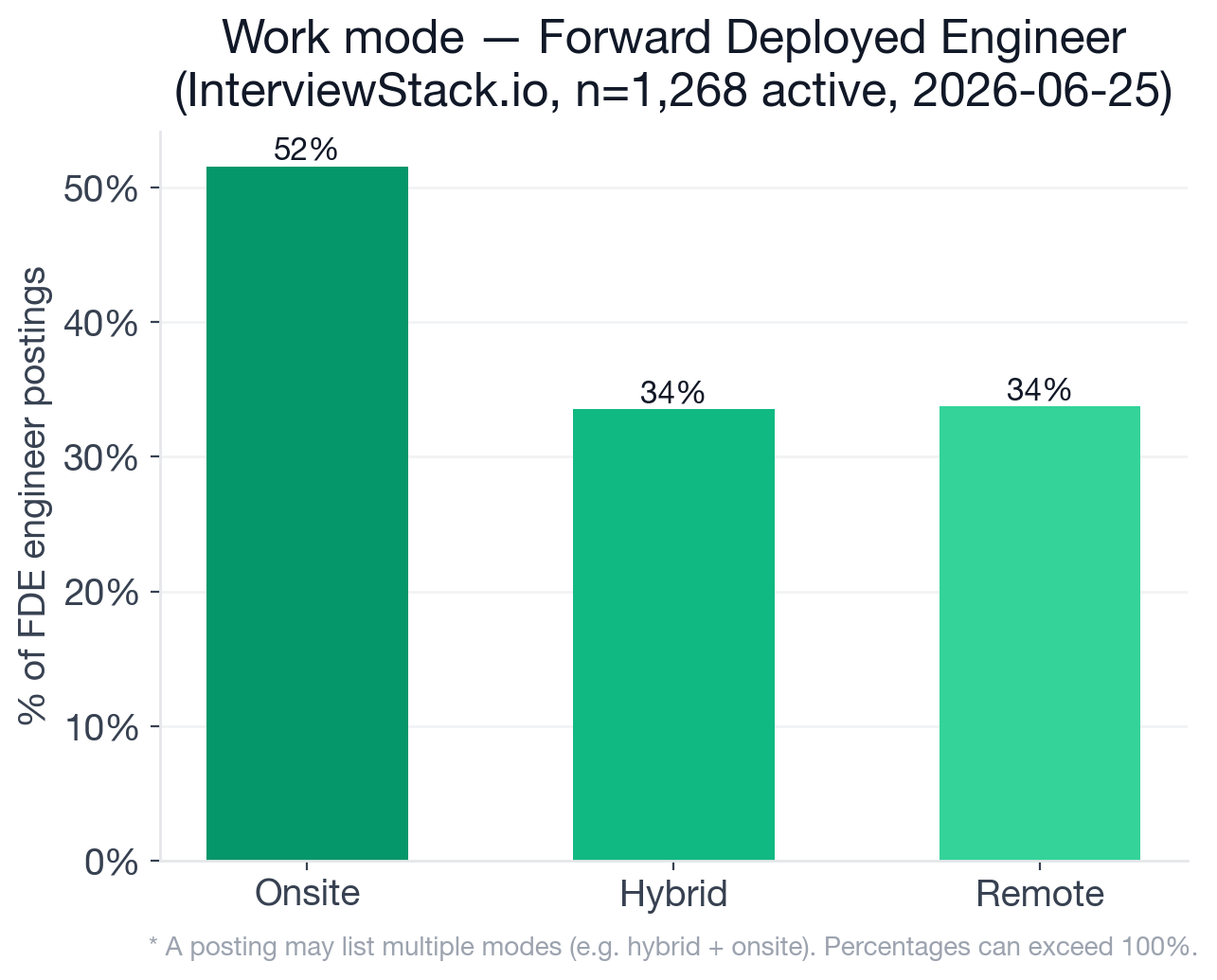
Work mode distribution. Percentages sum above 100% because a single posting can be tagged with multiple modes.
Onsite is the dominant mode at 52% of postings. Remote (34%) and hybrid (34%) are both significant, but the embedded operating model explains the onsite weight: you are often literally working in the customer's office, connected to their internal network, accessing systems that do not permit remote connections. The role's core value proposition is physical presence and proximity to the client's team, which is why FDE postings are among the more onsite-heavy positions in the broader engineering market.
What Does an FDE Actually Earn?
Among US postings where compensation is disclosed, the median Forward Deployed Engineer base salary is $184,700 (n=286 postings, roughly 26% of the US subset). This figure is base salary only. Equity, RSUs, bonuses, and sign-on are not captured in posting data, and total compensation at top employers runs substantially higher: external sources report total compensation ranging from $170,000-$200,000+ (Indeed salary data) to average TC around $238,000 in broader surveys, with staff-level FDE roles at AI labs reported significantly higher. The first-party board data anchors the base salary picture; treat the external TC figures as directional benchmarks rather than precise data.
The range is wide, from $43,000 to $412,500, which reflects everything from a contract engagement at a services firm to a staff-level AI lab role.
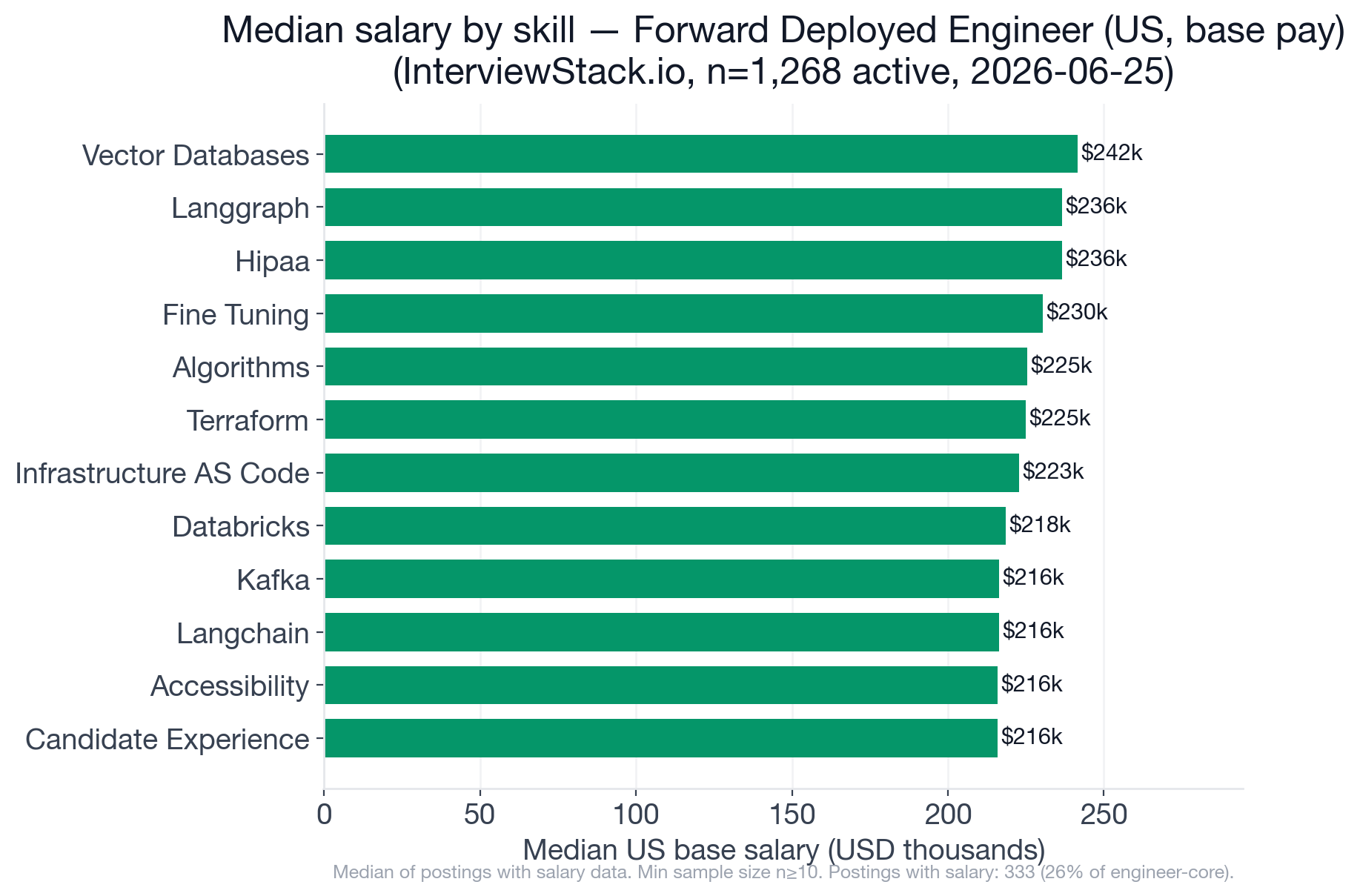
Median US base salary for FDE engineer-core postings mentioning each skill. Skills with fewer than 10 US salary data points excluded. Sample sizes reflect the US-disclosed-salary subset only.
The premium skills cluster in two areas.
The first is the AI-native stack. Vector databases (the infrastructure layer for RAG applications) carry a median of $241,500 (n=12; small sample, treat with appropriate caution). LangGraph (a framework for orchestrating stateful, multi-step AI agent workflows in Python) reaches $236,500 (n=13). HIPAA (the US healthcare data-privacy and security standard) ties LangGraph exactly at $236,500 (n=13): a direct reflection of the regulated-industry demand visible in the employer data, where pharma and health-tech FDE roles require engineers who can manage compliance gatekeeping and AI deployment simultaneously. Fine-tuning comes in at $230,400 (n=16), and LangChain (a Python library for chaining LLM calls and connecting them to external tools and data sources) at $216,300 (n=27). These are not "knows what AI is" skills. They are skills for building AI systems that run in production under real load and real regulatory constraints.
The second premium cluster is infrastructure-as-code. Terraform at $225,000 (n=23) sits just below fine-tuning. For an FDE, this makes sense: you do not just build the system, you provision the infrastructure it runs on, and doing that repeatably across many different customer cloud environments requires IaC discipline rather than click-through console work.
LLMs themselves carry a $13,200 premium above the $184,700 baseline at $197,900 median (n=100). That premium is real, but shrinking: LLMs are already a common expectation, not a rare specialty, and the market is pricing them accordingly. The ceiling is in the layer above: building multi-step agentic systems with frameworks like LangGraph or orchestrating fine-tuned models at deployment.
Python, the only table-stakes skill, shows a US median of $180,000 (n=172), actually $4,700 below the $184,700 baseline. That is not a penalty for knowing Python; it is a base-rate effect. Every FDE knows Python, so the skill does not move pay within the FDE population. The premium comes from what you build with it.
When "Forward Deployed" Jumped the Engineering Fence
The FDE data includes 176 non-engineering "Forward Deployed X" postings alongside the 1,268 engineer-core set, representing 12% of the 1,444 total FDE-titled active openings as of June 25, 2026. The titles include Forward Deployed Product Manager (multiple companies), Forward Deployed AI Strategist (ElevenLabs), Forward Deployed Designer, Forward Deployed AI Scientist (BCG X), and at the further end, a Forward Deployed Accountant (FloQast) and a Forward Deployed Lawyer (Eudia).
The pattern is Palantir's operating model spreading to every client-facing function. If embedding an engineer inside a customer produces better outcomes than handing off a slide deck, the same logic applies to accountants, lawyers, and product managers. The engineering role is several years ahead in scale and compensation, but the direction is the same: every function that currently operates at arm's length from the customer is a candidate for the forward-deployed model.
How to Break Into a Forward Deployed Engineer Role
The skill and seniority profile makes the preparation strategy concrete. You need production engineering depth, AI-native fluency at the deployment layer (not just model familiarity), enterprise integration experience (auth stacks, multi-cloud, data pipelines), and the ability to operate independently in an unfamiliar environment.
A few concrete steps for engineers building toward the role:
Build and deploy something outside your own organization. FDE interviews probe production experience, not whiteboard ability. A system you built that runs in someone else's environment and handles real traffic is the baseline signal the role requires.
Practice AI system design, not just distributed systems design. How do you design a RAG pipeline for a customer with a proprietary document store and a 200ms latency budget? How do you scope a fine-tuning project when the customer's labeled data is thin and inconsistent? Use AI mock interviews to rehearse the technical depth an FDE panel expects, including the customer-context framing that standard SWE interviews do not test.
Drill the integration layer. IAM, SSO, SAML, multi-cloud networking, and CI/CD deployment pipelines in customer environments are the topics FDE postings explicitly call out. The InterviewStack.io question bank covers AI Engineer and Software Engineer topics that map to this skill set directly.
Build the AI-native foundations. LangChain, LangGraph, and RAG architecture are the specific frameworks that carry the largest salary premiums. Structured study via our courses on ML, system design, and enterprise architecture closes the gap faster than ad-hoc practice.
Browse live openings. The InterviewStack.io job board aggregates active FDE postings across the full market. For roles with the highest skill overlap with FDE, browse AI Engineer openings and Software Engineer openings to build familiarity with the full range of what these postings ask for.
FAQ
Q. What is a Forward Deployed Engineer?
A Forward Deployed Engineer (FDE) is a customer-embedded engineer who builds and deploys production software inside the client's environment. Unlike a sales engineer (who demos) or a solutions architect (who designs), the FDE writes real code, owns the outcome, and stays until the system is operational. The model was pioneered by Palantir and has been adopted by AI labs, consulting firms, and enterprise software vendors.
Q. Is a Forward Deployed Engineer a software role or an AI role?
Both. Our analysis of 1,444 live FDE postings found that ~48% map most closely to the general software-engineering family (software engineer, fullstack, backend, frontend) while ~26% map to AI and ML roles (AI engineer, ML engineer, data scientist). The skill data confirms it: Python appears in 61% of postings and LLMs in 40%, a combination you won't see in a standard software-engineer posting.
Q. What skills do Forward Deployed Engineers need in 2026?
Python (61%) is the only table-stakes skill. The common tier requires LLMs (40%), APIs (35%), AWS (31%), Automation (30%), Data Pipelines (25%), Azure (25%), TypeScript (24%), and Java (20%). Enterprise integration skills like IAM, SSO, and SAML appear as a distinct cluster in roughly 10% of postings, signaling that connecting AI systems to real enterprise security stacks is a core FDE responsibility.
Q. What is the salary for a Forward Deployed Engineer in 2026?
The median US base salary is $184,700 across 286 postings with disclosed US salary data (roughly 26% coverage of the US subset). That figure is base only; equity and bonuses are not captured in posting data. External sources report total compensation ranging from around $170,000-$200,000+ (Indeed salary data) to an average TC of approximately $238,000 in broader surveys, with staff-level FDE roles at top AI labs reported significantly higher. Among the largest US salary premiums above the baseline: vector databases ($241,500), LangGraph and HIPAA (tied at $236,500), fine-tuning ($230,400), algorithms ($225,400), and Terraform ($225,000).
Q. Who is hiring Forward Deployed Engineers in 2026?
Accenture leads with 94 active openings, more than OpenAI (35) or Palantir (25, tied with Catalyst Labs, a lesser-known AI services firm). Salesforce (20), Databricks (15), Boston Consulting Group (14), and Mistral AI (13) follow. The breadth of the employer list, spanning consulting giants, AI labs, data platforms, and regulated industries, shows the role has moved well beyond its Palantir origin.
Q. How is a Forward Deployed Engineer different from a solutions architect or sales engineer?
A sales engineer handles pre-sales demos. A solutions architect designs the system and hands off. A Forward Deployed Engineer writes production code inside the customer's environment and stays until the system is working and the customer's team can maintain it. Snowflake describes it precisely: "When you complete an engagement, you don't just leave the customer with a slide deck; you leave them with a fully operational, production-hardened system."
Q. Is the Forward Deployed Engineer role entry-level accessible?
No. Fewer than 1% of active FDE postings are entry-level (8 of 1,268 in the engineer-core set). Mid-level roles dominate at 77% of postings, with senior and staff titles making up the remaining 22%. The role requires production engineering experience, AI fluency, and the ability to operate autonomously inside a client's environment, none of which a new graduate can readily demonstrate.
The Bar Is High for a Reason
FDE is one of a small number of engineering roles where the technical and interpersonal demands amplify each other rather than trade off. You need production engineering depth to build reliable systems in unfamiliar environments, AI-native fluency to wire LLMs into them correctly, enterprise integration knowledge to clear the auth and data-residency blockers, and the consulting judgment to diagnose what the customer actually needs versus what they are asking for. That combination is rare, and both the compensation and the near-zero entry-level share reflect it.
For engineers who are building toward all of those pieces, FDE represents a high-ceiling path that the AI deployment era has only made more central. The integration wall is not going away. If anything, it grows as AI systems become more embedded in regulated industries and more dependent on proprietary customer data. The engineers who learn to cross it reliably are going to be in demand for a long time.
Topics
Ready to practice?
Put what you've learned into practice with AI mock interviews and structured preparation guides.