
Your offline AUC went up, and click-through fell 3.5% anyway. That single contradiction is the whole interview: the number you trusted to say "safe to ship" is now a suspect, and a prepared mid-level AI Engineer candidate is about to lose points on how they react to it, not on what they know.
This walkthrough follows one illustrative 30-minute round on AI Engineer debugging and testing ML systems, built from a real InterviewStack.io interview blueprint. The answers below are dramatized composites ("a common answer is..."), not transcripts, and the scenario is not any specific company's question.
Key Findings
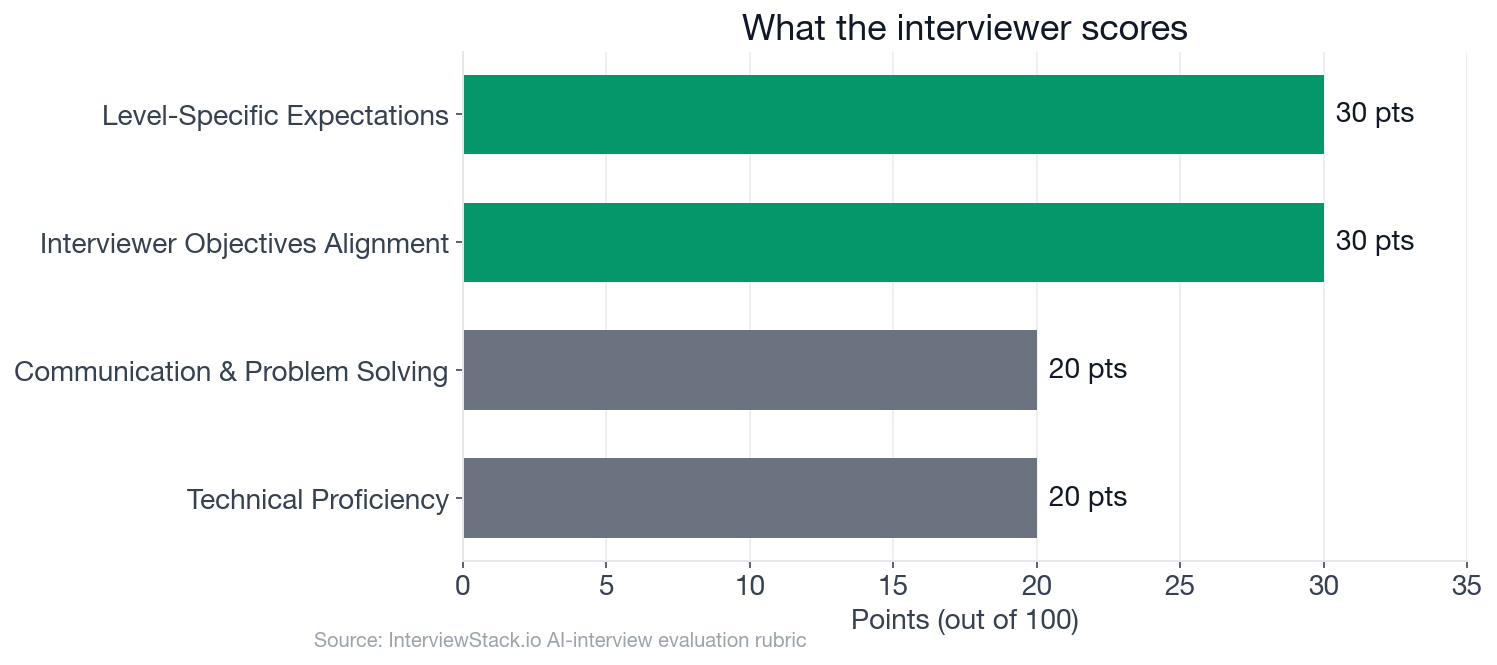
- The round is scored out of 100 points: 30 for objectives alignment, 30 for level-specific expectations, 20 for technical proficiency, 20 for communication.
- Structure and judgment (objectives plus level) carry 60 of the 100 points; pure technical proficiency carries 20.
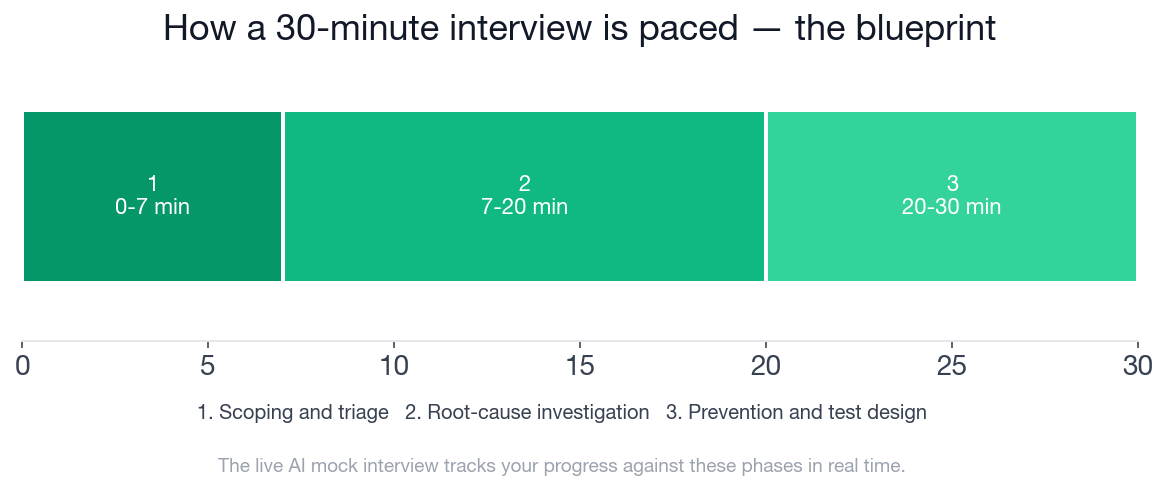
- The 30 minutes split into three phases: triage (0-7), root-cause investigation (7-20), and prevention and test design (20-30).
- Root-cause investigation is the longest phase at 13 minutes, with 5 of the blueprint's 14 expected checklist items.
- The scenario stacks four symptoms: a 3.5% CTR drop, new-user calibration drift, an OOM in roughly 1 of every 8 training jobs, and rerun metrics that differ.
- Strong candidates name 3 failure buckets in the first 7 minutes: online serving regression, offline evaluation issue, and training instability.
The Validation Set Is the First Suspect, Not the Last
The scenario, as an interviewer would read it out:
The interview question
You are joining an onsite round for an AI Engineer role on a team that maintains a production ranking model for a large-scale recommendations surface. Last week, the team shipped a new training pipeline and an updated model checkpoint. Offline evaluation on the validation set showed a small improvement in AUC, but after deployment:
- click-through rate dropped by 3.5%
- calibration drift increased for new users
- ~1 in 8 GPU training jobs fails with an
  intermittent OOM during the second epoch
- rerunning the same config sometimes gives
  materially different validation metrics
The training stack uses PyTorch Distributed Data Parallel, mixed precision, nightly feature generation, and a separate online feature service for inference. How would you investigate this end-to-end, identify the most likely root causes, and improve the system so similar issues are caught before deployment?
What Is This AI Engineer Debugging Interview Really Probing?
Not whether you can name the bug. The interviewer is watching whether you prioritize user impact, isolate variables instead of leaping to one cause, and propose diagnostics concrete enough to run tomorrow. At mid-level the bar is independent ownership of a well-scoped plan, not novel research, which is why the 30-point level-specific dimension punishes both timid and overbuilt answers.
Four Turns Where Prepared Candidates Slip
Turn 1: The First Thirty Minutes
Interviewer: "What would you do first in the first 30 minutes of the incident, and what evidence would help you decide whether to roll back or continue investigating?"
Turn 2: Data, Bug, or Skew
Interviewer: "How would you distinguish between a data issue, a training bug, and a training-serving skew issue in this scenario?"
Turn 3: Narrowing the OOM
Interviewer: "If the intermittent OOM only happens in distributed mixed-precision training and not on a single GPU, how would you narrow it down?"
Turn 4: Tests Without Exact Outputs
Interviewer: "What concrete tests would you add to the pipeline for probabilistic model behavior where exact output matching is unrealistic?"
Why Is Reading This Not Enough?
Spotting these mistakes on the page took seconds. Avoiding them live is different: the clock is running, the interviewer asks an unscripted follow-up halfway through your hypothesis, and the structure you planned dissolves. The gap between recognizing a good answer and producing one under time pressure only closes with reps. An AI mock interview gives you exactly that, with follow-ups you cannot predict.
The Blueprint a Strong Candidate Hits
This is the 14-item path through the 30 minutes. It is also what the live AI mock interview tracks you against in real time, phase by phase.
- ✓States a clear initial priority order, typically protecting production metrics first while preserving evidence
- ✓Asks for or proposes key artifacts: model version, training config diff, dataset snapshots, deployment timeline, slice metrics, and logs
- ✓Separates symptoms into likely buckets: online serving regression, offline evaluation issue, and training instability
- ✓Mentions reproducing from a known seed/checkpoint or comparing against the previous known-good pipeline
- ✓Proposes comparing offline vs online feature values on the same sampled requests to detect training-serving skew
- ✓Checks for data leakage, schema drift, null/default value changes, join/key issues, label shifts, and slice-level regressions such as new users
- ✓Mentions verifying loss/metric implementation, example weighting, sampler behavior, and batch construction for silent training bugs
- ✓Uses deterministic reruns or reduced test cases to investigate non-determinism, including random seeds, dataloader workers, shuffling, AMP, and DDP synchronization behavior
- ✓Suggests concrete OOM diagnostics such as per-rank batch composition, sequence length or sparse feature cardinality spikes, gradient accumulation, memory fragmentation, and activation checkpointing or batch-size experiments
- ✓Proposes unit tests for feature transforms and label generation with explicit edge cases and expected outputs
- ✓Defines dataset or schema validation checks such as range/null/cardinality/distribution constraints and train-validation leakage guards
- ✓Designs integration tests that exercise training-to-serving feature parity or end-to-end scoring on fixed canary examples
- ✓Suggests regression gates using tolerances or confidence intervals for non-deterministic metrics instead of exact equality
- ✓Adds observability and reproducibility artifacts such as config/version lineage, sampled feature logs, memory metrics, and model comparison dashboards
Run This Round Live
Start the AI mock interview for this exact scenario. You get the same three phases, unscripted follow-ups, and feedback scored against the four rubric dimensions above. If you want to drill first, the Debugging and Testing ML Systems question bank has focused practice, and the preparation guides cover company-specific loops. For architecture-side rounds, see our AI Engineer ML system architecture walkthrough, or browse current AI Engineer openings.
FAQ
Q. What does an AI Engineer debugging and testing ML systems interview cover?
It tests how you scope an ambiguous production regression across data, model, training, and serving, then turn the fix into tests and guardrails. The 30-minute blueprint splits into triage (0-7 minutes), root-cause investigation (7-20), and prevention and test design (20-30).
Q. How is a mid-level debugging interview scored?
Out of 100 points: Interviewer Objectives Alignment 30, Level-Specific Expectations 30, Technical Proficiency 20, and Communication and Problem Solving 20. Structure and judgment carry 60 points, so a structured plan outscores a clever single guess.
Q. Should I roll back first or keep investigating when CTR drops?
State a priority order that protects production metrics first while preserving evidence. Roll back to the known-good checkpoint if impact is large and rising, keep the failing artifacts, and investigate against the previous pipeline as a baseline.
Q. How do I tell training-serving skew from a training bug?
Compare offline and online feature values on the same sampled requests. If they differ, it is skew. If features match but the new-user slice still regresses, look at labels, sampling, loss, and metric code inside training.
Q. How do you test a model when outputs are not deterministic?
Replace exact equality with tolerances or confidence intervals on metrics, and pin fixed canary examples for end-to-end scoring. Pair those with unit tests on feature transforms and schema, null, and distribution checks.
Q. Why does a distributed mixed-precision job OOM intermittently?
Common suspects are per-rank batch composition differences, spikes in sequence length or sparse feature cardinality, gradient accumulation, and memory fragmentation. Narrow it with per-rank memory logging and batch-size or activation-checkpointing experiments.
Where Your Next Rep Goes
The 3.5% CTR drop was never about one bug. It was about whether you can turn four tangled symptoms into three testable buckets in seven minutes and then make the fix stick. Do that out loud, against a clock, a few times, and the real round feels familiar.
Topics
Ready to practice?
Put what you've learned into practice with AI mock interviews and structured preparation guides.