
The AI Engineer Generative AI and LLM Interview Rewards Diagnosis Over a Bigger Model
A mid-level AI Engineer sits down for a 30-minute interview built around a familiar product ask: design the first production version of an internal assistant that answers questions from technical documentation, summarizes design docs, and drafts incident follow-ups for thousands of engineers. This walkthrough is built from a real InterviewStack.io AI-interview blueprint for exactly that scenario, and the trap isn't a missing framework or an unfamiliar API. It's what a candidate does the moment the assistant starts sounding confident about the wrong answer.
That moment arrives early. The product team reports the assistant "sounds confident but often grounds answers in the wrong internal document." A candidate under time pressure hears "wrong answer" and reaches for the obvious fix: a bigger, more capable model. The interview isn't built to reward that instinct. It's built to see whether you can treat a confidently wrong answer as a system with four possible failure points, and work through them in order.
Key Findings
- Interviewer Objectives Alignment and Level-Specific Expectations each carry 30 of the interview's 100 rubric points, together worth more than Technical Proficiency and Communication combined (60 vs. 40).
- The 30-minute interview packs 14 checklist items into 3 phases: 4 in the first 8 minutes, 5 across minutes 8-18, and 5 more across minutes 18-30.
- The scenario sets two hard latency budgets in one system: under 2 seconds for simple Q&A and under 6 seconds for document summarization.
- Technical Proficiency and Communication & Problem-Solving split the remaining 40 points evenly, 20 each.
- This walkthrough dramatizes 4 of the interview's 6 real follow-up prompts, spanning the model-trade-offs phase (minutes 8-18) and the evaluation and production-readiness phase (minutes 18-30).
- The interview explicitly excludes GPU kernel optimization, distributed-training internals, and frontier-research depth, keeping the bar on applied system design.
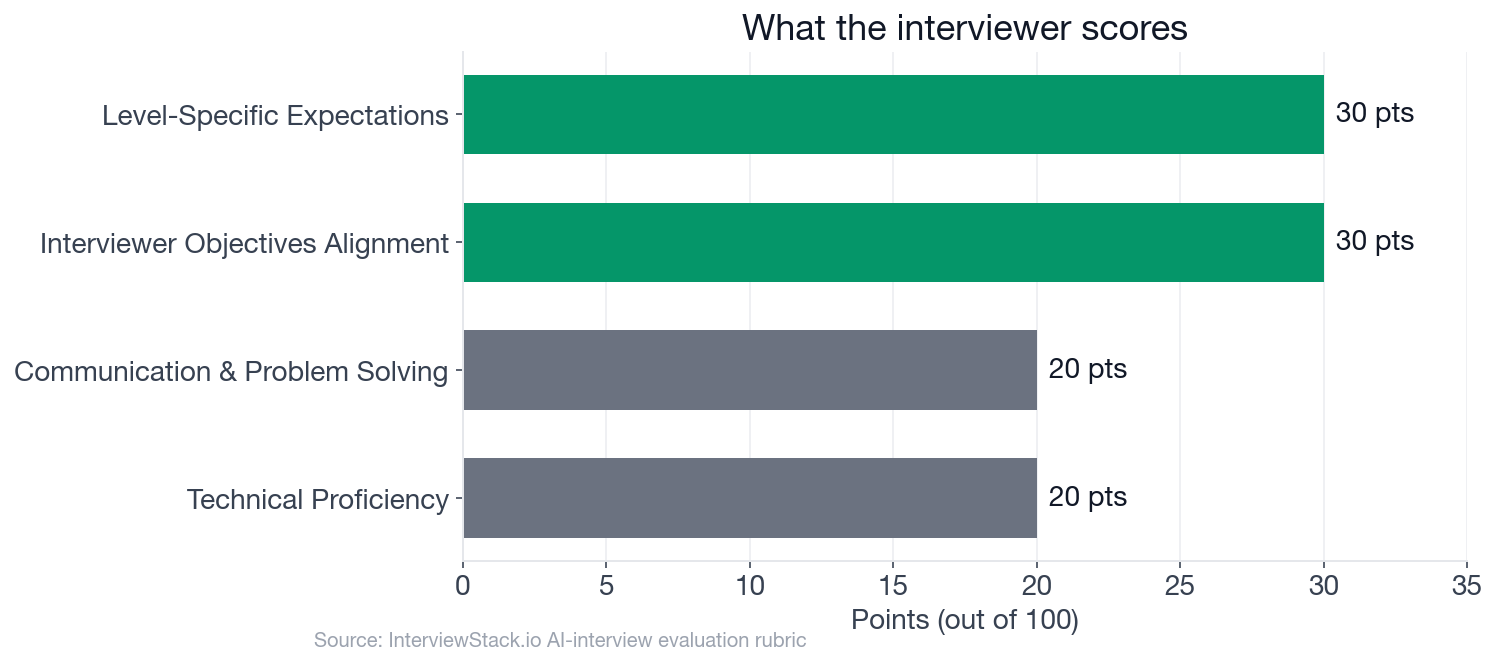 Interviewer Objectives Alignment and Level-Specific Expectations together hold 60 of the 100 points, the two dimensions every mistake in this walkthrough costs the most against.
Meet the Scenario
The interview question
You are building an internal assistant for software engineers at a large tech company. The assistant should answer questions about internal technical documentation, summarize design docs, and help draft incident follow-ups. It will be used by thousands of engineers globally, and the product team cares about answer quality, low latency, and preventing confident but incorrect responses.
Assume you have access to general-purpose large language models via API, a corpus of internal documents, and standard application infrastructure.
How would you design the first production version of this assistant, and what trade-offs would drive your key decisions?
The interviewer isn't grading whether you can name a vector database. They're watching whether you frame this as a full LLM application (retrieval, prompt design, inference strategy, evaluation, and operations), reason correctly about tokenization, context windows, and sampling, and make concrete quality-latency-cost-safety trade-offs appropriate for a first launch, not a research prototype. That LLM application stack shows up constantly in real job postings too, per our breakdown of what companies actually want from AI Engineers right now.
Where Does an AI Engineer Actually Lose Points on This LLM Question?
Four follow-ups from the real interview package carry most of the signal. Here's how a candidate named Noah handles them, and where a mid-level bar actually sits.
Turn 1: Diagnosing the confident wrong answer
Interviewer: "If early users report that the assistant sounds confident but often grounds answers in the wrong internal document, how would you diagnose whether the main issue is retrieval, prompt construction, context-window limits, or model behavior?"
Turn 2: Two latency budgets, one system
Interviewer: "Suppose latency needs to stay under 2 seconds for simple Q&A and under 6 seconds for document summarization. How would that change your model, prompt, and system design choices?"
Turn 3: What "ready to launch" actually means
Interviewer: "What would you measure offline and online before expanding this assistant to all engineers, and how would you define a bad failure versus an acceptable imperfect answer?"
Turn 4: Sensitive data without a blanket ban
Interviewer: "Imagine security raises concerns that users may paste sensitive incident data into prompts. What safeguards would you put into the design without making the product unusable?"
Spotting the Mistake on the Page Is the Easy Part
Every mistake above reads clearly with no clock running and no interviewer waiting on your next sentence. Live, thirty minutes in, with a follow-up you did not see coming, "let's just use a bigger model" is exactly the kind of shortcut a prepared candidate still reaches for under pressure. Recognizing a mistake in someone else's transcript and catching yourself making it in real time are different skills, and the second one only comes from reps.
What Does a Strong Answer to This AI Engineer LLM Interview Actually Cover?
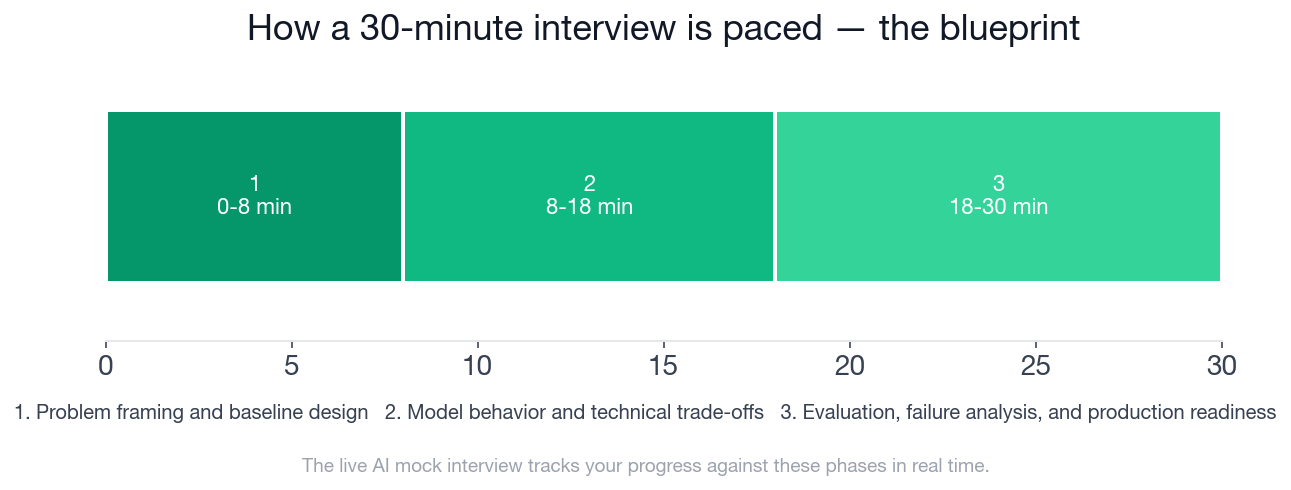 Each phase's checklist has to land inside its window, from an 8-minute framing phase through a 10-minute model-trade-offs phase to a 12-minute evaluation and production-readiness phase.
This is the blueprint a strong candidate hits, phase by phase, and it's the exact structure the AI mock interview tracks you against in real time as you answer.
- ✓Asks or states assumptions about primary use cases such as Q&A versus summarization versus drafting
- ✓Identifies quality, latency, and hallucination risk as first-order constraints
- ✓Proposes a coherent baseline architecture, typically involving retrieval over internal docs plus an LLM response layer
- ✓Distinguishes first-launch scope from later enhancements
- ✓Explains why retrieval is needed instead of relying only on pretrained knowledge for internal docs
- ✓Correctly reasons about context-window limits and proposes chunking, ranking, summarization, or hierarchical context strategies
- ✓Shows understanding that tokenization affects effective context length, latency, and cost
- ✓Chooses decoding settings appropriate to task, such as lower randomness for factual Q&A and potentially different settings for drafting
- ✓Can compare larger versus smaller models and when fine-tuning or a non-generative model may be more appropriate
- ✓Defines concrete offline checks such as groundedness/faithfulness, answer correctness on curated internal tasks, retrieval relevance, and summarization quality
- ✓Defines online metrics such as task completion, citation click-through, latency, escalation rate, or user feedback
- ✓Describes how to isolate failures across retrieval, prompt, model, and post-processing components
- ✓Suggests practical safeguards such as citations, abstention/fallback behavior, prompt/input filtering, access controls, or sensitive-data handling
- ✓Balances launch pragmatism with risk reduction rather than aiming for perfect model behavior
Practice This Exact Scenario
You've now watched four ways to lose points on this exact question. The only way to find out if you would catch them live, with the clock running and no page to scroll back through, is to run the interview yourself. Start the AI mock interview on generative AI and large language models and get turn-by-turn, rubric-based feedback the moment you finish. If you want to drill the systems-design side of the role too, we've broken down the AI Engineer machine learning system architecture interview turn by turn as well.
If you want to drill the underlying concepts first, retrieval-augmented generation, context-window strategy, decoding settings, before taking the full interview, the generative AI and LLM question bank breaks the topic into individual questions. For broader AI Engineer interview prep, browse the preparation guides.
FAQ
Q. What does a mid-level AI Engineer generative AI and LLM interview actually score?
The rubric is worth 100 points across four dimensions: 30 for Interviewer Objectives Alignment (did you design a workable production assistant), 30 for Level-Specific Expectations (did you show a mid-level 2-5 year bar of trade-off judgment), 20 for Technical Proficiency, and 20 for Communication and Problem Solving.
Q. If an LLM assistant sounds confident but grounds answers in the wrong document, is that a model problem?
Not usually first. The interview rewards ruling out retrieval quality, prompt construction, and context-window truncation before concluding the base model itself is at fault, because in a retrieval-augmented system those three layers are the more common source of a confidently wrong answer.
Q. How do you design an LLM assistant that needs to answer in under 2 seconds and summarize in under 6?
Treat the two latency budgets as two different systems rather than one pipeline: a lean model with a thin, high-precision retrieval pass for quick Q&A, and a larger model or deeper retrieval and multi-pass summarization for the 6-second budget, with caching and streaming to make the slower path feel responsive.
Q. When should you fine-tune an LLM instead of using retrieval-augmented generation?
For most first-version internal assistants, retrieval-augmented generation over a general-purpose model is the more defensible starting point, because it keeps the underlying knowledge current without a retraining cycle. Fine-tuning becomes worth the cost mainly for consistent output format, tone, or a narrow domain, not for keeping facts up to date.
Q. What should you measure before rolling an internal LLM assistant out to every engineer?
Offline, score a curated set of internal-doc questions for groundedness, faithfulness, and retrieval relevance before launch. Online, track task completion, citation click-through, latency, and escalation rate, and define in advance what counts as a bad failure (confidently wrong with no citation) versus an acceptable one (partial or hedged but correctly grounded).
Q. How do you handle sensitive incident data pasted into prompts without breaking the product?
Layer proportionate controls instead of a blanket block: redact or flag common sensitive patterns before a prompt leaves the client, scope model and logging access so less raw incident data is retained than necessary, and lean on the access controls already tied to internal-docs permissions rather than asking the model to police sensitivity itself.
Q. How long does the AI Engineer LLM mock interview run and how many follow-up questions does it include?
The scenario runs 30 minutes across three phases: 8 minutes on problem framing and baseline design, 10 minutes on model behavior and technical trade-offs, and 12 minutes on evaluation, failure analysis, and production readiness, with the interviewer working through six scripted follow-up prompts across those phases.
Bigger Model Is Not a Diagnosis
The candidates who do well on this question never treat "the answer was wrong" as one problem with one fix. They treat it as four possible layers, retrieval, prompt, context window, model, and work through them in order before reaching for a bigger model. That discipline is the actual skill this interview is checking for, and it only sharpens with a real clock running against you.
Topics
Ready to practice?
Put what you've learned into practice with AI mock interviews and structured preparation guides.