
The Flashiest Idea Is Rarely the Best Near-Term Bet
Picture a mid-level AI Engineer interview on innovation and emerging technology. Thirty minutes, one scenario: an enterprise collaboration company wants to invest in a new AI capability for its internal knowledge assistant, something that beats what search, retrieval, and summarization already do. Most candidates can name a capability without much trouble. Where they lose real points is right after, reaching for the most ambitious-sounding option, usually a fully autonomous agent, before ever comparing it against a narrower bet that actually fits an enterprise customer's appetite for risk.
This walkthrough is built from a real interview package blueprint, the same structure InterviewStack.io's AI interviewer scores against, not a generic study guide. If you want to warm up on the underlying concepts first, the AI Engineer question bank breaks innovation and emerging technology down by difficulty. Every mistake below maps to a specific rubric line the interviewer is actually watching.
Key Findings
- Interviewer Objectives Alignment and Level-Specific Expectations each carry 30 of the 100 rubric points, together 60% of the score, before Technical Proficiency (20) or Communication and Problem Solving (20) even factor in.
- The 30-minute interview runs across 4 phases: opportunity framing and recommendation (0-8 min), solution shape and trade-offs (8-18 min), evaluation and rollout (18-27 min), and decision quality under challenge (27-30 min).
- Phase 2 (solution shape and technical trade-offs) and Phase 3 (evaluation and rollout plan) each carry 5 of the interview's 17 total checklist items, tied as the densest phases in the blueprint.
- The final phase runs just 3 minutes but still carries its own 3-item checklist testing whether a recommendation survives a stakeholder pushing back.
- The Phase 1 checklist rewards an opening that references enterprise constraints such as privacy, permissions, trust, or deployment risk, not just naming a capability.
- The blueprint carries 6 follow-up questions in total; this walkthrough dramatizes 4 of them, chosen for the sharpest scoring gaps.
- 4 tangents are explicitly out of scope for this interview, including leetcode-style coding and deep model-training math, keeping the round focused on product-facing AI system judgment.
What Is the AI Engineer Innovation and Emerging Technology Interview Built to Catch?
The interviewer is evaluating whether you can spot a credible opportunity, separate genuine business value from technology that merely impresses in a demo, and propose something an enterprise team could actually ship and govern. Here's the exact prompt a candidate would see.
The interview question
You are supporting a product team at a large cloud collaboration company whose enterprise knowledge assistant already handles search, basic retrieval, and summarization across chat, docs, tickets, and meeting notes. Leadership wants to invest in one emerging AI capability over the next 6 to 12 months to create real customer value and improve internal efficiency.
Enterprise customers are highly sensitive to privacy, hallucinations, and admin control. The company has strong data infrastructure and model-serving capabilities already in place, but limited appetite for long, risky research bets, and success should show up as user productivity, support efficiency, or lighter administrator workload.
Given the context above, what emerging AI capability would you recommend this team pursue next, and how would you evaluate whether it is worth building?
Notice what the prompt does not ask for: the most advanced capability. It asks for the one worth building, and those are not always the same thing.
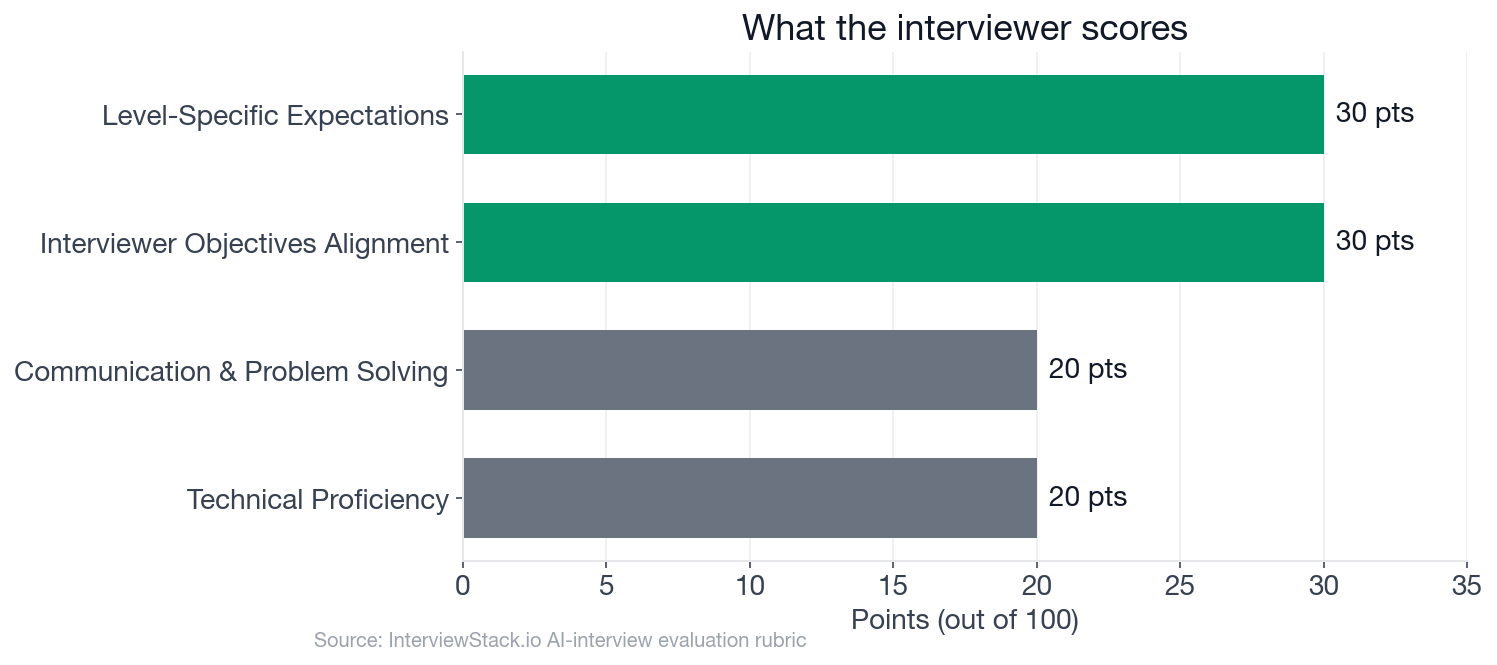
The scoring weights above explain why Turn 4 below is the highest-scoring moment in the whole interview: the leadership-versus-customer pivot sits squarely inside the two dimensions worth 60 of the 100 points.
Four Turns, One Instinct to Chase Hype
Below are 4 of the 6 follow-up prompts from the real blueprint, picked because they trace the same instinct through every phase. Each one hands "Iris," a composite stand-in for common mid-level answers, a chance to either ground the recommendation in real constraints or chase whatever sounds most advanced. Watch the pattern repeat until leadership itself starts pushing the same direction.
Turn 1: Comparing Options, Not Just Picking One
Interviewer: "What alternatives would you consider before committing to your recommendation, and how would you compare them objectively?"
Turn 2: Scoping a Version That Can Actually Ship
Interviewer: "How would you design the first production version so it can ship within one or two quarters without creating major reliability or compliance risk?"
Turn 3: Proving Value, Not Just a Good Demo
Interviewer: "What data, offline evaluation, and online metrics would you use to decide if the capability is genuinely valuable rather than just impressive in demos?"
Turn 4: When Leadership Wants the Bigger Bet
Interviewer: "Suppose leadership is excited about fully autonomous agents, but customers are nervous about trust and control. How would that change your proposal?"
What Happens When the Interviewer Changes the Ask at Minute 27?
Each of Iris's four answers looks reasonable in isolation. That's the point: on the page, with the mistake already labeled red, the fix is obvious. In a real 30-minute room, nothing is labeled, and you don't get time to research how anyone else has handled this exact trade-off before you answer. You're holding a scope you already committed to and a metric you already defined, and then the interviewer hands you a stakeholder conflict with three minutes left on the clock. Recognizing that leadership's excitement is not a reason to abandon the guardrails you argued for ten minutes earlier, in real time, without a hint, is a different skill than reading a critique after the fact. That gap only closes with reps under real time pressure and unscripted follow-ups, which is exactly what a live AI Engineer emerging technology mock interview forces you to practice.
The Blueprint Runs From Recommendation to Defense in Four Phases
A strong candidate doesn't just avoid Iris's four mistakes individually. The recommendation from minute one still has to be recognizable at minute thirty: scoped down under pressure, but never abandoned. Below is the exact blueprint used to grade this interview, phase by phase.
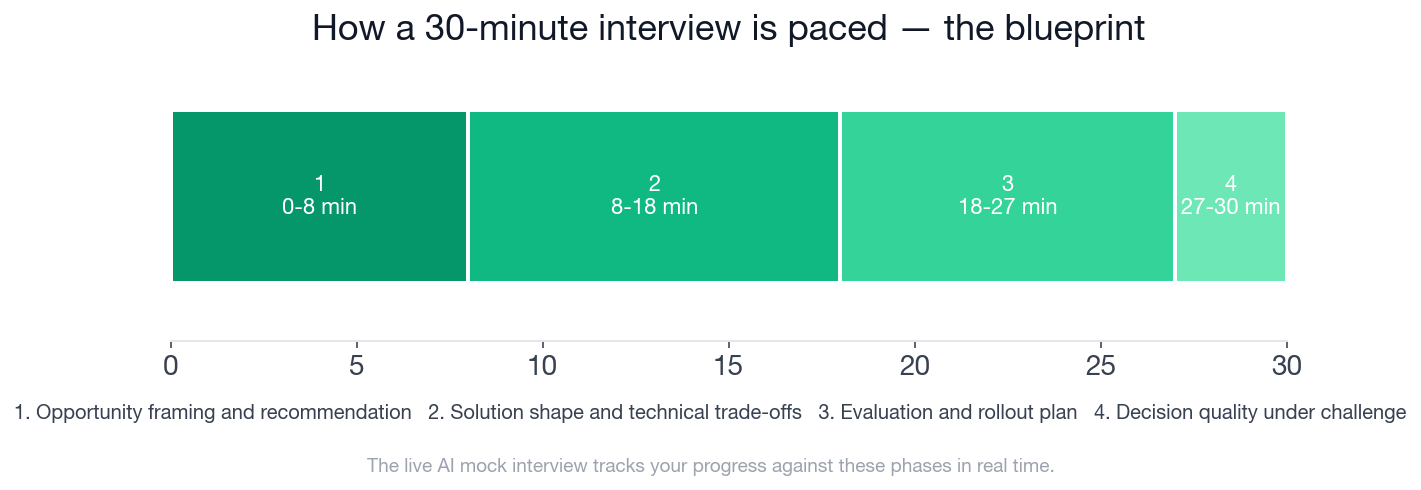
The 30-minute session is paced into four phases, from the opening recommendation through defending it under a stakeholder challenge, each with its own checklist.
- ✓Clarifies or states assumptions about target users such as end users, support teams, or admins
- ✓Chooses a specific direction such as assisted workflow automation, constrained agentic actions, proactive knowledge synthesis, or admin copilots
- ✓Explains why this is a better near-term bet than more speculative alternatives
- ✓References enterprise constraints like privacy, permissions, trust, or deployment risk in the initial framing
- ✓Describes a feasible MVP architecture at the right level, for example retrieval plus orchestration plus bounded actions plus logging
- ✓Makes sensible decisions around human-in-the-loop vs autonomy based on trust and risk
- ✓Calls out important inputs such as permissions-aware retrieval, action whitelisting, feedback collection, and observability
- ✓Discusses latency, cost, and reliability as product constraints rather than afterthoughts
- ✓Avoids magical assumptions about model accuracy or enterprise data quality
- ✓Defines offline evaluation signals relevant to the use case, such as task success, factual grounding, action correctness, or time-to-completion proxies
- ✓Defines online metrics tied to behavior or outcomes, such as adoption, task completion rate, support handle time, deflection, or admin hours saved
- ✓Proposes a phased rollout like internal dogfood, limited tenants, high-confidence workflows, or opt-in beta
- ✓Identifies key failure modes such as incorrect actions, stale knowledge, permission leakage, low user trust, or poor workflow fit
- ✓Suggests instrumentation or review loops to diagnose whether issues come from model quality, retrieval, UX, or targeting
- ✓Responds coherently when presented with a conflicting stakeholder priority like leadership hype or customer caution
- ✓Adjusts scope or controls without abandoning the core value proposition
- ✓Ends with a clear recommendation, success criteria, and next validation step
This is the same blueprint InterviewStack.io's AI interviewer tracks in real time. Miss a checklist item and it shows up in your phase-by-phase feedback, not just a final score.
Ready to Defend This Recommendation Under Pressure?
Reading Iris's four mistakes is the easy twenty minutes. The AI Engineer Innovation and Emerging Technology AI mock interview runs you through this exact scenario for real: the interviewer adapts its follow-ups to what you actually say, tracks the blueprint above in real time, and hands you rubric-mapped feedback the moment you finish. If you want to drill the underlying concepts first, opportunity framing, MVP scoping, evaluation design, before taking the full session, the AI Engineer question bank covers innovation and emerging technology questions by difficulty. If LLM application design is your weaker spot generally, we also walked through an AI Engineer generative AI and LLM interview. And if you want to see what teams are hiring AI Engineers for right now, browse current AI Engineer openings or the broader preparation guides library.
FAQ
Q. What does the AI Engineer Innovation and Emerging Technology interview actually cover?
The 30-minute interview covers recommending a concrete emerging AI capability for an enterprise product, comparing it against real alternatives, scoping a shippable first version with human-in-the-loop safeguards, defining offline evaluation signals and online success metrics, naming enterprise failure modes like permission leakage or stale knowledge, and defending the recommendation when a stakeholder pushes for a bigger bet. It is scored across four rubric dimensions: Interviewer Objectives Alignment (30 points), Level-Specific Expectations (30 points), Technical Proficiency (20 points), and Communication and Problem Solving (20 points).
Q. How do I know if an AI capability is genuinely valuable instead of just impressive in a demo?
Pair an offline evaluation signal, such as how often the system's answers stay grounded in the correct source document, with an online metric tied to real behavior, such as adoption, task completion rate, support handle time, or admin hours saved. A demo that gets applause but has no defined threshold for either signal has not actually proven business value yet, and this interview scores that distinction directly.
Q. Should I recommend a fully autonomous agent in this interview?
Not by default. The scenario explicitly sets a low appetite for risky bets and high sensitivity to trust and admin control, so a fully autonomous agent with no human checkpoint is usually the wrong first move even if it sounds the most advanced. A staged approach, human-reviewed actions now with a defined path to more autonomy later, tends to score better because it satisfies both the near-term feasibility checklist item and the enterprise-constraints checklist item.
Q. What failure modes should I mention for an enterprise AI knowledge assistant?
The blueprint's checklist calls out incorrect actions, stale knowledge, permission leakage, low user trust, and poor workflow fit as the key failure modes to name. Strong answers also propose how to detect each one, for example instrumentation or a review loop that can tell whether a problem traces back to model quality, retrieval, UX, or targeting, rather than listing risks with no way to diagnose them.
Q. How do I diagnose moderate adoption with unclear business impact after launch?
Separate the three usual causes before proposing a fix: model quality (the system gives wrong or unhelpful answers), workflow fit (the answers are fine but nobody's workflow actually routes through this tool), and measurement (the tool is working, but the metric tracking it does not capture the value). The interview rewards naming which of the three you would investigate first and how, rather than guessing at a single explanation.
Q. What level is this interview calibrated for, and how long does it run?
It runs 30 minutes and is calibrated for a mid-level AI Engineer (2 to 5 years of experience). You are expected to structure the problem and make a justified recommendation without heavy prompting, propose an MVP with reasonable boundaries and safeguards, and connect technical choices to one or two business metrics, but you are not expected to design a long-term research agenda or invent novel algorithms.
Q. How can I practice this exact interview?
The AI Engineer Innovation and Emerging Technology AI mock interview runs the same scenario with an interviewer that adapts its follow-ups to your actual answers and scores you against the blueprint above. If you want to drill specific concepts first, the AI Engineer question bank breaks the topic down by difficulty.
Hype Doesn't Survive the Follow-Up
An idea that sounds the most advanced and an idea that is actually worth building are not the same claim, and this interview is built to make you prove the difference under a clock. The candidates who score well are not the ones with the most futuristic pitch. They are the ones whose recommendation from minute one still holds up, reshaped but not abandoned, when leadership pushes for more at minute twenty-seven.
Topics
Ready to practice?
Put what you've learned into practice with AI mock interviews and structured preparation guides.