
A $36,900 Gap Built on Two Different Vocabularies
AI Engineer postings pay a median $165,000 US base salary; Business Intelligence Analyst postings pay $128,100, both figures base-only, with no equity, bonus, or sign-on disclosed in postings. That's a $36,900 gap, and it's the number most people ask about first. The more useful story is why the gap exists: these two roles barely speak the same vocabulary. We looked at every active posting for both roles on the InterviewStack.io job board, 5,508 for AI Engineer and 2,750 for Business Intelligence Analyst, and their top-30 skill lists overlap by just 18%.
A note on the data: role classifiers aren't perfect, and a minority of each sample sits at the edges of the role's core definition, AI-training and data-labeling contractor postings on the AI Engineer side, and defense or logistics-analyst titles pulled in by the word "intelligence" on the Business Intelligence Analyst side. Neither shifts the skill picture below; both roles' top skill lists stay squarely on-topic.
LLMs, Generative AI, and Retrieval-Augmented Generation (RAG, the technique of grounding a model's answer in a company's own documents) define what an AI Engineer builds, and none of the three crack Business Intelligence Analyst's top-30 list. Its own vocabulary, Data Visualization, Power BI, Tableau, is just as absent on the AI Engineer side. Two roles filed under "works with data," running on almost entirely separate toolkits.
| AI Engineer | Business Intelligence Analyst | |
|---|---|---|
| Median US base salary (no equity/bonus) | $165,000 | $128,100 |
| Active postings | 5,508 | 2,750 |
| Top skill | Python (66.6%) | Data Visualization (66.4%) |
| Remote + hybrid share | ~57% | ~43% |
| Entry-level share | 5.3% | 5.1% |
| Skill overlap (Jaccard) | 18% shared (pairwise) | 18% shared (pairwise) |
Key Findings
- AI Engineer postings carry a median $165,000 US base salary, a $36,900 (28.8%) premium over Business Intelligence Analyst's $128,100.
- AI Engineer posts roughly double the volume: 5,508 active listings versus 2,750 for Business Intelligence Analyst.
- Skill overlap (Jaccard similarity, the share of skills the two roles' top-30 lists have in common) is just 18%.
- LLMs (39.1%), Generative AI (38.1%), and RAG (37.7%) anchor AI Engineer postings but appear nowhere in Business Intelligence Analyst's top-30 skill list.
- SQL runs backward from what the titles suggest: 65.6% of Business Intelligence Analyst postings ask for it, versus just 18.8% of AI Engineer postings.
- Entry-level access is nearly identical: 5.3% of AI Engineer postings versus 5.1% of Business Intelligence Analyst postings.
- AI Engineer offers more schedule flexibility: ~57% of postings are remote or hybrid, versus ~43% for Business Intelligence Analyst.
- Within AI Engineer's own postings, the title's defining skills, LLMs, RAG, Generative AI, pay within about $7,500 of the role's baseline; Distributed Systems and System Design pay $30,000 or more above it.
Same Data, Two Completely Different Jobs
An AI Engineer spends most of the week building the systems that make a language model useful inside a product: retrieval pipelines, model evaluation, inference endpoints, and the prompts that feed the model. Heavy APIs, CI/CD, and Observability signal production software work with an AI-shaped payload, not research. A Business Intelligence Analyst spends the week closer to the business itself: querying and modeling warehouse data, building dashboards, and turning what the numbers say into something a director can act on. Data Governance and Data Quality showing up as exclusive skills signal a role responsible for whether stakeholders trust the numbers, not just display them. One role ships AI systems. The other ships answers.
Which Skills Do AI Engineer and Business Intelligence Analyst Actually Share?
Both roles lean on Python, cloud infrastructure, and machine learning, but not evenly, and one shared skill runs in the opposite direction from what the job titles imply.
| Skill | AI Engineer | Business Intelligence Analyst |
|---|---|---|
| Python | 66.6% | 39.4% |
| SQL | 18.8% | 65.6% |
| Automation | 34.4% | 20.3% |
| Data Pipelines | 18.5% | 30.0% |
| Machine Learning | 36.3% | 8.4% |
| Azure | 29.5% | 15.1% |
| AWS | 32.6% | 11.1% |
| Monitoring | 28.8% | 11.4% |
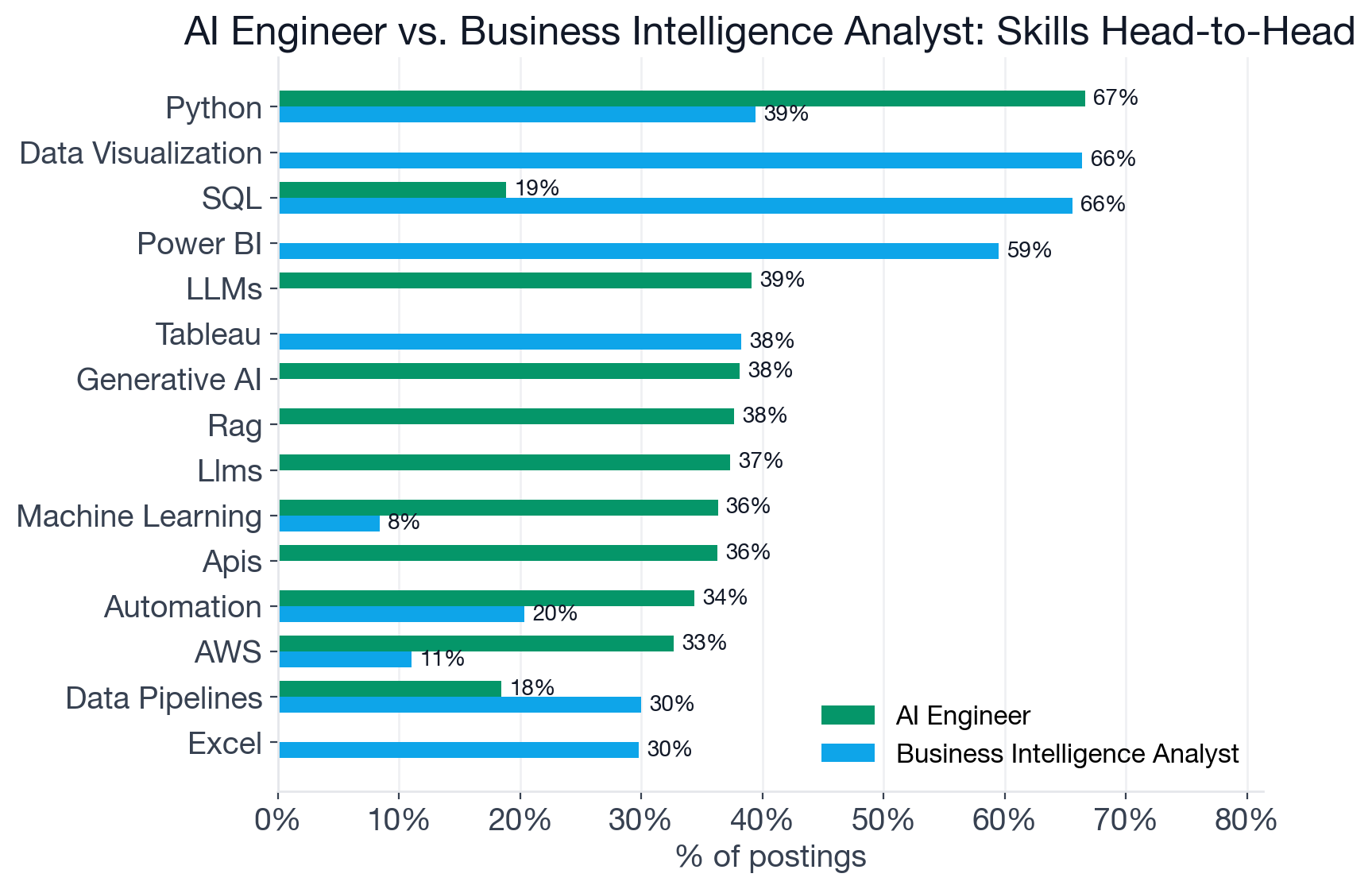 Python is the closest thing to a true bridge skill between the two roles, but it still skews 1.7x toward AI Engineer.
Python is genuinely mutual, and Automation, Azure, AWS, and Monitoring all clear the shared-skill threshold while still skewing toward AI Engineer's cloud stack. SQL is the outlier, running backward from what the titles suggest: 65.6% of Business Intelligence Analyst postings require it, more than 3.5x AI Engineer's 18.8%. An AI Engineer is more likely to call an API that returns data than to write the query that produces it. If you already know SQL well, it transfers cleanly into Business Intelligence Analyst work; it barely registers on the AI Engineer side.
Where the Two Roles Split Completely
AI Engineer's exclusive cluster is entirely about building AI systems: LLMs (39.1%), Generative AI (38.1%), RAG (37.7%), Prompt Engineering (24.3%), and LangChain (22.0%, an open-source framework for chaining LLM calls into applications), none of which appear in Business Intelligence Analyst's top-30 list. Business Intelligence Analyst's exclusive cluster runs the opposite direction, toward presenting and governing data that's already collected: Data Visualization (66.4%), Power BI (59.5%), Tableau (38.2%), Excel (29.8%), and Data Quality (21.3%). For the full skill breakdown behind each role, see AI Engineer Skills Companies Want in 2026 and Business Intelligence Analyst Skills Companies Want in 2026.
This split is real, but it isn't evidence that Business Intelligence Analysts don't touch AI at all. Job postings only list a skill when it's an explicit requirement, and Machine Learning, the closest thing Business Intelligence Analyst has to an AI-adjacent tag, shows up in just 8.4% of postings. That number measures who's hired to build AI systems, not who uses AI tools to do their job. The Stack Overflow 2025 Developer Survey and JetBrains' 2025 developer ecosystem survey put general AI-tool usage (Copilot, ChatGPT, and similar) at 84% or higher across technical roles, with roughly half using them daily. AI Engineer postings measure who gets paid specifically to build AI; they don't measure who's expected to use it, and that expectation is converging across both roles faster than the postings show. Anyone building the AI Engineer stack from scratch can start with InterviewStack's interactive courses.
Which Role Pays More in 2026?
AI Engineer earns a median $165,000 US base salary versus $128,100 for Business Intelligence Analyst, a $36,900 (28.8%) premium. Both figures are base salary only, drawn from US postings where wage-transparency laws produce consistent disclosure; equity, bonus, and sign-on aren't reported in job postings, so total compensation at top employers runs higher than either number.
The surprise: within AI Engineer's own postings, the skills that define the job title don't buy much of a premium. LLMs (+$7,000 over baseline, n=432), RAG (+$6,000, n=403), Generative AI (+$3,600, n=375), and Prompt Engineering (+$0, n=252) all sit within about $7,500 of the $165,000 baseline. Business Intelligence Analyst shows the identical pattern from the other side: Power BI and Excel, the two tools most associated with the job, pay at or below the role's own baseline.
| Skill | Role | Premium vs. role baseline | Sample size |
|---|---|---|---|
| Distributed Systems | AI Engineer | +$35,500 | 78 |
| Vertex AI (Google Cloud's managed ML platform) | AI Engineer | +$30,600 | 54 |
| System Design | AI Engineer | +$30,200 | 77 |
| Power BI | Business Intelligence Analyst | -$3,800 | 253 |
| Excel | Business Intelligence Analyst | -$13,300 | 116 |
| Data Science | Business Intelligence Analyst | +$23,700 | 123 |
| dbt (a SQL-based transformation tool that runs inside the warehouse) | Business Intelligence Analyst | +$21,900 | 65 |
| Looker | Business Intelligence Analyst | +$19,400 | 55 |
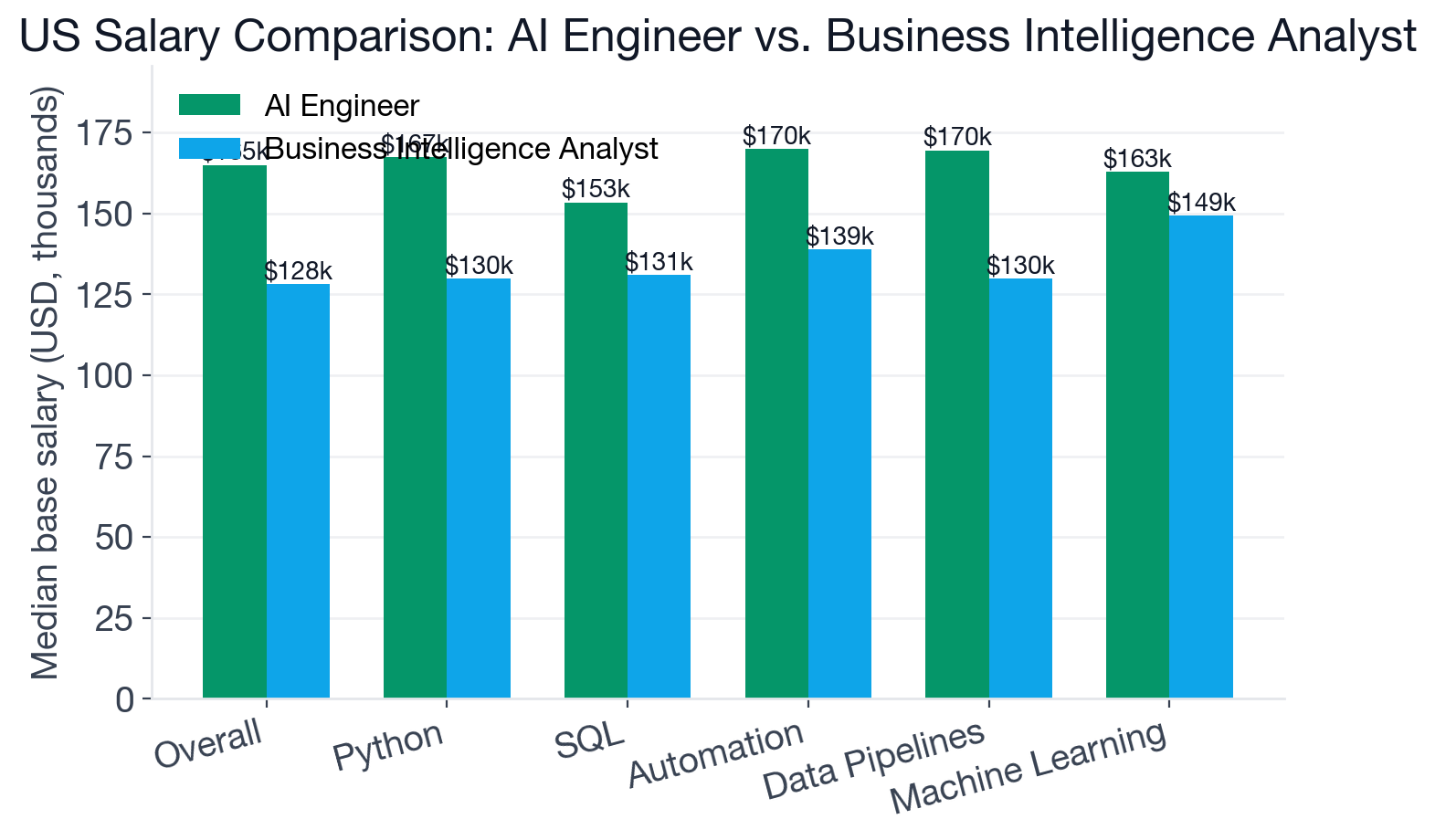 US base salary only; the skills that headline each job title pay flat or below baseline, while the real premium sits one layer down in production or pipeline depth.
Knowing how to call an LLM is the entry ticket for AI Engineer; keeping that system running at scale (Distributed Systems, System Design) is what actually moves the number. For Business Intelligence Analyst, the fastest way to close the gap isn't prompting an LLM, it's the data-engineering layer underneath the dashboard: dbt, Looker, and Data Science all clear a $19K-plus premium over baseline.
Who's Hiring, and How Hard Is It to Break In?
AI Engineer posts roughly double the volume of Business Intelligence Analyst, 5,508 active listings versus 2,750, and spreads across a wider geography: Germany, Canada, the UK, and Singapore all crack its top 10 countries. Business Intelligence Analyst's list leans more toward Brazil (9.6%), consistent with Mercado Libre landing as the role's single largest employer in this dataset at a 2.5% share. Worth flagging: some Mercado Libre postings captured under this role are logistics and operations analyst titles rather than classic BI roles, so that employer's share likely overstates its actual BI hiring. Both roles are similarly US-concentrated (33.8% vs. 32.7%) and within a tenth of a point on India's share (11.5% each).
Where the two roles genuinely converge is entry-level access, and it doesn't favor either one: 5.3% of AI Engineer postings and 5.1% of Business Intelligence Analyst postings are explicitly entry-level, and both sit mostly in the mid-level band (56.4% and 64.8%). AI Engineer does skew more senior overall (38.3% senior-or-staff versus 30.0%) and offers meaningfully more remote and hybrid work (~57% versus ~43%).
Match the Work to the Role You'd Actually Do
Choose AI Engineer if you:
- Want to build and ship AI systems (LLM pipelines, RAG, agents) rather than analyze existing data, and you're fine with LLM skills being the entry ticket, not the pay lift.
- Want more remote and hybrid flexibility: ~57% of postings offer it, versus ~43% for Business Intelligence Analyst.
- Don't mind a role that skews more senior (38.3% senior-or-staff), since the market rewards production-systems depth over AI vocabulary alone.
Choose Business Intelligence Analyst if you:
- Want to work close to business stakeholders, translating data that's already collected into a decision, rather than building the systems behind it.
- Already have strong SQL and visualization chops (Power BI, Tableau) and would rather build the data-engineering layer underneath (dbt, Snowflake, BigQuery) than pivot into AI/ML engineering.
- Aren't choosing based on an easier entry bar: at 5.1% entry-level share, it's statistically the same door as AI Engineer, not an easier one.
Either path benefits from realistic practice first. InterviewStack's AI mock interviews cover both tracks, and its Question Bank has focused drills for SQL, LLM system design, and dashboard-to-decision reasoning. If Business Intelligence Analyst is the closer fit, Data Analyst vs Business Intelligence Analyst is a tighter comparison with a much smaller pay gap.
FAQ
Q. How much more does an AI Engineer earn than a Business Intelligence Analyst in 2026?
AI Engineer postings show a median US base salary of $165,000, versus $128,100 for Business Intelligence Analyst, a $36,900 (28.8%) premium. Both figures are base salary only; equity and bonus are not disclosed in job postings.
Q. Do AI Engineer and Business Intelligence Analyst share any skills?
Some, but the overlap is thin. Skill overlap (Jaccard similarity) between the two roles' top-30 skill lists is just 18%. Python is the closest thing to a shared foundation, appearing in 66.6% of AI Engineer postings versus 39.4% of Business Intelligence Analyst postings, though even that skews heavily toward AI Engineer.
Q. Does SQL matter for AI Engineer roles?
Less than the title suggests. SQL appears in just 18.8% of AI Engineer postings, compared to 65.6% of Business Intelligence Analyst postings, where it functions as table stakes. SQL clears the threshold to count as a shared skill by frequency, but the direction of that overlap runs opposite to what the job titles imply.
Q. Do Business Intelligence Analysts need to know AI or machine learning?
Explicit AI-build skills like Generative AI, RAG, and prompt engineering do not appear in Business Intelligence Analyst's top-30 skill list at all; the closest proxy, Machine Learning, shows up in just 8.4% of postings. That measures who is hired to build AI systems, not who uses AI tools day to day. The Stack Overflow 2025 Developer Survey puts general AI-tool usage at 84% or higher across technical roles, so ambient use, like Power BI Copilot or ChatGPT for query drafting, is a separate and much larger number.
Q. Which role has more open positions in 2026?
AI Engineer, by a wide margin. This dataset shows 5,508 active AI Engineer postings versus 2,750 for Business Intelligence Analyst, roughly double.
Q. Which skills actually pay a premium within AI Engineer postings?
Not the ones in the job title. LLMs, RAG, and Generative AI, the skills that literally define the role, sit within about $7,500 of the role's $165,000 baseline. The larger premiums show up one layer down, in skills like Distributed Systems (plus $35,500) and System Design (plus $30,200).
Q. Is Business Intelligence Analyst an entry-level friendly role?
About as much as AI Engineer is, and no more. Entry-level share is nearly identical for both roles: 5.1% for Business Intelligence Analyst versus 5.3% for AI Engineer. Neither role is an easy first job; both sit mostly in the mid-level band.
The Premium Sits in the Depth, Not the Title
AI Engineer and Business Intelligence Analyst share a market, both count as "data" work at most companies, but almost nothing else: an 18% skill overlap, zero AI-specific crossover, and a $36,900 pay gap that traces to production-systems depth on one side and data-pipeline depth on the other, not to the word AI in a job title. If you're already in one of these roles, raising your ceiling doesn't necessarily mean switching roles. Browse current AI Engineer or Business Intelligence Analyst openings and see which vocabulary you already speak.
Topics
Ready to practice?
Put what you've learned into practice with AI mock interviews and structured preparation guides.