
The Skills Overlap by 82%. The Paycheck Still Splits by $14,500.
Few role pairs we've compared on this dataset share more of their skill list than Data Analyst and Business Intelligence Analyst. Their top-30 skill sets overlap by 82% (a Jaccard similarity score of 0.82, the fraction of skills shared by both roles out of every distinct skill across the two), tying the highest overlap measured in this series so far. Yet the two titles still land on different medians, different market sizes, and a $14,500 gap in base pay, a figure scoped to US base salary only; equity, bonus, and sign-on aren't disclosed in postings and aren't reflected in either number below.
We pulled every active posting for both roles on the InterviewStack.io job board as of July 2026, 8,318 Data Analyst listings and 2,724 Business Intelligence Analyst listings, skills extracted from descriptions with synonyms collapsed. The question here isn't "which skills should I learn": both roles already ask for nearly the same ones. It's what the leftover 18% actually buys, and whether it's worth the smaller, better-paid door over the larger, cheaper one.
| Data Analyst | Business Intelligence Analyst | |
|---|---|---|
| Median US base salary | $115,000 | $129,500 |
| Active postings | 8,318 | 2,724 |
| Top skill | SQL (58.1%) | Data Visualization (67.2%) |
| Entry-level share | 7.1% | 5.2% |
| Remote share | 15.7% | 14.9% |
| Skill overlap (Jaccard) | 82% (pairwise) | 82% (pairwise) |
Key Findings
- Data Analyst and Business Intelligence Analyst postings share 82% of their top-30 skill sets, tying the highest overlap measured across our whole role-comparison series to date.
- Business Intelligence Analyst's median US base salary is $129,500 (n=485) versus Data Analyst's $115,000 (n=1,639), a $14,500 gap; Data Analyst pay sits 11.2% below the BI Analyst median.
- Data Analyst carries 3.05x the job volume of Business Intelligence Analyst (8,318 versus 2,724 active postings).
- Only three skills clear the exclusivity threshold across both roles combined: Process Improvement for Data Analyst (9.8%), and Data Warehouse (9.7%) plus dbt (9.1%) for BI Analyst.
- Power BI, the tool in Business Intelligence's own name, pays $5,900 below the BI Analyst median ($123,600 versus $129,500); dbt (+$17,500) and Snowflake (+$16,800) pay well above it.
- Entry-level share is thin for both roles: 7.1% of Data Analyst postings versus 5.2% of BI Analyst postings.
- Work mode is nearly identical across both roles: roughly 56% onsite, 30% hybrid, 15% remote.
- Generative AI carries a salary premium in both roles (Data Analyst $135,800 median across 71 postings; BI Analyst $147,300 across 27) despite not appearing in either role's top-30 skill list.
A data-quality note on both role definitions: A random sample of titles from this dataset shows meaningful noise on both sides. On the Data Analyst side, a chunk of sampled titles are senior Manager/Director/Principal-level strategy or pharma-research roles that use "data analytics" as a functional descriptor rather than an individual-contributor Data Analyst scope (for example, "Sr Dir Business Insights & Marketing Analytics" and "Scientist, Pharmaceutical Development & Data Analytics"). On the Business Intelligence Analyst side, roughly a third of sampled titles are unrelated defense or government intelligence-analyst postings ("Imagery Intelligence Analyst," "Medical Intelligence Analyst," "Technical Intelligence Analyst") pulled in because the classifier matches on the word "intelligence," not "business intelligence" (a pattern corroborated by defense contractors Booz Allen Hamilton and CACI International appearing among BI Analyst's most frequent employers in this dataset). Both roles' top-20 skill lists stay clean regardless (no defense- or pharma-specific terms show up in either), so the skill-overlap and skill-premium findings below are reliable; treat both median salaries as directionally correct but somewhat inflated upper-bound estimates rather than precise, narrowly-scoped IC-analyst figures.
What These Two Titles Actually Ask You to Do
A Data Analyst gets handed a business question, pulls the data, and builds the chart or dashboard that answers it, usually for a different stakeholder team each sprint (sales one week, finance the next). The work is broad and reactive.
A Business Intelligence Analyst is closer to a platform owner: instead of answering one-off questions, they build and maintain the dashboards and data models everyone else self-serves from. That tracks with the data: Data Warehouse and dbt (a SQL-based tool for transforming and modeling data inside the warehouse) are BI Analyst's only two genuine skill exclusives, both closer to the plumbing than the presentation layer. The BI Analyst is judged on whether the dashboard stays right for a year; the Data Analyst, on whether this week's answer was right.
Which Skills Does Every Posting Expect, Regardless of Title?
Both roles converge on the same five tools before anything else: SQL, Data Visualization, Power BI, Python, and Tableau all clear 30% of postings on both sides, and three of the five clear a majority in at least one role.
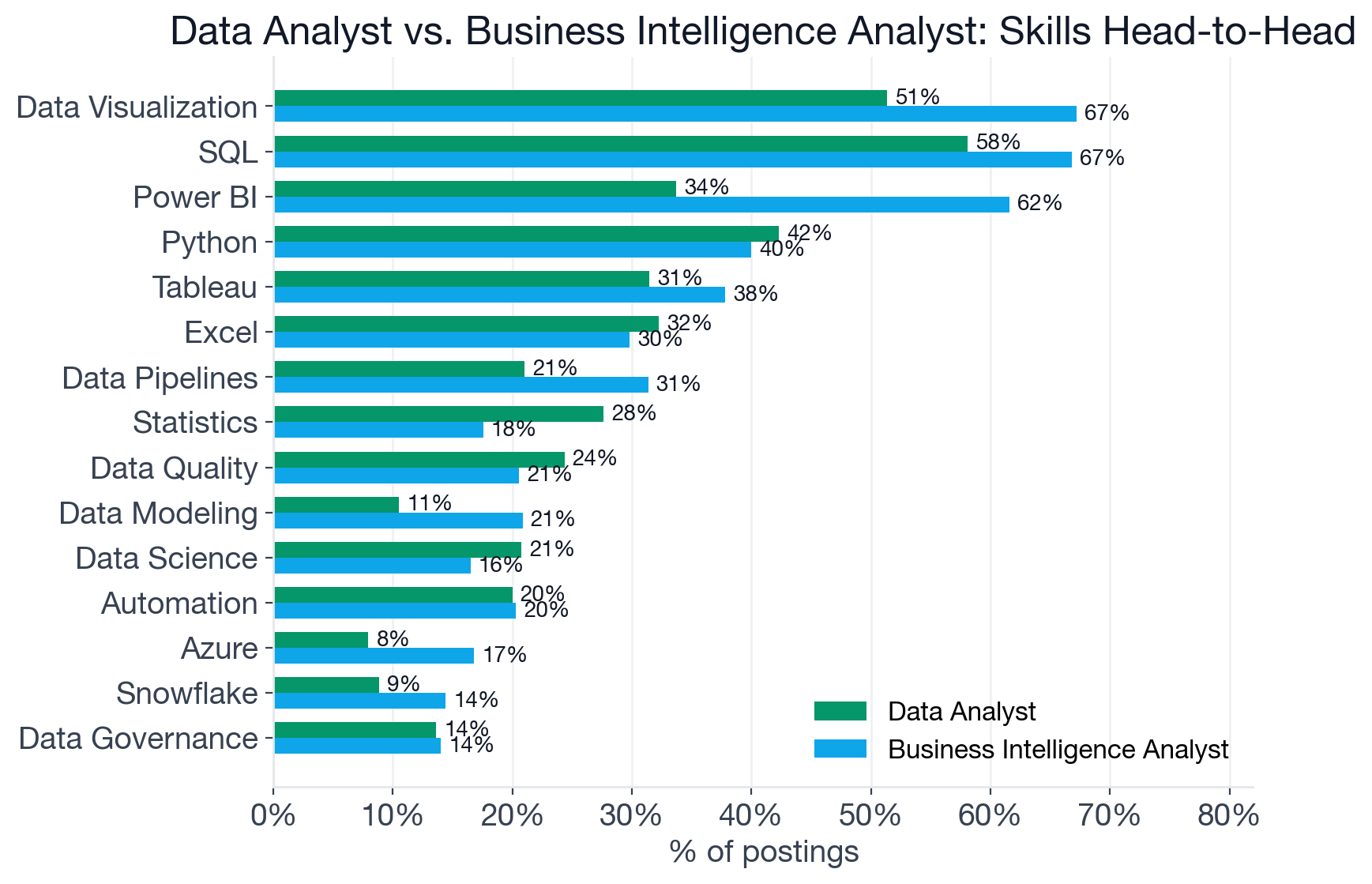
SQL and Data Visualization are functionally tied for the top spot in BI Analyst postings (66.8% versus 67.2%); for Data Analyst, SQL leads by a clearer 6.8-point margin. Power BI is nearly twice as common in BI Analyst postings as in Data Analyst postings.
| Skill | Data Analyst | BI Analyst |
|---|---|---|
| SQL | 58.1% | 66.8% |
| Data Visualization | 51.3% | 67.2% |
| Power BI | 33.7% | 61.6% |
| Python | 42.3% | 40.0% |
| Tableau | 31.4% | 37.8% |
| Excel | 32.2% | 29.8% |
| Data Pipelines | 21.0% | 31.4% |
| Statistics | 27.6% | 17.5% |
If you already have SQL, a visualization tool, and Python, you aren't learning a new toolkit to move between these titles, you're relabeling the one you have. The clearest gap in this shared list is Power BI: 61.6% of BI Analyst postings versus 33.7% for Data Analyst, consistent with BI Analyst owning the platform's build-out rather than just pulling a chart from it. Data Pipelines follows the same pattern (31.4% versus 21.0%).
Where the Two Roles Actually Diverge
Given 82% overlap, there isn't much left over. Only three skills clear the exclusivity bar (present at meaningful frequency in one role, essentially absent in the other): Process Improvement for Data Analyst (9.8% of postings), and Data Warehouse (9.7%) plus dbt (9.1%) for BI Analyst.
That's a thin list, and it's honest about what it says: Data Analyst's one exclusive skill points toward operational, process-facing work embedded across a business, while both of BI Analyst's exclusives point toward the modern data stack, the same layer that our Data Engineer versus BI Analyst comparison found carries BI Analyst's highest-paying skills. The divergence here isn't a different skill set so much as a tilt: BI Analyst leans a few degrees further toward the warehouse, Data Analyst leans a few degrees further toward the business.
Does Business Intelligence Analyst Pay More Than Data Analyst?
Every figure here is scoped to US postings with base pay disclosed; equity, bonus, and sign-on aren't captured in listings, so total comp at well-funded employers runs higher than what's below.
Business Intelligence Analyst carries a $129,500 median US base salary (n=485) against Data Analyst's $115,000 (n=1,639), a $14,500 gap, with Data Analyst sitting 11.2% below the BI Analyst median. That gap opens before either role differentiates on skills: it's baked into the title itself.
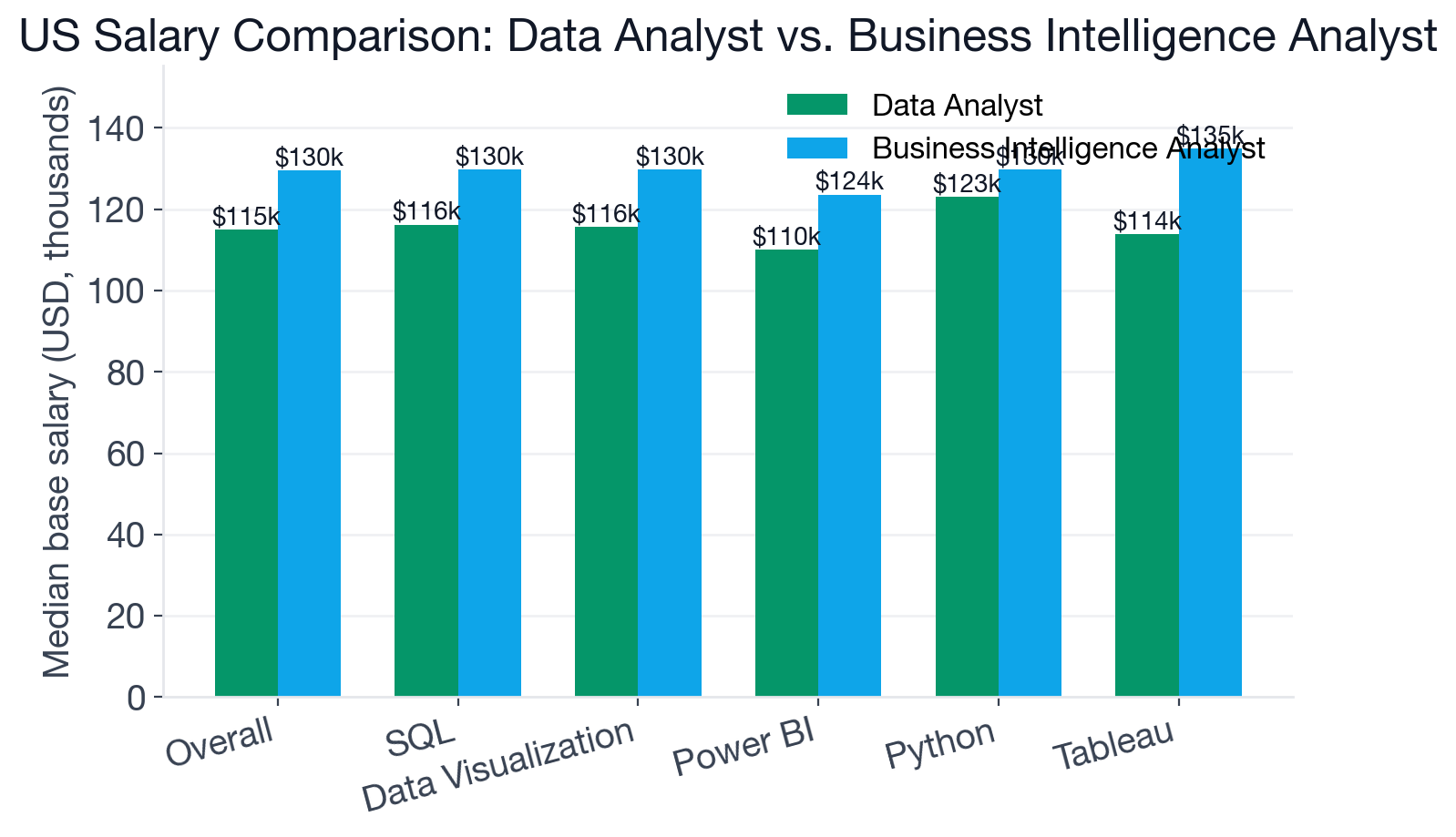
Business Intelligence Analyst's median US base salary sits $14,500 above Data Analyst's, but the skills that pay above each role's own median are nearly identical.
The more interesting number sits inside each role's own salary-by-skill breakdown: the same handful of skills move both baselines the same direction, and the tools carrying the job title itself pay below average. Power BI, the software Business Intelligence Analyst is named after, has a median of $123,600 in BI Analyst postings (n=229), $5,900 below BI's own baseline; in Data Analyst postings, Power BI runs $110,000 (n=458), $5,000 below that role's own baseline. Excel does the same on both sides: $108,400 for BI Analyst (n=105, $21,100 below baseline) and $100,000 for Data Analyst (n=556, $15,000 below baseline).
Data Analyst skills paying above the $115,000 baseline
| Skill | Median US salary | Premium | Sample size |
|---|---|---|---|
| A/B Testing | $146,800 | +$31,800 | 142 |
| dbt | $140,300 | +$25,300 | 120 |
| Generative AI | $135,800 | +$20,800 | 71 |
| Snowflake | $130,000 | +$15,000 | 179 |
| Looker | $130,000 | +$15,000 | 161 |
Business Intelligence Analyst skills paying above the $129,500 baseline
| Skill | Median US salary | Premium | Sample size |
|---|---|---|---|
| CI/CD | $158,200 | +$28,700 | 31 |
| BigQuery | $157,500 | +$28,000 | 27 |
| Looker | $149,500 | +$20,000 | 57 |
| A/B Testing | $148,000 | +$18,500 | 35 |
| dbt | $147,000 | +$17,500 | 66 |
Generative AI follows the same above-baseline pattern in both roles, but it's the clearest case of why a low posting percentage doesn't mean a skill is rare in practice. It shows up explicitly in only 71 of Data Analyst's 8,318 postings (0.9%) and 27 of BI Analyst's 2,724 (1.0%): an explicit-build requirement, not a baseline one. That's the wrong number to read as "how many of these people use AI." Independent surveys put ambient AI tool use, Copilot, ChatGPT, natural-language querying inside Power BI, at 84% adoption and 51% daily use among people who write code and build reports for a living. Job postings stay quiet on that layer for the same reason they've always stayed quiet on Excel's AutoSum: it's assumed, not requested. Power BI itself is retiring its legacy natural-language search feature for Copilot by the end of 2026, so BI Analyst's exposure to that layer is about to stop being optional.
Which Role Is Easier to Break Into?
Data Analyst is the bigger, faster-moving market by a wide margin: 8,318 active postings versus 2,724 for BI Analyst, a 3.05x volume gap. That shows up in absolute entry-level openings too. 592 Data Analyst postings are tagged entry-level against 141 for BI Analyst, more than four times as many, even though Data Analyst's entry-level rate (7.1%) isn't dramatically higher than BI Analyst's (5.2%).
Every other structural cut looks close to identical. Seniority mix tracks within a couple of points (mid-level 61.5% versus 63.2%; senior 23.9% versus 23.1%; staff 7.4% versus 8.6%). Work mode is essentially the same too: onsite dominates both at roughly 56%, hybrid sits near 30%, remote is 15.7% versus 14.9%. Geography agrees at the top too, the US leads both (37.3% versus 33.2%) and India is the clear second for both (11.8% versus 12.4%), with one modest divergence below that: Data Analyst's next market is the UK (4.6%), BI Analyst's is Brazil (7.5%).
Which Should You Choose?
Choose Data Analyst if you:
- Want the larger, more accessible job market: 8,318 active postings versus 2,724, roughly 3x the pool to apply into.
- Are earliest in your career: 592 entry-level Data Analyst postings exist right now versus 141 for BI Analyst, over four times as many.
- Haven't built data-warehouse or dbt experience yet: Data Analyst postings rarely name either as a requirement, so you can grow into that layer on the job.
Choose Business Intelligence Analyst if you:
- Want the higher baseline pay: $129,500 median US base versus $115,000, a $14,500 gap before any specialization.
- Already have, or want to build, data-modeling and warehouse skills: dbt and Data Warehouse are BI Analyst's only two genuine skill exclusives; dbt pays $17,500 above the role's own median, though Data Warehouse itself sits slightly below it ($127,300 versus the $129,500 baseline).
- Are fine with a smaller, slower-to-fill market in exchange for the higher floor: the seniority mix and entry bar are barely different from Data Analyst's.
How to Use This in Your Job Search
Practice the stakeholder-facing question both roles get asked, "walk me through how you'd investigate a metric drop," with AI mock interviews tuned to whichever title you're prepping for.
To close the one gap that's real, drill dbt and data-modeling questions in the Question Bank, and use our interactive courses to build warehouse foundations from zero. Then browse live Data Analyst postings or Business Intelligence Analyst postings filtered to skills you already have, and read our deeper breakdowns of Data Analyst skills and Business Intelligence Analyst skills.
FAQ
Q. What's the salary difference between Data Analyst and Business Intelligence Analyst in 2026?
Business Intelligence Analyst carries a $129,500 median US base salary (n=485) versus Data Analyst's $115,000 (n=1,639), a $14,500 gap. Equity, bonus, and sign-on aren't disclosed in job postings and aren't reflected in either figure.
Q. Do Data Analyst and Business Intelligence Analyst postings really require the same skills?
Almost entirely, yes. The two roles share 82% of their top-30 skill sets (the Jaccard overlap coefficient), tying the highest similarity measured across this comparison series so far. SQL, Data Visualization, Power BI, Python, Tableau, and Excel all clear meaningful frequency in both.
Q. Which role has more job openings in 2026?
Data Analyst, by a wide margin. There are 8,318 active Data Analyst postings versus 2,724 for Business Intelligence Analyst, a 3.05x volume advantage.
Q. Is Business Intelligence Analyst harder to break into than Data Analyst?
Slightly, on both counts that matter. Entry-level postings make up 7.1% of Data Analyst listings versus 5.2% for BI Analyst, and because the overall BI Analyst market is roughly a third the size, there are fewer entry-level openings in absolute terms too (592 versus 141).
Q. Which specific skills actually pay more within these roles?
The same skills move both baselines in the same direction. dbt, Snowflake, Looker, and A/B Testing all sit well above each role's own median, while Power BI and Excel, the tools most associated with each title, pay below their role's baseline. dbt adds roughly $25,300 to the Data Analyst median and $17,500 to the Business Intelligence Analyst median.
Q. Do these roles require AI or machine learning skills?
Not as a baseline requirement for either. Generative AI doesn't clear the top-30 skill list for Data Analyst or BI Analyst; it only shows up in the salary-premium data for a small slice of postings (Data Analyst: $135,800 median across 71 postings; BI Analyst: $147,300 across 27). That's an explicit-build requirement, not a measure of who uses AI tools day to day. Industry surveys put ambient AI tool adoption, Copilot, ChatGPT, and similar, at 84% among people who write code and build reports for a living.
Q. Should I apply as a Data Analyst or a Business Intelligence Analyst?
If you want the larger, more accessible job market and don't yet have data-warehouse or dbt exposure, Data Analyst is the faster way in. If you already have (or want to build) data-modeling and warehouse skills and want the higher baseline pay in a smaller but well-compensated market, target Business Intelligence Analyst.
It's the Title That Changes, Not the Skills
Whatever title ends up on the offer letter, the toolkit barely moves: SQL, a BI tool, Python, and a warehouse show up in both descriptions at similar rates. What actually changes is which market you're competing in and what that market calls the same $14,500. Browse live Data Analyst openings or Business Intelligence Analyst openings on the InterviewStack.io job board to see which postings match what you already know.
Topics
Ready to practice?
Put what you've learned into practice with AI mock interviews and structured preparation guides.