
ASQ CQE Never Once Shows Up in a Test Automation Engineer Posting
Every one of the 341 postings that mention the ASQ Certified Quality Engineer (CQE) credential in this window sits inside a QA Engineer listing. Not one sits inside a Test Automation Engineer listing, even though Test Automation Engineer supplies close to 1 in 8 of the postings scanned. For a role label that, on paper, covers both manufacturing quality work and software test automation, that is a clean, almost surgical split.
We looked at 12,646 active QA Engineer and Test Automation Engineer postings on the InterviewStack.io job board over a 90-day window, scanning each description for ASQ CQE mentions and how the posting frames them. ASQ CQE, issued by ASQ (the American Society for Quality), is built around statistical process control, root cause analysis, and manufacturing quality systems, not test scripts or CI pipelines, and the postings that mention it read exactly that way.
The skill list, the employer roster, and this role split all point the same direction: toward factories, not sprints. ASQ CQE shows up in 2.7% of postings across the two-role scope, concentrated entirely in the QA Engineer bucket. If Test Automation Engineer mentioned it at the same rate QA Engineer does, we would expect roughly 45 mentions. The actual count is zero.
Key Findings
- ASQ CQE appears in 2.7% of the 12,646 QA Engineer and Test Automation Engineer postings scanned (341 mentions).
- All 341 mentions sit inside QA Engineer postings; zero appear in Test Automation Engineer postings, versus roughly 45 expected if the rate matched QA Engineer's.
- Only 3.1% of classified mentions (7 of 224) treat ASQ CQE as required, about 1 in 32; the rest call it preferred.
- The headline US base salary comparison looks almost flat (-1.4%), but the real gap is 8.8% lower at mid-level and 11.3% lower at senior level, six to eight times larger than the headline number.
- About 84% of the top employers naming ASQ CQE make physical products: medical devices, aerospace and defense hardware, or industrial equipment.
- Six Sigma (60.1%), Quality Management (58.4%), and Quality Assurance (47.8%) are the three most common skills alongside ASQ CQE mentions.
- ASQ CQE almost never stacks with another certification; only 1 of 341 mentions also names one (ISTQB).
| Role | Postings Scanned | ASQ CQE Mentions | Mention Rate | Share of All Mentions |
|---|---|---|---|---|
| QA Engineer | 11,160 | 341 | 3.1% | 100% |
| Test Automation Engineer | 1,486 | 0 | 0% | 0% |
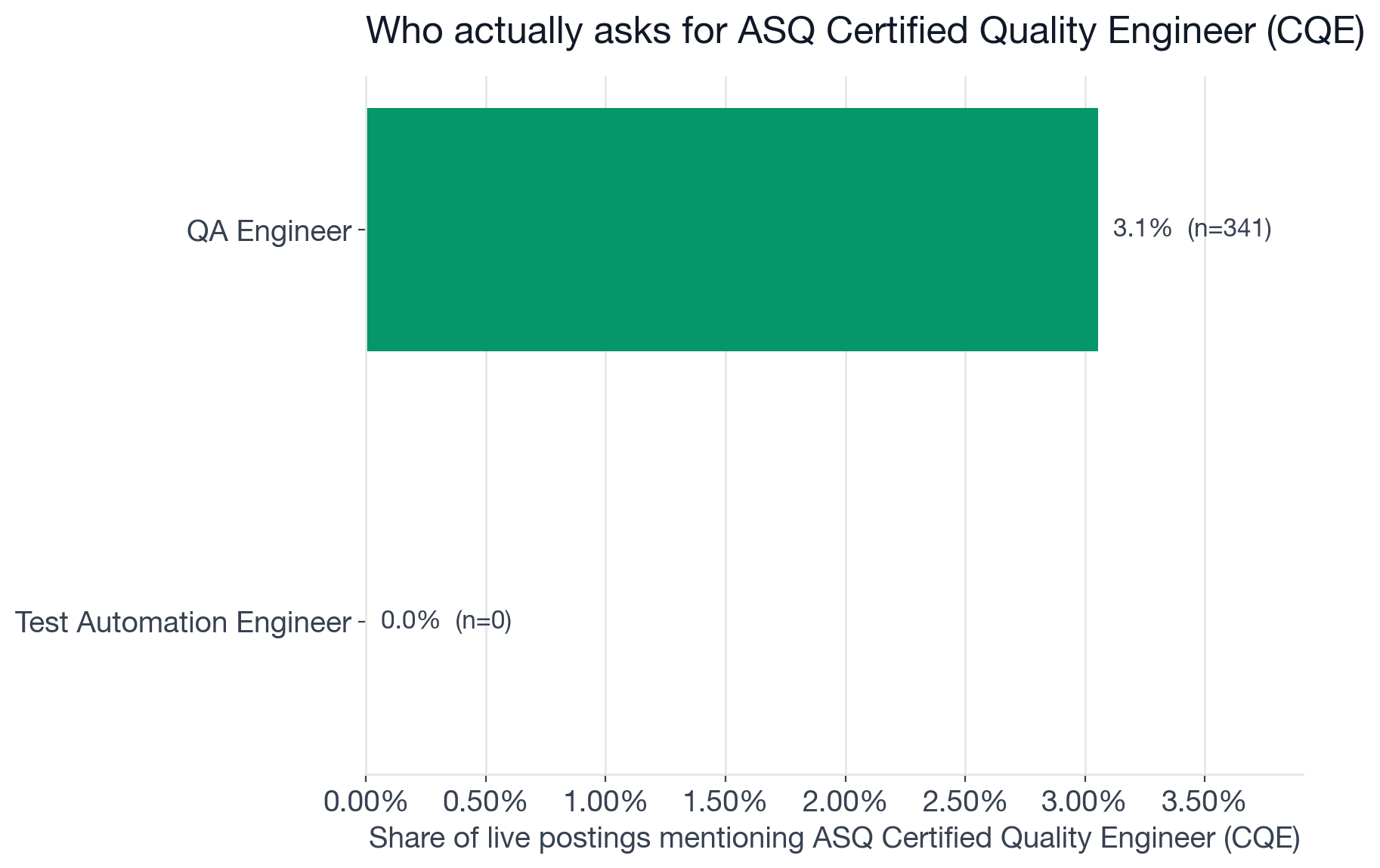
QA Engineer is already the larger role in this scope, 88.2% of the 12,646 postings scanned, so some concentration there is expected. What is not expected is a hard zero on the other side. Test Automation Engineer supplies 11.8% of the combined posting pool; if ASQ CQE showed up there at the same 3.1% rate it does in QA Engineer postings, that would be about 45 mentions. The real count is zero, which is a stronger claim than "QA Engineer mentions it more." Read plainly, it looks like QA Engineer and Test Automation Engineer are pulling from genuinely different hiring populations here, not just different rates on the same one.
If you are weighing which role fits your background, the QA Engineer skill profile and the Test Automation Engineer skill profile are the fuller picture beyond this one certification.
The Skills Behind ASQ CQE Mentions Point to the Factory Floor
The skill list attached to ASQ CQE mentions reads like a manufacturing quality-engineering syllabus, not a software-testing one. Six Sigma, the defect-reduction methodology built around statistical process control, appears in 60.1% of ASQ CQE-mentioning postings. Quality Management (58.4%) and Quality Assurance (47.8%) sit close behind, and Root Cause Analysis (43.7%) rounds out the top tier alongside Quality Control (34.9%).
| Skill | Share of ASQ CQE-Mentioning Postings |
|---|---|
| Six Sigma | 60.1% |
| Quality Management | 58.4% |
| Quality Assurance | 47.8% |
| Root Cause Analysis | 43.7% |
| Quality Control | 34.9% |
| Statistical Process Control (SPC) | 32.3% |
| Process Improvement | 27.9% |
| CAPA | 27.3% |
| Data Analysis | 22.6% |
| Statistics | 22.3% |
What is more telling is what is missing. None of the usual software-testing vocabulary, test automation, Selenium, API testing, CI/CD, appears anywhere in the top 20 skills tied to ASQ CQE mentions. In its place: statistical process control, SPC for short, the use of control charts to monitor a manufacturing process for drift; CAPA, short for corrective and preventive action, the formal defect-investigation process used across FDA- and ISO-regulated manufacturing; Lean Manufacturing (14.4% of mentions); and Calibration (7.9%). That is the vocabulary of an engineer keeping a production line inside tolerance, not one keeping a build green.
Cert-stacking is nearly nonexistent here, too. Only 1 of the 341 ASQ CQE mentions in this dataset also names another certification: ISTQB, a software-testing credential this series has covered separately. That single overlap is 0.3% of ASQ CQE mentions, about as close to zero as any certification pair logged in this series. Whatever these two credentials are certifying, it mostly is not the same job. If you want to see the Six Sigma or statistical process control postings directly, both are filterable on the job board.
Which Industries Are Actually Asking for ASQ CQE?
Roughly 84% of the mentions in the table below come from companies that manufacture a physical product. That is a genuinely different employer roster than most of what this series has covered, where federal IT contractors or software consultancies usually dominate.
| Company | Postings Mentioning ASQ CQE |
|---|---|
| Abbott Laboratories | 12 |
| Eaton Corporation | 11 |
| Danaher | 10 |
| Leidos | 9 |
| Corning | 8 |
| Leonardo DRS | 7 |
| Zimmer Biomet | 7 |
| Joby Aviation | 7 |
| CACI International | 6 |
| Northrop Grumman | 6 |
| Cirrus Aircraft | 6 |
| Anduril Industries | 6 |
Three groups make up almost the whole table. Medical device and life-sciences manufacturers, Abbott Laboratories, Danaher, and Zimmer Biomet, account for 30.5% of the kept mentions. Aerospace and defense hardware makers, Leonardo DRS, Joby Aviation, Northrop Grumman, Cirrus Aircraft, and Anduril Industries, account for 33.7%, the largest single cluster. Industrial manufacturers, Eaton Corporation and Corning, add another 20.0%. Combined, these three physical-product groups supply 84.2% of the mentions in this table. The remainder, 15.8%, comes from Leidos and CACI International, government-technology and defense-services contractors, the smaller slice here after dominating the employer roster on several other certifications this series has covered.
The mechanism is straightforward: ASQ CQE certifies competence in manufacturing quality systems, and the companies that need that competence build things you can hold, medical devices under FDA oversight, aircraft and defense hardware under strict tolerances, industrial equipment on a production line. None of that maps naturally onto a software company's QA org, and the employer roster confirms it.
What Fraction of ASQ CQE Mentions Are Actually Mandatory?
Not many. Of the 341 postings that mention ASQ CQE, 224 use wording specific enough to classify as required or preferred; the other 117 (34.3%) do not specify either way and are excluded from the ratio below. Within that classified group, only 7 postings (3.1%, about 1 in 32) state ASQ CQE as a required qualification.
| Classification | Mentions | Share of Classified |
|---|---|---|
| Preferred | 217 | 96.9% |
| Required | 7 | 3.1% |
For a candidate deciding whether the CQE exam is worth sitting, the practical read is blunt: not holding it disqualifies you from almost none of these postings. It functions as a credential employers are glad to see on a manufacturing quality engineer's resume, not a gate they enforce at the application stage.
ASQ CQE's Real Pay Gap Is Six to Eight Times Larger Than the Headline Number
All salary figures here are advertised US base pay on the subset of postings that disclose it, not total compensation. Equity, bonus, and non-US postings are excluded, and the comparison baseline throughout is other postings in the same QA Engineer and Test Automation Engineer scope that do not mention ASQ CQE, not the whole market.
Postings that mention ASQ CQE advertise a median US base salary of $109,980, versus $111,500 for postings in the same scope that do not mention it (n=154 with ASQ CQE, n=3,157 without), a gap of just 1.4%. Taken at face value, that reads as basically no effect. It is not the honest number. Split by seniority level, the real gap is far larger everywhere it can be measured.
| Seniority Level | Without ASQ CQE (Median US Base) | With ASQ CQE (Median US Base) | Difference | n (with / without) |
|---|---|---|---|---|
| Entry | $72,500 | Not reportable (n=2) | N/A | 2 / 101 |
| Mid-level | $101,675 | $92,700 | -8.8% | 91 / 2,113 |
| Senior | $132,900 | $117,900 | -11.3% | 45 / 601 |
| Staff | $145,310 | Not reportable (n=16) | N/A | 16 / 342 |
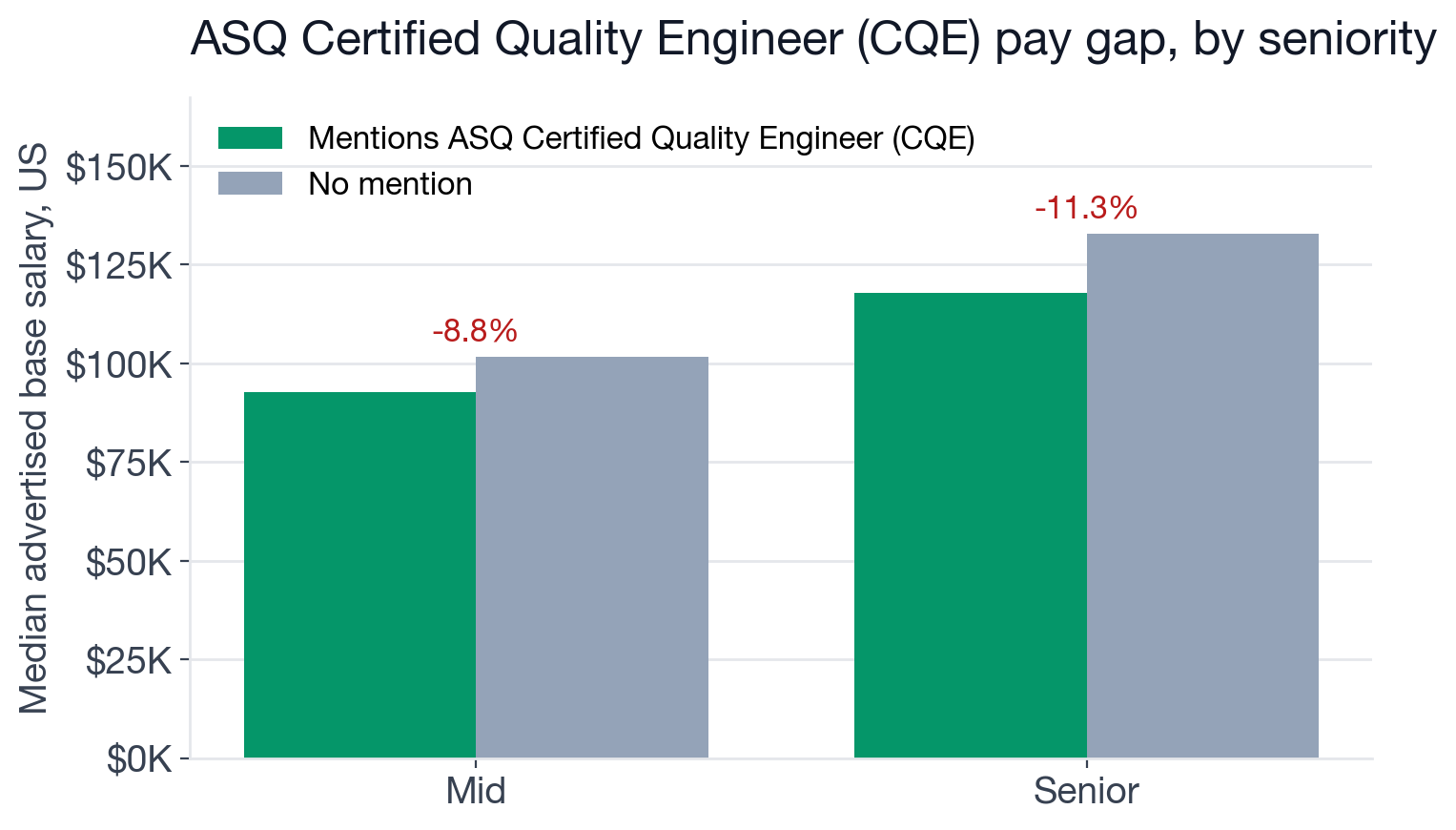
Mid-level and senior are the two bands with enough ASQ CQE-tagged salaries to trust (n=91 and n=45), and both show a real, meaningfully larger gap than the aggregate: 8.8% at mid-level, 11.3% at senior, roughly six to eight times the size of the flat 1.4% headline number. Entry (n=2) and staff (n=16) both fall short of the 25-posting floor we require before reporting a median on the ASQ CQE side.
The reason the flat aggregate and the much larger level-matched gaps can both be true comes down to composition. ASQ CQE-mentioning postings are almost entirely mid-level and senior (93.3% combined) and nearly skip the entry band (0.6% versus 3.6% for non-mentioning postings), which is the cheapest tier at a $72,500 median. That shift, away from the lowest-paid band, pulls the ASQ CQE aggregate up relative to a population that still carries a normal share of entry-level postings, which is why the aggregate understates what the same-level comparison actually shows.
One methodology note applies to that composition argument: seniority here is inferred from title keywords, and a posting with no explicit level word defaults to mid-level, which can compress the measured entry and senior counts on both sides of the comparison. A majority of the sampled ASQ CQE-mentioning titles are bare ("Quality Engineer," "Quality Manager," "Quality Specialist") without an explicit level marker, so the true entry-level share could be somewhat higher than the 0.6% reported here. That said, a near-zero entry-level presence is independently plausible for this credential: ASQ's own CQE eligibility rules require several years of quality-related work experience, which would keep genuinely entry-level postings from asking for it regardless of how the classifier reads the title.
A second piece of the story sits in the role split covered above. Test Automation Engineer, the software-leaning half of this scope, carries a higher non-mentioning baseline ($117,000 median) than QA Engineer overall ($110,800 median). Since ASQ CQE mentions sit entirely in QA Engineer postings, the comparison group they are measured against includes that higher-paying, software-leaning slice of the market. A manufacturing-heavy certification compared against a benchmark that includes better-paying software-adjacent postings is a plausible, though not fully provable, piece of why the real gap runs negative at every level that can be measured.
Deciding Whether ASQ CQE Fits Your Next Move
If you already work in manufacturing quality engineering, or you're deciding whether to move into it, ASQ CQE is squarely aimed at that track: statistical process control, root cause analysis, CAPA, and Lean Manufacturing are what these postings actually ask for, not test automation frameworks. It is worth having on a resume for that work. It will not open a door that a lack of it would otherwise close, since only 1 in 32 classified mentions treat it as required, and it shows no presence at all in Test Automation Engineer postings, so it is not a credential to add if you are targeting software test automation roles.
To prepare for interviews where root cause analysis, process control, or a CAPA investigation comes up, practice with AI mock interviews that simulate real quality-engineering scenarios rather than certification trivia. The Question Bank is a faster way to drill specific topics like Six Sigma methodology, statistical process control, and root cause analysis frameworks that show up across ASQ CQE-adjacent postings. If your statistics or process-improvement fundamentals need work before you apply, InterviewStack's interactive courses cover the underlying concepts these postings actually test for. When you are ready to apply, browse current openings in QA Engineer or Test Automation Engineer, or browse across both roles at once.
FAQ
Q. What share of QA Engineer and Test Automation Engineer postings mention ASQ CQE?
About 2.7% of the 12,646 active postings scanned across both roles mention ASQ CQE (341 postings). Every one of those mentions sits inside a QA Engineer posting; none appear in Test Automation Engineer postings.
Q. Is ASQ CQE usually required, or just preferred?
Almost always preferred. Of the 224 ASQ CQE mentions specific enough to classify, only 7 (about 1 in 32) state it as a hard requirement, and the other 217 call it preferred. A further 117 mentions don't specify either way and are excluded from that ratio.
Q. Does ASQ CQE ever appear in Test Automation Engineer postings?
Not in this dataset. Test Automation Engineer accounts for 1,486 of the 12,646 postings scanned (about 11.8%), and none of them mention ASQ CQE. If it appeared at the same 3.1% rate it does in QA Engineer postings, we would expect roughly 45 Test Automation Engineer mentions instead of zero.
Q. Do postings that mention ASQ CQE pay more than ones that don't?
The headline comparison looks almost flat: postings that mention ASQ CQE advertise a median US base salary of $109,980 versus $111,500 for postings in the same two-role scope that don't, about 1.4% lower. That headline number understates the real gap. Within the same seniority level, ASQ CQE postings pay 8.8% less at mid-level and 11.3% less at senior level, roughly six to eight times the size of the flat aggregate.
Q. What kinds of companies actually ask for ASQ CQE?
Mostly manufacturers of physical products, not software or IT firms. Among the top employers naming ASQ CQE, about 84% are medical device makers (Abbott Laboratories, Danaher, Zimmer Biomet), aerospace and defense hardware manufacturers (Leonardo DRS, Joby Aviation, Northrop Grumman, Cirrus Aircraft, Anduril Industries), or industrial manufacturers (Eaton Corporation, Corning).
Q. What skills come up most often in ASQ CQE-mentioning postings?
Six Sigma (60.1%), Quality Management (58.4%), Quality Assurance (47.8%), Root Cause Analysis (43.7%), and statistical process control (32.3%) lead the list, a manufacturing quality-engineering skill set rather than a software-testing one.
Q. Does ASQ CQE commonly appear alongside other certifications?
Almost never. Only 1 of the 341 ASQ CQE mentions in this dataset also names another certification, ISTQB, and that pairing shows up in just 0.3% of ASQ CQE mentions. ASQ CQE holders in this market are not typically stacking credentials.
ASQ CQE Belongs to the Factory Floor, Not the Sprint Board
None of this makes ASQ CQE a weak credential; it just means it is aimed at a specific, identifiable slice of quality work. The postings that mention it come from companies that build medical devices, aircraft, and industrial equipment, ask for statistical process control and root cause analysis rather than test automation, and almost never require it outright even when they name it. If your work sits in manufacturing quality engineering, that lines up with what the exam actually covers. If you are targeting software test automation roles instead, this particular credential has, in this dataset, never once been the thing that got a Test Automation Engineer posting written.
Topics
Ready to practice?
Put what you've learned into practice with AI mock interviews and structured preparation guides.