
ISTQB Is Common to Mention and Rare to Require
The ISTQB Certified Tester certification, issued by the International Software Testing Qualifications Board, shows up in roughly 3 in 100 active QA, test automation, and SDET postings. But showing up and being demanded are two different things. Of the postings specific enough to classify, only 1 in 18 treats the certification as a hard requirement; the other 17 call it preferred, a plus, or nice-to-have. For a credential built around a standardized syllabus and a real exam, that is a strikingly weak gatekeeping signal.
We looked at 13,040 active postings across QA Engineer, Test Automation Engineer, and Software Development Engineer in Test (SDET) roles on the InterviewStack.io job board over a 90-day window, scanning each description for ISTQB mentions and how the posting frames them. SDET contributed no postings in this window under our current role-matching filter, so the breakdown below covers QA Engineer and Test Automation Engineer postings specifically.
The pattern gets more interesting past the aggregate. Test Automation Engineer postings lean on ISTQB nearly twice as hard as plain QA Engineer postings, and the overall pay comparison, essentially flat on its face, hides a real premium once you isolate the one seniority band with enough disclosed salaries to trust.
Key Findings
- ISTQB appears in just 2.9% of QA Engineer, Test Automation Engineer, and SDET postings analyzed (379 of 13,040).
- Only 5.6% of classified mentions (12 of 216) treat ISTQB as required; the other 94.4% call it preferred, exactly 1 in 18.
- Test Automation Engineer postings mention ISTQB in 4.9% of listings versus 2.6% for QA Engineer, roughly 1.9 times as often.
- The overall US base salary comparison is nearly flat ($110,000 with ISTQB vs $110,445 without, a 0.4% gap), but the only seniority band with enough disclosed salaries to compare, mid-level, shows a real 8.7% premium ($110,000 vs $101,200).
- ISTQB-mentioning postings skew more senior overall (32.7% senior or staff vs 25.3% for non-mentioning postings), which is part of why the flat aggregate understates the mid-level number.
- The top three employers naming ISTQB, Kyndryl (12 mentions), CACI International (11), and Steampunk (11), span IT services, federal contracting, and government-technology work.
- CompTIA Security+ is the most common co-occurring certification, and it still appears in just 1.8% of ISTQB-mentioning postings; ISTQB rarely stacks with other credentials.
How Often Does an ISTQB Mention Actually Mean Required?
Almost never. Of the 379 postings that mention ISTQB, 216 use wording specific enough to classify as required or preferred; the other 163 (43.0%) don't specify either way and are excluded from the ratio below. Within that classified group, only 12 postings (5.6%, exactly 1 in 18) state ISTQB as a required qualification.
| Classification | Mentions | Share of Classified |
|---|---|---|
| Preferred | 204 | 94.4% |
| Required | 12 | 5.6% |
For a candidate deciding whether the Foundation Level exam is worth the time, the practical read is blunt: lacking ISTQB disqualifies you from almost none of these postings. It functions as a credential employers are glad to see, not a gate they enforce. That is a different profile from several other certifications in this series that skew required far more often; ISTQB reads closer to a nice signal than a must-have.
Test Automation Engineers Ask for ISTQB Nearly Twice as Often as QA Engineers
Test Automation Engineer postings mention ISTQB in 4.9% of listings; QA Engineer postings mention it in 2.6%. That is about 1.9 times the rate, and it holds even though QA Engineer is by far the larger role here: 11,518 of the 13,040 postings scanned, against Test Automation Engineer's 1,522.
| Role | Postings Scanned | ISTQB Mentions | Mention Rate | Share of All ISTQB Mentions |
|---|---|---|---|---|
| Test Automation Engineer | 1,522 | 75 | 4.9% | 19.8% |
| QA Engineer | 11,518 | 304 | 2.6% | 80.2% |
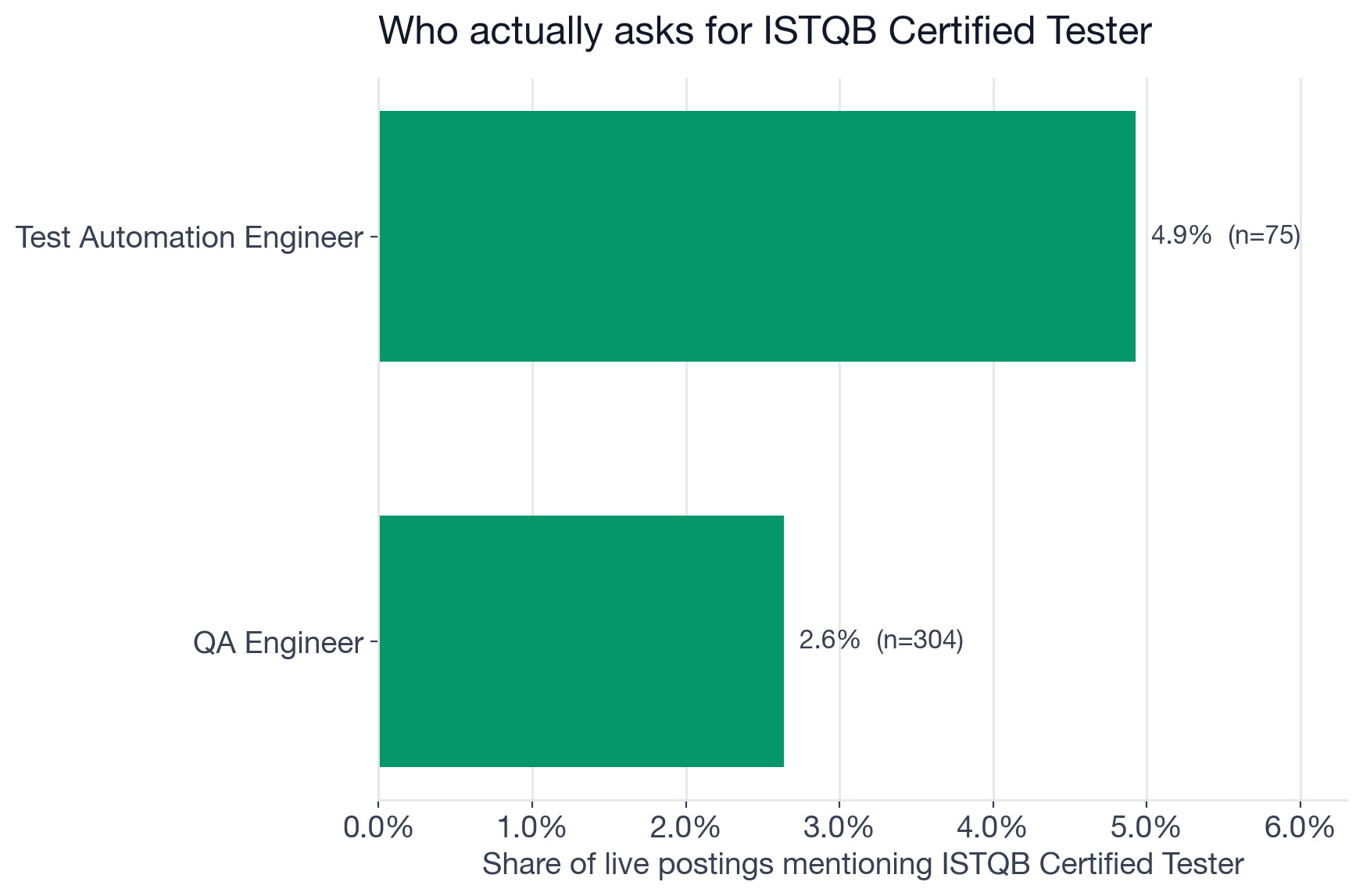
Test Automation Engineer supplies just 11.7% of the combined posting pool but 19.8% of every ISTQB mention, an over-index of about 1.7 times its size. QA Engineer runs close to parity (80.2% of mentions off 88.3% of postings). Volume still favors QA Engineer by a wide margin simply because it is the much bigger role, but rate clearly favors Test Automation Engineer. Read plainly, that fits what a QA Engineer versus Test Automation Engineer comparison would predict: Test Automation Engineer work sits closer to the structured test-design and traceability practices the ISTQB syllabus actually covers, while QA Engineer is a broader title spanning manual, exploratory, and process work alongside automation.
If you are weighing which role to target, the Test Automation Engineer skill profile and the QA Engineer skill profile are the fuller picture beyond this one certification.
ISTQB's Flat Headline Salary Number Hides a Real Mid-Level Premium
All salary figures here are advertised US base pay on the subset of postings that disclose it, not total compensation. Equity, bonus, and non-US postings are excluded, and the comparison baseline throughout is other postings in the same three-role scope that don't mention ISTQB, not the whole market.
Postings that mention ISTQB advertise a median US base salary of $110,000, versus $110,445 for postings in the same scope that don't mention it (n=44 with ISTQB, n=3,345 without), a gap small enough to call flat. Taken at face value, that would suggest the certification does nothing for pay. It doesn't hold up once you split by level, and our data-quality checks flag exactly this: a reversal where the aggregate hides the real story at the one level with enough data to trust.
| Seniority Level | Without ISTQB (Median US Base) | With ISTQB (Median US Base) | Difference | n (with / without) |
|---|---|---|---|---|
| Entry | $72,550 | Not reportable (n=1) | N/A | 1 / 100 |
| Mid-level | $101,200 | $110,000 | +8.7% | 35 / 2,226 |
| Senior | $132,000 | Not reportable (n=6) | N/A | 6 / 655 |
| Staff | $145,000 | Not reportable (n=2) | N/A | 2 / 364 |
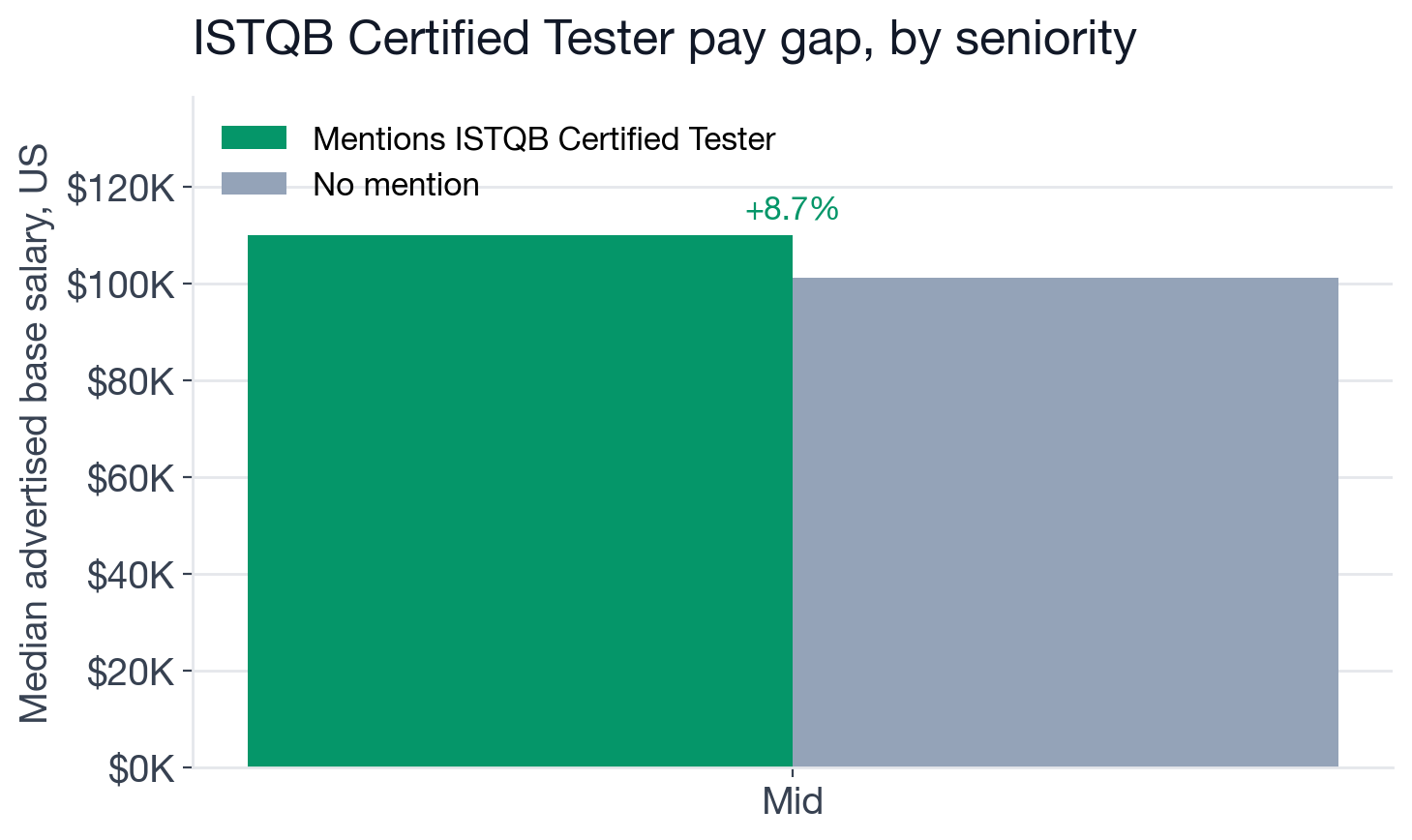
Mid-level is the only band with enough ISTQB-tagged salaries (n=35) to compare directly, and it shows a real premium: $110,000 versus $101,200, up 8.7%. Entry (n=1), senior (n=6), and staff (n=2) all fall well short of the 25-posting floor we require before reporting a median, so those cells aren't reportable on the ISTQB side.
The reason the flat aggregate and the real mid-level premium can both be true comes down to how the two populations are built. Roughly four in five of the salary-disclosing ISTQB postings (35 of 44) are already mid-level, so the ISTQB aggregate sits close to the mid-level number on its own. The non-ISTQB population is far larger and carries a meaningful chunk of senior ($132,000 median) and staff ($145,000 median) postings that pull its own aggregate above its own mid-level figure ($101,200). Comparing the two aggregates side by side ends up comparing a pool that reads almost like mid-level pay alone against a benchmark nudged upward by real senior and staff volume, which understates the level-matched premium that is actually there.
That isn't a seniority-mix story working in ISTQB's favor, either. ISTQB-mentioning postings actually skew more senior overall than non-mentioning postings (32.7% senior or staff versus 25.3%, a mean seniority level of 1.45 versus 1.30), and entry-level representation is thinner (1.3% versus 3.6%). A more senior mix should, if anything, push the aggregate up, not flatten it. The flat headline number is a byproduct of small ISTQB sample sizes at senior and staff, not evidence that a premium doesn't exist there; there simply isn't enough disclosed pay data yet to say what it looks like at those levels. One methodology limit worth flagging: seniority here is inferred from title keywords, and a posting with no explicit level word (a plain "Test Engineer" or "QA Engineer," both common in this dataset) defaults to mid-level, which compresses the measured entry/senior/staff edges in both groups. That mechanical effect doesn't point in a direction that would flip the comparison above, but the true senior-skew gap could differ somewhat from the 32.7%-versus-25.3% figures shown.
ISTQB Hiring Spans IT Consultancies, Federal Contractors, and Regulated Industries
| Company | Postings Mentioning ISTQB |
|---|---|
| Kyndryl | 12 |
| CACI International | 11 |
| Steampunk | 11 |
| Thermo Fisher Scientific | 8 |
| Miratech | 7 |
| CapTech Consulting | 7 |
| Leidos | 7 |
| Atos | 6 |
| Be Shaping The Future | 5 |
| Roche | 5 |
| Exadel | 4 |
| CGM | 4 |
Kyndryl, CACI International, and Steampunk top the list, but no single industry dominates the way it does for some certifications this series has covered. IT-services and consulting firms account for the largest single cluster: Kyndryl, Miratech, CapTech Consulting, Atos, Be Shaping The Future, and Exadel together supply 47.1% of the mentions in this table. These are the firms that staff QA and test automation teams for enterprise clients, and a recognized testing certification is a natural thing to ask candidates for when the work itself is client-facing test delivery.
Federal and government-technology contractors, CACI International, Steampunk, and Leidos, make up another 33.3%. That is a smaller share than the concentration this series has found for several security certifications, where a specific compliance directive effectively drives the credential. ISTQB's presence here reads more like the same process-heavy contracting culture valuing a recognized testing methodology than a formal mandate.
The remaining 19.5% comes from regulated healthcare and life-sciences employers: Thermo Fisher Scientific, Roche, and CGM, most likely CompuGroup Medical, a health-information software vendor. Software that ships inside a medical device, a lab instrument, or a clinical records system typically has to survive a formal validation and traceability process, and ISTQB's structured approach to test design and documentation maps directly onto that kind of work.
What Else Travels Alongside an ISTQB Mention?
CompTIA Security+ is the most common certification to appear alongside ISTQB, and it still shows up in just 1.8% of ISTQB-mentioning postings (7 of 379). No other certification in the dataset clears 1%.
| Certification | Share of ISTQB-Mentioning Postings |
|---|---|
| CompTIA Security+ | 1.8% |
| CCNA | 0.8% |
| TOGAF | 0.5% |
| CISA | 0.3% |
| CompTIA Network+ | 0.3% |
| ASQ Certified Quality Engineer (CQE) | 0.3% |
That is a genuinely different pattern from the security certifications this series usually covers, where a dominant partner credential shows up in a third, half, or more of mentions. ISTQB mostly stands alone. It certifies a testing methodology rather than a security or infrastructure domain, so it doesn't naturally pair with the certification-stacking pattern that shows up elsewhere. If you are weighing whether CompTIA Security+ is worth adding alongside it, that pairing is real but thin at this scale.
The skill list around ISTQB mentions is more informative than the certification list, and it skews heavily toward test automation rather than manual testing:
| Skill | Share of ISTQB-Mentioning Postings |
|---|---|
| Automation | 71.2% |
| Agile | 62.8% |
| Test Automation | 53.8% |
| CI/CD | 46.2% |
| Quality Assurance | 42.5% |
| Jira | 41.7% |
| Selenium | 40.6% |
| Postman | 33.0% |
| API Testing | 32.7% |
| Playwright | 32.2% |
Automation tops the list at 71.2%, and named automation frameworks (Selenium, Playwright) and API-testing tools (Postman, API Testing) all place in the top ten. Read plainly, employers pairing an ISTQB mention with this stack want a candidate who knows the formal testing vocabulary the certification teaches and can automate it, not someone doing manual test-case execution by hand.
Turning This Data Into an ISTQB Study and Search Plan
If you are deciding whether ISTQB is worth the exam fee and study time, the honest starting point is your target role, not the certification alone. It shows up more in Test Automation Engineer postings than QA Engineer ones, and its measurable salary edge only shows up at mid-level, so it is a stronger bet once you are a few years past entry level and already working in automation.
To prepare for interviews where testing methodology or automation architecture comes up, practice with AI mock interviews that simulate real test-strategy conversations rather than certification trivia. The Question Bank is a faster way to drill specific topics like test design techniques, defect lifecycle, and automation architecture that show up across ISTQB-adjacent postings. If your automation fundamentals (Selenium, Playwright, API testing) need work before you start applying, InterviewStack's interactive courses cover the underlying testing and automation concepts these postings actually test for. When you are ready to apply, browse current openings across all three roles, or filter directly to postings that ask for Test Automation.
FAQ
Q. Does the ISTQB certification get you hired as a QA Engineer in 2026?
Not by itself. ISTQB appears in just 2.9% of QA Engineer, Test Automation Engineer, and SDET postings analyzed (379 of 13,040), and only 1 in 18 of the postings clear enough to classify treat it as required rather than preferred. It reads as a resume signal, not a gatekeeping credential.
Q. Is ISTQB usually required or just preferred in job postings?
Preferred, almost always. Of the 216 ISTQB mentions specific enough to classify, only 12 (5.6%) use required language; the other 204 (94.4%) call it preferred, a plus, or nice-to-have. A further 163 mentions don't specify either way and are excluded from that ratio.
Q. Does having ISTQB certification pay more?
The overall comparison looks flat: postings that mention ISTQB advertise a median US base salary of $110,000 versus $110,445 for postings in the same three roles that don't mention it, a 0.4% difference. But the only seniority band with enough disclosed salaries to compare on its own, mid-level, shows a real 8.7% gap ($110,000 versus $101,200), so the flat headline number understates what is actually happening at that level.
Q. Which role asks for ISTQB more, QA Engineer or Test Automation Engineer?
Test Automation Engineer. It mentions ISTQB in 4.9% of its postings versus 2.6% for QA Engineer, roughly 1.9 times as often, even though Test Automation Engineer is a much smaller share of the combined posting pool.
Q. Which companies ask for ISTQB certification?
The employers naming ISTQB most often split into three groups: IT-services and consulting firms (Kyndryl, Miratech, CapTech Consulting, Atos), government-technology contractors (CACI International, Steampunk, Leidos), and regulated healthcare and life-sciences companies (Thermo Fisher Scientific, Roche) that build software under formal quality requirements.
Q. Does ISTQB certification usually come with other certifications?
Rarely. CompTIA Security+ is the most common co-occurring credential in this dataset, and it still appears in just 1.8% of ISTQB-mentioning postings. No other certification clears 1%. ISTQB mostly stands alone rather than stacking with other credentials.
Q. Is ISTQB worth it for a QA or test automation career in 2026?
It signals foundational testing knowledge that a meaningful share of QA and test automation postings recognize, but it is almost never a hard requirement and its salary effect only shows up clearly at mid-level. Treat it as a credible line on a resume, not a substitute for hands-on automation and testing experience.
ISTQB Is a Credibility Line, Not a Gate
None of this makes ISTQB worthless, but it settles into the resume as a credibility signal rather than a hiring gate. Almost no posting in this scope will reject a candidate for lacking it, and it barely travels with any other certification. What it does carry is a real, if narrow, salary edge exactly where you would expect to find one: mid-career testers with disclosed pay, concentrated more in test automation work than in general QA. If you already work in testing and are weighing whether to sit the exam, the data says it will not open doors that are otherwise closed, but it also will not go unnoticed once you are in the room.
Topics
Ready to practice?
Put what you've learned into practice with AI mock interviews and structured preparation guides.