
CompTIA Security+ Has Two Different Salary Stories, and Level Is the Split
CompTIA Security+ postings look like a pay cut on paper: the median advertised salary across postings that mention the certification is 12.6% below postings that don't, in the same set of security roles. Split that comparison by seniority level, though, and the story reverses. At mid-level, where three out of four Security+-mentioning postings actually sit, cert postings advertise a median $5,900 more than non-cert postings in the same roles. The aggregate number and the level-by-level numbers are both true. They just answer different questions.
We looked at active postings across five security roles, Information Security Analyst, Cybersecurity Engineer, Penetration Tester, Security Architect, and Digital Forensic Examiner, on the InterviewStack.io job board, 9,816 postings from the last 90 days, and flagged every one that mentions CompTIA Security+ by name: 831 of them do. What follows is who's actually asking for it, whether it's required or just preferred, and where the salary gap does and doesn't hold up.
Key Findings
- CompTIA Security+ appears in 8.5% of active postings across the five-role scope (831 of 9,816 analyzed over 90 days).
- Of the 492 postings that clearly specify required vs. preferred, 22.2% require Security+ outright and 77.8% list it as preferred.
- The mid-level pay comparison favors Security+ postings: $119,600 vs. $113,700 median, a 5.2% edge, at the level where 75.5% of Security+-mentioning postings sit.
- That edge reverses at senior level (-5.7%, $157,625 vs. $167,150) and widens further at staff level (-20.9%, $142,450 vs. $180,000).
- Rolled together without controlling for level, the aggregate shows Security+ postings at -12.6% ($122,400 vs. $140,000), a number driven mostly by seniority mix, not the certification itself.
- Information Security Analyst asks for Security+ most often among the five roles (10.1% of postings); Security Architect asks for it least (5.1%).
- CISSP is the most common certification asked for alongside Security+, appearing in 49.8% of Security+-mentioning postings.
- The top employers asking for Security+, CACI International, Booz Allen Hamilton, and Leidos among them, are almost entirely federal and defense contractors.
Which Security Roles Actually Ask for Security+?
Demand for Security+ isn't even across the five roles in scope. Information Security Analyst postings mention it most often: 400 of 3,971 active postings, or 10.1%. Penetration Tester postings mention it in 8.3% of cases (38 of 460), and Cybersecurity Engineer postings, despite being the largest pool at 4,113 postings, mention it in only 7.7% (317 postings). Digital Forensic Examiner sits at 7.0% (40 of 569), and Security Architect asks for it least, at 5.1% (36 of 703).
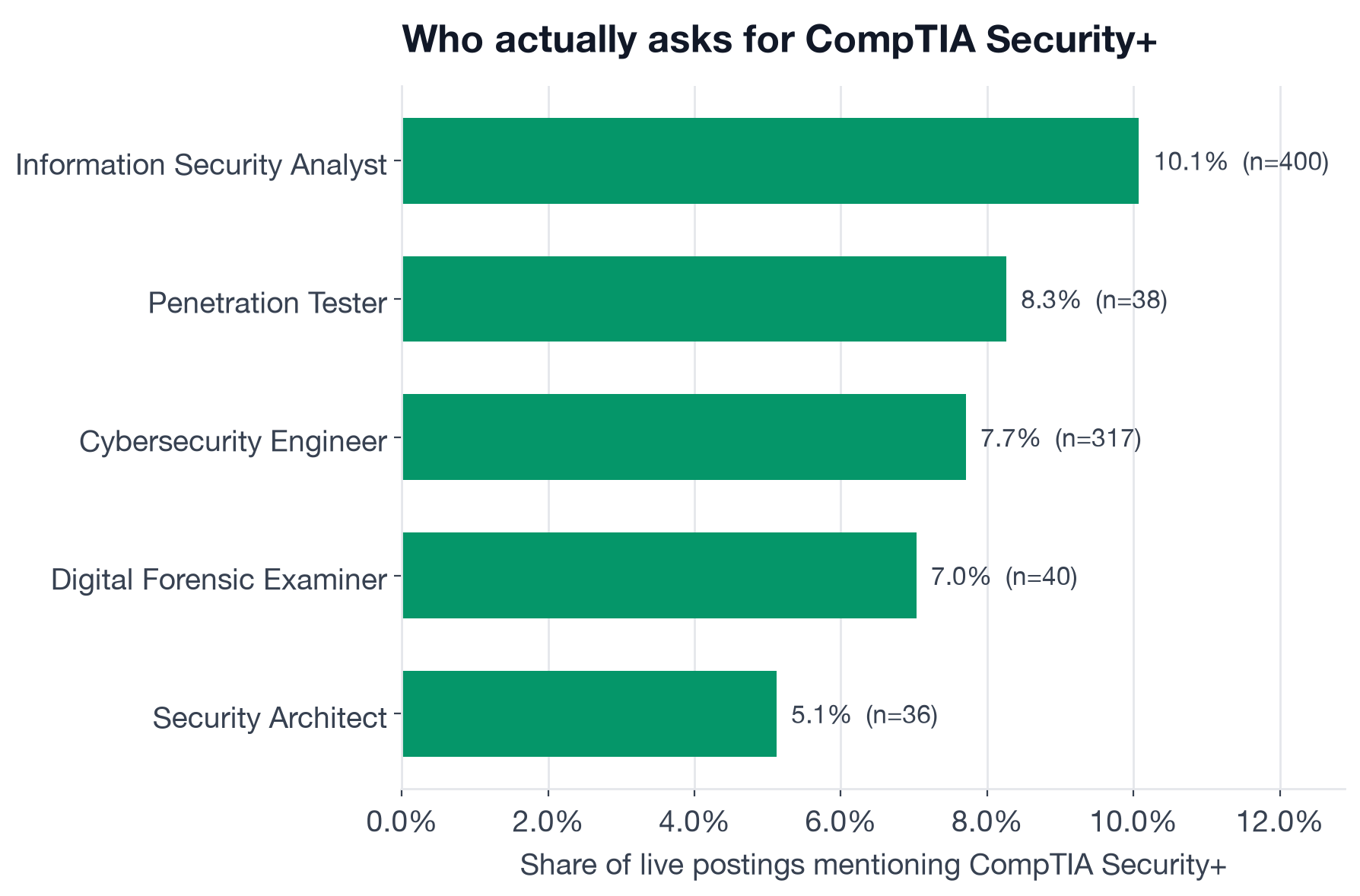 Information Security Analyst leads Security+ demand at just over 1 in 10 postings; Security Architect trails at 1 in 20.
| Role | Active postings | Mention Security+ | Share |
|---|---|---|---|
| Information Security Analyst | 3,971 | 400 | 10.1% |
| Penetration Tester | 460 | 38 | 8.3% |
| Cybersecurity Engineer | 4,113 | 317 | 7.7% |
| Digital Forensic Examiner | 569 | 40 | 7.0% |
| Security Architect | 703 | 36 | 5.1% |
Even at its highest, Security+ shows up in about 1 in 10 postings for any given role. Most security hiring in 2026 doesn't gate on this specific credential, in any of the five roles.
Federal Contractors Are Driving Most of the Demand
The employers asking for Security+ most often are not a cross-section of the security-hiring market. They're a specific segment of it.
| Employer | Postings mentioning Security+ |
|---|---|
| CACI International | 51 |
| Booz Allen Hamilton | 47 |
| Leidos | 26 |
| General Dynamics Information Technology | 25 |
| Peraton | 21 |
| Northrop Grumman Corporation | 18 |
| DecisionPoint Corporation | 13 |
| AnaVation | 11 |
| Ntt Limited | 9 |
| ]init[ | 8 |
| Dark Wolf Solutions | 8 |
Nearly every name on that list is a federal or defense contractor, or a firm with a substantial government-services practice. That's not a coincidence. Security+ is one of the baseline certifications accepted under the Department of Defense's 8140 directive (the policy that sets minimum required certifications for many DoD and federal-contractor cybersecurity roles), and government contractors write that requirement directly into job postings far more often than commercial employers do. That backdrop explains two patterns later in this post: why Security+ shows up as "preferred" more often than "required," and why the pay comparison looks worse the further up the seniority ladder you go.
Is Security+ Actually Required, or Just Nice to Have?
Most of the time, it's a preference, not a gate. Of the 831 postings that mention Security+, 492 (59.2%) use language specific enough to classify as either required or preferred; the remaining 339 use boilerplate phrasing ("required or equivalent," open-ended cert lists) that we can't confidently classify either way.
Within that classified group of 492, 22.2% (109 postings) require Security+ outright, and 77.8% (383 postings) list it as preferred. That split lines up with how baseline federal-contractor certification requirements are typically written: postings frequently list Security+ alongside several acceptable alternatives, CySA+, GSEC, SSCP, rather than naming it as the single mandatory credential, which reads as "preferred" rather than "required."
The practical read: if you already hold Security+, it clears the preferred bar in the large majority of postings that specify one. If you don't have it yet, the low required-rate (22.2% of classified mentions, about 13% of all mentions) means it's rarely the single blocker keeping you out of a role in this scope.
Where the Mid-Level Pay Edge Actually Lives
Splitting the salary comparison by seniority is the whole story here, so start there instead of the aggregate.
| Level | With Security+ (median) | Without Security+ (median) | Gap |
|---|---|---|---|
| Entry | Sample too small to report (n=12) | $92,500 | Not reportable |
| Mid-level | $119,600 | $113,700 | +5.2% |
| Senior | $157,625 | $167,150 | -5.7% |
| Staff | $142,450 | $180,000 | -20.9% |
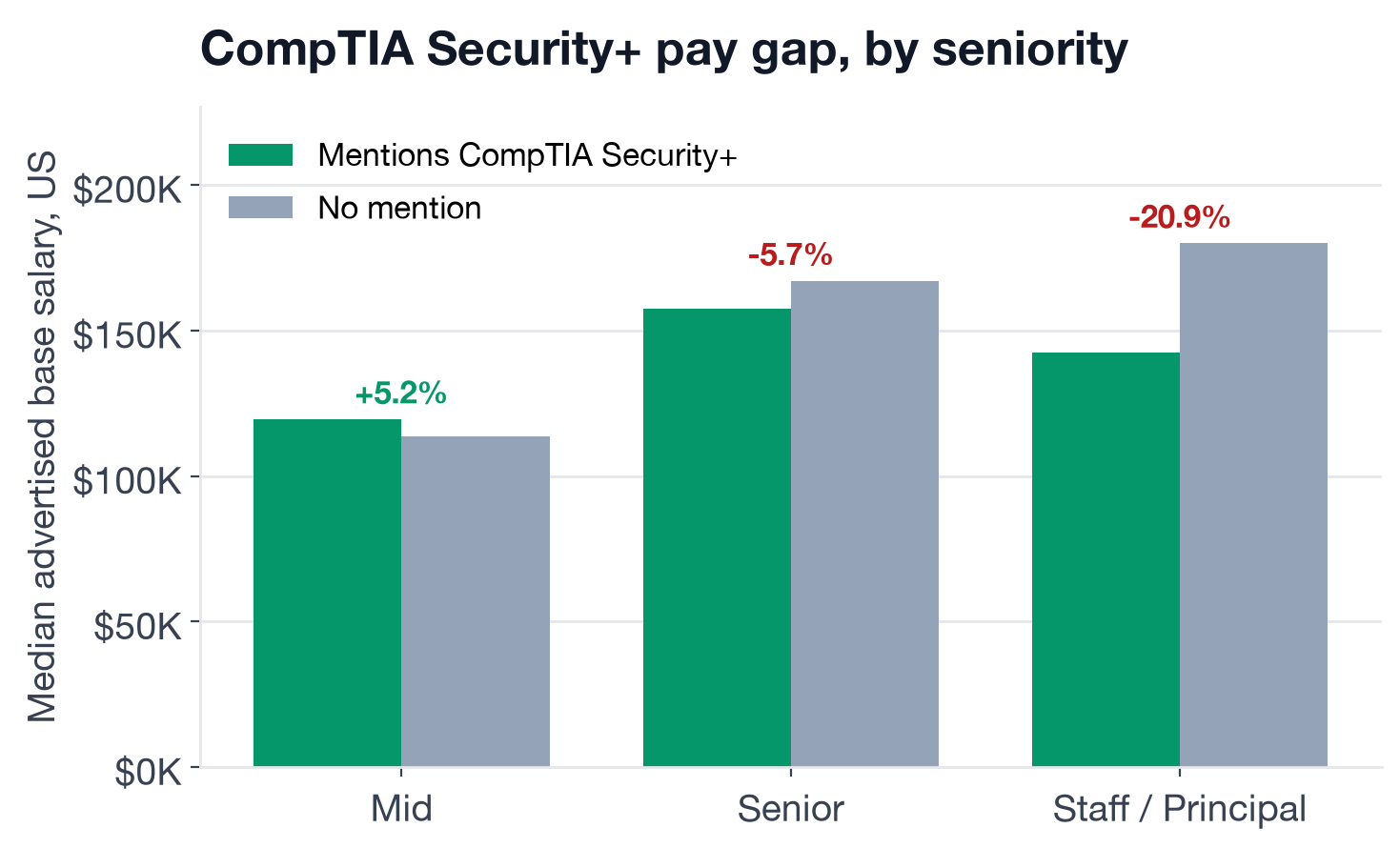 The only level where Security+ postings out-advertise non-cert postings is mid-level, where the bulk of the cert's demand actually sits.
Mid-level is also where 75.5% of Security+-mentioning postings land, versus 64.6% of non-cert postings in the same roles. Cert postings are underrepresented at senior (15.8% vs. 20.8%) and staff (5.4% vs. 12.2%) levels. Roll every level into one number without controlling for that mix, and Security+ postings show a median of $122,400 against $140,000 for non-cert postings, a 12.6% gap that reads like a penalty for holding the certification. It isn't one. It's what you get when a credential concentrated in mid-level, compliance-driven contractor roles gets compared against a pool that includes a larger share of senior and staff postings, which pay more everywhere, Security+ or not.
The federal-contractor concentration from the previous section is doing most of the explanatory work here too. Baseline-certification compliance roles are disproportionately built at the mid-level tier; the senior and staff security roles that pay the most in this dataset skew toward hiring where Security+ isn't the credential doing the signaling. All figures above are advertised US base salary only (equity, bonus, and clearance premiums aren't disclosed in postings), and the comparison baseline throughout is other postings in the same five-role scope, not the broader job market.
What Else Do These Postings Ask For?
Security+ rarely travels alone. CISSP shows up alongside it in 49.8% of Security+-mentioning postings, more than any other certification. CEH follows at 28.9%, then CompTIA CySA+ (23.0%) and CISM (21.9%).
| Certification | Co-occurs with Security+ |
|---|---|
| CISSP | 49.8% |
| CEH | 28.9% |
| CompTIA CySA+ | 23.0% |
| CISM | 21.9% |
| GIAC GSEC | 15.6% |
| CCNA | 15.4% |
| SSCP | 13.1% |
| GIAC GCIH | 12.4% |
| CompTIA CASP+ | 9.1% |
| OSCP | 9.0% |
The skill list tells a similar story: postings that mention Security+ are heavy on operations, not just credentials. Monitoring appears in 49.6% of them, Incident Response in 43.0%, SIEM (security information and event management platforms) in 36.8%, and Risk Management in 31.9%. If you're preparing for one of these roles, that's a more useful prep target than the exam alone: employers pair Security+ with a working SOC skill set, not just the credential. Postings that combine Cybersecurity Engineer roles with Incident Response work are a reasonable place to start looking.
How to Use This in Your Job Search
If you're deciding whether to sit for Security+, the data points at timing more than raw value: it's most useful as a way into mid-level SOC and security-analyst roles, especially at government contractors, and least useful as a lever for senior or staff-level compensation. If you already hold it, lead with the operational skills employers pair it with rather than the credential alone.
Drill the skills that actually show up alongside Security+, monitoring, incident response, SIEM triage, risk assessment, with InterviewStack's Question Bank, which breaks practice questions down by topic. If you're newer to the field and want to build the underlying concepts before the exam or the interview, InterviewStack's interactive courses cover networking, security fundamentals, and cloud security basics. Once you have a target role in mind, run a mock interview against it to see where the gaps actually are. And if you're weighing two adjacent security paths, our breakdown of Information Security Analyst vs. Penetration Tester covers how those two roles diverge on skills and pay.
To see current openings, browse active postings across all five roles in this scope or filter down to a specific one.
FAQ
Q. How many active postings mention CompTIA Security+ in 2026?
831 of 9,816 active postings analyzed across five security roles, Information Security Analyst, Cybersecurity Engineer, Penetration Tester, Security Architect, and Digital Forensic Examiner, on the InterviewStack.io job board mention CompTIA Security+, about 8.5% of the scope, over a 90-day window.
Q. Is CompTIA Security+ usually required or just preferred?
Preferred, in most cases where postings specify one. Of the 492 postings clear enough to classify, 77.8% list Security+ as preferred and 22.2% require it outright. Another 339 mentions use ambiguous phrasing we can't confidently classify either way.
Q. Do postings that ask for Security+ pay more than postings that don't?
It depends entirely on seniority level. At mid-level, where three-quarters of Security+-mentioning postings sit, cert postings advertise a median $119,600 versus $113,700 for non-cert postings in the same roles, about 5.2% higher. At senior level the gap flips to -5.7%, and at staff level it widens to -20.9%. Rolled together without controlling for level, the aggregate shows Security+ postings 12.6% below non-cert postings ($122,400 vs. $140,000), but that number mostly reflects seniority mix, not the certification itself.
Q. Which security role most often asks for Security+?
Information Security Analyst, at 10.1% of its 3,971 active postings (400 mentions), the highest rate among the five roles in scope. Security Architect asks for it least often, at 5.1%.
Q. Who is actually hiring for CompTIA Security+?
The employer roster is dominated by federal and defense contractors: CACI International, Booz Allen Hamilton, Leidos, General Dynamics Information Technology, and Peraton account for the largest share of Security+-mentioning postings in this sample. That matches Security+'s role as one of the baseline certifications accepted under the Department of Defense's 8140 directive for many federal cybersecurity positions.
Q. What other certifications get asked for alongside Security+?
CISSP is by far the most common, appearing in 49.8% of Security+-mentioning postings, followed by CEH (28.9%), CompTIA CySA+ (23.0%), and CISM (21.9%). Security+ tends to show up as a baseline alongside, not instead of, more advanced certifications.
Q. Is CompTIA Security+ worth getting for a cybersecurity career?
The data points to it being most useful as an entry-to-mid-career credential, not a senior-level differentiator. It shows a real, if modest, pay edge at mid-level and appears in roughly 1 of every 12 postings across the role scope, but the postings that ask for it skew mid-level and federal-contractor-heavy, and that pay edge reverses once you're competing for senior or staff roles.
The Honest Read on Security+'s Career Value
Security+ isn't a senior-level lever, and the data doesn't support treating it like one. What it reliably does is open mid-level doors, especially at federal and defense contractors that write it into baseline compliance requirements, and pair with a specific operational skill set worth building alongside it. Where you are in your career should decide how much weight to put on it, not the other way around.
Topics
Ready to practice?
Put what you've learned into practice with AI mock interviews and structured preparation guides.