
The Best-Paid Skills Aren't in Either Job Title
Ask what a Penetration Tester does, and you'd expect "Penetration Testing" to be the skill that pays. It isn't. The literal title skill shows up in 43.0% of Penetration Tester postings, more than any other skill in the dataset, yet postings that name it price $2,400 below the role's own $142,400 median (n=75). The skills that actually carry a premium for Penetration Tester, Threat Intelligence, Automation, and Incident Response, are all skills the role shares with Information Security Analyst, the defensive-side title it usually gets compared against.
We pulled every active posting for both roles from the InterviewStack.io job board as of August 2026: 5,690 for Information Security Analyst and 598 for Penetration Tester, with skills, salary, seniority, and location normalized. The same inversion shows up on the Analyst side, just in reverse: SIEM, the one skill that genuinely belongs to Information Security Analyst alone, pays less than several skills the role borrows from the tester's world.
| Information Security Analyst | Penetration Tester | |
|---|---|---|
| Median US base salary | $99,100 | $142,400 |
| Active postings | 5,690 | 598 |
| Top skill | Monitoring (31.3%) | Penetration Testing (43.0%) |
| Remote share | 7.8% | 20.1% |
| Entry-level share | 3.1% | 3.8% |
| Skill overlap (Jaccard) | 43% (pairwise) | 43% (pairwise) |
Skill overlap (Jaccard) is one shared similarity score between the two roles, not a separate figure per role; it's repeated in both columns for readability.
Key Findings
- Penetration Tester's median US base salary is $142,400 (n=156), a $43,300 premium (43.7%) over Information Security Analyst's $99,100 (n=1,675).
- Information Security Analyst postings outnumber Penetration Tester postings 9.52 to 1: 5,690 active listings versus 598.
- Penetration Testing, the literal title skill, prices $2,400 below Penetration Tester's own baseline (n=75), even though it's the role's single most common skill at 43.0%.
- Threat Intelligence, Automation, and Incident Response, all skills shared with Information Security Analyst, are Penetration Tester's real premium skills: +$22,400, +$19,600, and +$16,200 respectively.
- SIEM is the only skill that clears the exclusivity bar for Information Security Analyst (15.8% of postings); it carries a real +$23,200 premium, but that's smaller than ten separate skills the role shares with Penetration Tester, topped by AWS (+$44,100) and Automation (+$38,900).
- Penetration Tester's exclusive skill list runs 10 skills deep (OWASP, Application Security, PowerShell, and more); Information Security Analyst's runs one skill deep once a physical-security staffing artifact is excluded.
- Entry-level share is thin on both sides: 3.1% for Information Security Analyst, 3.8% for Penetration Tester.
- Penetration Tester is more remote-friendly: 20.1% remote versus 7.8% for Information Security Analyst, which stays 73.3% onsite.
Two Jobs Guarding Opposite Sides of the Same Fight
An Information Security Analyst's week runs on defense: watching a SIEM (security information and event management platform) for anomalies, triaging what's real, and documenting evidence for compliance, reactive work built around the assumption someone is already trying to get in.
A Penetration Tester's week runs on offense: simulating the same attacks a real adversary would try, against systems the company already believes are secure. That means the OWASP (Open Web Application Security Project) methodology for web-application flaws, scripting exploits in Bash and PowerShell, and probing Active Directory environments and low-level code in C++ and Java. The output isn't a triaged alert, it's a validated finding the client has to fix.
Full per-role skill breakdowns live in the Information Security Analyst skills report and the Penetration Tester skills report.
Which Skills Actually Pay More, Once You Look Past the Title?
Among US postings (where wage-transparency laws produce consistent disclosure), the median Information Security Analyst base salary is $99,100 and the median Penetration Tester base salary is $142,400, a $43,300 (43.7%) gap. Equity, bonus, and sign-on aren't disclosed in job postings, so total compensation at senior levels runs higher than either figure. Penetration Tester's US salary sample is thin (n=156 versus 1,675 for Analyst), so treat any single skill's premium there as a directional signal, not a precise one. The Penetration Tester title sample also pulls in a notable share of AI/LLM red-teaming and security-research postings, including Mercor, an AI-training staffing marketplace, as the single largest employer at 4.9% of postings, alongside classic client-engagement testing work. That's an adjacent but distinct specialty, and it could pull the median in either direction.
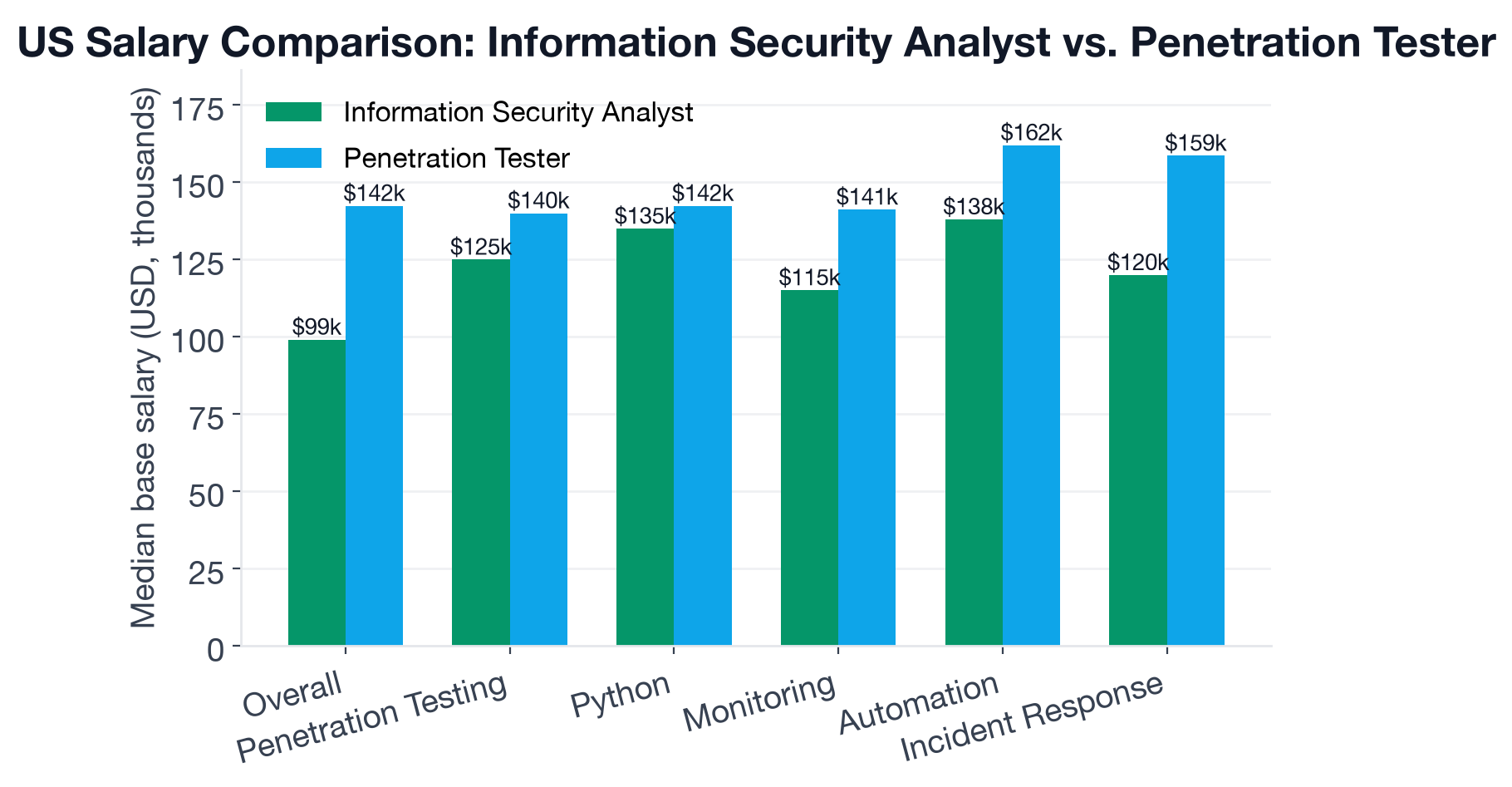
As the chart above shows, the $99,100-versus-$142,400 gap is only the headline number. The pattern inside each role's own numbers is the real story, and it's the same pattern on both sides. Neither role's headline, title-defining skill pays a premium over that role's own baseline:
| Skill | Role | % of postings | Median US salary | vs. role's own baseline |
|---|---|---|---|---|
| Penetration Testing | Penetration Tester (own title skill) | 43.0% | $140,000 | -$2,400 |
| OWASP | Penetration Tester (exclusive) | 19.1% | $140,000 | -$2,400 |
| Bash | Penetration Tester (exclusive) | 13.0% | $135,000 | -$7,400 |
| Threat Intelligence | Penetration Tester (shared with Analyst) | 17.4% | $164,800 | +$22,400 |
| Automation | Penetration Tester (shared with Analyst) | 23.9% | $162,000 | +$19,600 |
| Incident Response | Penetration Tester (shared with Analyst) | 18.2% | $158,600 | +$16,200 |
| SIEM | Information Security Analyst (exclusive) | 15.8% | $122,300 | +$23,200 |
| AWS | Information Security Analyst (shared) | 9.2% | $143,200 | +$44,100 |
| Automation | Information Security Analyst (shared) | 13.2% | $138,000 | +$38,900 |
Every Penetration Tester exclusive skill with enough US salary data to price (OWASP, PowerShell, Bash) sits at or below the role's own baseline, same as Penetration Testing itself. Only the skills shared with Information Security Analyst, Threat Intelligence, Automation, Incident Response, carry a premium.
The Analyst side runs the same pattern in reverse. SIEM, the role's one genuine exclusive skill, does pay a real premium: $122,300, $23,200 above the $99,100 baseline (n=196). But that's smaller than several shared skills: AWS adds $44,100 (n=143), Automation adds $38,900 (n=188), and Threat Intelligence, Python, and Cloud Security each add an identical $35,900 (n=120, 133, and 100, a common job-posting salary band rather than a data error). Even Penetration Testing itself, when it shows up in an Analyst posting, adds $25,900 (n=49). On both sides, the skills that pay best cross the line between offense and defense, not the ones that stay inside it.
Where Do the Two Skill Sets Actually Diverge?
The list of skills unique to each role is lopsided, and the imbalance is itself a finding. Only two skills clear the exclusivity threshold for Information Security Analyst (at least 8% of Analyst postings, under 5% of Penetration Tester postings): SIEM (15.8%) and Customer Service (13.2%). Customer Service tracks closely with Allied Universal, a physical-security staffing firm that accounts for 8.3% of the Analyst postings in this dataset, and prices at $47,800 (n=328), $51,300 below the role's own baseline, the sharpest negative signal among named skills in either dataset. Treating it as a genuine analyst skill would overstate what the role asks for, so SIEM is the only exclusive skill counted here.
Penetration Tester's exclusive list runs ten skills deep: OWASP (19.1%), Application Security (15.1%), PowerShell (14.0%), Google Cloud (13.7%), Bash (13.0%), APIs (11.7%), Java (10.5%), Active Directory (10.4%), C++ (10.4%), and Vulnerability Assessment (9.4%), a broad toolkit spanning web-application methodology, multiple scripting and exploit languages, a cloud platform, and Windows identity infrastructure. The role expects testers to attack whatever stack a client runs, not one specialty.
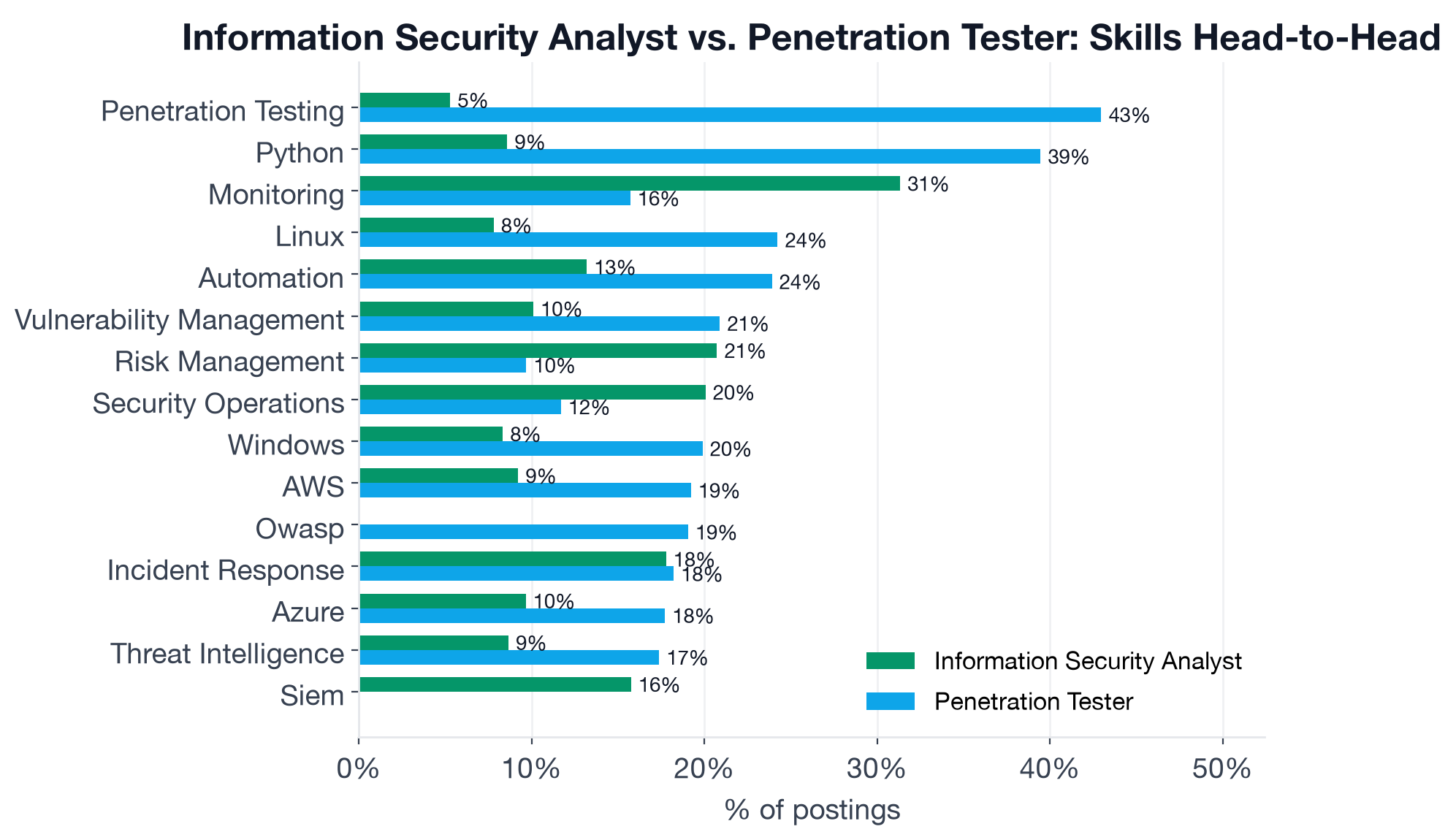
Monitoring (31.3%) and Security Operations (20.1%) lead the Analyst bars; Penetration Testing (43.0%), Python (39.5%), and Linux (24.2%) lead the Tester bars, the same defense-versus-offense split that shows up in the exclusive-skills breakdown below.
Neither role's top-30 skill list names an explicit AI or machine learning skill (Analyst's only trace is Generative AI, priced at n=27 in the US salary-disclosed sample; the skill isn't in the top-30 list, so its true share of all 5,690 postings can't be measured here). That's a floor on what postings state, not a ceiling on what practitioners use. A 2026 SANS Institute survey found AI use across cybersecurity teams jumped from 50% to 78% of organizations in a year, mostly as an alert-triage copilot, the kind of work Analyst postings already describe. On the offensive side, industry research found the share of red-team engagements incorporating AI tools grew from 12% to 38% between 2024 and 2026, but with a catch: 87.8% of practitioners using AI to generate pentest findings say the output still needs significant manual validation, the judgment a $142,400 median is arguably paying for. For a deeper look at either side, see how AI is changing Information Security Analyst work and how AI is changing Penetration Tester work.
How Big Is the Information Security Analyst Market vs. Penetration Tester?
Information Security Analyst is the far larger market: 5,690 active postings against Penetration Tester's 598, a 9.52x volume advantage. That total carries a data-quality caveat: beyond the 8.3% of Analyst postings at Allied Universal (a physical-security staffing firm, not an IT-security employer), the raw title sample includes other facility- and guard-adjacent postings: "Security Officers," "Security Dispatcher," "Loss Prevention Specialist," so the true count of IT/cyber-focused Analyst roles runs somewhat below the raw 5,690. The volume lead over Penetration Tester is too large for that to change the direction of the finding. That doesn't make Analyst dramatically easier to break into at the entry level, though: just 3.1% of Analyst postings are entry-level (179 of 5,690), versus 3.8% for Penetration Tester (23 of 598). Both are effectively closed to candidates with zero prior security experience, and Penetration Tester skews more senior overall: 22.6% senior and 8.4% staff, versus 12.4% and 6.8% for Analyst.
Penetration Tester is also the more flexible role by location: 20.1% remote and 28.6% hybrid, versus 7.8% remote and 20.4% hybrid for Information Security Analyst, which stays 73.3% onsite. Both roles concentrate in the US (52.1% Analyst, 44.0% Penetration Tester), with Penetration Tester spreading further into India (7.0%) and the UK (6.7%).
Pick Based on the Work, Not Just the Paycheck
Choose Information Security Analyst if you:
- Want the highest volume of open roles right now (9.52x more postings than Penetration Tester) and a realistic path in from adjacent IT or SOC-adjacent work.
- Are comfortable with reactive, alert-driven work day to day: watching a SIEM, triaging incidents, documenting compliance evidence.
- Plan to raise your own pay by layering in cloud, automation, and threat-intelligence skills, all of which already price well above the role's baseline.
Choose Penetration Tester if you:
- Want the higher pay ceiling ($142,400 median, a $43,300 premium) and can compete in a much smaller, more senior-skewed market.
- Already have hands-on scripting and exploit experience across multiple platforms (Bash, PowerShell, Java, C++, Active Directory) rather than a single specialty.
- Want project-based, adversarial engagements over continuous monitoring, and value the wider remote and hybrid options this role offers.
If neither track fits, Information Security Analyst also compares well against Security Architect and Digital Forensic Examiner, two other paths built on the same SOC foundation.
Either path benefits from practicing the scenarios interviewers actually ask about: drill security-specific questions in the Question Bank, build foundational scripting and cloud-security skills in interactive courses, or run a full AI mock interview against an Analyst or Penetration Tester scenario before you apply.
FAQ
Q. Which pays more, Information Security Analyst or Penetration Tester?
Penetration Tester pays more. The median US base salary is $142,400 across 156 postings with US salary disclosed, versus $99,100 across 1,675 postings for Information Security Analyst, a $43,300 (43.7%) gap. Both figures are base salary only; equity, bonus, and sign-on are not disclosed in job postings.
Q. How many Information Security Analyst and Penetration Tester jobs are open right now?
Information Security Analyst is the far larger market: 5,690 active postings versus 598 for Penetration Tester, a ratio of about 9.52 to 1. Penetration Tester is a much smaller, more specialized niche within the broader security field.
Q. Does knowing how to do a penetration test pay a Penetration Tester more?
Not on its own. Penetration Testing appears in 43.0% of Penetration Tester postings, the role's single most common skill, but it prices $2,400 below the role's own $142,400 median (n=75). The skills that do carry a real premium for Penetration Tester, Threat Intelligence (+$22,400), Automation (+$19,600), and Incident Response (+$16,200), are all skills the role shares with Information Security Analyst, not skills exclusive to offensive testing.
Q. What skill most defines Information Security Analyst work?
SIEM (security information and event management software) is the only skill that clears the exclusivity bar for Information Security Analyst in this comparison: 15.8% of postings ask for it, and it carries a genuine premium ($122,300, +$23,200 over the role's own baseline, n=196). Customer Service also clears the raw frequency threshold (13.2%) but tracks closely with physical-security-guard staffing firms in the dataset and is not treated as a real skill signal for the analyst role.
Q. Is Information Security Analyst or Penetration Tester easier to break into?
Neither is easy at the entry level: 3.1% of Information Security Analyst postings and 3.8% of Penetration Tester postings are explicitly entry-level. Information Security Analyst's much larger volume of openings (9.52 times more postings) makes it the more realistic first move into security, even without a meaningfully lower entry-level share.
Q. Are these roles remote-friendly?
Penetration Tester is more remote-friendly: 20.1% of postings are fully remote and 28.6% are hybrid, versus 7.8% remote and 20.4% hybrid for Information Security Analyst, which stays 73.3% onsite.
Q. Do Information Security Analyst or Penetration Tester jobs require AI skills?
Neither role's top 30 skill list names an explicit AI or machine learning skill in this dataset (Information Security Analyst's only trace is a thin Generative AI signal, n=27 in the US salary-disclosed sample; the skill doesn't appear in the top-30 list, so its true share of all 5,690 postings isn't measurable here). That's a floor, not a ceiling: a 2026 SANS Institute survey found AI use in cybersecurity jumped from 50% to 78% of organizations in one year, and separate industry research found the share of red-team engagements incorporating AI tools grew from 12% to 38% between 2024 and 2026, though nearly 88% of practitioners who use AI to generate pentest findings say the output still needs significant manual validation.
The Premium Hides in the Overlap
Neither title's own specialty is where the money is. Penetration Tester pays for the judgment that transfers from defensive work, not for running a pentest by the book; Information Security Analyst pays more for cloud and automation skills borrowed from the offensive side than for the SIEM work the title implies. If you're choosing between these two paths, the skills worth building are less about which title you're chasing and more about which side of that overlap you're willing to work on. Browse open Information Security Analyst roles or Penetration Tester roles on InterviewStack.io to see which fits where you are now.
Topics
Ready to practice?
Put what you've learned into practice with AI mock interviews and structured preparation guides.