
One Skill Defines the Smaller, Better-Paid Job
Ninety-two percent of Digital Forensic Examiner postings ask for one specific skill: Incident Response, one of the tightest single-skill concentrations we have measured anywhere in this series. Information Security Analyst runs the opposite pattern: its top skill, Monitoring, shows up in under a third of postings, and the role spreads across risk management, security operations, and a dozen adjacent tools instead of collapsing around any one of them.
That structural difference, one job built around a single discipline, the other spread thin across a whole stack, is also where the pay gap between them starts to make sense. We pulled every active posting for both roles from the InterviewStack.io job board as of August 2026: 5,747 for Information Security Analyst and 723 for Digital Forensic Examiner, skills normalized so "edr" and "endpoint detection and response" count once.
| Information Security Analyst | Digital Forensic Examiner | |
|---|---|---|
| Median US base salary | $97,600 | $133,500 |
| Active postings | 5,747 | 723 |
| Top skill | Monitoring (31.5%) | Incident Response (92.0%) |
| Senior + staff share | 19.3% | 32.4% |
| Remote + hybrid | 28.0% | 43.7% |
| Entry-level share | 3.1% | 4.0% |
| Skill overlap (Jaccard) | 67% shared (pairwise) | 67% shared (pairwise) |
Key Findings
- Incident Response appears in 92.0% of Digital Forensic Examiner postings (665 of 723) but only 17.8% of Information Security Analyst postings, the widest single-skill split either role tracks.
- Digital Forensic Examiner's median US base salary is $133,500 (n=217), $35,900 (about 37%) above Information Security Analyst's $97,600 (n=1,710).
- Information Security Analyst carries 7.95x the posting volume: 5,747 active listings versus 723 for Digital Forensic Examiner.
- The two roles' top-30 skill sets overlap 67% (Jaccard), yet zero skills clear the exclusivity bar for Information Security Analyst; five clear it for Digital Forensic Examiner.
- Digital Forensic Examiner skews notably more senior: 32.4% of its postings are senior or staff level, versus 19.3% for Information Security Analyst.
- Digital Forensic Examiner is also more flexible: 43.7% of postings are remote or hybrid, versus 28.0% for Information Security Analyst (73.5% onsite).
- Automation, EDR, and Threat Intelligence carry the largest premium of the 16 skills that pay above baseline in both roles: +$39,900, +$27,400, and +$37,400 on the analyst's own baseline, +$25,000, +$24,800, and +$23,300 on the examiner's.
Where Digital Forensic Examiner's Skill Set Pulls Away
Information Security Analyst is the SOC (Security Operations Center) generalist job: dashboards, alert triage, risk assessments, and posture documentation for auditors. Digital Forensic Examiner is the narrower specialty called in after something has already gone wrong: preserve the evidence, reconstruct what happened across disk and logs, and produce findings that hold up under legal scrutiny. That scope difference is most of why Incident Response alone accounts for 92.0% of Digital Forensic Examiner postings, one of the highest single-skill concentrations we have measured across this series, against just 17.8% for Information Security Analyst, the widest single-skill split either role tracks.
The rest of the examiner's differentiator layer reads like an evidence-handling toolkit: Digital Forensics itself (14.2%), Root Cause Analysis (11.1%), Malware Analysis (10.7%), and PowerShell (8.9%, scripting for artifact collection), none of which show up at meaningful frequency in Information Security Analyst postings. Google Cloud also lands here (12.2%), likely inflated by Mandiant, Google's forensics and incident-response consultancy, which appears directly in this dataset's title samples.
Worth flagging before reading too much into the evidence-and-courtroom framing: Digital Forensics itself is only the 18th most common skill tag in this dataset for a role that carries the name, well behind generalist skills like Monitoring, SIEM, and Incident Management. A random sample of job titles behind this dataset skews the same way, generic titles like "Information Security Officer," "Incident Response Lead," and "Associate Manager - Security" far outnumber titles that actually say "forensic" or "examiner." Read that as a scope signal rather than a data error: postings the board classifies as Digital Forensic Examiner lean toward the DFIR (Digital Forensics and Incident Response) hybrid roles common at corporate security consultancies and MSSPs (managed security service providers), not exclusively the narrower evidence-and-litigation specialist role the same title can also describe (law enforcement, eDiscovery, litigation support). The skill and pay comparisons below hold for that DFIR-flavored population; expect a different mix if you're specifically targeting law-enforcement or eDiscovery forensic work.
Run the filter the other direction and the list is empty: not one skill clears the same bar for Information Security Analyst. Every skill common enough to define the analyst role, Monitoring, Risk Management, Security Operations, Vulnerability Management, also shows up often enough in Digital Forensic Examiner postings to count as shared rather than exclusive. The analyst role is the broader half of this pair; the examiner role is the narrower one.
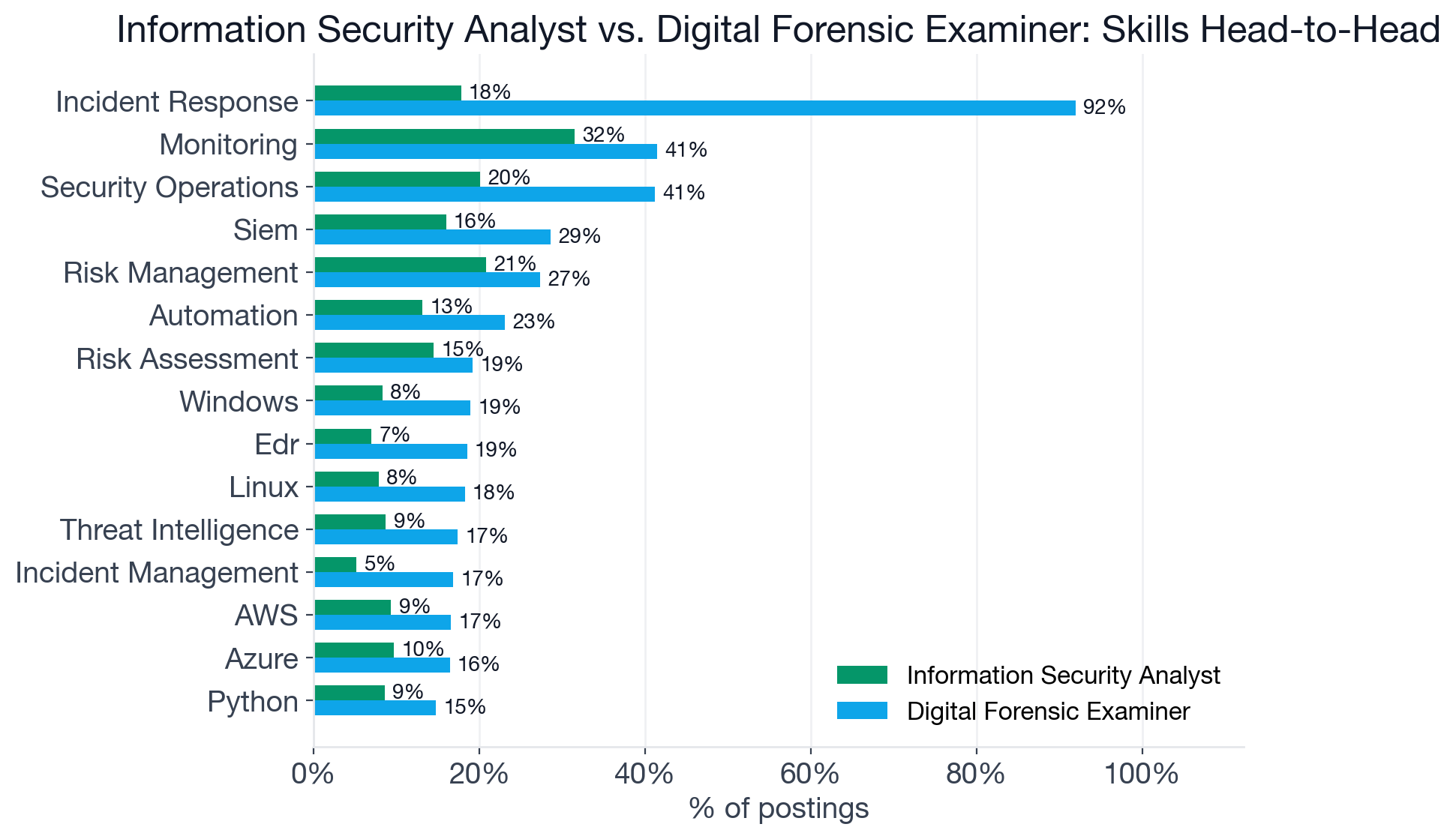 Incident Response is the one skill that separates these two postings almost completely; everything else clusters closer together.
Which Skills Do Both Roles Actually Share?
A lot, on paper. The two roles' top-30 skill sets overlap by 67% (Jaccard similarity), one of the higher overlap scores in this series, a reminder that these are adjacent specialties inside the same security function rather than unrelated jobs.
| Skill | Information Security Analyst | Digital Forensic Examiner |
|---|---|---|
| Incident Response | 17.8% | 92.0% |
| Monitoring | 31.5% | 41.5% |
| Security Operations | 20.1% | 41.2% |
| Risk Management | 20.8% | 27.4% |
| SIEM | 16.0% | 28.6% |
| Automation | 13.1% | 23.1% |
| Threat Intelligence | 8.7% | 17.4% |
| EDR | 7.0% | 18.5% |
| AWS | 9.4% | 16.6% |
| Python | 8.6% | 14.8% |
SIEM (Security Information and Event Management, the platforms that centralize logs and alerts) and EDR (Endpoint Detection and Response, the tooling that watches individual machines for compromise) both skew toward Digital Forensic Examiner, evidence that examiners inherit the same detection stack analysts use, then go further into evidence collection once an incident happens.
Sixteen of the 21 skills shared across both roles' salary tables clear a genuine, positive premium in both roles independently (all with a sample of at least 25 postings on each side), a wider pattern than the raw overlap alone suggests. Ranked by the smaller of the two roles' gains, the floor each skill is worth no matter which title you hold, three pull furthest ahead: Automation adds $39,900 on the analyst's own $97,600 baseline (n=181) and $25,000 on the examiner's $133,500 baseline (n=45); EDR adds $27,400 for analysts (n=67) and $24,800 for examiners (n=26); Threat Intelligence adds $37,400 for analysts (n=122) and $23,300 for examiners (n=28). Python is a close fourth at a $16,500 floor (n=134 analyst, n=29 examiner), and SIEM, Vulnerability Management, and AWS also clear a real premium in both roles, just a smaller one. Whatever the title, automation, endpoint tooling, and threat intelligence are the three shared skills worth learning first if you want the highest guaranteed floor. See what those postings actually require: Automation-tagged Information Security Analyst roles, Threat-Intelligence-tagged Digital Forensic Examiner roles, or EDR-tagged Digital Forensic Examiner roles.
Where's the AI in Either Job?
Neither role's top-30 skill list names AI or machine learning explicitly. Job postings only tag an AI skill when it is stated as an explicit requirement; they do not capture the AI tools a team already uses by default. A 2025 ISC2 Cybersecurity Workforce Study of more than 16,000 practitioners found 69% of cybersecurity organizations are already integrating, testing, or in early evaluation of AI, and separate research on AI adoption inside the SOC puts the figure higher for security operations specifically: 94% of security leaders report using AI somewhere in the SOC, running an average of seven AI tools per team.
Digital Forensic Examiner has its own wrinkle: AI is already displacing hours of manual keyword search and log correlation in forensic triage, and image and video categorization is now standard in commercial forensic suites. Adoption is deliberately paced by courtroom-admissibility and chain-of-custody standards, a real brake unique to this role, not evidence examiners are behind on AI. Expect both roles to keep using AI tools daily long before "AI" becomes a line item in either job posting.
Why Does Digital Forensic Examiner Pay $35,900 More?
Digital Forensic Examiner's median US base salary is $133,500 across 217 postings with disclosed pay; Information Security Analyst's is $97,600 across 1,710 postings, a $35,900 gap, about 37% above the analyst baseline. Both figures are base salary only: equity, bonus, and sign-on are not disclosed in postings, so total compensation at top employers runs higher than either number suggests.
Some of that gap is a genuine specialization premium, the smaller, more senior-skewed examiner role commands more. But part of it is also what the Information Security Analyst title gets stretched to cover, from SOC-analyst and cyber-risk roles down to physical-security supervisor and dispatcher titles ("Site Supervisor - Security," "Security Dispatcher - Educational Facility"). Customer Service, a skill tag in 13.3% of these postings, prices at just $47,800 (n=338), $49,800 below the role's blended baseline, a strong signal that a meaningful slice of the $97,600 median comes from non-technical, security-adjacent postings rather than SOC work.
Look at what technical skills pay within the analyst role instead, and the picture tightens: AWS adds $44,300 (n=151), Automation adds $39,900 (n=181), Threat Intelligence and Cloud Security each add $37,400 (n=122, n=101), and Python adds $35,400 (n=134), a sample of the technical skills that clear well above the blended baseline, not an exhaustive list. Most of these same skills also carry a real, if smaller, premium on the examiner's own baseline: AWS adds $6,500 there (n=32), Cloud Security adds $6,600 there (n=29), and Python adds $16,500 there (n=29). On the examiner side, Incident Response itself, the skill that defines 92% of the role, is nearly flat against the baseline (+$1,500, n=202); the premiums with the highest floor in both roles at once are Automation (+$25,000 on the examiner's own baseline, +$39,900 on the analyst's), EDR (+$24,800 examiner-side, +$27,400 analyst-side), and Threat Intelligence (+$23,300 examiner-side, +$37,400 analyst-side). The pattern holds in both roles: the skill that gets you the interview is rarely the skill that gets you the raise.
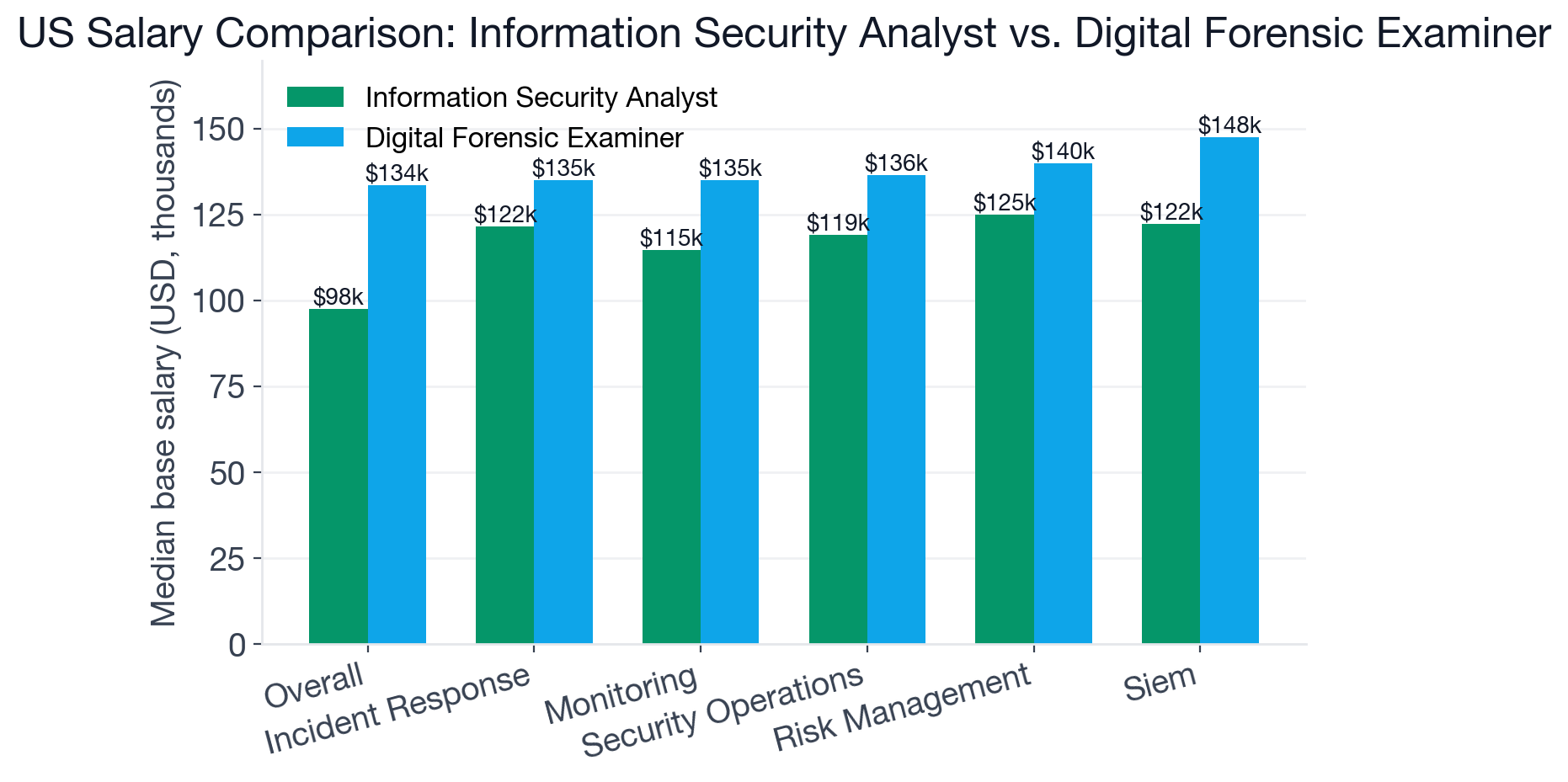 Digital Forensic Examiner's overall US base salary sits well above Information Security Analyst's, but the same handful of skills, not the job title, drive the premium inside each role.
Which Role Is Easier to Get Into, and Where Is It Based?
Neither is a soft landing for a first job: entry-level postings are 3.1% of Information Security Analyst listings and 4.0% of Digital Forensic Examiner listings, both well under 1 in 20. Past that entry gate, Digital Forensic Examiner skews notably more senior, 32.4% senior or staff versus 19.3% for Information Security Analyst, consistent with a smaller, specialized market that hires fewer generalist mid-level analysts and more people who already know the work. It is also more flexible: 43.7% of postings are remote or hybrid versus 28.0% for Information Security Analyst, which stays 73.5% onsite. Both roles concentrate in the United States (52.1% analyst, 46.2% examiner), with India, the UK, Australia, and Canada rounding out the next tier for both.
Choose the Role That Fits, Not Just the Paycheck
Choose Information Security Analyst if you want the larger, more accessible market (7.95x more postings), prefer ongoing monitoring and risk work over incident-driven crisis response, and want to build toward automation, threat intelligence, or cloud security specialties, where the analyst role's real salary premiums sit, $35K to $40K above baseline.
Choose Digital Forensic Examiner if you want the smaller, better-paid, more senior-skewed specialty and don't mind a narrower door in (not because entry-level access is harder here, that share is actually slightly higher than the analyst role's, but because there are simply far fewer total openings), are drawn to after-the-fact investigation (evidence preservation, log correlation, findings that hold up under legal scrutiny), and value flexibility: remote and hybrid postings run about 16 points higher than in the analyst role.
How to Use This to Plan Your Next Move
Start by browsing what a realistic posting actually asks for: current Information Security Analyst openings or current Digital Forensic Examiner openings. For a deeper breakdown of either role, see Information Security Analyst Skills Companies Want in 2026 and Digital Forensic Examiner Skills Companies Want in 2026, or Information Security Analyst vs Security Architect for a third path.
For the shared foundation, monitoring, SIEM, and incident-response fundamentals, InterviewStack's Question Bank has focused drill sets to work through before an interview. If you're newer to the field, interactive courses covering security fundamentals build the baseline both roles assume. Once you have a target role, AI mock interviews let you rehearse the incident-response scenarios examiners get asked, or the risk-and-compliance scenarios analysts get asked, before the real one.
FAQ
Q. Does Information Security Analyst or Digital Forensic Examiner pay more in 2026?
Digital Forensic Examiner pays more. Its median US base salary is $133,500 across 217 postings with disclosed salary, versus $97,600 for Information Security Analyst across 1,710 postings, a $35,900 gap, about 37% above the analyst baseline. Both figures are base salary only; equity and bonus are not disclosed in postings.
Q. What is the biggest skill difference between Information Security Analyst and Digital Forensic Examiner?
Incident Response. It appears in 92.0% of Digital Forensic Examiner postings (665 of 723) but only 17.8% of Information Security Analyst postings (1,023 of 5,747), the widest single-skill split either role tracks. Digital Forensic Examiner postings also name Digital Forensics, Malware Analysis, and Root Cause Analysis at rates that never clear meaningful frequency in Information Security Analyst postings. Digital Forensics itself is a comparatively modest 14.2% tag here, a sign these postings skew toward DFIR (Digital Forensics and Incident Response) hybrid roles rather than pure evidence-and-courtroom forensic examiner work.
Q. How much do the two roles' skill sets overlap?
Their top-30 skill sets overlap by 67% (Jaccard similarity), one of the higher overlap scores in this series, reflecting how closely adjacent these two security specialties are. Monitoring, SIEM, Risk Management, Security Operations, and Automation all show up at meaningful frequency in both roles, usually at different rates.
Q. Is Digital Forensic Examiner harder to break into than Information Security Analyst?
Neither is an easy first job. Entry-level postings are 3.1% of Information Security Analyst listings and 4.0% of Digital Forensic Examiner listings. Digital Forensic Examiner does skew more senior overall: 32.4% of its postings are senior or staff level, versus 19.3% for Information Security Analyst.
Q. Do these roles require AI skills in 2026?
Neither role's top 30 skills include an explicit AI or machine learning tag in job-posting language. That does not mean AI is absent from the work: a 2025 ISC2 study found 69% of cybersecurity organizations are already integrating, testing, or evaluating AI, and separate SOC-specific research finds security leaders report running an average of seven AI tools inside the SOC. Digital Forensic Examiners increasingly use AI for keyword search and log correlation, though adoption is intentionally paced by courtroom-admissibility and chain-of-custody standards.
Q. Which role has more open positions right now?
Information Security Analyst, by a wide margin: 5,747 active postings versus 723 for Digital Forensic Examiner, a volume ratio of 7.95x. Digital Forensic Examiner is a genuinely smaller, more specialized market.
Q. Which role offers more remote or hybrid work?
Digital Forensic Examiner. 43.7% of its postings are remote or hybrid (15.4% remote, 28.4% hybrid), versus 28.0% for Information Security Analyst (7.7% remote, 20.3% hybrid), which stays 73.5% onsite.
The Trade Is Openings for Pay
Neither role is objectively better; they optimize for different things. Information Security Analyst is the larger, more accessible market: 7.95x the postings, a broader skill footprint, and a lower bar to a first offer. Digital Forensic Examiner is the smaller, better-paid specialty: one dominant skill, a more senior posting mix, and more remote flexibility once you're in. Decide which side of that trade you actually want before you decide which title to chase.
Topics
Ready to practice?
Put what you've learned into practice with AI mock interviews and structured preparation guides.