
One Skill Defines the Architect. No Skill Defines the Analyst.
Ask what a Security Architect does, and the postings answer with one word: Security Architecture. It shows up in 63.1% of Security Architect listings, roughly double the concentration of any single skill in the Information Security Analyst dataset. Ask what an Analyst does, and the postings scatter across a dozen overlapping duties, none of which dominates.
We pulled every active posting for both roles from the InterviewStack.io job board as of August 2026, 5,757 for Analyst and 1,089 for Architect, with skills, salary, seniority, and location normalized. That gap in how postings are written explains most of the pay gap between the titles, not just a difference in seniority.
| Information Security Analyst | Security Architect | |
|---|---|---|
| Median US base salary | $99,100 | $174,100 |
| Active postings | 5,757 | 1,089 |
| Top skill | Monitoring (31.5%) | Security Architecture (63.1%) |
| Remote share | 7.9% | 15.7% |
| Entry-level share | 3.2% | 1.7% |
| Skill overlap (Jaccard) | 43% (Jaccard) | 43% (Jaccard) |
Key Findings
- Information Security Analyst postings outnumber Security Architect postings 5.29 to 1: 5,757 active listings versus 1,089.
- The US base salary gap between the two titles is $75,000 (43.1%) at the median: $174,100 (n=248) for Security Architect versus $99,100 (n=1,658) for Information Security Analyst.
- One skill, Security Architecture, appears in 63.1% of Security Architect postings; no single skill clears even 32% of Information Security Analyst postings (Monitoring, the top skill, sits at 31.5%).
- Skill overlap between the two roles is 43% (Jaccard on each role's top 30 skills), but the shared core is asymmetric: Cloud Security, Azure, AWS, and IAM are nominally shared, yet each appears 3 to 4 times more often in Security Architect postings.
- Only 1.7% of Security Architect postings are entry-level (18 of 1,089), versus 3.2% for Information Security Analyst (183 of 5,757).
- Security Architect postings are more flexible: 15.7% remote and 40.8% hybrid, versus 7.9% remote and 20.8% hybrid (73.0% onsite) for Information Security Analyst.
- Every one of Information Security Analyst's own core skills (Monitoring, Risk Management, Incident Response, SIEM) pays above the role's own median; Security Architect's own core skills barely move the needle by comparison, Security Architecture itself adds just $2,500 over baseline, while Cloud Security and Risk Assessment pay below it (-$1,200 and -$15,700).
A Security Analyst Watches the System. An Architect Designs It.
The day-to-day split matches the skill data. An Analyst's week runs on alerts: watching a SIEM (security information and event management platform) for anomalies, triaging what's real, investigating incidents, documenting what happened for compliance. It's reactive by design, and the skill list reflects that: Monitoring, Risk Management, Security Operations, and Incident Response all sit in the 18-32% range with nothing towering over the rest.
An Architect's week runs on decisions made before anything ships: which identity model a new system uses, where the trust boundary sits between a cloud service and the rest of the network, how a Zero Trust policy gets enforced. The exclusive-skill list confirms it: CI/CD and DevSecOps don't clear the top-30 skill list for Analyst postings, and Agile falls just short too, appearing in just 4.9% of Analyst postings (a hair under the 5% shared-skill cutoff) versus 14.0% of Architect ones, meaning the design work happens inside the software delivery pipeline, not a quarterly review. Neither role's top skills include an explicit AI tag, but that's a floor, not a ceiling: a 2026 SANS Institute survey found AI use in cybersecurity jumped from 50% to 78% of organizations in a single year, and the split tracks the same divide. Analysts increasingly work alongside AI that triages alerts first; architects are increasingly the ones deciding how AI systems get contained.
Each role's full skill profile is broken down separately: see Information Security Analyst skills and Security Architect skills.
Which Skills Do Both Roles Actually Share?
Both roles draw from the same security fundamentals, just at different depths. Fifteen skills clear the 5%-in-both threshold that defines genuine overlap, more than the headline chart below can show at a glance:
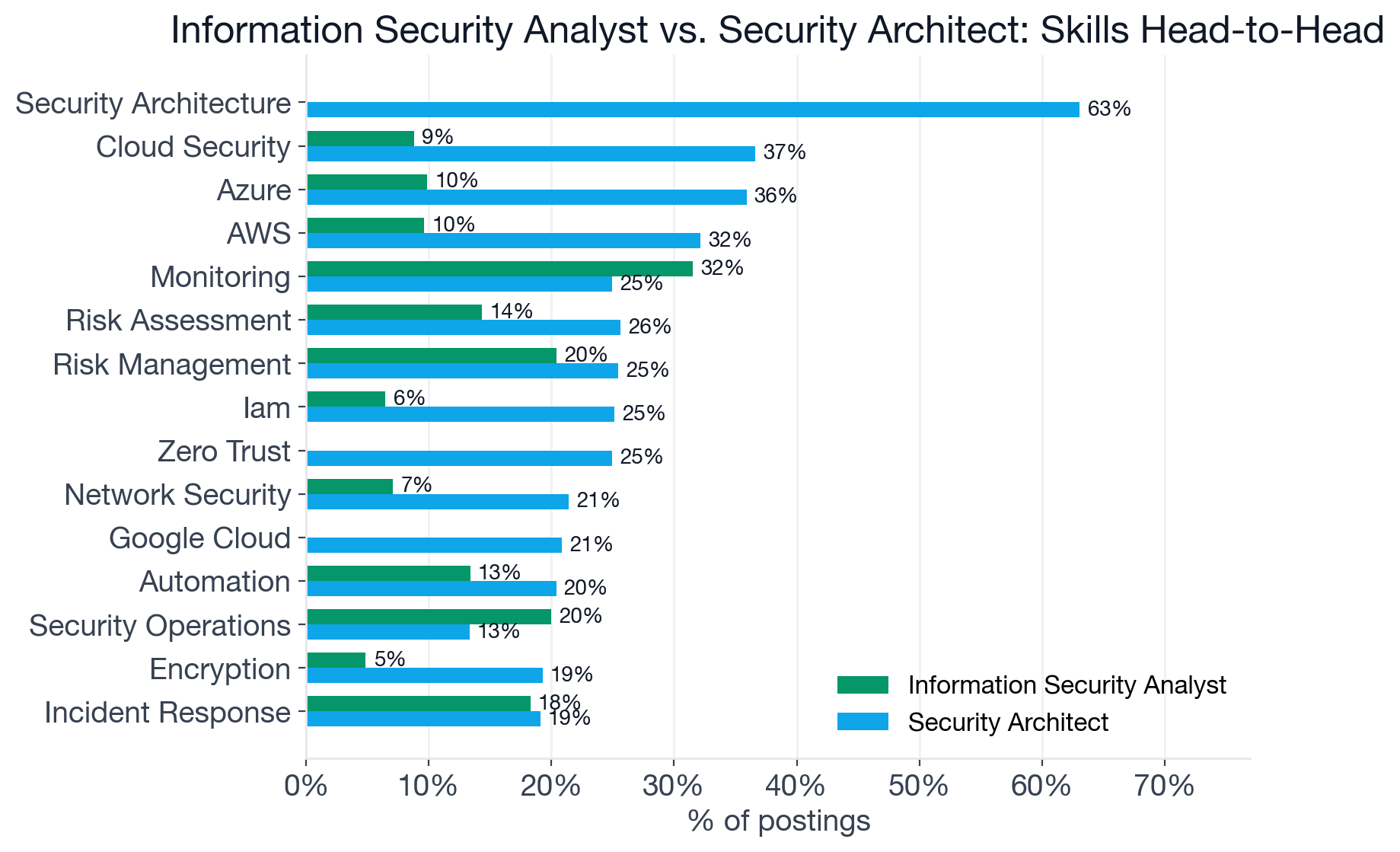
The chart ranks the top skills across both roles by overall prominence; a few of them, like Security Architecture, Zero Trust, Google Cloud, and Encryption, are far more common in Architect postings and don't clear the 5% overlap bar in the Analyst dataset. The table below is the complete list of skills that clear 5% of postings in both roles, sorted from most to least common on average:
| Skill | Information Security Analyst | Security Architect |
|---|---|---|
| Monitoring | 31.5% | 25.0% |
| Risk Management | 20.4% | 25.4% |
| Azure | 9.9% | 35.9% |
| Cloud Security | 8.8% | 36.6% |
| AWS | 9.6% | 32.1% |
| Risk Assessment | 14.3% | 25.6% |
| Incident Response | 18.3% | 19.1% |
| SIEM | 16.7% | 19.0% |
| Automation | 13.4% | 20.4% |
| Security Operations | 20.0% | 13.3% |
| IAM | 6.5% | 25.2% |
| Network Security | 7.1% | 21.4% |
| Vulnerability Management | 10.3% | 16.1% |
| Python | 8.7% | 12.7% |
| Firewalls | 7.8% | 13.4% |
Four of the fifteen buck the trend that defines the rest. Incident Response and SIEM are genuinely balanced: both roles ask for them at close to the same rate, so that expertise transfers directly. Monitoring and Security Operations lean the other way, toward the Analyst side (31.5% vs 25.0%, and 20.0% vs 13.3%). Every other shared skill skews hard toward Architect. Cloud Security shows the widest gap: 36.6% of Security Architect postings versus 8.8% of Analyst ones, roughly 4.2x. IAM, Azure, and AWS follow a similar pattern, each 3.3x to 3.9x more common in Architect postings. Cloud security exposure alone doesn't qualify you for an Architect role. Architects are asked for it nearly four times as often, which means depth, not familiarity, is the bar.
Which Skills Set the Two Titles Apart?
The list of skills unique to each role is lopsided, and that imbalance is itself a finding. Only two Analyst skills clear the exclusivity threshold (at least 8% of Analyst postings, under 5% of Architect postings): Threat Intelligence (9.1%) and Windows (8.8%). A third candidate, Customer Service at 13.7%, tracks closely with Allied Universal, a physical-security staffing firm that accounts for 8.0% of the Analyst postings in this dataset on its own; treating it as a genuine skill signal here would overstate what the role actually asks for, so it's left out.
Security Architect's exclusive list runs ten skills deep, led by a design-and-identity cluster: Zero Trust (25.0%), Google Cloud (20.8%), Encryption (19.3%), Identity and Access Management (15.9%, tracked separately from the abbreviated IAM tag in the shared-skills table above, where it sits at 25.2%), and Threat Modeling (16.2%). Below that sits the software-delivery layer noted above (Agile, Application Security, CI/CD, DevSecOps, all 12-14%), a cluster that falls short of the top-30 skill cutoff for Analyst postings rather than one that's genuinely missing from Analyst work: Agile itself still shows up in 4.9% of Analyst listings, and CI/CD, DevSecOps, and Application Security each still turn up often enough in Analyst postings to register a US salary median, just not often enough to crack the Analyst top 30. Counting Security Architecture itself, the single most concentrated skill in either dataset, that's ten skills unique to Architect against two for Analyst, a reasonable proxy for how much more specialized the Architect job actually is.
Which Pays More: Information Security Analyst or Security Architect?
Security Architect pays $174,100 at the US median versus Information Security Analyst's $99,100, a $75,000 (43.1%) gap between the two titles. Both figures are base salary only, from postings with US salary disclosed (n=248 and n=1,658); equity, bonus, and sign-on aren't captured in job listings, so total compensation at senior levels runs higher than either number shown here. Treat the $75,000 gap as an upper bound rather than a precise figure: a meaningful slice of the Analyst title sample is physical-security and guard-services postings rather than cybersecurity roles (Allied Universal alone accounts for 8.0% of Analyst listings), and those lower-paying postings likely pull the Analyst median down, widening the apparent gap versus Security Architect.
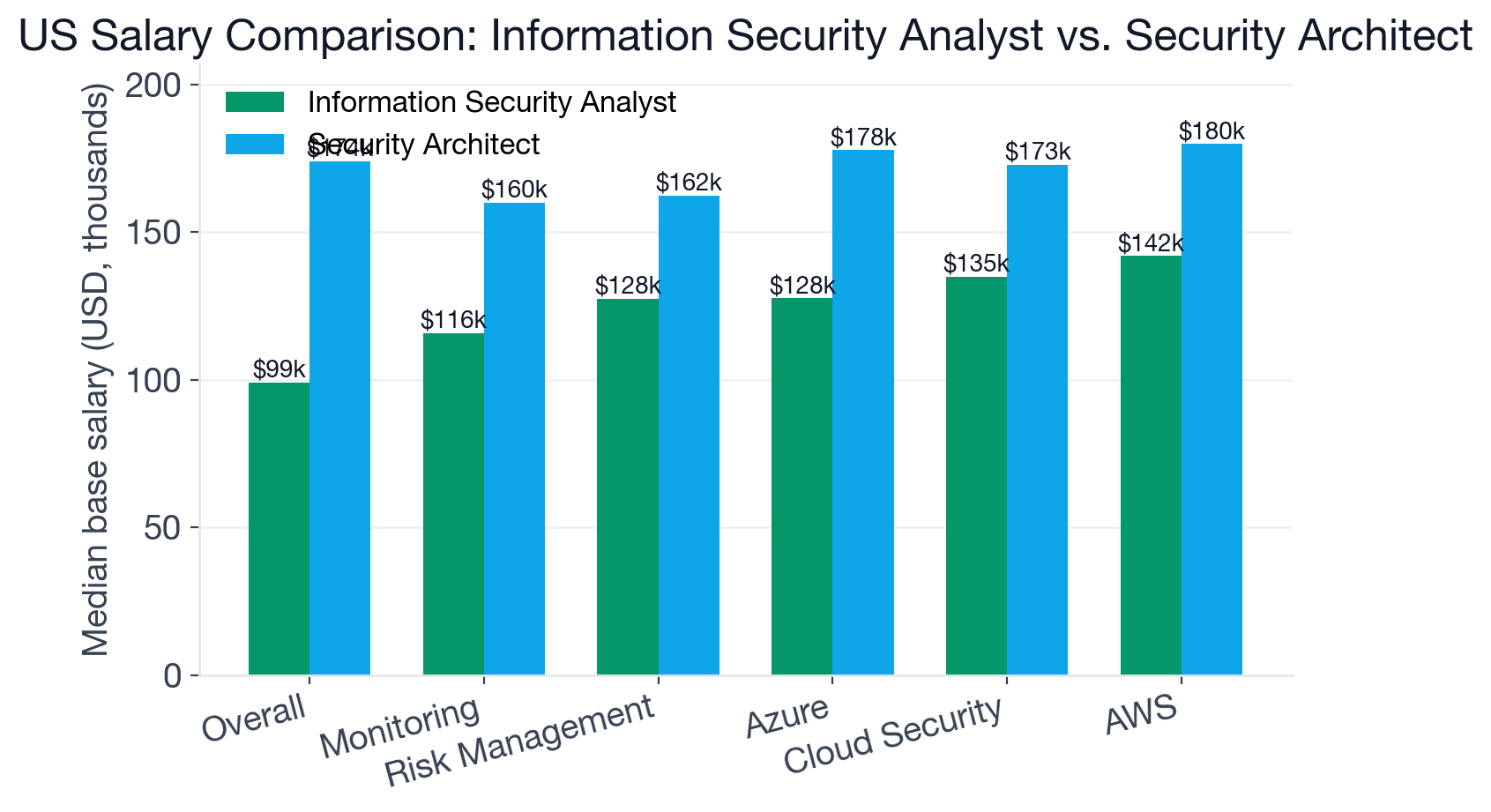
For every skill shown above, the same expertise commands a higher US base salary under a Security Architect title than under an Information Security Analyst one.
The more interesting story is what happens inside each role's own skill list. Security Architect's headline skills already sit at its ceiling: Security Architecture itself adds only $2,500 over baseline (n=161), and Cloud Security and Risk Assessment actually pay below it (-$1,200 and -$15,700). The real Architect premiums sit one layer down: Zero Trust adds $13,400 (n=79), IAM adds $15,900 (n=65), and APIs add $34,500 on a smaller sample (n=28).
Information Security Analyst runs the opposite pattern. Its own core operational skills already carry a real premium: Risk Assessment adds $30,400, Risk Management adds $28,400, Incident Response adds $24,400, SIEM adds $24,100, and even Monitoring, the most common skill in the dataset, adds $16,800. Some of the largest premiums in the dataset sit outside the role's usual skill set entirely: SOX compliance adds $58,400 (n=26), Machine Learning adds $60,000 (n=32), Data Science adds $55,700 (n=34), and Generative AI adds $54,900 (n=27), a small, likely hybrid slice of governance-, analytics-, and AI-adjacent postings rather than typical Analyst work.
Within the more representative, higher-volume tier, six skills cluster between $47,800 and $55,900: GDPR compliance ($55,900, n=45), Technical Documentation ($54,700, n=30), Procurement ($51,400, n=28), Program Management and Encryption, which tie at $50,900 (n=60 and n=63), and Change Management ($47,800, n=28). Two skills in the same tier run notably higher: Cloud Architecture adds $64,400 (n=26), the largest premium of any skill tracked for the role, and APIs add $56,700 (n=30). AWS adds $42,800 (n=157), and Threat Intelligence, Python, and Cloud Security each add an identical $35,900. The fastest way to raise Analyst pay isn't more monitoring, it's picking up the cloud, compliance, and architecture-adjacent skills above, the ones Architect postings already treat as standard.
Which Role Has More Openings, and Where Are They?
Information Security Analyst is the far bigger market, 5,757 active postings against Security Architect's 1,089, a 5.29x volume advantage. But that volume doesn't translate into easier entry: only 3.2% of Analyst postings are entry-level (183 of 5,757), and Architect is tighter still at 1.7% (18 of 1,089). Neither title is a realistic first security job.
Seniority mix explains part of the pay gap. Architect postings skew senior or staff 36.1% of the time (23.0% senior, 13.0% staff), versus 19.2% for Analyst (12.7% senior, 6.5% staff). Analyst roles concentrate more in the US (50.9% versus 37.4% for Architect, which spreads further into India at 10.6%), and Architect roles are noticeably more flexible: 56.5% hybrid or remote combined, versus 28.7% for Analyst, which stays 73.0% onsite. If flexible work matters as much as the title itself, that's arguably the sharper signal here.
Should You Aim for Analyst or Architect?
Choose Information Security Analyst if you:
- Want the highest volume of open roles right now (5.29x more postings than Architect) and a realistic path in from adjacent IT, helpdesk, or systems-administration work.
- Are comfortable starting in reactive, alert-driven work (SIEM, Incident Response, Monitoring) and building toward a specialization once you're established.
- Plan to raise your own pay over time by layering in cloud and compliance skills (AWS, Cloud Security, GDPR, Encryption) on top of the core SOC skill set.
Choose Security Architect if you:
- Already have several years of hands-on security experience and want to design systems and set standards rather than monitor them day to day.
- Want the higher pay ceiling ($174,100 median, a $75,000 premium) and can compete in a smaller, more senior-skewed pool with almost no entry-level openings.
- Want work embedded in the build pipeline (Agile, CI/CD, DevSecOps) instead of the security operations center.
Either path benefits from practicing the scenarios interviewers actually ask about: drill security-specific questions in the Question Bank, or run a full AI mock interview against an Analyst or Architect scenario before you apply.
FAQ
Q. Which pays more, Information Security Analyst or Security Architect?
Security Architect pays more. The median US base salary is $174,100 across 248 postings with US salary disclosed, versus $99,100 across 1,658 postings for Information Security Analyst, a $75,000 (43.1%) gap. Both figures are base salary only; equity, bonuses, and sign-on are not disclosed in job postings.
Q. How many Information Security Analyst and Security Architect jobs are open right now?
Information Security Analyst is the far larger market: 5,757 active postings versus 1,089 for Security Architect, a ratio of about 5.29 to 1. Security Architect is the smaller, more senior specialization that most analysts grow into rather than start in.
Q. Is Security Architect a promotion path from Information Security Analyst?
The data is consistent with that pattern. Security Architect skews more senior (36.1% of postings are senior or staff level, versus 19.2% for Information Security Analyst) and has a smaller entry-level share (1.7% versus 3.2%). Both roles are hard to enter directly, but Architect postings almost never target candidates with zero prior security experience.
Q. What skills overlap between Information Security Analyst and Security Architect?
The two roles share a 43% skill overlap (Jaccard similarity across each role's top 30 skills), spanning 15 individual skills that each clear 5% of postings in both roles. But the overlap is uneven: Cloud Security, Azure, AWS, and IAM technically clear the shared-skill threshold in both roles, yet each appears 3 to 4 times more often in Security Architect postings than in Information Security Analyst postings.
Q. What skill most separates Security Architect from Information Security Analyst?
Security Architecture itself. It appears in 63.1% of Security Architect postings, the single most concentrated skill signal in either dataset, while no individual skill clears even 32% of Information Security Analyst postings (Monitoring, the top Analyst skill, tops out at 31.5%).
Q. Do Information Security Analyst or Security Architect jobs require AI skills?
Neither role's top 30 skill list contains an explicit AI or generative AI skill tag, a genuine absence rather than a measurement gap. That does not mean AI tools are unused: a 2026 SANS Institute survey found AI use in cybersecurity jumped from 50% to 78% of organizations in a single year, and Analyst-facing tools like AI-assisted SIEM alert triage are already reducing response times in production security operations.
Q. Is Security Architect harder to break into than Information Security Analyst?
Yes, in two ways. Only 1.7% of Security Architect postings are entry-level (18 of 1,089), versus 3.2% for Information Security Analyst, and the market itself is 5.29 times smaller, so there are fewer openings competing for the same pool of experienced candidates.
The Architect Specializes. The Analyst Generalizes.
Neither title is wrong to use the word "security." They just describe opposite shapes of the same field: one role defined by a single skill asked for nearly two-thirds of the time, the other defined by a dozen skills that each show up roughly a fifth to a third of the time and never dominate. That difference in shape, more than raw experience, is what explains the $75,000 pay gap. Browse open Information Security Analyst roles or Security Architect roles on InterviewStack.io to see which shape fits where you already are.
Topics
Ready to practice?
Put what you've learned into practice with AI mock interviews and structured preparation guides.