
Security Architecture Has a $55K Salary Fault Line
The Security Architect job market in 2026 has a split running through its salary data that is difficult to ignore: Firewalls is associated with a $137,300 global median in this dataset (the US-only Firewalls sample does not reach the 25-posting reporting threshold for a standalone US figure), while the US baseline for the role sits at $171,600. Zero Trust (the architectural philosophy of "never trust, always verify" that replaced perimeter defense as the dominant security model) pays $192,400 in US postings. The spread between the perimeter-defense and identity-first ends of the skill spectrum: $55,100.
This is not just two skills with different pay. It is the market pricing two different versions of what a Security Architect is. One version is rooted in perimeter defense: firewalls, vulnerability management, compliance-driven risk management. The other is built around identity-first architecture: IAM (Identity and Access Management), Zero Trust, threat modeling, detection engineering. The salary data, drawn from 976 active Security Architect postings on the InterviewStack.io job board, separates those two versions cleanly.
The divide matters because both versions appear in the same job title. A posting might say "Security Architect" and mean either. Knowing which side of the split your target employers are on is arguably more useful than any individual skill.
Key Findings
- 976 active Security Architect postings analyzed across the live job board as of June 2026.
- Median US base salary is $171,600 (n=196 US postings with disclosed salary).
- Zero Trust pays $192,400 US median (n=52), a $20,800 premium. Firewalls shows a $137,300 global median (n=32; US-only sample below reporting threshold). The spread across the skill spectrum: $55,100.
- API security (listed as "APIs" in the dataset) tops the US premium table at $198,300 (n=30; just above the reporting threshold), a $26,700 premium. The identity cluster follows: IAM at $191,900, Identity and Access Management at $190,000, both $18-20K above baseline.
- Only one skill clears the table-stakes bar: Security Architecture at 60% of postings. Everything else is common or differentiator.
- Multi-cloud fluency is a structural expectation: AWS and Azure appear together in 30% of postings (lift 2.04); AWS and Google Cloud co-occur at 21% (lift 2.52, the highest in the dataset).
- Only 19 of 976 postings (2%) are entry-level, making Security Architect one of the most experience-gated roles in tech.
- The role is 46% onsite and only 19% fully remote, below the remote share for most senior tech roles.
Which Security Architect Skills Move the Salary Needle?
These figures are restricted to US postings only, where wage-transparency laws produce consistent disclosure, so the numbers are directly comparable. They are base salary: equity, bonuses, RSUs, and sign-on are not disclosed in postings, so total compensation at top employers runs meaningfully higher. The 976-posting dataset captures the Security Architect title broadly; roughly one in five postings reflects an adjacent security role (government information security officers, security engineers, or security specialists without explicit architect scope). The core skill and salary patterns reported here are consistent across the dataset.
The overall US median for Security Architect postings is $171,600 (n=196).
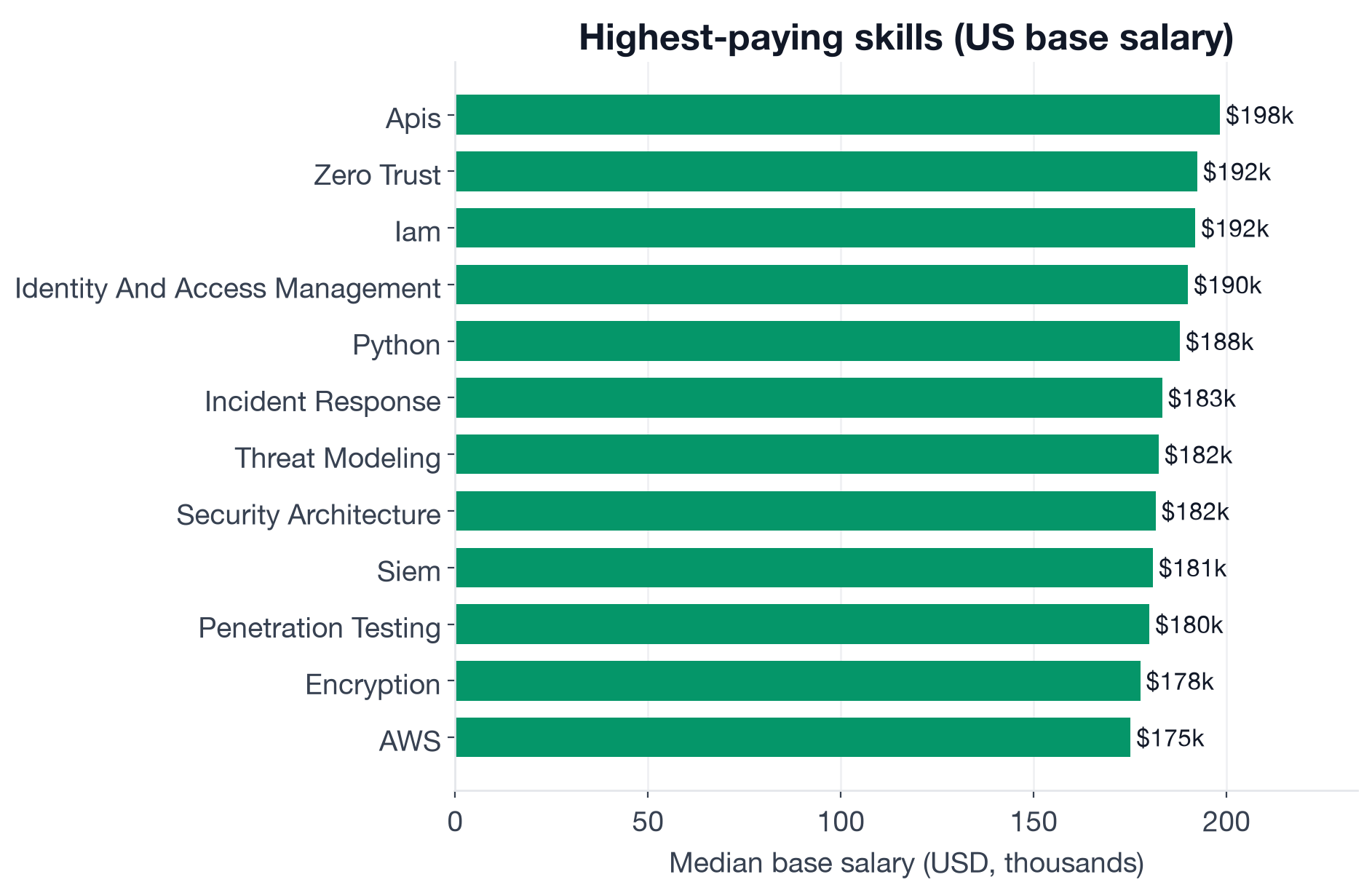
Median base salary for Security Architect postings that mention each skill. Figures are US-only where the skill has 25 or more US salary data points. †Firewalls uses the global dataset median (n=32 globally; US-only sample below threshold). All figures are base salary only.
The pattern is clear once you see the two clusters:
Skills that command premiums of $10K or more above the $171,600 baseline:
| Skill | US Median | Premium |
|---|---|---|
| APIs (API security)* | $198,300 | +$26,700 |
| Zero Trust | $192,400 | +$20,800 |
| IAM | $191,900 | +$20,300 |
| Identity and Access Management | $190,000 | +$18,400 |
| Python | $187,900 | +$16,300 |
| Incident Response | $183,300 | +$11,700 |
| Threat Modeling | $182,400 | +$10,800 |
| Security Architecture | $181,600 | +$10,000 |
*APIs: n=30, just above the 25-posting reporting floor. The confidence interval is wider than for better-sampled skills like Zero Trust (n=52) or IAM (n=50). Treat this figure as directional. All other rows are US-only base salary.
Skills that sit near or below the $171,600 baseline:
| Skill | US Median | vs. Baseline |
|---|---|---|
| Cloud platforms (AWS, Azure, GCP) | $173,900-$175,100 | +$2,300-$3,500 |
| Risk Assessment | $168,100 | -$3,500 |
| Risk Management | $159,300 | -$12,300 |
| Vulnerability Management | $152,800 | -$18,800 |
| Firewalls† | $137,300 | -$34,300 vs. US baseline |
†Firewalls: global median across all markets (n=32). US-only sample below the 25-posting reporting threshold; included here for structural comparison with the perimeter-defense layer. All other rows in this table are US-only.
The top row in the premium table belongs to a specialist niche: API security architecture (listed as "APIs" in this dataset) shows a $198,300 US median on a sample of 30 postings. That n=30 sits right at the 25-posting reporting floor, so treat the specific figure as directional rather than definitive. The directional signal is meaningful: the skill appears in 8.7% of postings, concentrated in organizations explicitly requiring expertise in securing microservice and cloud-native API layers, including authentication flows, service-to-service authorization, and API endpoint controls.
The cloud platforms (AWS at $175,100, Azure at $175,000, Google Cloud at $173,900) all cluster within a narrow $3,500 band above the baseline. They are expected competencies rather than differentiators within this role: not knowing a major cloud filters you out, but knowing it does not move you up the offer curve.
The below-baseline cluster tells the real story. Risk Management, Vulnerability Management, and Firewalls are associated with the compliance-and-perimeter layer of security work: keeping the audits current, patching CVEs, maintaining traditional perimeter defenses. The market prices these skills at a discount relative to the role median, a direct signal that organizations are transitioning away from purely reactive, perimeter-centric security and toward proactive, identity-first architectures.
Zero Trust, IAM, and Identity and Access Management are the skills associated with that transition. Together they represent the architectural philosophy that replaced the perimeter: assume breach, verify identity at every layer, limit lateral movement through tight access controls. Architects who can design those systems at cloud scale command a $20K premium. Python adds $16,300, reflecting the scripting and automation work that modern security architecture requires: writing policy-as-code, automating detection rules, building identity lifecycle tooling.
One outlier worth noting: the SIEM skill (Security Information and Event Management, the log aggregation and correlation platform most security teams use as their detection nerve center) shows a $180,900 US median (n=38), a $9,300 premium. Postings that ask for SIEM experience are asking for architects who can design detection architectures, not just configure tools.
If you want to browse Security Architect openings that emphasize Zero Trust or those requiring IAM architecture skills, the filtered views surface them directly.
What Skill Families Define a Security Architect in 2026?
Group individual skills into families and count how many postings ask for at least one skill in each family.
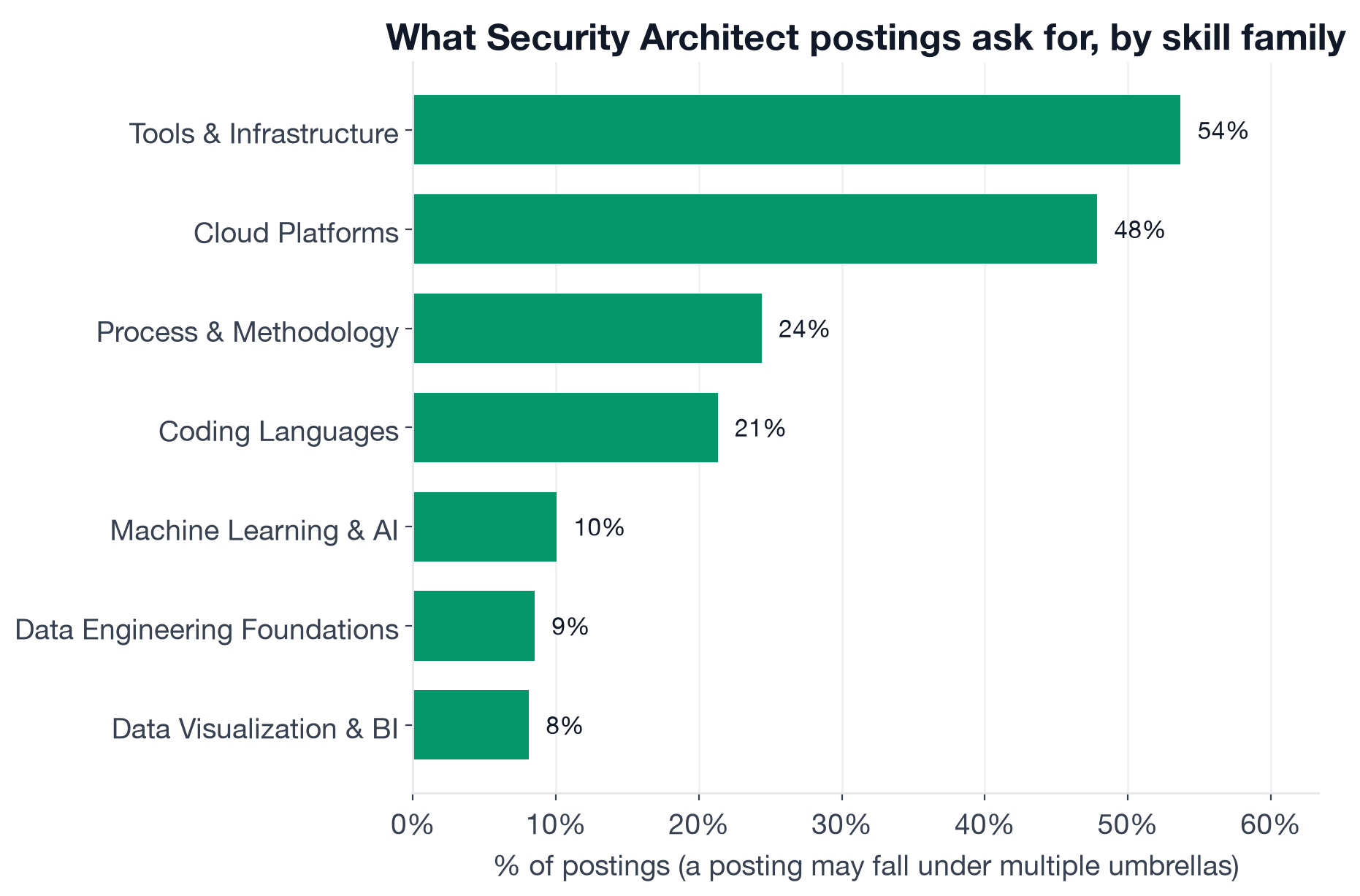
Share of Security Architect postings asking for at least one skill in each family. A posting that mentions both Azure and AWS counts once under Cloud Platforms.
The "Other" bucket (97%) is a catch-all for the security-domain skills themselves: Security Architecture, Cloud Security, Risk Management, IAM, Zero Trust, Network Security, and their peers. Nearly every posting qualifies. The more informative picture comes from the secondary families:
- Tools & Infrastructure (54%): Monitoring, Automation, Kubernetes, Linux. More than half of all postings expect the architect to work at the infrastructure layer, not just write policy documents.
- Cloud Platforms (48%): Azure, AWS, Google Cloud. Nearly half of postings name at least one major cloud, and as the skill pairs section below shows, many name all three.
- Process & Methodology (24%): Agile, Stakeholder Management, Project Management. A quarter of postings reflect the management and cross-functional communication layer of the role.
- Coding Languages (21%): Overwhelmingly Python. One in five postings expects the architect to write code, a share that has grown as infrastructure-as-code and policy-as-code practices spread.
- Machine Learning & AI (10%): Generative AI (5.7%) leads this family. The framing matters here: this measures Security Architects explicitly hired to design or govern AI systems. It is the explicit floor, not the ceiling of AI relevance.
The ambient layer is much larger. A 2026 Darktrace survey (n=1,540 security leaders across 14 countries) found Generative AI embedded in 77% of security stacks globally. Separately, 51% of professional developers report using AI tools daily (Stack Overflow Developer Survey 2025), and 85% report using them regularly (JetBrains Developer Ecosystem Survey 2025). Security Architects work in environments where AI-driven detection and response are already operational. The 5.7% explicit requirement measures the architects hired specifically to build those systems. The rest are expected to architect around them regardless.
The Three Tiers of Security Architect Skills
Drill into individual skills and three tiers emerge based on how broadly they appear across postings.
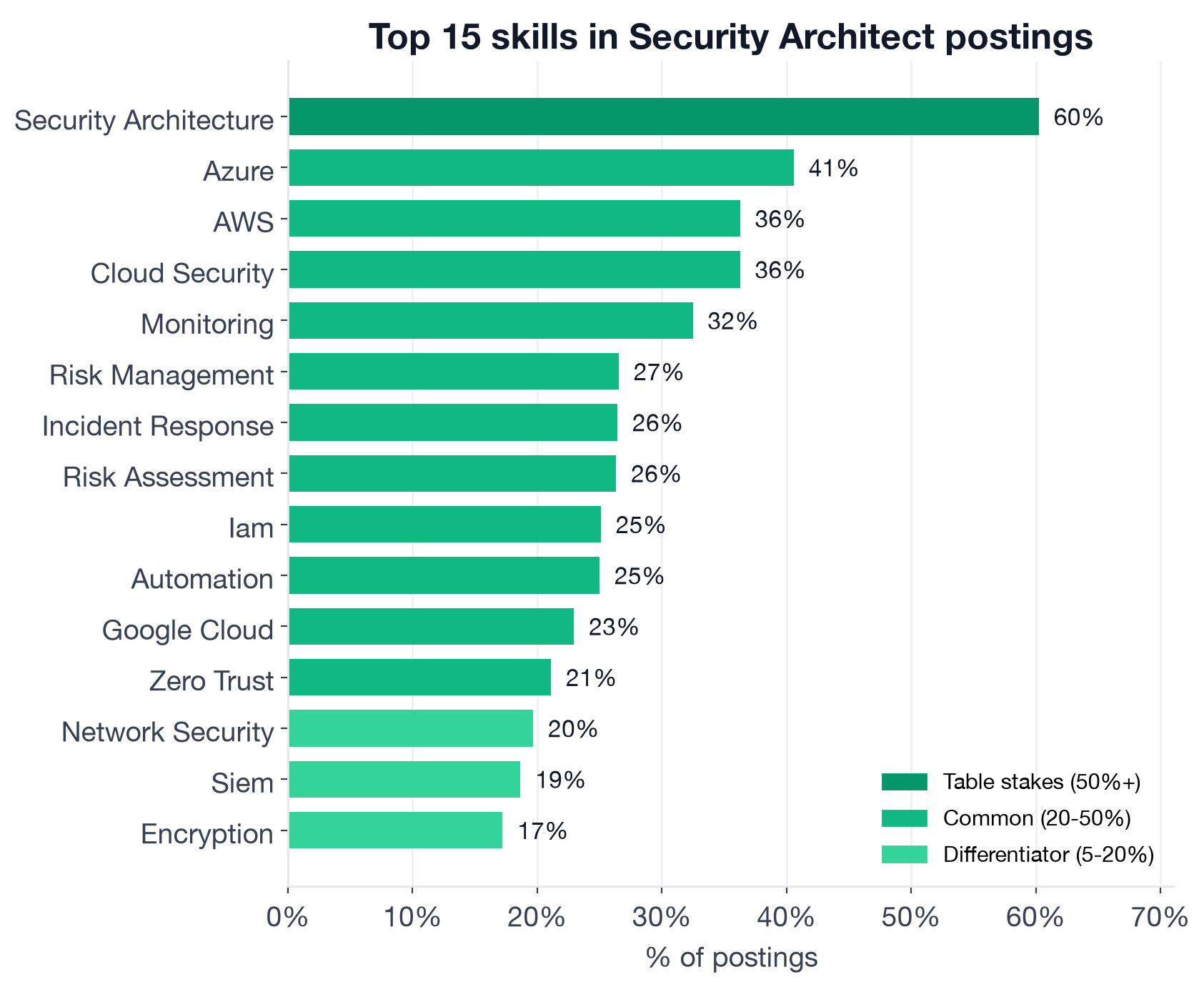
Top individual skills in Security Architect postings, color-coded by tier. Above 50% = table stakes; 20-50% = common; 5-20% = differentiator.
Table Stakes (50%+ of postings)
- Security Architecture: 60% (Security Architect openings)
A single skill. This is unusual. Most roles have three to five skills at the table-stakes level. Security Architect has one: the domain itself. The implication is that beyond demonstrating fluency in security architecture as a discipline, there is no default required stack. Companies diverge sharply on which specific skills they need below that threshold.
Common Expectations (20-50% of postings)
The eleven skills in this tier define the role's typical operating environment:
- Azure: 41%
- AWS: 36%
- Cloud Security: 36%
- Monitoring: 32%
- Risk Management: 27%
- Incident Response: 26%
- Risk Assessment: 26%
- IAM: 25%
- Automation: 25%
- Google Cloud: 23%
- Zero Trust: 21%
Three cloud platforms, two identity/access skills (IAM and Zero Trust), and a risk/incident cluster together make up the common layer. The cloud picture is multi-platform by design: AWS and Azure are nearly tied at 36% and 41%, with Google Cloud close behind at 23%. A Security Architect in 2026 is not a single-cloud specialist.
Differentiators (5-20% of postings)
The differentiator list is long (38 skills), which reflects how specialized sub-domains within security architecture have become. Selected highlights:
- Network Security (20%), SIEM (19%), Encryption (17%), Threat Modeling (16%)
- DevSecOps (11%): the practice of integrating security controls into CI/CD pipelines
- OWASP (9%): the Open Web Application Security Project's vulnerability standards, relevant for application security specializations
- Generative AI (5.7%), EDR (6.5%): EDR (Endpoint Detection and Response) platforms for real-time threat detection
Skills below 20% are not "nice to haves" across the board. They are requirements for specific sub-specializations: network security architects need Network Security and Firewalls; detection engineers need SIEM and Threat Intelligence; application security architects need OWASP and penetration testing. Matching your skills to the right sub-domain is as important as acquiring them.
Multi-Cloud Is the Default, Not the Exception
Among the top 25 skills, the co-occurrence pairs that far exceed chance expectation reveal the dominant structural patterns in Security Architect hiring.
| Skill pair | Joint postings | % of all | Lift |
|---|---|---|---|
| AWS + Google Cloud | 205 | 21% | 2.52 |
| Azure + Google Cloud | 205 | 21% | 2.26 |
| AWS + Azure | 293 | 30% | 2.04 |
| IAM + AWS | 144 | 15% | 1.62 |
| Azure + Zero Trust | 144 | 15% | 1.72 |
| IAM + Azure | 145 | 15% | 1.46 |
| Security Architecture + Threat Modeling | 134 | 14% | 1.40 |
| Security Architecture + Zero Trust | 152 | 16% | 1.22 |
Lift greater than 1 means the pair appears together more often than their individual frequencies would predict.
The three cloud-to-cloud pairs all clear lift 2.0, the highest cluster in the dataset. In most engineering roles, cloud platform pairs like this have lower lift because engineers specialize in one cloud. Security Architects break that pattern: 30% of postings ask for both AWS and Azure, 21% ask for both AWS and Google Cloud. The typical Security Architect is expected to protect multi-cloud environments simultaneously, not specialize within one provider.
The IAM-cloud pairs (IAM + AWS at lift 1.62, IAM + Azure at 1.46) confirm what the salary data already showed: identity and access management is how security gets applied to cloud infrastructure. The two are functionally inseparable in modern cloud architectures.
Security Architecture + Threat Modeling (lift 1.40) and Security Architecture + Zero Trust (lift 1.22) sketch the shape of the higher-paying sub-type: the architect who designs systems based on a modeled threat landscape and a zero-trust access model, rather than maintaining compliance checklists and perimeter hardware.
If you have AWS experience and want to specialize in IAM-focused Security Architect roles, the filtered view surfaces those postings directly.
How Steep Is the Entry-Level Barrier?
Security Architect earns its reputation as an experience-gated role.
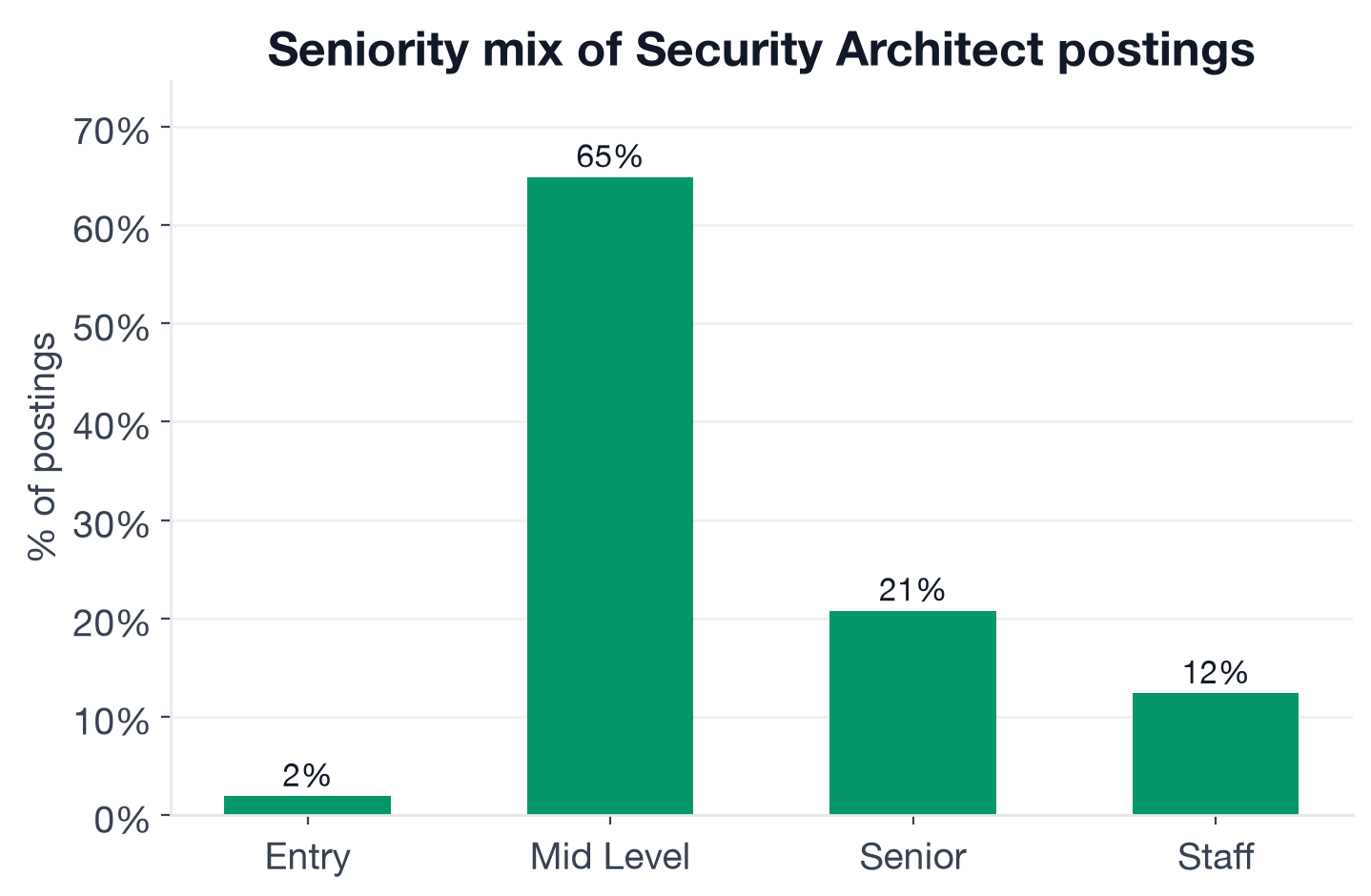
Seniority distribution of active Security Architect postings, inferred from job-title keywords.
- Mid-level: 65% (633 postings)
- Senior: 21% (203)
- Staff/Lead/Principal: 12% (121)
- Entry: 2% (19)
Two of every 100 postings are entry-level. Not two percent of a large pool: nineteen postings, out of 976 total. Security Architect sits among the most experience-gated roles in tech.
The senior-and-above tier (senior plus staff) is 33% of all postings, a substantial demand curve for IC growth. There is real runway at the top of this track: organizations hiring at the staff and principal level are looking for architects who can define the security strategy for an entire enterprise, not configure individual controls. If you are targeting senior Security Architect openings, expect the differentiator skills (Zero Trust, Threat Modeling, SIEM architecture, IAM at scale) to be requirements rather than optional additions.
The practical implication: the path into Security Architecture almost always runs through a neighboring role first. Security Operations, Cloud Security Engineering, Application Security, or Network Engineering are the common entry points. Candidates who transition from those roles bring the production-environment credibility that Security Architect postings require.
Where Are Security Architect Jobs Located, and How Remote-Friendly Are They?
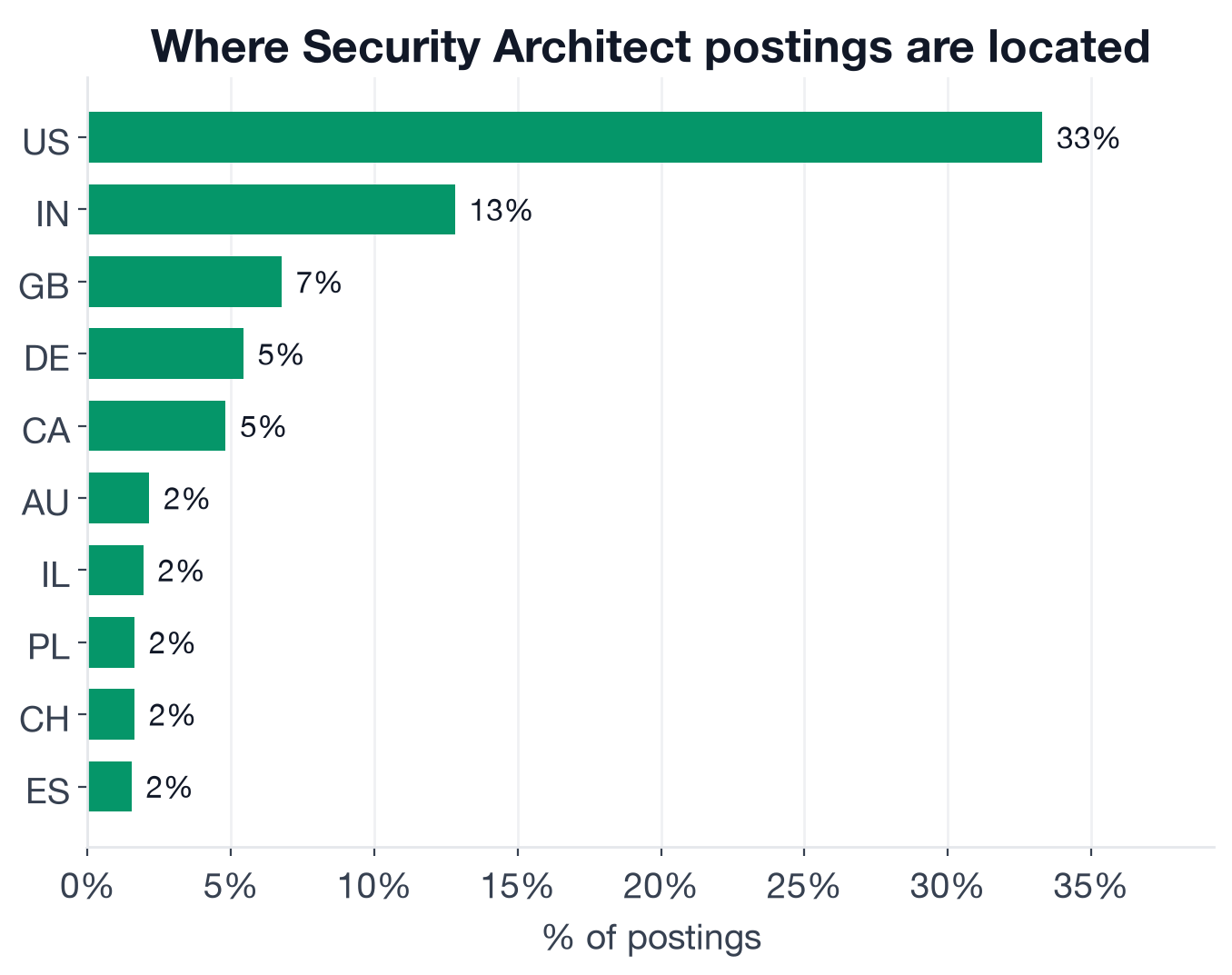
Top countries by share of active Security Architect postings.
- United States: 33% (325 postings)
- India: 13% (125)
- United Kingdom: 7% (66)
- Germany: 5% (53)
- Canada: 5% (47)
The US holds a third of the market, with a meaningful spread across mature tech economies. The India share (13%) is lower than for engineering roles like Data Engineer or Software Engineer, reflecting the strategic and advisory nature of Security Architect work, which tends to cluster closer to the business units and data it protects.
The remote picture is notably constrained.
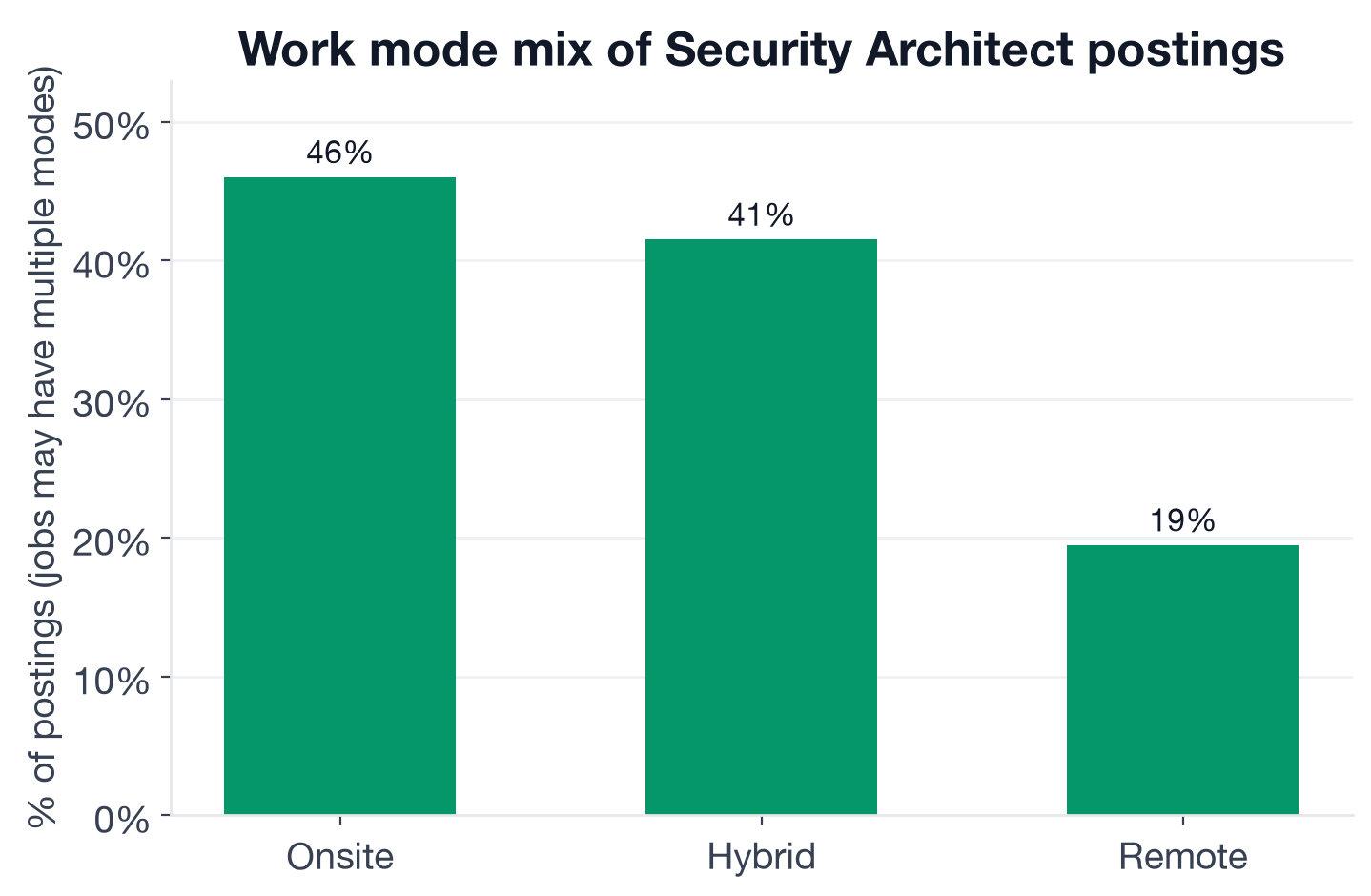
Share of Security Architect postings by work mode.
- Onsite: 46% (449 postings)
- Hybrid: 41% (405)
- Remote: 19% (190) (fully-remote Security Architect openings)
Only 1 in 5 postings is fully remote, a lower share than cloud engineers or data roles. The combination of classified government work, on-premises security hardware, and the expectation that Security Architects participate directly in incident response drives the onsite and hybrid majority. Hybrid is the most workable middle ground, and it accounts for 41% of postings.
Who's Hiring Security Architects in 2026?
The hiring mix reflects the industries that carry the highest security architecture demand: consulting firms that deploy Security Architects to client engagements, industrial and aerospace companies with complex OT security needs, financial services with regulatory requirements, and dedicated security specialists.
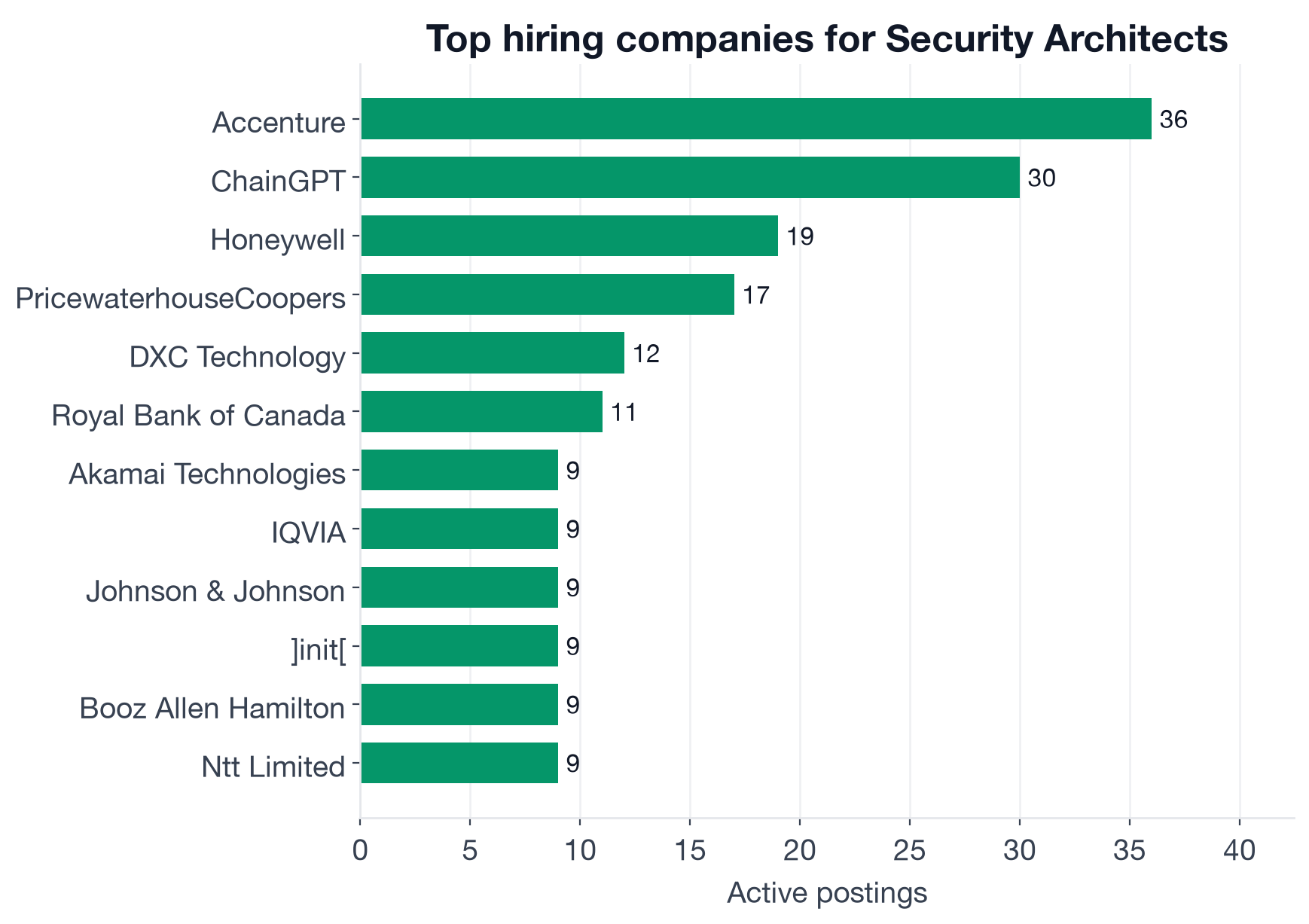
Top companies by active Security Architect postings (distinct openings). No reposting artifacts detected.
| Company | Postings | Sector |
|---|---|---|
| Accenture | 36 | Global consulting |
| ChainGPT | 30 | Blockchain / AI security |
| Honeywell | 19 | Industrial / aerospace |
| PricewaterhouseCoopers | 17 | Big Four consulting |
| DXC Technology | 12 | IT services |
| Royal Bank of Canada | 11 | Banking |
| Akamai Technologies | 9 | CDN / security infrastructure |
| IQVIA | 9 | Healthcare data / pharma |
| Johnson & Johnson | 9 | Healthcare |
| Booz Allen Hamilton | 9 | Government consulting / defense |
| NTT Limited | 9 | Global IT services |
| Thales | 8 | Defense / aerospace |
| Leidos | 8 | Government / defense |
Consulting and IT services firms (Accenture, PwC, DXC, Booz Allen, NTT) dominate the top slots, consistent with how Security Architect demand often flows through managed security service providers and advisory firms before appearing in direct-hire postings. ChainGPT's position at #2 reflects the growing demand for security architecture expertise in blockchain and Web3 infrastructure, a vertical with distinct requirements around smart contract security, key management, and decentralized identity. The defense and aerospace cluster (Honeywell, Leidos, Thales, Booz Allen) and healthcare presence (IQVIA, J&J) round out an industry mix that covers government, finance, healthcare, and industrial, the four sectors that consistently drive Security Architect headcount.
How to Use This in Your Job Search
The salary fault line points to a practical prep sequence.
Anchor on the identity and access layer. The premium cluster (Zero Trust, IAM, Incident Response, Threat Modeling) traces a coherent architectural path: design systems that verify identity at every layer, model threats before they materialize, and detect incidents through well-instrumented SIEM architectures. If you have a background in any one of these areas, the others extend naturally from it. Practice identity and access management architecture questions in the question bank to build the fluency that surfaces in onsite rounds.
Build multi-cloud breadth, not single-cloud depth. Security Architect is one of the few senior roles where fluency across all three clouds is the norm rather than the exception. The co-occurrence data is clear: AWS and Azure appear together in 30% of postings, AWS and Google Cloud in 21%. Start with AWS Security Architect openings if you are AWS-native, but invest in understanding the IAM and security primitives of at least a second cloud before targeting senior roles.
Add code to your toolkit. Python at $187,900 US median (+$16,300) is the highest-paying individual coding skill in this dataset and appears in 14% of postings. The use cases are specific: automating detection rules, writing infrastructure-as-code security policies, scripting identity lifecycle processes. You do not need to become a software engineer, but production-quality Python for security automation is a real differentiator. Our interactive courses cover Python and systems foundations that apply directly to these use cases.
Expect the onsite default. If your preference is fully remote, start with the filtered remote openings to understand the realistic pool (about 190 postings at any given time). Hybrid is the more workable target: 41% of the market, with the remote-flexibility percentage climbing in SaaS and cloud-native companies.
Practice the full round. Security Architect interviews involve system design (design a zero-trust network, secure a cloud-native architecture), threat modeling walkthroughs, and behavioral questions about incident handling. Our Security Architecture interview walkthrough shows what a full round looks like in practice. AI mock interviews let you run those rounds under realistic conditions and get structured feedback on your architectural reasoning and security assumptions.
Browse and filter on the job board. Explore current Security Architect openings and use skill and seniority filters to target the sub-domain that matches your background. The board updates daily.
FAQ
Q. What is the median salary for a Security Architect in 2026?
The median US base salary across 196 Security Architect postings with US salary disclosed is $171,600. That is base salary only; equity, bonuses, and sign-on are not disclosed in job postings, so total compensation at top employers runs meaningfully higher.
Q. Which Security Architect skills pay the highest premium over the role baseline?
The highest US salary premium in this dataset belongs to API security architecture: $198,300 median (n=30; just above the 25-posting reporting threshold). The identity cluster follows: Zero Trust pays $192,400 (n=52), a $20,800 premium over the $171,600 baseline; IAM pays $191,900 (n=50), a $20,300 premium; Identity and Access Management pays $190,000 (n=43), an $18,400 premium. Python adds $16,300 ($187,900, n=30). Incident Response adds $11,700 and Threat Modeling adds $10,800. At the other end, Firewalls shows a global median of $137,300 (n=32; the US-only sample is below the 25-posting reporting threshold for a standalone US median), the lowest in the dataset.
Q. What are the table-stakes skills for a Security Architect in 2026?
Security Architecture is the only true table-stakes skill, appearing in 60% of postings (588 of 976). The common tier (20-50%) includes Azure (41%), AWS (36%), Cloud Security (36%), Monitoring (32%), Risk Management (27%), Incident Response (26%), Risk Assessment (26%), IAM (25%), Automation (25%), Google Cloud (23%), and Zero Trust (21%).
Q. How competitive is Security Architect as an entry-level role?
Extremely competitive. Only 19 of 976 postings (roughly 2%) are explicitly entry-level, making it one of the most experience-gated roles in tech. Mid-level dominates at 65% (633 postings), with senior at 21% (203) and staff/lead at 12% (121).
Q. Where are Security Architect jobs located, and how remote-friendly is the role?
The United States holds 33% of postings (325 of 976), followed by India (13%), UK (7%), Germany (5%), and Canada (5%). The role is notably onsite-heavy: 46% of postings are onsite, 41% are hybrid, and only 19% are fully remote, one of the lower remote shares among senior tech roles.
Q. Do Security Architects need to know multiple cloud platforms?
Yes, multi-cloud fluency is a defining signature of this role. AWS and Azure appear together in 30% of all postings with a co-occurrence lift of 2.04, far above chance. AWS and Google Cloud co-occur at 21% of postings (lift 2.52, the highest lift in the dataset). Security Architects are routinely expected to protect environments spanning all three major clouds simultaneously.
Q. Is AI fluency becoming part of the Security Architect role?
In two distinct ways. Explicitly, about 5.7% of postings name Generative AI as a requirement, measuring architects hired to design or govern AI systems. Separately, a 2026 Darktrace survey found Generative AI is already embedded in 77% of security stacks globally, meaning most Security Architects are responsible for AI-powered environments whether their job description says so or not.
What the Salary Fault Line Is Telling You
The gap between Firewalls (at $137,300 in the global dataset) and Zero Trust ($192,400 US median) is not a coincidence. It is the labor market pricing the transition from perimeter-centric security to identity-first security. Organizations that have made that transition are willing to pay more for architects who can design the new model. Those still running perimeter defenses are hiring for maintenance.
For a Security Architect building their career in 2026, the practical read is: the compliance and perimeter skills keep the role legitimate, but they do not command a premium. The architectural skills that do, Zero Trust, IAM, Threat Modeling, and Python-enabled automation, are the ones that move the offer. The salary data makes the direction of the field explicit. Building toward the high-premium cluster is not just about earning more; it is about being relevant to the next ten years of security architecture work.
Topics
Ready to practice?
Put what you've learned into practice with AI mock interviews and structured preparation guides.