
Pentesters Adopted AI Fast, Then Started Pulling Back
Most "AI is changing this job" stories move in one direction: adoption climbs, trust climbs with it. Penetration testing is the rare role where those two lines just split. We looked at every active Penetration Tester posting on the InterviewStack.io job board over a 90-day window, 476 postings, and flagged which ones explicitly required AI or machine-learning skills in the description. Only 13.4% did. That is a narrow slice, hired specifically to build, red-team, or manage AI systems rather than to run ordinary offensive-security engagements. (A dataset note: alongside core Penetration Tester and Red Team titles, this pool also picks up closely adjacent offensive-security titles like Vulnerability Researcher, plus a smaller share of Vulnerability Management and Security Researcher postings that lean more toward defensive analysis than hands-on testing. That blend is typical for how this role is tagged across job boards and doesn't change the AI-adoption pattern below, but it's worth knowing the 476-posting base is broader than a "Penetration Tester" title-only search would return.)
Outside that narrow slice, the picture looks completely different. Industry survey data puts daily AI tool use among working hackers and security researchers at 82%, and climbing. But the same period saw a sharp drop in how much organizations trust AI to run an engagement without a human in the loop. Those two facts together, not either one alone, are the real story of what AI is doing to this job in 2026.
Key Findings
- 13.4% of Penetration Tester postings (64 of 476) explicitly require new-wave generative AI skills; 22.1% mention AI in any form.
- 82% of hackers and security researchers report using AI tools in their daily workflow (Bugcrowd, 2026), up from 71% a year earlier.
- Confidence in fully autonomous AI-powered pentesting fell from 29% of organizations in 2025 to 9% in 2026 (Cobalt/Dark Reading).
- Machine Learning is the single most-cited AI-related skill at 12.8% of postings; LLMs and AI Agents tie for the top new-wave skill at 7.8% each.
- Zero of 34 entry and junior postings require any AI skill; the rate climbs from 11.9% at mid-level to 19% at staff level.
- Israel's AI-requirement rate (64.3%, n=14) is more than 5 times the US rate (11.4%, n=193), the largest single-country outlier in the dataset.
- The US salary sample for AI-required roles (n=14) is too small to report a median; the global gap between AI and non-AI postings is roughly $990, not a meaningful premium.
What Pentesting Looked Like Before AI Wrote the Recon Scripts
Three or four years ago, a Penetration Tester's toolkit was almost entirely manual craft: Burp Suite for web app testing, Nmap and Metasploit for network enumeration, custom Python scripts for one-off exploit development, and a report written from scratch after the engagement wrapped. "AI security testing" existed, but it lived in a narrow specialty lane, testing adversarial inputs against machine-learning models for companies that had ML in production, not something a generalist pentester touched. Large language models weren't yet part of the daily kit, and prompt injection wasn't a category anyone tested for because there was nothing to inject a prompt into.
That changed fast once generative AI tools became mainstream enough to speed up the unglamorous parts of the job: parsing large recon dumps, drafting first-pass findings, summarizing a sprawling codebase before a source-code review. None of that required a job posting to say "AI" explicitly. It just became part of how the work got done, the same way postings never listed "must know how to use a web browser."
How Many Penetration Tester Postings Actually Require AI Skills?
Job postings capture only one layer of AI adoption: the jobs where a company is explicitly hiring someone to build, deploy, or red-team an AI system. That layer sits at 13.4% for Penetration Testers, with another 12.8% citing traditional machine learning or deep learning (mostly AI-security research roles, not core offensive-security work). Combined, 22.1% of postings mention AI in any form.
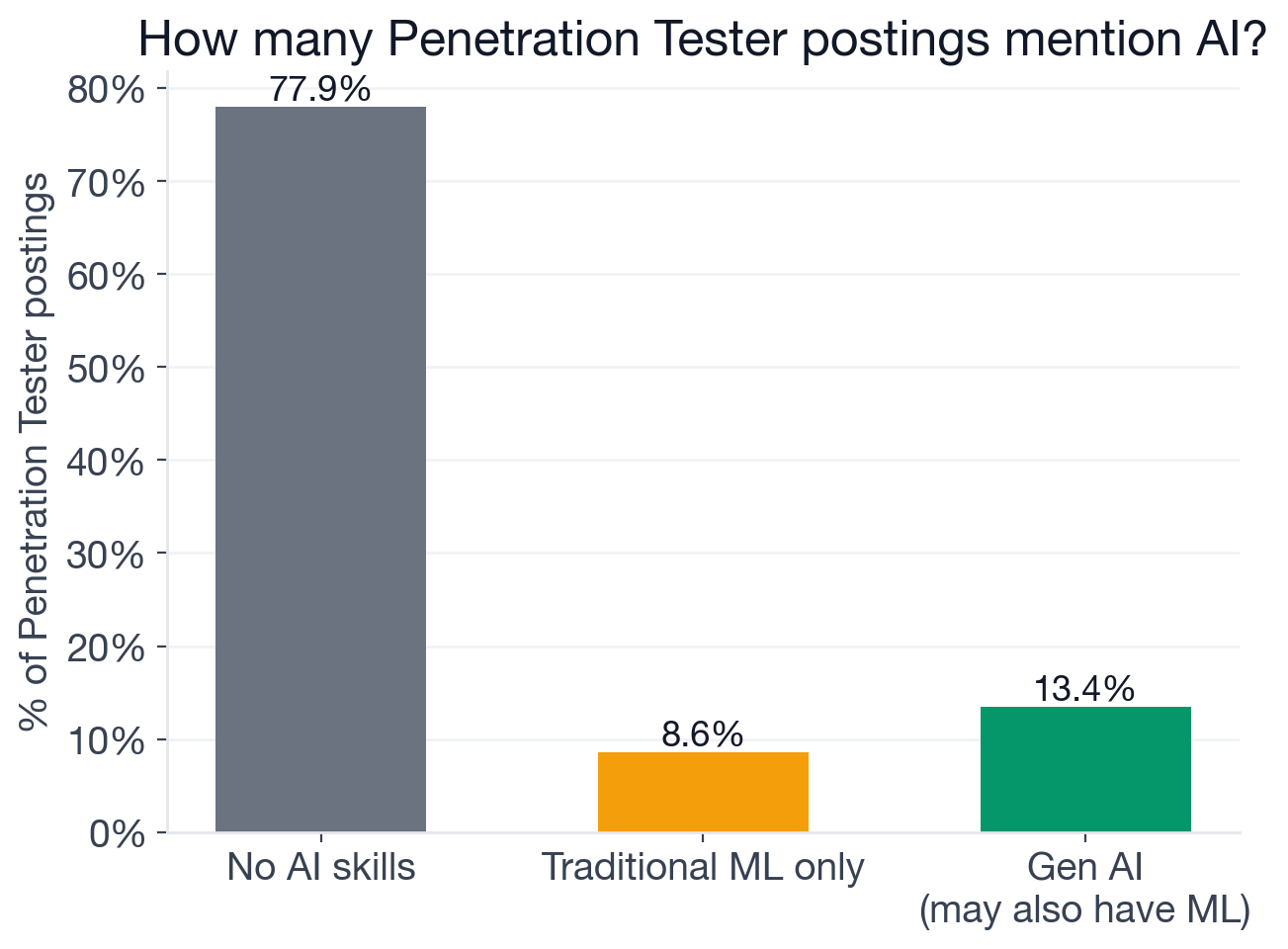 Roughly 1 in 8 Penetration Tester postings explicitly requires generative AI skills; nearly 1 in 4 mentions AI in some form.
That 13.4% is a floor, not a ceiling. It measures who companies are hiring to build with AI. It says nothing about who is expected to use AI day to day, and that ambient layer is much larger. Bugcrowd's Inside the Mind of a Hacker 2026 report, the industry's largest annual survey of practicing offensive-security researchers, found 82% now use AI tools in their daily workflow, up from 71% in 2025 and 64% in 2023. HackerOne's 2025 researcher-signal data puts the figure even more conservatively at over two-thirds using AI or automation tools to speed up reconnaissance and cut repetitive work. Neither survey requires a job posting to say "AI" for that usage to count.
Here is the part that makes Penetration Testing different from almost every other role in this series: the ambient layer isn't climbing in a straight line toward full automation. Cobalt's research, reported by Dark Reading, found that confidence in fully autonomous, AI-powered penetration testing fell from 29% of organizations in 2025 to just 9% in 2026, because roughly three-quarters of organizations said automated systems missed significant vulnerabilities when run unsupervised. Employers are adopting AI as a daily co-pilot for recon, triage, and drafting, and simultaneously losing faith in letting it run an engagement on its own. Both trends are true at once, and a Penetration Tester's job in 2026 sits exactly at that intersection: use AI constantly, trust it selectively.
Which AI Skills Are Companies Actually Naming?
When a posting does name an AI skill, the ranking tells its own story. Machine Learning, the older, pre-generative-AI term, is still the single most-cited AI-related skill at 12.8% of all postings, ahead of every new-wave concept individually. Among the generative-AI-era skills specifically, LLMs (large language models) and AI Agents are tied for the top spot at 7.8% each, both well ahead of Generative AI as a general term (2.5%) and named platforms like OpenAI (1.9%).
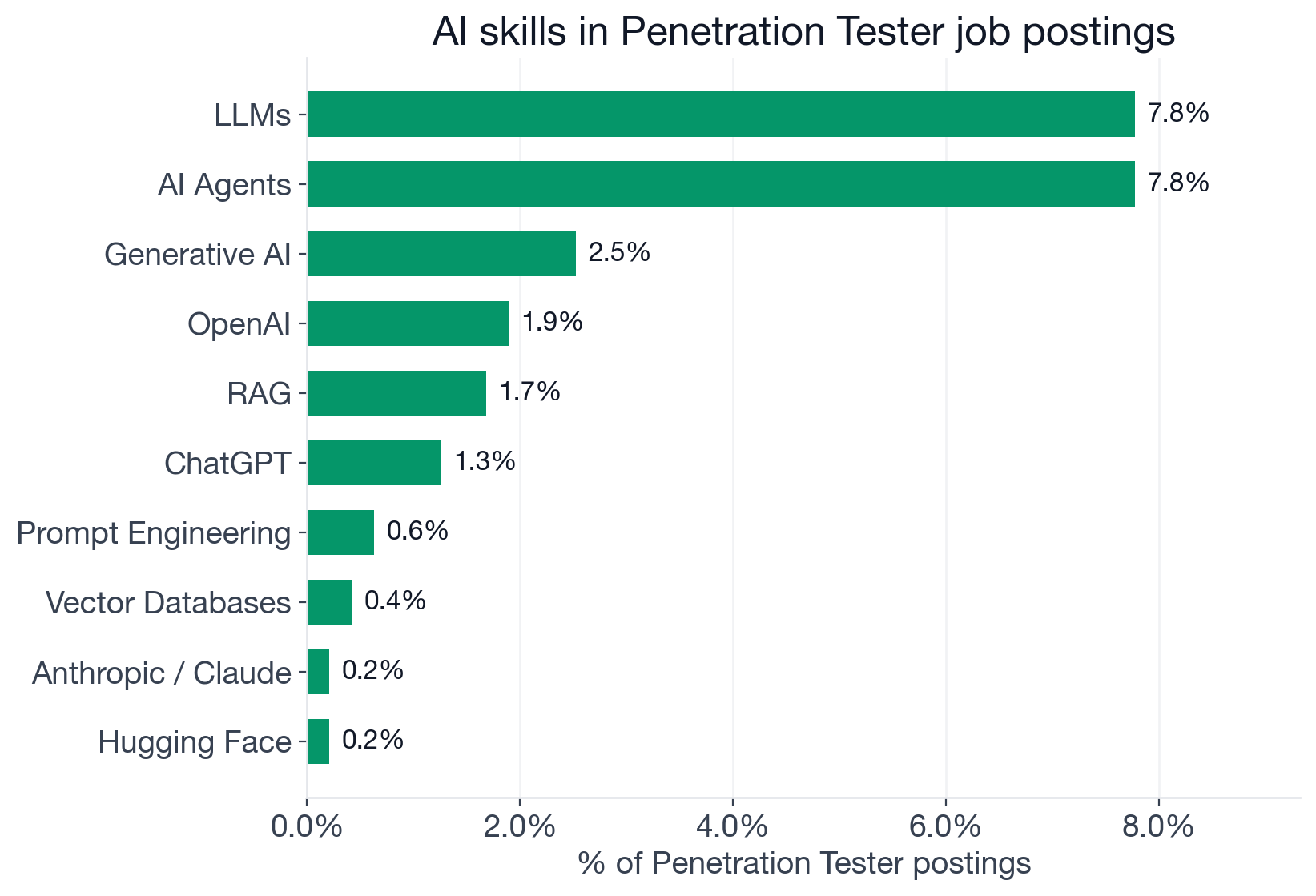 Machine Learning leads on raw frequency, but LLMs and AI Agents, tied at 7.8% each, are the top generative-AI-era skills, ahead of named platforms and frameworks.
| Skill | Postings | % of Total |
|---|---|---|
| Machine Learning | 61 | 12.8% |
| LLMs | 37 | 7.8% |
| AI Agents | 37 | 7.8% |
| Generative AI | 12 | 2.5% |
| Deep Learning / Neural Nets | 10 | 2.1% |
| OpenAI | 9 | 1.9% |
| RAG | 8 | 1.7% |
| ChatGPT | 6 | 1.3% |
| Prompt Engineering | 3 | 0.6% |
RAG (retrieval-augmented generation, a technique for grounding a model's answers in a specific document set rather than its training data alone) shows up in 1.7% of postings, small in absolute terms but notable as a sign that some Penetration Tester roles now touch AI-application security testing, not just traditional network and web-app work. The overall shape of the list, Machine Learning and AI Agents ahead of consumer-facing names like ChatGPT, suggests companies naming AI in a Penetration Tester posting are usually hiring for AI-system security work: red-teaming a model, testing an agent's guardrails, or assessing an ML pipeline, not asking a generalist to demonstrate that they've used a chatbot.
Is There a Salary Signal for AI Skills Yet?
Short answer: not one you can trust yet. Among US postings with disclosed base salary (equity, bonus, and sign-on are not captured in posting data, so total compensation at top employers runs higher than these figures), only 14 required new-wave AI skills, well below the sample size needed to report a confident median. The non-AI US baseline, built from 84 postings, sits at $137,000.
Globally, where currency conversion makes direct comparison less precise, postings with any AI skill showed a median of $133,750 (n=38) against $132,760 (n=96) without one, a gap of roughly $990. That is close enough to noise that it would be misleading to call it a premium. For a role where the explicit-AI slice is this narrow, the honest read is that the market hasn't generated enough disclosed-salary AI postings yet to price the skill distinctly. Worth checking again as the sample grows; not a number to negotiate around today.
Who's Actually Being Asked to Build AI Systems?
The clearest pattern in this dataset isn't in the skills list, it's in who gets asked for them. Zero of the 34 entry-level and junior postings analyzed (9 entry, 25 junior) required any AI skill. The requirement doesn't show up at all until mid-level, where it sits at 11.9% of postings, then climbs steadily through senior (15%) and staff (19%).
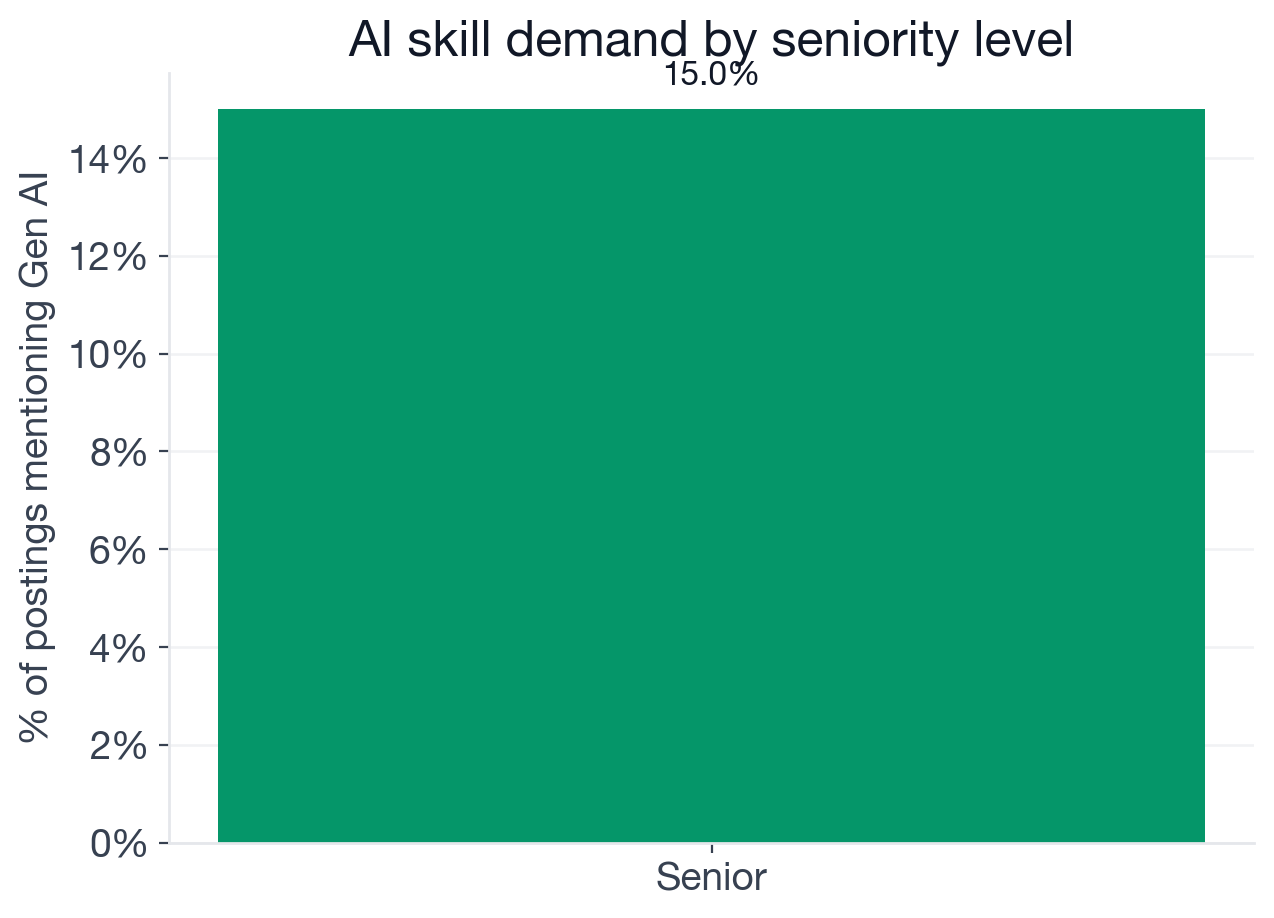 AI requirements are entirely absent below mid-level and rise with seniority, consistent with AI-security work being an added specialty layered onto core pentesting experience rather than a starting point.
That pattern fits the nature of the work: red-teaming an AI system or assessing an ML pipeline is a specialty built on top of core offensive-security skill, not something a company hands to someone building their first year of experience. It reinforces the earlier point too. AI-system work is senior-skewed and narrow, while ambient AI tool use for recon and reporting is something every level, including a junior tester, is likely already doing without it appearing in a job description.
Geography adds a sharper outlier. Israel's AI-requirement rate is 64.3% (9 of 14 postings), more than five times the US rate of 11.4% (22 of 193 postings, the largest single-market sample in the dataset). The Israeli sample is small enough that the exact number should be read as directional, but it lines up with Israel's known concentration of offensive-security and cyber-intelligence firms. Canada (22.2% of 27 postings) and Germany (25% of 8 postings, also a small sample) sit above the US baseline as well, while larger European markets like France and Spain showed no AI-tagged postings at all in this window. The dataset doesn't have usable industry or top-employer breakdowns for this role this cycle, so we're not drawing a sector or company-level conclusion here, geography is the cleanest cross-cut the data supports.
How to Use This in Your Job Search
If you're building toward the AI-security specialty, the data says to aim at systems thinking, not tool familiarity. LLMs and AI Agents are tied as the top-named skills, meaning companies want people who can red-team an agent's guardrails or assess how a model handles adversarial input, not people who can demonstrate they've used ChatGPT. Browse current Penetration Tester openings that name AI Agents or LLM-specific roles to see how those postings actually describe the work before you tailor a resume toward them.
For the much larger group of Penetration Testers not chasing an AI-security title, the ambient layer still matters. If 82% of practicing hackers are already using AI tools for recon and reporting, an interviewer may reasonably assume you are too, even if the posting never says so. Practice explaining your AI-assisted workflow in a mock interview so you're ready to talk through where you use AI and, just as importantly, where you don't trust it without verifying the output yourself, a distinction the Cobalt confidence data suggests employers are increasingly asking about. To build the underlying offensive-security fundamentals that AI-security work is layered on top of, the Question Bank and interactive courses cover core penetration-testing and application-security topics you'll need regardless of how the AI slice of the role evolves. For a fuller picture of the skills, salary, and hiring patterns across the whole role, see our companion post on Penetration Tester skills companies want in 2026.
FAQ
Q. How many Penetration Tester job postings explicitly require AI skills in 2026?
13.4% of Penetration Tester postings (64 of 476 analyzed) explicitly require new-wave generative AI skills such as LLMs, AI agents, or generative AI. Another 12.8% mention traditional machine learning or deep learning, mostly in AI-security-adjacent postings. Combined, 22.1% of postings mention AI in some form.
Q. Do Penetration Testers actually use AI day to day even when the job posting doesn't mention it?
Yes. Bugcrowd's Inside the Mind of a Hacker 2026 report found that 82% of hackers and security researchers now use AI tools in their daily workflow, up from 71% the year before. That is the ambient layer: recon automation, report drafting, code triage, the kind of usage that rarely gets written into a job description.
Q. Is AI replacing human penetration testers?
The data points the other way. Confidence in fully autonomous AI-powered penetration testing fell from 29% of organizations in 2025 to just 9% in 2026, per Cobalt research reported by Dark Reading, because unsupervised automated tools still miss significant vulnerabilities roughly three-quarters of the time. AI is being adopted as a daily assistant, not an autonomous replacement.
Q. Which AI skills are most in demand for Penetration Tester roles?
Machine Learning is the single most-mentioned AI-related skill overall, appearing in 12.8% of postings, largely tied to AI-security research work. Among new-wave generative AI skills, LLMs and AI Agents are tied for the top spot at 7.8% each, ahead of Generative AI (2.5%) and OpenAI-specific tooling (1.9%).
Q. Do entry-level Penetration Tester jobs require AI skills?
No. Zero of the 34 entry and junior postings analyzed (9 entry, 25 junior) required any AI skill. AI requirements only start showing up at mid-level (11.9% of postings) and climb through senior (15%) and staff (19%) roles.
Q. Is there a salary premium for Penetration Testers with AI skills?
Not a reliable one yet. Only 14 US postings with disclosed salary required new-wave AI skills, below the sample size needed to report a confident median. Globally, postings with any AI skill showed a median of $133,750 versus $132,760 without it, a gap too small and too cross-currency to call a real premium. It is a signal worth watching, not a number to plan a raise around.
Q. Where are AI-skill requirements most common for Penetration Tester jobs?
Israel stands out sharply: 64.3% of its Penetration Tester postings (9 of 14) require AI skills, far above any other country, though the sample is small. Among larger markets, Canada (22.2% of 27 postings) and the US (11.4% of 193 postings, the largest sample in the dataset) show more typical rates.
Two Speeds, One Job
Penetration testing in 2026 is running at two speeds at once: adoption of AI as a daily tool is nearly universal among practicing researchers, while trust in AI as an autonomous operator is shrinking fast enough to reverse a year of momentum. Neither speed cancels the other out. The job posting's 13.4% figure tells you where companies are hiring for AI-system security specifically; it says nothing about the AI already running quietly in every tester's recon workflow. Read both numbers, and you get a more accurate map of the role than either one gives you alone.
Topics
Ready to practice?
Put what you've learned into practice with AI mock interviews and structured preparation guides.