
A Widely Earned AWS Badge, a Thin Presence in Job Postings
AWS Solutions Architect Associate, often shortened to AWS SAA, is a widely held cloud certification, yet employers rarely ask for it by name. Across Cloud Architect, Cloud Engineer, Solutions Architect, DevOps Engineer, and Site Reliability Engineer postings on the InterviewStack.io job board over the last 90 days, only 255 of 12,782 active postings mention it, 1.99%, roughly 1 in 50. When it does show up, it's almost never a gate: of the mentions clear enough to classify, 91.7% call it preferred rather than required.
That gap between reputation and requirement carries into pay. Postings that mention AWS Solutions Architect Associate advertise a median US base salary of $149,500, about 9.4% below the $165,000 median for postings in the same five roles that don't mention it. This compares advertised base pay only; equity, bonus, and other compensation aren't disclosed in job postings and aren't part of this comparison. The gap isn't mainly a seniority story, cert-mentioning and non-mentioning postings have almost identical average seniority, so what actually explains it is which roles and which employers the mentions cluster in.
Key Findings
- AWS Solutions Architect Associate is named in just 1.99% of active postings across five cloud infrastructure roles (255 of 12,782, roughly 1 in 50).
- Of the 157 mentions clear enough to classify, 91.7% say preferred and only 8.3% say required, about 11 to 1.
- Postings mentioning the cert advertise a median US base salary of $149,500 versus $165,000 for postings in the same role scope that don't, a 9.4% gap.
- The only seniority band with enough data to check, mid-level (n=68), shows a smaller 6.3% gap ($142,400 versus $152,000); entry, senior, and staff samples are too small to report.
- Average seniority is nearly identical between cert-mentioning and non-mentioning postings (1.52 versus 1.50), so the pay gap isn't primarily a seniority effect.
- Cloud Engineer mentions the cert most often (3.83%), while Solutions Architect and DevOps Engineer, the two largest roles in scope, mention it least (1.52% and 0.92%).
- Federal contractors Booz Allen Hamilton, Peraton, Leidos, and Northrop Grumman are the four most frequent employers asking for it.
- CompTIA Security+ and Azure Solutions Architect Expert (AZ-305) each co-occur in roughly 1 in 5 of these postings.
How Often Do Employers Actually Ask for It?
Demand is uneven across the five roles in scope, and it doesn't track posting volume.
| Role | Active postings | Mention the cert | Share |
|---|---|---|---|
| Cloud Engineer | 2,454 | 94 | 3.83% |
| Cloud Architect | 1,561 | 56 | 3.59% |
| Solutions Architect | 4,002 | 61 | 1.52% |
| DevOps Engineer | 4,765 | 44 | 0.92% |
Site Reliability Engineer, the fifth role in this scope, isn't broken out above: across this 90-day window it didn't add any postings or mentions beyond what's already counted in the other four roles, so there's nothing distinct to report for it here.
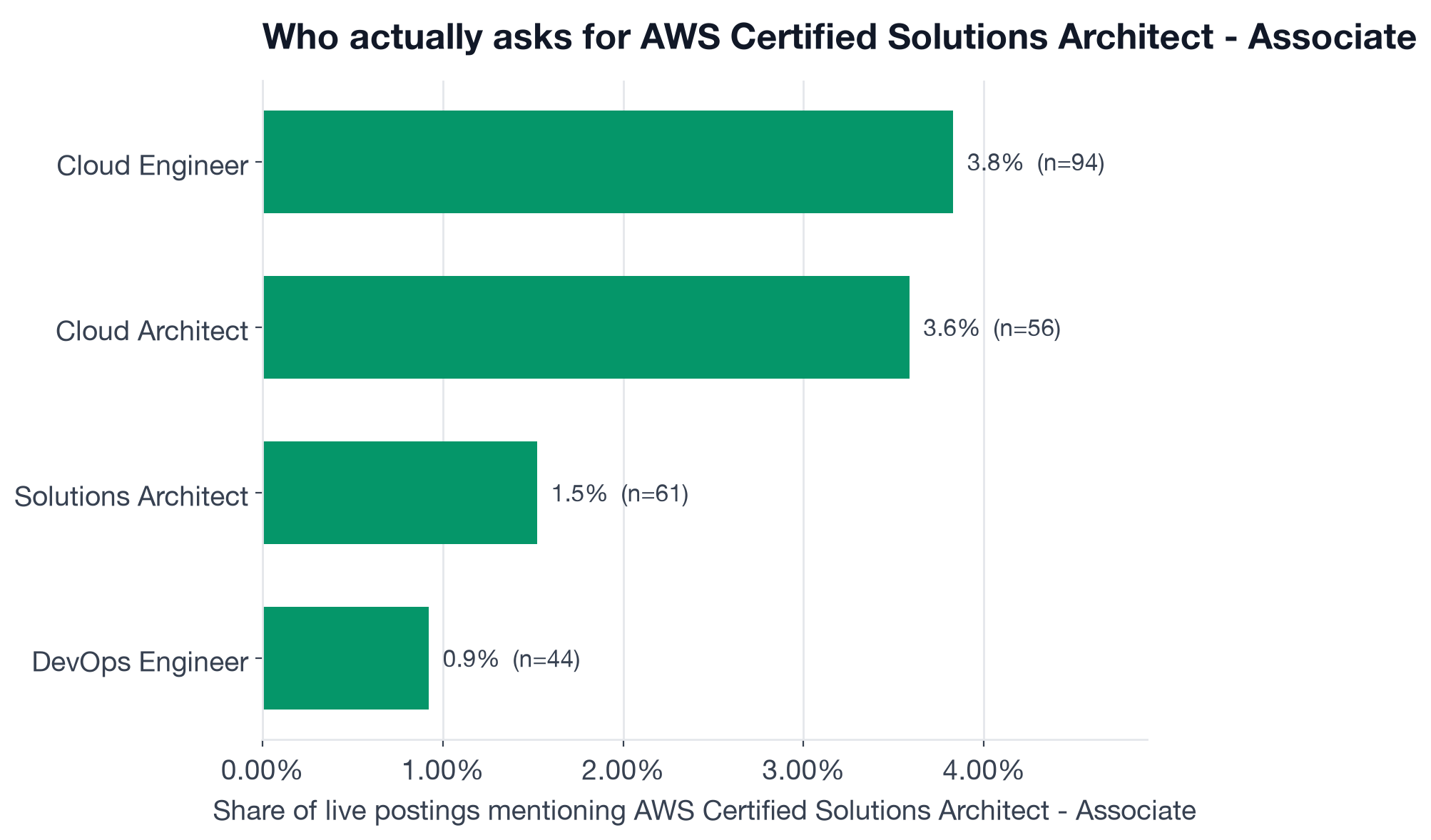 Cloud Engineer and Cloud Architect name the certification roughly four times as often as DevOps Engineer.
Cloud Engineer makes up 19.2% of postings in this scope but 36.9% of every cert mention, almost double its expected share. Cloud Architect shows the same pattern at a smaller scale: 12.2% of postings, 22.0% of mentions. Solutions Architect and DevOps Engineer run the other way. Solutions Architect is the role the certification is literally named after, yet it accounts for just 23.9% of mentions against 31.3% of postings, and DevOps Engineer, the single largest role in this scope at 37.3% of postings, contributes only 17.3% of mentions, less than half its expected share. The certification clusters more in hands-on infrastructure titles than in the Solutions Architect title it shares a name with, whose day-to-day work leans more strategic at some employers and more hands-on at others.
Preferred, Not Required
Of the 255 total mentions, 157 (61.6%) use language clear enough to classify as required or preferred; the remaining 98 (38.4%) use open-ended phrasing, certification lists, "or equivalent" clauses, that doesn't resolve either way. Within that classified set, required is rare: 13 postings (8.3%) require the certification outright, and 144 (91.7%) list it as preferred, a ratio of about 11 to 1.
Zoomed out to every mention in the dataset, not holding the certification disqualifies a candidate outright in only about 5% of postings that name it at all (13 of 255). For the large majority, it reads as evidence of competence an employer is glad to see, not a line a resume has to clear.
Why AWS SAA Postings Pay Less, Not More
All salary figures here are advertised US base pay only, on the subset of postings that disclose it. Equity, bonus, and other compensation aren't part of job-posting data, so total compensation typically runs higher than what's reported here. The comparison baseline throughout is other postings in the same five-role scope that don't mention the certification, not the broader job market.
Postings that mention AWS Solutions Architect Associate show a median US base salary of $149,500 (n=109) against $165,000 for postings that don't (n=3,447), a 9.4% gap. Read on its own, that number looks like the certification correlates with lower pay across the board. It's more precise than that, and less certain: only one seniority band has enough with-cert salary data to report separately.
| Level | With the cert (median) | Without the cert (median) | Gap |
|---|---|---|---|
| Entry | Not reportable (n=3) | $111,000 (n=50) | n/a |
| Mid-level | $142,400 (n=68) | $152,000 (n=1,828) | -6.3% |
| Senior | Not reportable (n=19) | $179,500 (n=1,021) | n/a |
| Staff | Not reportable (n=19) | $185,000 (n=548) | n/a |
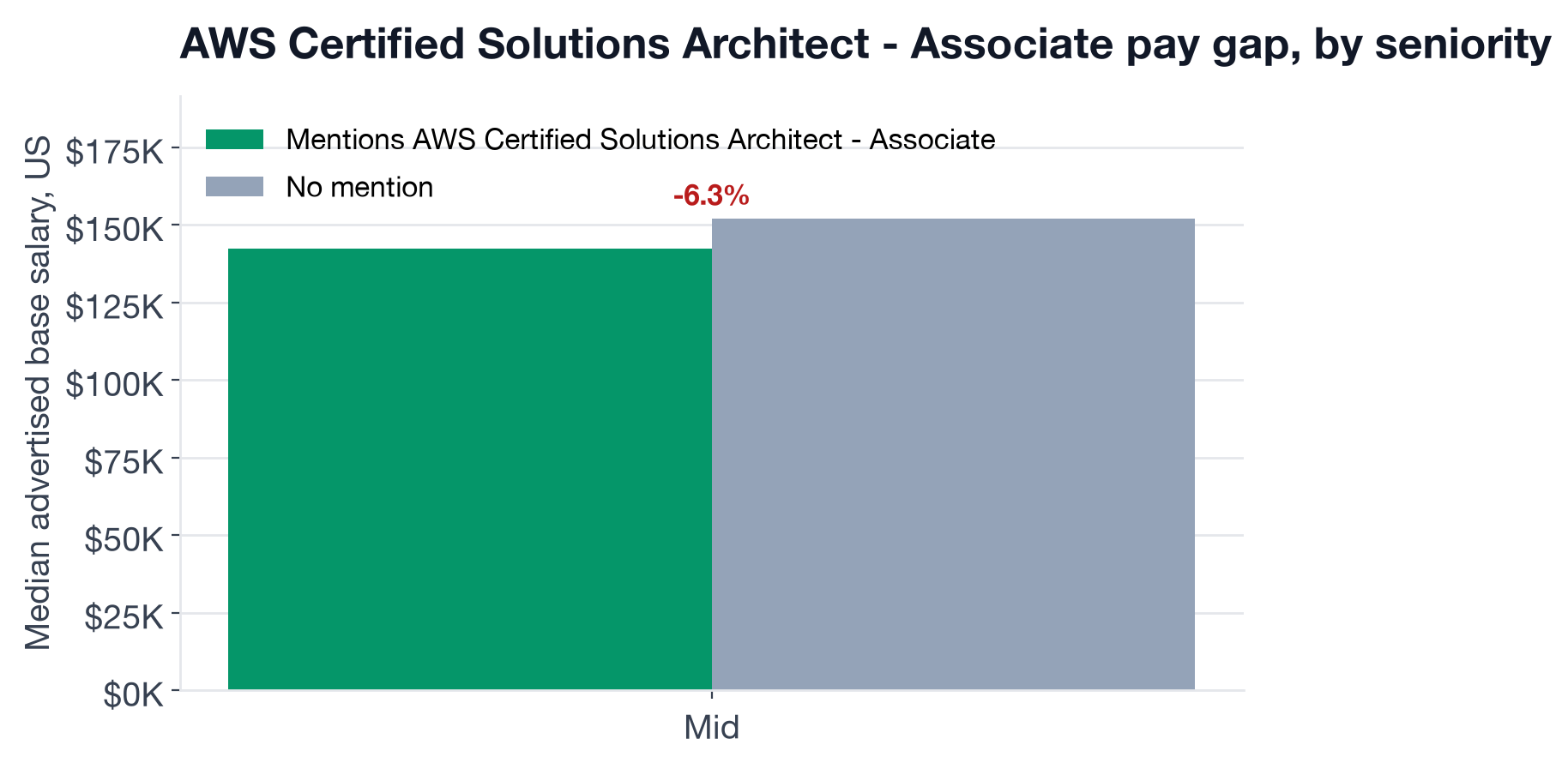 Mid-level is the only band with enough with-cert salary data to report, and the gap there, -6.3%, is narrower than the raw aggregate.
At mid-level, the gap narrows to -6.3%, smaller than the -9.4% aggregate. Entry, senior, and staff postings that mention the certification are all too thin (n=3, 19, and 19) to report on their own, so we can't say whether the gap holds, closes, or widens at those levels. What we can rule out is a simple seniority explanation: average seniority is nearly identical between cert-mentioning and non-mentioning postings (1.52 versus 1.50 on our internal level scale), so the two groups aren't pulling from meaningfully different experience tiers overall. One caveat on that comparison: seniority is inferred from title keywords, and a posting with no explicit level word, a plain "Solutions Architect" or "Cloud Architect" title, common in this dataset, defaults to mid-level, which compresses the measured spread in both groups. So 1.52 versus 1.50 is closer to a floor than an exact read, though the two figures are close enough that a large hidden seniority skew is unlikely to be doing most of the work.
A role-mix effect fits the data better than a blanket certification penalty, though it isn't a clean split across all four roles. Cloud Engineer, the role that names the certification most often (36.9% of all mentions, almost double its 19.2% share of postings), also has the lowest non-cert baseline pay of the four roles in scope at $150,000, and that pairing alone pulls the cert-mentioning median down. Solutions Architect fits the same pattern from the other direction: it has the highest non-cert baseline pay in scope ($180,350) and is underrepresented in mentions (23.9% of mentions against 31.3% of postings). But the other two roles don't cooperate with a tidy story. Cloud Architect has the second-highest baseline pay ($175,000) yet over-indexes on mentions (22.0% against 12.2% of postings), the same direction as cheaper Cloud Engineer, not the opposite. DevOps Engineer is itself one of the cheaper roles ($152,500) but is the most underrepresented mentioner of the four (17.3% against 37.3% of postings). Cloud Engineer's outsized, low-paying share of the cert-mentioning pool is doing most of the work in the aggregate gap; Cloud Architect and DevOps Engineer pull in opposite directions from what a simple cheap-over-mentions, expensive-under-mentions story would predict, and roughly offset each other.
Federal Contractors Drive Most of the Demand
Among employers with enough mentions to rank, federal and defense contractors make up a large share of demand for this certification. Booz Allen Hamilton, Peraton, and Leidos lead, followed by Northrop Grumman.
| Employer | Postings mentioning the cert |
|---|---|
| Booz Allen Hamilton | 22 |
| Peraton | 12 |
| Leidos | 10 |
| Northrop Grumman Corporation | 8 |
| DXC Technology | 7 |
| Kyndryl | 6 |
| Esri | 6 |
| Steampunk | 5 |
| NCS Australia | 5 |
| NorthBay Solutions | 4 |
| Accenture Federal Services | 4 |
| HSBC | 3 |
Six of these twelve, Booz Allen Hamilton, Peraton, Leidos, Northrop Grumman, Steampunk, and Accenture Federal Services, are federal contractors, and together they account for roughly two-thirds of the mentions among this group. That's a plausible, not proven, piece of the salary story above: government cloud-migration and compliance work tends to specify named certifications as part of contract requirements rather than as a market signal of scarce architecture talent, which would also help explain why the certification shows up more as "preferred" boilerplate than a hard screen. Treat this as context rather than a causal claim; the data doesn't isolate pay by employer type.
What Else Do These Postings Ask For?
Postings that mention AWS Solutions Architect Associate rarely ask for AWS alone. Over half also name Terraform (56.1%), Automation (55.3%), CI/CD (55.3%), and infrastructure as code (52.9%), the toolset of DevOps-flavored infrastructure work rather than narrow, single-cloud design. Just over half (52.5%) also name Azure specifically, and 31.4% name Google Cloud, so a majority of these postings describe multi-cloud environments, not AWS-only shops.
| Certification | Co-occurs with the cert |
|---|---|
| CompTIA Security+ | 20.8% |
| Azure Solutions Architect Expert (AZ-305) | 20.4% |
| CISSP | 11.0% |
| TOGAF | 11.0% |
| Azure Administrator Associate (AZ-104) | 7.5% |
| CKA (Certified Kubernetes Administrator) | 7.1% |
That multi-cloud read carries into certifications. Azure's two credentials, AZ-305 and AZ-104, add up to a combined 27.8% of co-occurrence mentions (more than 1 in 4). Security-adjacent credentials pair up too: Security+, CISSP, CompTIA CASP+ (4.7%), and CCSP (4.3%) add up to 40.8% of mentions, roughly 2 in 5, which lines up with the federal-contractor concentration above. Both of those are sums of individually-reported co-occurrence rates, not deduplicated counts, and federal-contractor postings often list several of these as interchangeable ("CISSP or CASP+ or equivalent") rather than each independently required, so the true share of postings naming at least one of them is likely somewhat lower than the raw sum. AWS Solutions Architect Associate postings tend to describe multi-cloud, compliance-adjacent infrastructure work more than pure single-vendor cloud design.
Turning This Into a Job-Search Plan
The data here says more about where this certification clusters than about what to do with it, so treat it as a map rather than a checklist. If you're targeting Cloud Engineer or Cloud Architect roles, expect the certification to be seen more often, though still as a preferred signal rather than a gate in the large majority of postings. If you're targeting Solutions Architect or DevOps Engineer roles, the underlying skills, IAM, EC2, CloudFormation, Terraform, CI/CD, matter more than the badge itself; those show up in postings far more consistently than the certification name does.
Drill the topics that actually recur across these postings, IAM, VPC design, CloudFormation, multi-cloud tradeoffs, with InterviewStack's Question Bank, or build the underlying cloud-architecture and infrastructure-as-code foundations through InterviewStack's interactive courses if you're newer to the stack. Once you have a specific role targeted, run a mock interview against it to see where your real gaps sit. For a broader look at what the Solutions Architect skill stack looks like beyond this one certification, that post breaks down the full picture.
To see current openings, browse active postings across all five roles in this scope.
FAQ
Q. How often do employers ask for AWS Solutions Architect Associate by name?
It appears in just 1.99% of postings across Cloud Architect, Cloud Engineer, Solutions Architect, DevOps Engineer, and Site Reliability Engineer roles (255 of 12,782 active postings analyzed over a 90-day window on the InterviewStack.io job board), roughly 1 in 50 postings.
Q. Is AWS Solutions Architect Associate usually required or just preferred?
Preferred, overwhelmingly. Of the 157 mentions clear enough to classify, 91.7% (144) list it as preferred and only 8.3% (13) require it outright, a ratio of about 11 to 1. A further 98 mentions don't specify either way.
Q. Do postings that mention AWS Solutions Architect Associate pay more?
No. Postings mentioning it advertise a median US base salary of $149,500 versus $165,000 for postings in the same five roles that don't mention it, a 9.4% gap. At mid-level, the only seniority band with enough with-cert salary data to report (n=68), the gap narrows to 6.3% ($142,400 versus $152,000).
Q. Does seniority explain the salary gap?
Not much. Average seniority is nearly identical between postings that mention the certification and postings that don't (1.52 versus 1.50 on our internal level scale), so the gap is not primarily a seniority-mix effect. Note that titles with no explicit level word default to mid-level in this comparison, which compresses the measured spread, so treat 1.52 versus 1.50 as an approximate read rather than an exact one.
Q. Which role is most likely to ask for AWS Solutions Architect Associate?
Cloud Engineer, at 3.83% of postings (94 of 2,454), followed by Cloud Architect at 3.59% (56 of 1,561). Solutions Architect and DevOps Engineer, the two largest roles in this scope, mention it far less often (1.52% and 0.92%).
Q. Who's actually hiring for AWS Solutions Architect Associate?
Federal contractors make up a large share of the top employers. Booz Allen Hamilton, Peraton, Leidos, Northrop Grumman, Steampunk, and Accenture Federal Services together account for roughly two-thirds of mentions among the top employers in this dataset.
Q. What other certifications and skills show up alongside AWS Solutions Architect Associate?
CompTIA Security+ (20.8%) and Azure Solutions Architect Expert AZ-305 (20.4%) are the most common co-occurring certifications, and over half of these postings also ask for Terraform (56.1%), CI/CD (55.3%), and infrastructure as code (52.9%), pointing to DevOps-flavored, multi-cloud roles rather than narrow single-cloud positions.
Deciding Whether the AWS SAA Exam Is Worth Your Time
AWS Solutions Architect Associate is common to hold and rare to be named. Where it does show up, it functions as a soft signal more than a gate, and its salary story is a composition effect, which roles and which employers ask for it, rather than a seniority penalty or evidence the certification itself lowers pay. The stronger read of this data is that the underlying skills it certifies, IAM, networking, compute, infrastructure as code, matter more to employers in this scope than the badge, and that showing up prepared to talk through real architecture tradeoffs will carry further than the certification alone.
Topics
Ready to practice?
Put what you've learned into practice with AI mock interviews and structured preparation guides.