
Solutions Architect Is Two Roles Wearing One Badge
The surprising thing about Solutions Architect hiring data is what is not there: no table-stakes skill. In Data Engineer postings, Python and SQL each appear in 71% of listings. In Frontend Developer postings, JavaScript clears 80%. For Solutions Architect, nothing comes close to 50%. The highest individual skill, AWS, shows up in only 25% of postings. Azure and Automation each land around 23-24%.
That absence is itself the signal. We analyzed all 5,236 active Solutions Architect postings on the InterviewStack.io job board as of June 2026. The dataset spans the full SA ecosystem (cloud-infrastructure SAs, pre-sales SAs, and adjacent titles such as Enterprise Architect and Solution Consultant), with a small fraction of unrelated postings (banking relationship managers, risk managers) appearing as noise; these do not materially affect the skill distribution. The clearest finding is that the role is split between two fundamentally different profiles: a cloud-infrastructure engineering path (CI/CD, Kubernetes, Spark, Databricks) and a pre-sales consulting path (CRM, Salesforce, Agile). Both are genuine and well-established, but they pay very differently. The premium for the highest-demand cloud-infra skills over the role median reaches nearly $40,000.
Key Findings
- 5,236 active Solutions Architect postings analyzed on the InterviewStack.io job board as of June 2026.
- No skill crosses the 50% table-stakes threshold. AWS leads at 25%, followed by Azure (24%) and Automation (23%) as the only common-tier skills.
- Median US base salary is $174,600 (n=1,220 postings with US salary data disclosed; base pay only, equity excluded).
- Cloud-infra skills carry a $10-40K premium over the baseline: Google Cloud ($196K, +$21K), CI/CD ($195K, +$20K), AWS and Azure ($187.5K each, +$13K), Python ($185K, +$10K).
- Pre-sales skills trade below the role baseline: Agile ($167K, -$8K), CRM ($169K, -$5.5K), Salesforce ($173K, -$2K).
- Docker and Kubernetes are nearly inseparable in technical SA postings, with a co-occurrence lift of 7.8 (the highest pair in the dataset).
- Only 2.6% of postings are entry-level (137 of 5,236); 69% are mid-level, confirming SA is a career-pivot role, not a starting point.
- 48% onsite, 33% hybrid, 27% remote: customer-facing responsibilities keep this role more in-person than most tech titles.
What Skill Families Define a Solutions Architect Role?
Group individual skills into the families they belong to and count how many postings ask for at least one skill in that family. The stack for Solutions Architects looks like this:
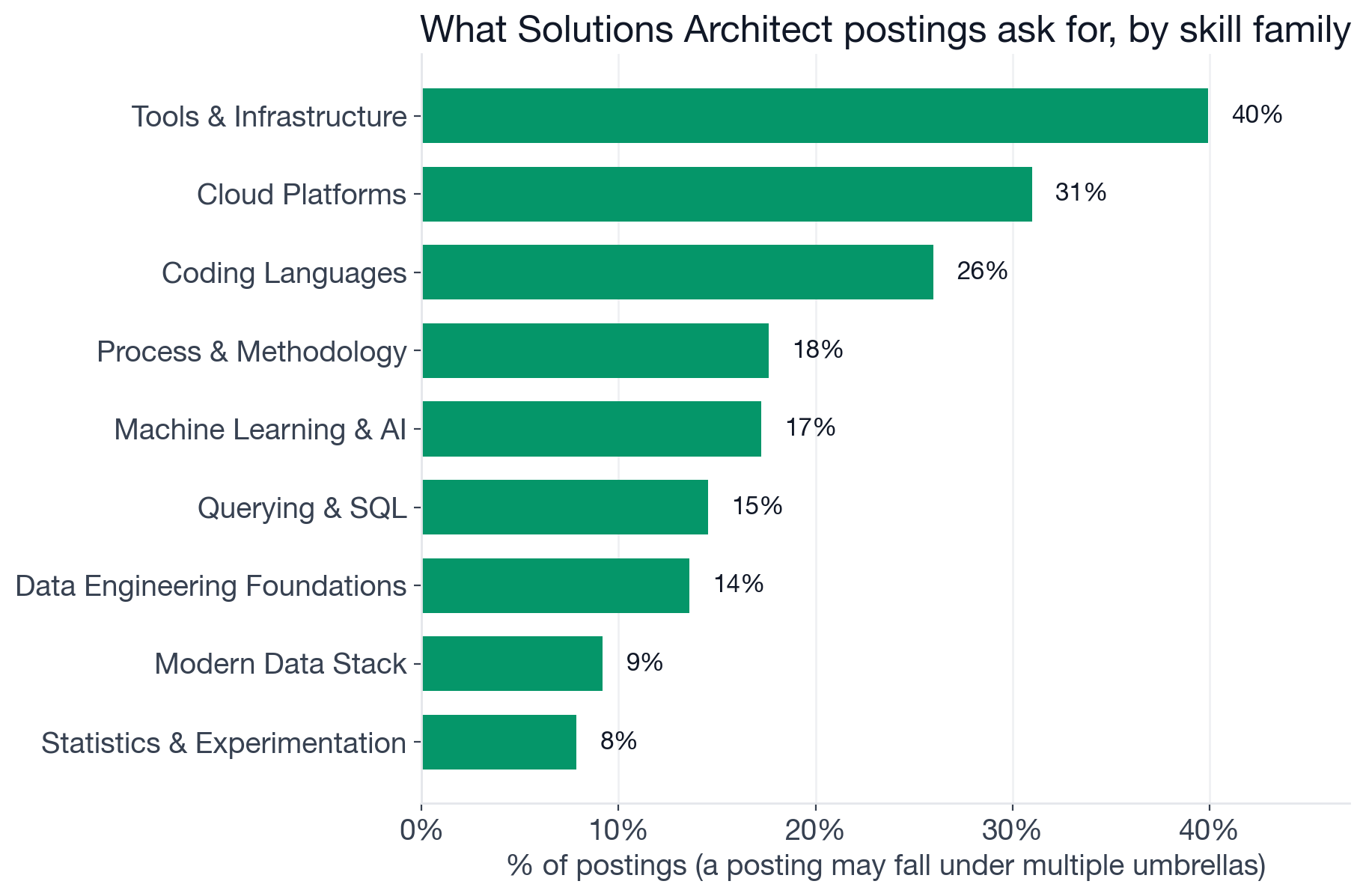
Share of Solutions Architect postings that ask for at least one skill in each family. A posting is counted once per family regardless of how many skills in that family it mentions.
The "Other" umbrella (69%) captures cross-cutting skills like APIs, scalability, CRM, microservices, CI/CD, and observability. Its dominance is the clearest sign of a breadth role: Solutions Architects are expected to stitch together components from many domains rather than go deep in one.
Cloud Platforms (31%) and Tools and Infrastructure (40%) form the technical foundation, but neither reaches the overwhelming share that pipeline-building commands in Data Engineer postings. Coding Languages sits at 26%, driven mostly by Python and Java, both well below the 70%+ levels they hit in engineering roles. Process and Methodology (18%) is where Agile lives, representing the consulting and delivery-planning dimension of the job.
Machine Learning and AI sits at 17.2%, driven primarily by Generative AI (8.4%) and Machine Learning (6.1%). That number measures SAs explicitly hired to design AI systems for customers. It is a floor, not a ceiling. Developer surveys consistently find that 85-90% of tech professionals now use AI tools regularly (see the Stack Overflow Developer Survey 2024): for proposal drafting, architectural research, RFP automation, and demo preparation. An SA who engages with AI only when a posting explicitly requires it is competing at a structural disadvantage. The explicit 17% measures the build AI track; ambient AI usage applies to every SA in every track.
Which Skills Actually Show Up on Job Descriptions?
Three tiers emerge when individual skills are ranked by posting frequency.
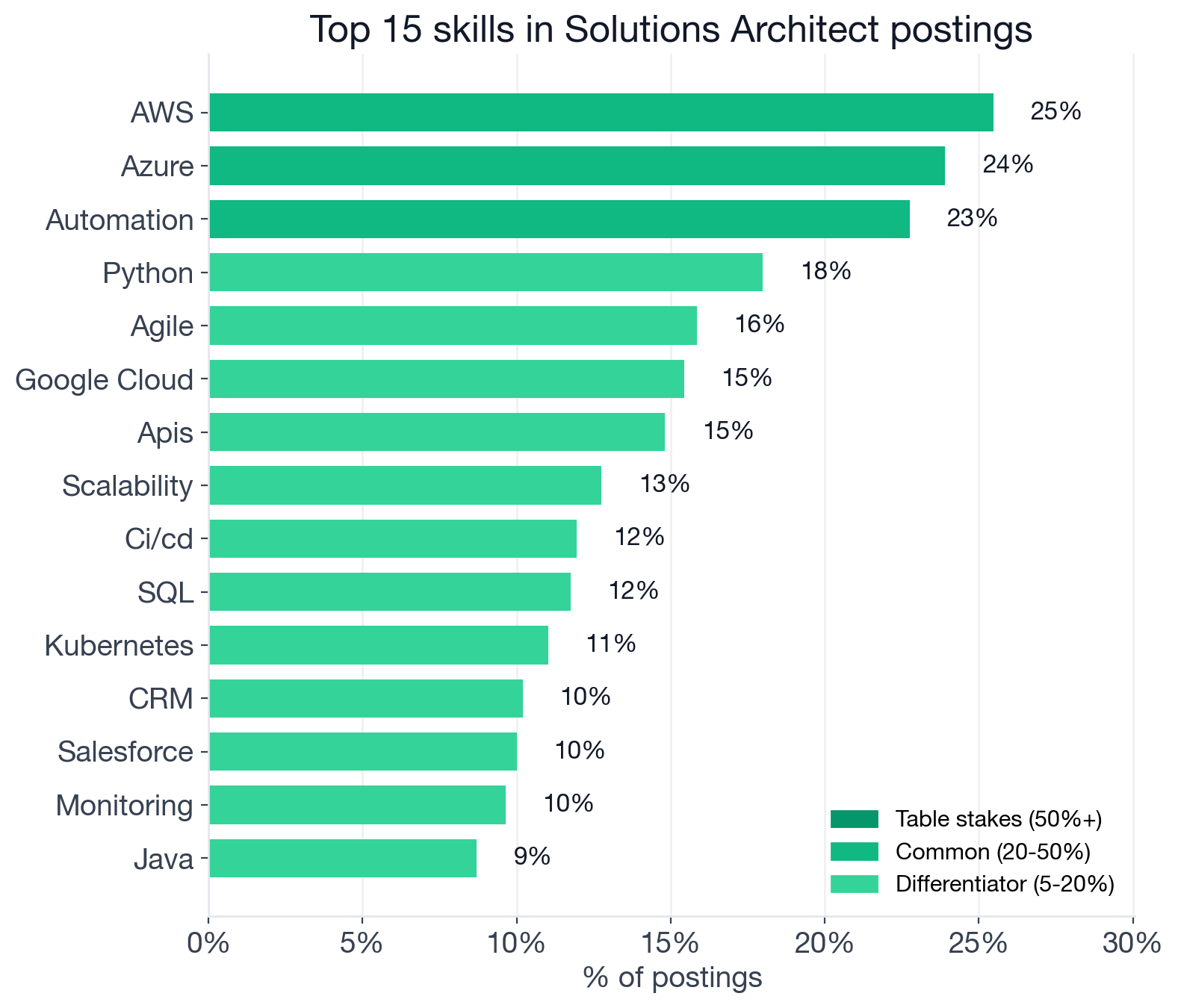
Solutions Architect skills ranked by posting frequency. No skill reaches the 50% table-stakes line. The three common-tier skills (20-50%) are the closest thing to a baseline for the role.
Common Tier (20-50%)
The only skills appearing in more than one in five postings:
- AWS: 25% (browse AWS-focused SA openings)
- Azure: 24% (browse Azure-focused SA openings)
- Automation: 23%
No single cloud owns the SA title. AWS leads by a narrow margin, but Azure is right behind it. The practical implication: you need cloud literacy, not single-platform depth. The skill-pair data (more on this below) confirms that postings naming one cloud routinely name a second.
Differentiator Tier (5-20%)
This is where the role splits. On the technical side: Python (18%), Google Cloud (15%), CI/CD (12%), SQL (12%), Kubernetes (11%), Microservices (8%), Databricks (7%). On the business-facing side: Agile (16%), CRM (10%), Salesforce (10%). APIs (15%), Scalability (13%), Monitoring (10%), Java (9%), and Generative AI (8%) sit in the middle, relevant to both paths.
The differentiator list is long because SA is a legitimately broad role. A recruiter scanning for an SA to support enterprise cloud migration will look for CI/CD and Kubernetes. One hiring for a SaaS platform pre-sales team will look for CRM and Salesforce. Both write "Solutions Architect" in the title. Knowing which column a given posting falls into is the key skill-selection decision.
Which Path Pays More?
Salary figures below are US base salary only, where wage-transparency laws produce consistent disclosure. Equity, bonuses, RSUs, and sign-on are not captured in posting data, so total compensation at top employers, particularly in tech and finance, runs meaningfully higher than what we report here.
The median US base salary for Solutions Architect postings is $174,600 (n=1,220). That is a strong starting point. But the spread around that median breaks clearly along the two-path fault line.
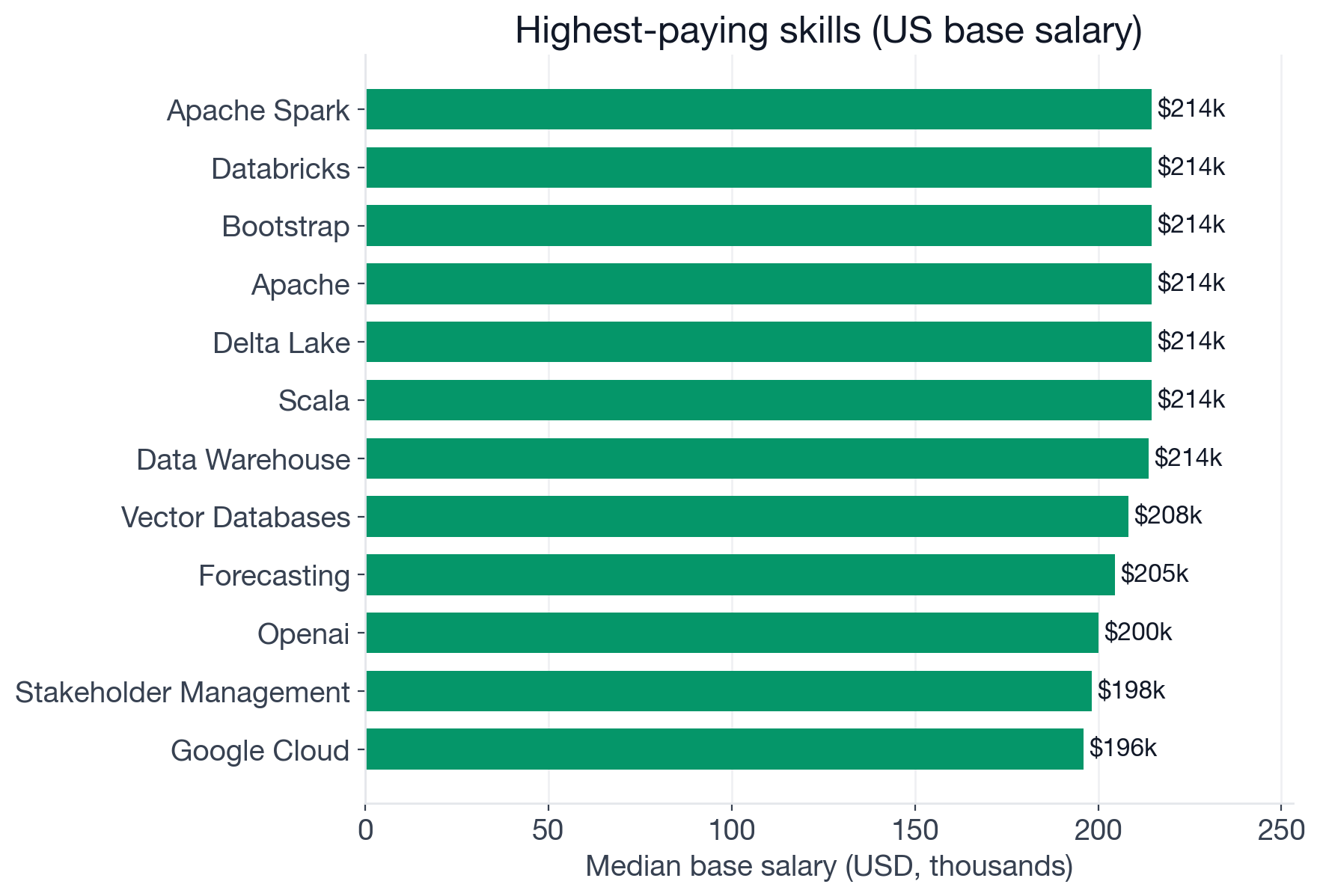
Median US base salary for Solutions Architect postings that mention each skill. Skills above the $174,600 role baseline skew toward cloud-infrastructure work; skills below it skew toward pre-sales and consulting.
Above the baseline (cloud-infrastructure path):
| Skill | US Median | Premium vs. $174.6K baseline | n |
|---|---|---|---|
| Apache Spark | $214,500 | +$39,900 | 80 |
| Databricks | $214,500 | +$39,900 | 132 |
| Google Cloud | $196,000 | +$21,400 | 226 |
| CI/CD | $195,000 | +$20,400 | 174 |
| Java | $187,800 | +$13,200 | 75 |
| Azure | $187,500 | +$12,900 | 335 |
| AWS | $187,500 | +$12,900 | 357 |
| Python | $184,600 | +$10,000 | 312 |
| Generative AI | $184,000 | +$9,400 | 127 |
| Kubernetes | $180,700 | +$6,100 | 143 |
At or below the baseline (pre-sales and consulting path):
| Skill | US Median | vs. baseline | n |
|---|---|---|---|
| Automation | $175,000 | +$400 | 273 |
| Salesforce | $172,500 | -$2,100 | 149 |
| CRM | $169,100 | -$5,500 | 150 |
| Agile | $166,800 | -$7,800 | 177 |
| Monitoring | $161,000 | -$13,600 | 132 |
| JavaScript | $157,000 | -$17,600 | 95 |
Three observations worth naming:
Apache Spark and Databricks at $214,500 reflect a specialized SA variant: data-platform architects who design large-scale lakehouse and pipeline architectures for enterprise customers. Spark appears in only 3.3% of SA postings, so these roles are rare, but when they exist they command the highest premiums in the dataset. Databricks SAs (7% of postings) are a bigger slice at the same salary level, partially explaining why Databricks is the top employer in this dataset.
Google Cloud earns an $8-9K premium over AWS and Azure: GCP-specialized SAs tend to work at data-intensive or AI-first companies where BigQuery, Vertex AI, and Google's data infrastructure have a strong foothold. The premium likely reflects both smaller supply of GCP-certified SAs and the tendency for GCP-native roles to sit closer to the engineering path than the sales path.
All pre-sales skills post medians below $174,600: Agile, CRM, and Salesforce are the three skills most associated with the consulting variant of the SA role. All three land below the role baseline in base salary. This does not mean the pre-sales path pays less overall: the consulting and sales-engineer track typically carries variable comp, OTE, and commissions not captured in job-posting data. The base salary comparison understates total earning potential for experienced pre-sales SAs. But the base floor is genuinely lower, which matters for candidates who value base certainty over variable upside.
Which Skill Pairs Signal Cloud-Infra vs. Pre-Sales Specialization?
Co-occurrence analysis identifies skill combinations that appear together more often than chance. Among the top-25 SA skills, the highest-lift pairs tell you which specialization a posting is actually looking for:
| Skill pair | Appears together in | Lift |
|---|---|---|
| Docker + Kubernetes | 5.1% of postings | 7.8 |
| CRM + Salesforce | 5.1% of postings | 4.96 |
| AWS + Google Cloud | 14.6% of postings | 3.72 |
| Azure + Google Cloud | 13.2% of postings | 3.57 |
| Java + Python | 5.4% of postings | 3.46 |
| AWS + Azure | 18.9% of postings | 3.11 |
| Python + SQL | 6.2% of postings | 2.95 |
| AWS + Microservices | 5.0% of postings | 2.47 |
| AWS + CI/CD | 7.2% of postings | 2.38 |
Each pair signals a distinct SA variant:
Docker + Kubernetes (lift 7.8) is the single most over-represented pair in the dataset. A posting that mentions Docker is nearly eight times more likely to also require Kubernetes than base frequencies would predict. These two are essentially inseparable in cloud-native infrastructure SA roles. If you see both on a job description, you are looking at a deeply technical, container-platform SA hire, likely one who owns architecture conversations with DevOps and platform engineering teams. Browse Docker and Kubernetes SA openings here.
CRM + Salesforce (lift 4.96) is the pre-sales mirror. A posting that names CRM is nearly five times more likely to also name Salesforce. These roles are SA in title but sales-engineering in function: helping enterprise customers design, configure, or extend their Salesforce environments. If you see CRM and Salesforce together, you are not looking at a cloud infrastructure role.
Multi-cloud triplet (AWS+GCP lift 3.72, Azure+GCP lift 3.57, AWS+Azure lift 3.11): All three major-cloud pairings show lift well above 1. An SA posting that names one cloud is substantially more likely to also name a second. Cloud breadth, not cloud depth, is the dominant hiring signal for this role.
Java + Python (lift 3.46) is the enterprise polyglot signature. Postings that ask for Java are 3.5x more likely to also ask for Python, the pattern of an SA who works with complex legacy Java codebases and scripts automation or data work in Python on top.
Who Gets In, and at What Level?
The seniority distribution for Solutions Architect is unlike most tech roles.
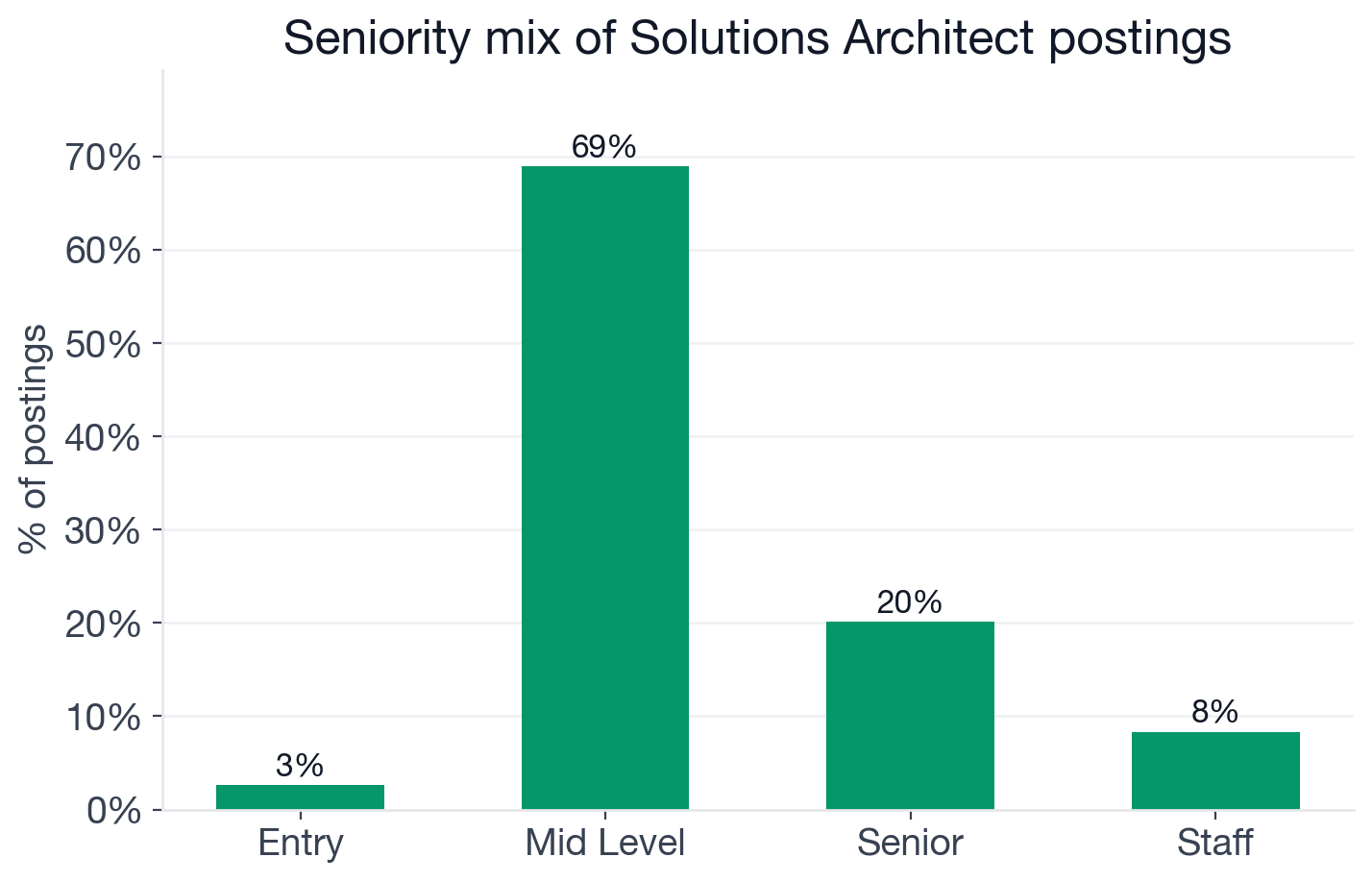
Seniority distribution of Solutions Architect postings, inferred from job title keywords. Postings without an explicit signal default to mid-level.
- Mid-level: 69% (3,610 postings)
- Senior: 20% (1,052 postings) (senior SA openings)
- Staff / Principal: 8% (437 postings)
- Entry-level: 2.6% (137 postings)
The 69% mid-level concentration is unusually high for a tech role. Compare it to Data Engineer (52% mid-level, per our Data Engineer skills analysis): SA has 17 percentage points more weight at mid-level, with correspondingly less senior and staff. This is what a career-pivot role looks like in the data. People arrive here mid-career, typically with 5-10 years of engineering, cloud, or technical sales experience, and most open roles are calibrated for exactly that profile.
The entry-level door is essentially closed. At 2.6%, fewer than 3 in 100 SA postings are genuinely open to someone without experience. The common route in is via software engineering, cloud engineering, or technical pre-sales, where you build the cross-domain credentials SA hiring managers want to see.
The senior ceiling exists but is narrower than it looks at 20%. Staff-level SAs (8%) are the specialists who drive account strategy, own enterprise architecture practices, and shape how a company's platform is sold and deployed at scale.
Where Are Solutions Architect Jobs, and How Remote-Friendly Is the Role?
Solutions Architect postings are notably US-concentrated compared to most technical roles.
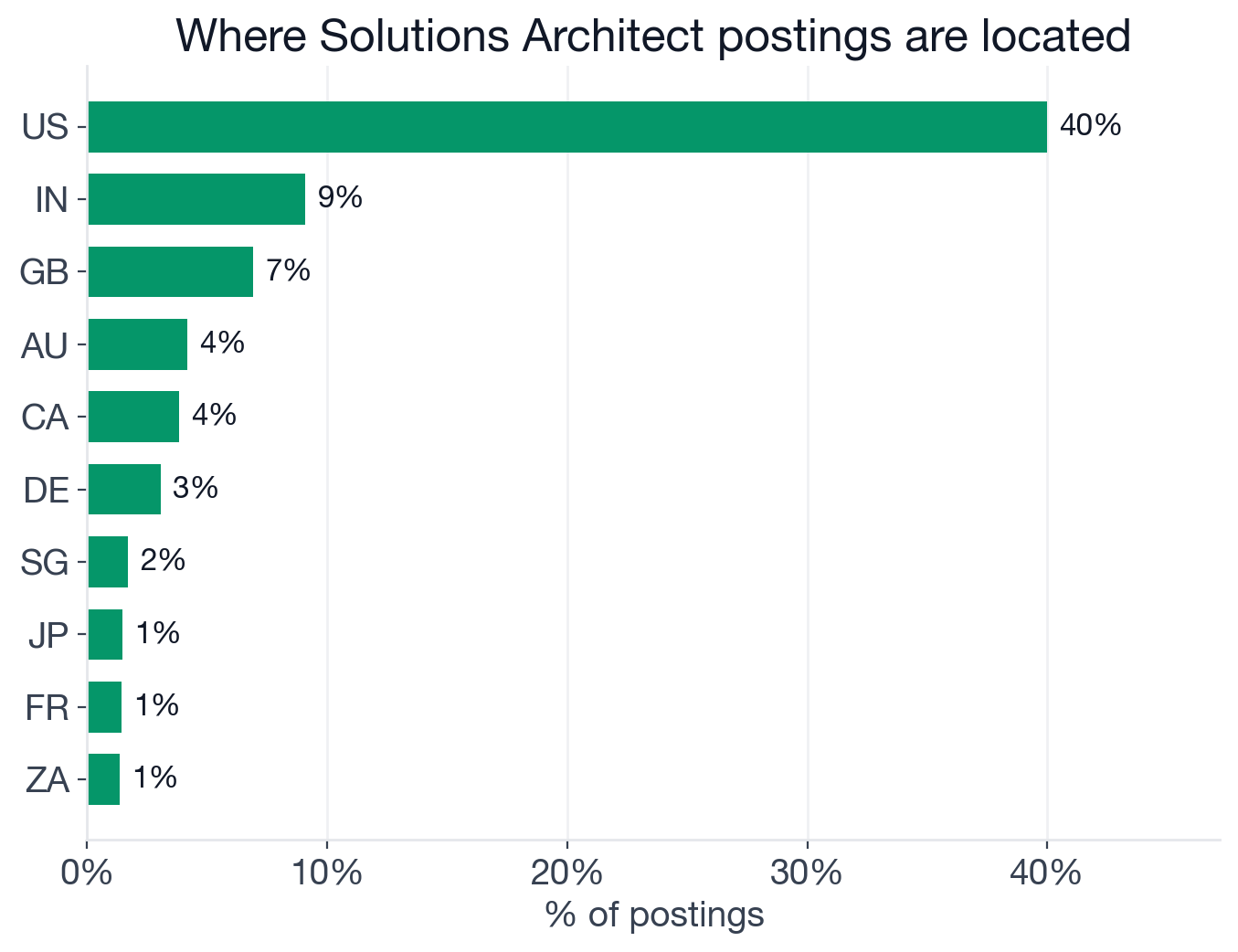
Top countries by share of Solutions Architect postings.
- United States: 40% (2,094 postings) (US-only SA openings)
- India: 9% (476 postings)
- United Kingdom: 7% (362 postings)
- Australia: 4% (219 postings)
- Canada: 4% (201 postings)
- Germany: 3% (160 postings)
The 40% US concentration is among the highest for any tech role we have analyzed. SA is a customer-facing role tightly coupled to enterprise sales motions, which remain heavily US-dominated. India's 9% is substantially lower than in delivery-heavy engineering roles: Data Engineer postings show 23% India share (per our Data Engineer skills analysis), which reflects the customer-advisory nature of the SA role: these are not offshore delivery positions.
The work-mode picture reinforces the in-person lean:
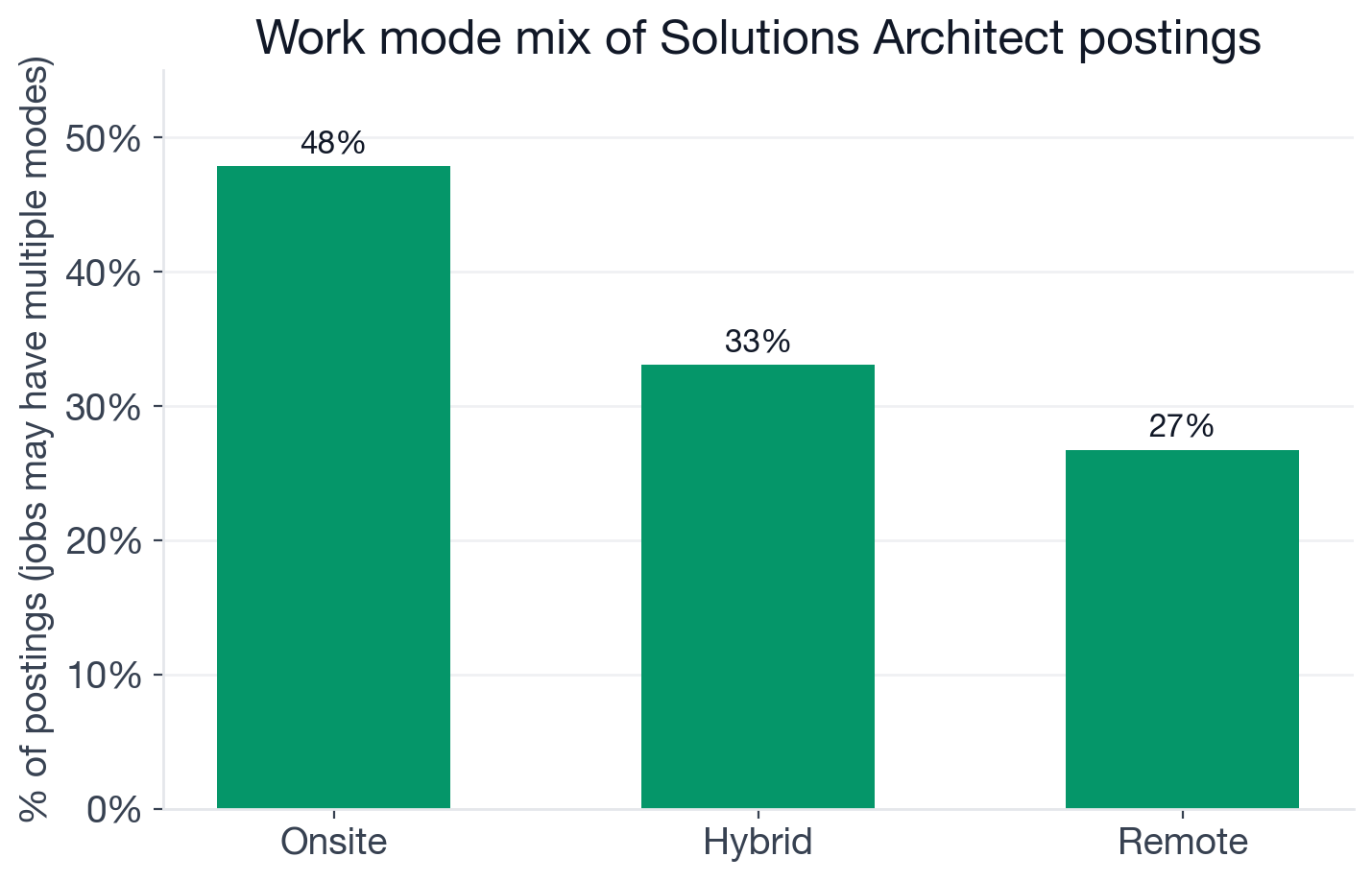
Work mode distribution of Solutions Architect postings. Some postings carry multiple tags, so percentages can sum above 100%.
- Onsite: 48% (2,507 postings)
- Hybrid: 33% (1,731 postings)
- Remote: 27% (1,400 postings) (fully-remote SA openings)
Onsite is the plurality mode. The 27% remote share is lower than Backend Developer or Data Engineer, tracking with the role's customer-facing nature. Fully remote SA positions do exist and concentrate in product-led SaaS companies. Enterprise consulting and systems-integrator SA roles default to onsite or hybrid.
Who's Hiring Solutions Architects in 2026?
The employer roster reflects the role's market: product companies that sell technical platforms to enterprise customers tend to have the deepest SA pipelines.
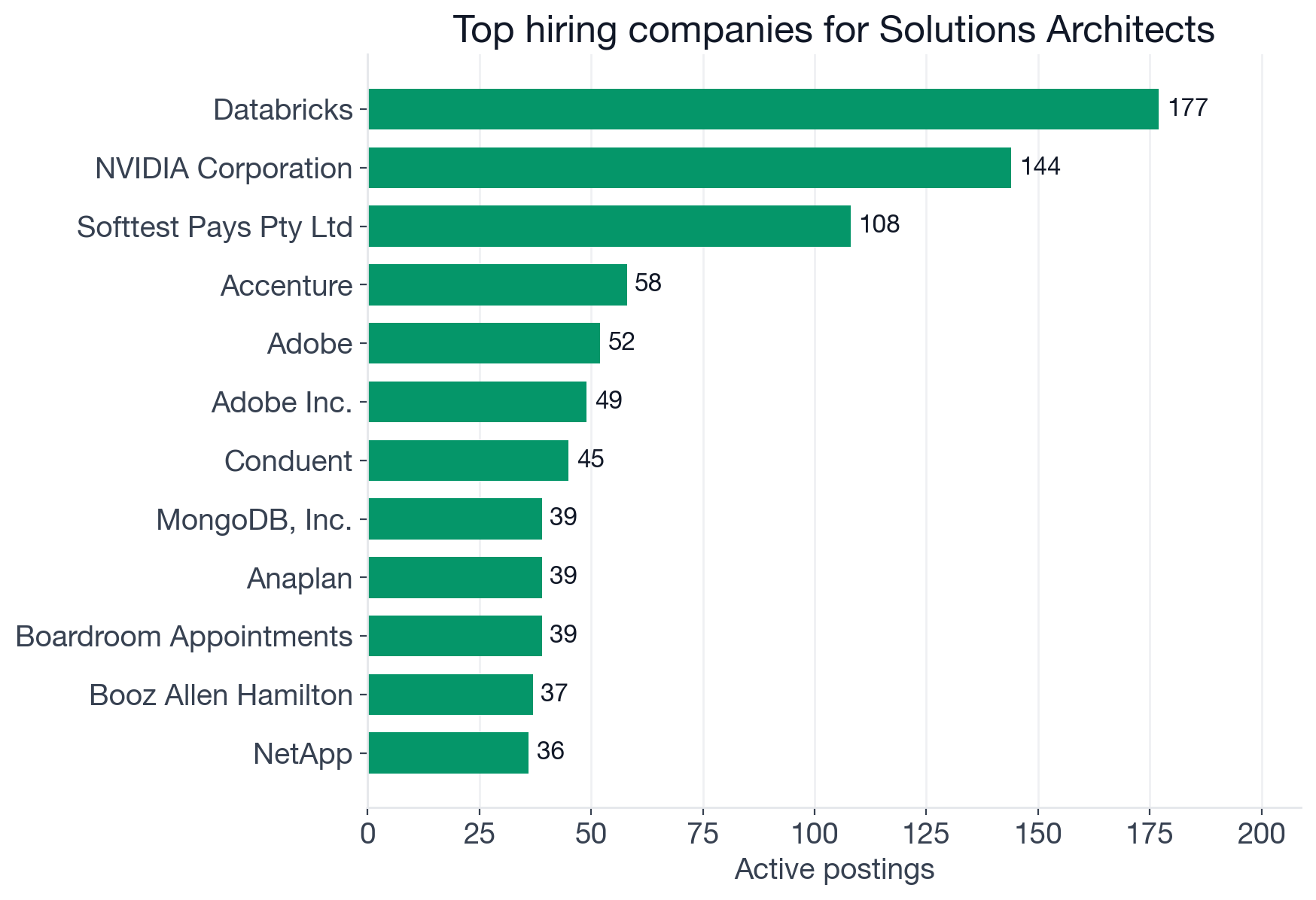
Top employers by active Solutions Architect postings. Staffing and recruiting firms are excluded from the table; only direct employers are shown.
| Company | Active postings | What kind of SA |
|---|---|---|
| Databricks | 177 | Data + AI platform SA |
| NVIDIA Corporation | 144 | GPU and AI infrastructure SA |
| Adobe | ~101 | Creative cloud and digital experience SA |
| Accenture | 58 | Consulting and SI |
| Conduent | 45 | IT services and BPO |
| MongoDB, Inc. | 39 | Document database platform SA |
| Anaplan | 39 | Enterprise planning software SA |
| Booz Allen Hamilton | 37 | Government consulting |
| NetApp | 36 | Storage and cloud infrastructure SA |
| Salesforce | 32 | CRM platform SA |
| Red Hat | 31 | Open-source cloud SA |
| NTT Limited | 30 | Global IT services |
| Stripe, Inc. | 28 | Payments platform SA |
| Roche | 26 | Life sciences and healthcare |
| PricewaterhouseCoopers | 26 | Big Four consulting |
Databricks (177 postings) and NVIDIA (144) dominate the top of the list, both on the high-premium technical path. Databricks SAs work in the data lakehouse space, which lines up directly with the Apache Spark and Databricks salary premiums in the data. NVIDIA SAs focus on GPU-accelerated infrastructure and AI systems deployments. Adobe combines two entity names ("Adobe" and "Adobe Inc.") for approximately 101 postings, selling digital experience and creative cloud enterprise packages.
Accenture, Booz Allen Hamilton, PwC, NTT, and Conduent represent the consulting segment: SI and managed-services firms that place SAs on enterprise client engagements. These roles lean toward the pre-sales and advisory path, which explains the lower base-salary signal associated with those skill clusters.
How to Use This in Your Job Search
Read postings for path signals before applying. A listing that leads with CI/CD, Kubernetes, and Python is a technical infrastructure role; one that leads with CRM, Salesforce, and Agile is a pre-sales or sales-engineering role. Both are legitimate SA positions, but they call for different prep and have different compensation structures. Browse current Solutions Architect openings and use skill filters to identify which path you are targeting.
Practice cross-domain architecture conversations. SA technical screens are not whiteboard coding rounds. They are design discussions where you explain tradeoffs between cloud providers, integration approaches, and architecture patterns to a mixed audience. AI mock interview practice is specifically useful for rehearsing these explanations under time pressure: justifying Kubernetes vs. serverless for a given workload, or explaining when Databricks is preferable to Snowflake, requires fluency that feels different when someone is timing you.
Drill the topics you are weakest on. If you are transitioning from software engineering, you likely have depth in one domain and gaps in others: cloud cost optimization, enterprise integration patterns, or pre-sales discovery conversations. The question bank lets you focus on specific topic areas rather than reviewing things you already know.
Build multi-cloud fluency, not multi-cloud certification. The skill-pair data is clear: SA postings that name one cloud tend to name a second. You do not need certificates in all three, but you do need the ability to discuss AWS, Azure, and GCP tradeoffs in the context of a customer's environment. Interactive courses covering cloud architecture, system design, and distributed systems give you the conceptual foundation for those conversations.
Use the preparation guides for target companies. If you are targeting Databricks, NVIDIA, or Adobe specifically, those SA interview processes reflect the technical depth of their platforms and differ substantially from consulting-firm SA screens. Company-specific interview preparation guides break down what each organization actually looks for.
FAQ
Q. What skills do companies want most for Solutions Architect roles in 2026?
No single skill appears in more than 26% of Solutions Architect postings, making the role breadth-first by design. AWS (25%), Azure (24%), and Automation (23%) sit in the common tier as the closest thing to a baseline. Above that, Python (18%), Agile (16%), Google Cloud (15%), APIs (15%), Scalability (13%), and CI/CD (12%) define the differentiator tier. Having none of the major clouds on your resume is the fastest filter-out.
Q. What is the median salary for a Solutions Architect in 2026?
The median US base salary across Solutions Architect postings with disclosed compensation is $174,600 (n=1,220 postings). That figure covers base pay only; equity, bonuses, and sign-on are not captured in posting data, so total compensation at top employers runs meaningfully higher.
Q. Which Solutions Architect skills carry the largest salary premium?
Among US postings, the largest premiums attach to data-engineering and cloud-native infrastructure skills. Apache Spark and Databricks both show a median of $214,500 (roughly $40K above the $174,600 role baseline). Google Cloud ($196K) and CI/CD ($195K) carry premiums of $21K and $20K respectively. AWS and Azure each sit at $187,500 (+$13K). Pre-sales skills like Agile ($167K), CRM ($169K), and Salesforce ($173K) all fall below the role baseline.
Q. Is Solutions Architect an entry-level role to break into?
No. Only 2.6% of Solutions Architect postings are entry-level (137 of 5,236). The role is overwhelmingly mid-level (69%), with almost no junior pipeline. Most Solutions Architects arrive with several years of experience as software engineers, cloud engineers, or technical consultants before transitioning into the SA function.
Q. Is Solutions Architect a remote-friendly role?
Less so than most tech roles. Onsite accounts for 48% of Solutions Architect postings, hybrid for 33%, and remote for 27%. The role's customer-facing responsibilities mean employers prefer proximity to clients. Fully remote SA positions do exist but concentrate in product-led SaaS companies rather than enterprise or consulting environments.
Q. What does the dominant Solutions Architect skill stack look like in 2026?
The highest-lift skill pair in Solutions Architect postings is Docker and Kubernetes, which co-occur with a lift of 7.8 (a posting that asks for one is nearly 8 times more likely to also ask for the other). The second-highest-lift pair is CRM and Salesforce (lift 4.96), the pre-sales signature. Multi-cloud combinations (AWS plus Google Cloud at lift 3.72, AWS plus Azure at 3.11) confirm that cloud breadth matters more than cloud depth.
Q. What AI skills do Solutions Architects need in 2026?
8.4% of Solutions Architect postings explicitly require Generative AI skills and 4.5% require LLM experience. These measure SAs hired to design and deploy AI systems for customers. Developer surveys consistently show 85-90% of tech professionals use AI tools regularly for ambient work (see the Stack Overflow Developer Survey 2024). Solutions Architects who use AI in their pre-sales and design workflow have a structural productivity advantage regardless of what their job posting says.
Where to Go From Here
Solutions Architect in 2026 is not one job. The two paths are real, the salary signals are clear, and the skill-pair data tells you which type of posting you are reading. Cloud-infra skills push base salary $10-40K above the $174,600 role median; pre-sales skills land below it, with variable comp making up the difference for experienced sellers. The entry door is narrow regardless of path, the mid-level plateau is broad, and the senior ceiling is lower than you would expect for a role with this much breadth. Pick your path, identify the four or five skills that define it, and search for postings that match your stack.
Topics
Ready to practice?
Put what you've learned into practice with AI mock interviews and structured preparation guides.