
AZ-500 Is Rare in Job Postings, and Its Salary Signal Is Even Thinner
Microsoft Certified: Azure Security Engineer Associate (AZ-500) certifies real, specific work: identity, network, platform, and data security inside Azure. It's also rare in the hiring data: just 134 of 14,660 active postings analyzed on the InterviewStack.io job board across Cybersecurity Engineer, Information Security Analyst, Cloud Engineer, and Systems Engineer roles over a trailing 90-day window name AZ-500 at all, about 0.91%, or 1 in every 109.
That sample is thin enough to create a harder problem than usual for a certification post: only 23 of those 134 postings also disclose a US base salary, short of the 25-posting floor this analysis requires before reporting a median. The standard next step for this kind of piece, comparing what AZ-500-mentioning postings pay against postings in the same roles that don't, isn't something this dataset can responsibly support. Wherever a comparison is possible below, the baseline is other postings in that same four-role scope, not the broader job market.
Key Findings
- AZ-500 appears in just 0.91% of active postings across four cybersecurity and cloud roles (134 of 14,660 analyzed), about 1 in every 109.
- Of the 78 mentions clear enough to classify as required or preferred, 91.0% call it preferred and only 9.0% call it required; the other 56 mentions (41.8% of all 134) don't specify either way.
- Cybersecurity Engineer postings mention AZ-500 at 1.66%, about 1.8 times the aggregate rate, and account for 53.0% of every mention despite being 29.2% of postings in scope.
- Systems Engineer mentions AZ-500 least often, at just 0.21%, so Cybersecurity Engineer postings name it roughly 7.7 times as often.
- Only 23 AZ-500-mentioning postings disclose a US base salary, below the 25-posting floor this analysis requires, so no salary comparison is reportable, at the aggregate level or at any individual seniority band.
- CISSP is the most common certification named alongside AZ-500, appearing in 51.5% of AZ-500 postings, ahead of CompTIA Security+ (36.6%) and CCSP (34.3%).
- Azure is named in 85.8% of AZ-500 postings, and AWS shows up in 43.3% of them too, pointing to multi-cloud security work rather than an Azure-only environment.
- No single employer dominates hiring: the top company, NTT Limited, accounts for just 4.5% of all mentions (6 of 134), and the top 10 employers combined cover only 23.9%.
How Often Does an AZ-500 Mention Actually Require the Certification?
Of the 134 total AZ-500 mentions in this dataset, 78 (58.2%) use language clear enough to classify as required or preferred; the remaining 56 (41.8%) sit inside certification lists or "or equivalent" phrasing that doesn't resolve either way. Within the classified set, required is rare: just 7 postings (9.0%) require AZ-500 outright, and 71 (91.0%) list it as preferred.
Zoomed out to every mention in the dataset, not holding AZ-500 disqualifies a candidate outright in only about 5.2% of postings that name it at all (7 of 134), roughly 1 in 19. For nearly everyone else, AZ-500 reads as a credential an employer is glad to see, not a line item a candidate has to clear before applying.
Cybersecurity Engineer Postings Drive More Than Half of All AZ-500 Mentions
Demand for AZ-500 doesn't track posting volume across the four roles in scope.
| Role | Active postings | Mention AZ-500 | Share |
|---|---|---|---|
| Cybersecurity Engineer | 4,282 | 71 | 1.66% |
| Cloud Engineer | 2,530 | 27 | 1.07% |
| Information Security Analyst | 4,113 | 28 | 0.68% |
| Systems Engineer | 3,735 | 8 | 0.21% |
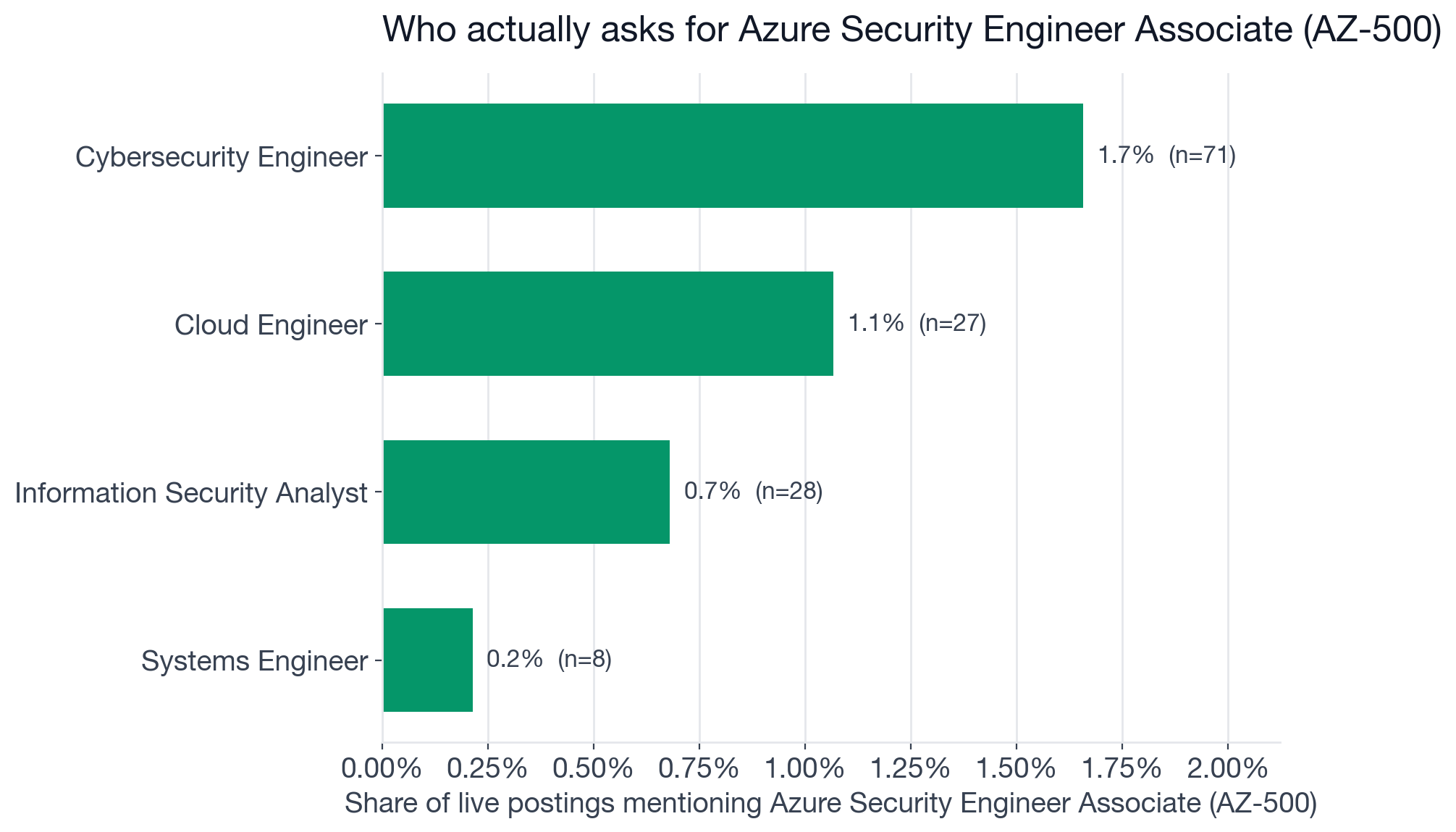 Cybersecurity Engineer postings name AZ-500 close to eight times as often as Systems Engineer postings, the widest gap between any two roles in this scope.
Cybersecurity Engineer makes up 29.2% of postings in this scope but 53.0% of every AZ-500 mention, nearly twice its expected share. Cloud Engineer runs a bit ahead of proportional too: 17.3% of postings, 20.1% of mentions. Information Security Analyst under-mentions relative to its size (28.1% of postings, 20.9% of mentions), and Systems Engineer is the sharpest under-mention of the four: 25.5% of postings but only 6.0% of mentions, less than a quarter of what its size would predict. AZ-500 certifies identity, network, platform, and data security work inside an existing Azure environment, and Cybersecurity Engineer, the title most directly responsible for hardening and monitoring that environment day to day, is where the certification concentrates most.
Why We're Not Publishing a Salary Number for AZ-500
Only 23 of the 134 AZ-500-mentioning postings disclose a US base salary, below the 25-posting floor this analysis requires before publishing a median. Breaking that already-thin sample down by seniority level leaves even less to work with: zero entry-level, 14 mid-level, 8 senior, and 1 staff-level postings carry both a certification mention and a disclosed salary, and none of those four bands individually clears the floor either.
That means there's no honest dollar figure to report here, not at the aggregate level and not at any individual seniority band. This is a limit of job-posting data, not a judgment about the certification's value. Postings that name a specific certification and disclose a specific salary are a narrow, self-selected slice of an already narrow slice (the 0.91% of postings that mention AZ-500 at all), and 23 data points isn't enough to separate a real pay signal from noise. The honest choice is to say plainly that this dataset can't answer "does AZ-500 pay more" right now, rather than force a number through a sample this small.
What the data can say, without a dollar figure attached, is how AZ-500-mentioning postings are distributed by seniority. They run 0% entry-level, 61.2% mid-level, 30.6% senior, and 8.2% staff. The rest of the four-role scope runs 3.1% entry-level, 63.6% mid-level, 21.9% senior, and 11.4% staff. The cert-mentioning group carries a larger senior share and a smaller staff share than the baseline, a mixed picture that doesn't point cleanly toward "more senior" or "less senior" overall, and it doesn't change the conclusion above either way: the underlying salary sample is too thin to test whether any part of that mix comes with a pay difference. One methodology limitation worth flagging on the 0% entry-level figure specifically: seniority here is inferred from title keywords, and a posting with no explicit level word defaults to mid-level, which compresses the measured spread. Roughly half of the sampled AZ-500 titles carry no such word, so that 0% may understate a small genuine entry-level presence rather than reflect its literal absence, though AZ-500 is not a cert entry-level candidates typically hold in the first place.
What Does an AZ-500 Job Actually Ask You to Know?
Beyond the certification name itself, Azure appears as a named skill in 85.8% of these postings, which is expected since the postings are selected for mentioning an Azure-specific certification. Cloud Security and Monitoring each show up in 62.7%, Automation in 59.7%, and Incident Response in 50.7%, the core day-to-day toolkit for running security operations inside an Azure environment. AWS shows up in 43.3% of AZ-500 postings too, nearly as often as Incident Response, a sign that a meaningful share of these roles cover multi-cloud security work rather than an Azure-only environment.
| Skill | Share of AZ-500 postings |
|---|---|
| Azure | 85.8% |
| Cloud Security | 62.7% |
| Monitoring | 62.7% |
| Automation | 59.7% |
| Incident Response | 50.7% |
| PowerShell | 46.3% |
| AWS | 43.3% |
| SIEM | 39.6% |
CISSP is the most common certification named alongside AZ-500, appearing in 51.5% of AZ-500 postings, well ahead of CompTIA Security+ (36.6%) and CCSP (34.3%). AZ-500's own Azure sibling credentials show up far less: Azure Administrator Associate (AZ-104) in 21.6% of postings, and Azure Solutions Architect Expert (AZ-305) in 12.7%. That pattern reads as AZ-500 being used to round out a broad security resume anchored on CISSP, more than to complete a specifically Azure-branded certification track.
| Certification | Co-occurs with AZ-500 |
|---|---|
| CISSP | 51.5% |
| CompTIA Security+ | 36.6% |
| CCSP | 34.3% |
| Azure Administrator Associate (AZ-104) | 21.6% |
| CISM | 18.7% |
| GIAC GCIH | 15.7% |
| Azure Solutions Architect Expert (AZ-305) | 12.7% |
AZ-500 Hiring Spans IT Services, Defense, and Banking, With No Employer Above 6 Mentions
Among employers with enough mentions to rank, no single company or industry dominates.
| Employer | Postings mentioning AZ-500 |
|---|---|
| NTT Limited | 6 |
| Peraton | 4 |
| Thales | 4 |
| Kimley-Horn | 4 |
| Danaher Corporation | 4 |
| Yoummday GmbH | 2 |
| Bank of America | 2 |
| NVISO | 2 |
| Relativity | 2 |
| Aviso Wealth | 2 |
NTT Limited leads with 6 of the 134 total mentions, just 4.5% of all AZ-500 demand, and the top 10 employers combined cover only 23.9%. The roster itself is genuinely mixed: an IT services firm (NTT Limited), a defense contractor (Peraton) next to a French aerospace and defense company (Thales), a US civil-engineering firm (Kimley-Horn), an industrial and life-sciences conglomerate (Danaher), a European outsourcing firm (Yoummday), a major bank (Bank of America), a cybersecurity consultancy (NVISO), a legal-technology company (Relativity), and a wealth-management firm (Aviso Wealth). That spread looks like a horizontal need rather than a sector-specific compliance requirement: any organization running production workloads on Azure needs someone accountable for securing them, regardless of industry.
What to Do With These Numbers Before You Register for the AZ-500 Exam
Given how rarely AZ-500 appears and how rarely it's required outright, the more useful frame is treating it as a specialization layered on top of a broader security credential, not a gate to a role. If you're targeting Cybersecurity Engineer postings, expect it to show up more than twice as often as in Systems Engineer or Information Security Analyst postings, though even there it's still a small minority of listings.
Drill Azure identity and access management, cloud security monitoring, and incident-response scenarios with InterviewStack's Question Bank, or build foundational cloud-security depth through InterviewStack's interactive courses if Azure-specific security work is newer to you. Once you have a specific role targeted, run a mock interview against it to find the real gaps a certification alone won't reveal. To see current openings, browse active postings across all four roles in this scope.
FAQ
Q. How common is Azure Security AZ-500 in cybersecurity and cloud job postings?
AZ-500 appears in 0.91% of active postings across Cybersecurity Engineer, Information Security Analyst, Cloud Engineer, and Systems Engineer roles on the InterviewStack.io job board (134 of 14,660 postings analyzed over a 90-day window), about 1 in every 109 postings in that scope.
Q. Is AZ-500 usually required or just preferred?
Preferred, overwhelmingly. Of the 78 AZ-500 mentions clear enough to classify, 91.0% call it preferred and only 9.0% call it required. A further 56 mentions, 41.8% of all 134, don't specify either way.
Q. Which role asks for AZ-500 the most?
Cybersecurity Engineer, at 1.66% of its own postings (71 of 4,282), about 1.8 times the 0.91% aggregate rate across the four roles in scope, and 53.0% of every AZ-500 mention despite being just 29.2% of the postings analyzed.
Q. Do postings that mention AZ-500 pay more?
We can't say reliably. Only 23 AZ-500-mentioning postings disclose a US base salary, below the 25-posting floor this analysis requires before reporting a median, and every individual seniority band falls even further short. The honest answer is that this dataset doesn't support a salary comparison for AZ-500 yet, not that there isn't one.
Q. What else do AZ-500 postings typically ask for?
Beyond the certification itself, Azure appears as a named skill in 85.8% of these postings, followed by Cloud Security and Monitoring (62.7% each) and Automation (59.7%). CISSP is the most common co-occurring certification, showing up in 51.5% of AZ-500 postings, well ahead of CompTIA Security+ (36.6%) and CCSP (34.3%).
Q. Which companies post the most AZ-500 job openings?
No single employer or industry dominates. NTT Limited leads with 6 of the 134 total mentions (4.5%), and the top 10 employers combined account for only 23.9% of all mentions, spanning IT services, defense, banking, and engineering firms.
Q. Is AZ-500 worth pursuing for a cybersecurity career?
The data shows AZ-500 as a low-required, high-preferred signal that's still rare even in the roles most likely to ask for it. It's a credible add-on next to a broader credential like CISSP or Security+, not a standalone qualification the market widely demands, and its actual pay impact isn't something this dataset can confirm yet.
What an AZ-500 Line Actually Signals on a Resume
AZ-500 is a specific, defensible credential for Azure-focused security work, but the hiring data available right now shows it as a small, mostly-optional signal rather than a market requirement: rare across the four roles most likely to ask for it, preferred far more often than required, and paired most often with a broader credential like CISSP rather than carried alone. What this dataset can't tell you yet is whether it moves your pay, and forcing an answer from a sample this small would be worse than admitting it isn't there. The steadier signal is the underlying skill set, Azure security architecture, identity and access management, incident response, that shows up in the majority of these postings whether or not the certification itself gets named.
Topics
Ready to practice?
Put what you've learned into practice with AI mock interviews and structured preparation guides.