
Employers Ask for AZ-104. They Almost Never Require It.
Rarely. Of the Azure Administrator Associate (AZ-104) mentions in active cloud and infrastructure postings clear enough to classify as required or preferred, only 6.7% call it required outright; 93.3% list it as preferred. AZ-104 itself isn't common to begin with: across Cloud Architect, Cloud Engineer, Network Engineer, Site Reliability Engineer, Systems Administrator, Systems Engineer, and DevOps Engineer postings on the InterviewStack.io job board, only 215 of 17,604 active postings analyzed over a trailing 90-day window mention it at all, about 1 in every 82.
Where it does appear, demand concentrates almost entirely in Cloud Engineer postings, which mention it more than three times as often as the aggregate rate. Postings that mention AZ-104 also advertise a lower salary than postings that don't, $129,500 versus $139,950 in US base pay, a comparison of advertised base salary only; equity, bonus, and other compensation aren't disclosed in job postings and aren't part of this comparison. That gap is too thin to break down by seniority level with any confidence, the first certification in this series where that's true at every level.
Key Findings
- Azure Administrator AZ-104 appears in just 1.22% of active postings across seven cloud and infrastructure roles (215 of 17,604 analyzed), about 1 in every 82 postings.
- Of the 105 mentions clear enough to classify, only 6.7% call it required; 93.3% list it as preferred, and 51.2% of all mentions don't specify either way.
- Cloud Engineer postings mention AZ-104 at 4.16% (about 1 in 24), 3.4 times the aggregate rate, and account for 47.4% of every mention despite being just 13.9% of postings in scope.
- Postings mentioning AZ-104 show a US base salary median of $129,500 (n=42) versus $139,950 for postings in the same roles that don't (n=5,693), a 7.5% gap.
- That gap can't be checked by seniority level: the 42 with-cert salary points split so thin across entry, mid, senior, and staff that none of the four bands clears the 25-posting reporting floor.
- AZ-104 postings run slightly less senior than the rest of the pool; staff-level makes up 6.0% of them, versus 11.6% for postings that don't mention it.
- AZ-104 co-occurs most with Azure Solutions Architect Expert AZ-305 (27.9% of AZ-104 postings) and CompTIA Security+ (20.9%).
- More than half of AZ-104 postings also name Terraform (51.6%) and Infrastructure as Code (43.3%), pointing to automation-heavy, often multi-cloud roles.
How Often Do Employers Actually Require AZ-104?
Of the 215 total AZ-104 mentions in this dataset, 105 (48.8%) use language clear enough to classify as required or preferred; the remaining 110 (51.2%) sit inside certification lists or "or equivalent" phrasing that doesn't resolve either way, the largest unclassified share logged for any certification in this series so far. Within the classified set, required is rare: just 7 postings (6.7%) require AZ-104 outright, and 98 (93.3%) list it as preferred.
Zoomed out to every mention in the dataset, not holding the certification disqualifies a candidate outright in only about 3.3% of postings that name it at all (7 of 215), roughly 1 in 31. For the overwhelming majority, AZ-104 reads as a credential an employer is glad to see on a resume, not a line item a candidate has to clear.
Demand for AZ-104 Sits Almost Entirely in One Role
Demand for AZ-104 is not spread evenly across the seven roles in this scope, and it doesn't track posting volume.
| Role | Active postings | Mention AZ-104 | Share |
|---|---|---|---|
| Cloud Engineer | 2,451 | 102 | 4.16% |
| Systems Administrator | 2,727 | 39 | 1.43% |
| Systems Engineer | 3,606 | 32 | 0.89% |
| DevOps Engineer | 4,720 | 26 | 0.55% |
| Cloud Architect | 1,518 | 8 | 0.53% |
| Network Engineer | 2,582 | 8 | 0.31% |
Site Reliability Engineer, the seventh role in this scope, isn't broken out above: it didn't contribute any postings to this 90-day window under the production filter, so there's nothing distinct to report for it here.
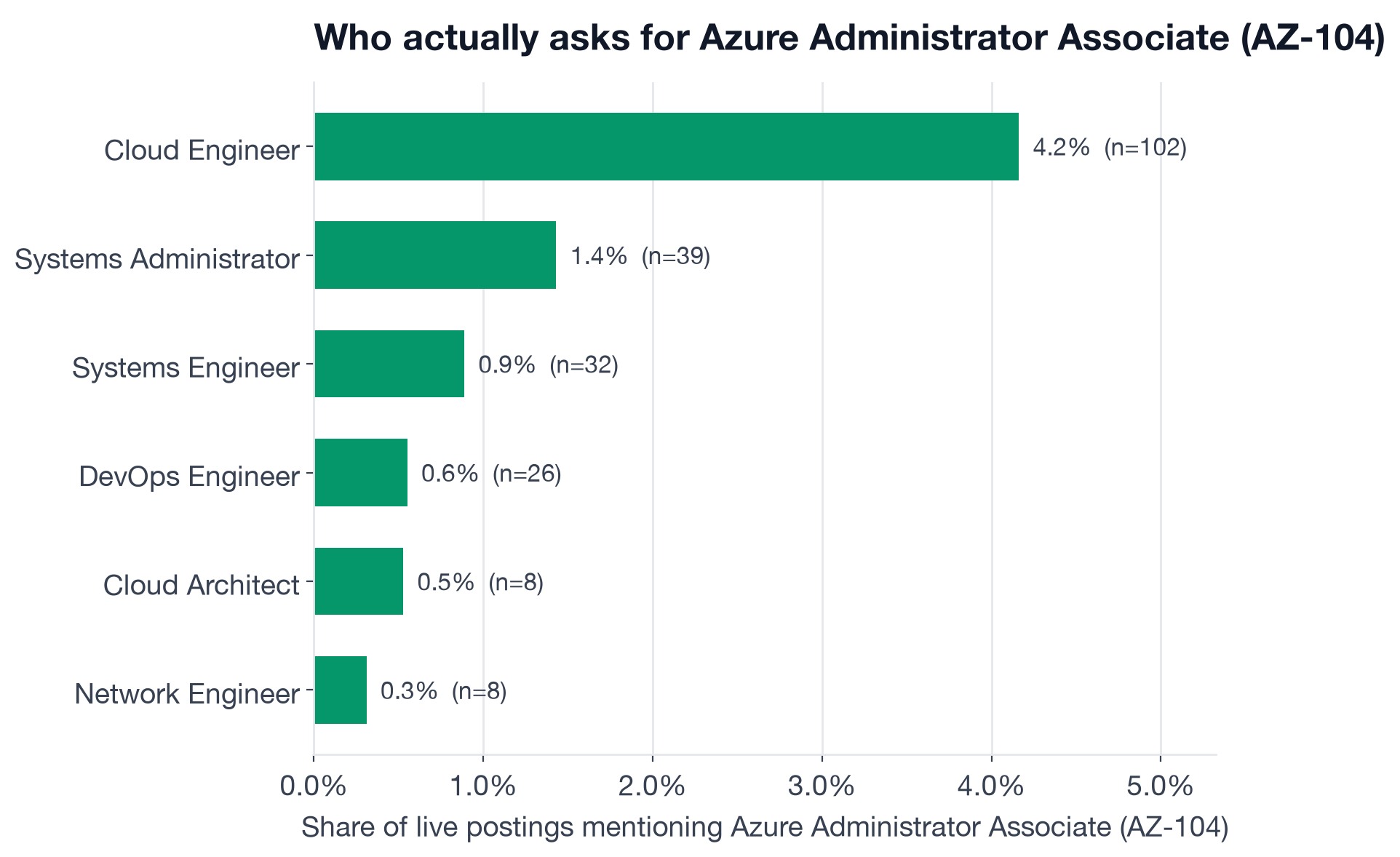 Cloud Engineer names AZ-104 roughly seven to eight times as often as Cloud Architect or DevOps Engineer, and more than 13 times as often as Network Engineer.
Cloud Engineer makes up 13.9% of postings in this scope but 47.4% of every AZ-104 mention, more than three times its expected share. Systems Administrator runs close to proportional: 15.5% of postings, 18.1% of mentions. The other four roles all under-mention relative to their size. Network Engineer and Cloud Architect are the sharpest: each contributes just 8 of the 215 total mentions (3.7% of the pool), despite Network Engineer alone making up 14.7% of postings in scope and Cloud Architect 8.6%. DevOps Engineer, the largest role in this scope at 26.8% of postings, contributes only 12.1% of mentions, less than half its expected share. AZ-104 certifies day-to-day Azure portal and CLI administration, account, storage, networking, and identity operations inside an existing tenant, and Cloud Engineer is the title where that work concentrates most directly in this dataset.
AZ-104 Postings Pay Less, and the Data Can't Say Why at Which Level
All salary figures here are advertised US base pay only, on the subset of postings that disclose it. Equity, bonus, and other compensation aren't part of job-posting data, so total compensation typically runs higher than what's reported here. The comparison baseline throughout is other postings in the same seven-role scope that don't mention AZ-104, not the broader job market.
Postings that mention AZ-104 show a median US base salary of $129,500 (n=42) against $139,950 for postings that don't (n=5,693), a 7.5% gap, about $10,450. Every certification examined earlier in this series has had at least one seniority band with enough with-cert salary data to check that gap against. AZ-104 doesn't: its 42 with-cert salary points split so thin across entry, mid, senior, and staff that none of the four individual bands clears the 25-posting floor needed to report a median.
| Level | With AZ-104 (median) | Without AZ-104 (median) | Gap |
|---|---|---|---|
| Entry | Not reportable (n=2) | $90,900 (n=101) | n/a |
| Mid-level | Not reportable (n=22) | $129,550 (n=3,460) | n/a |
| Senior | Not reportable (n=12) | $152,650 (n=1,309) | n/a |
| Staff | Not reportable (n=6) | $175,500 (n=823) | n/a |
There's no seniority-level pay chart for this certification, because none of the four rows above clears the reporting floor for a with-cert median.
What we can check is composition. AZ-104 postings skew slightly less senior than the rest of the pool: staff-level makes up 6.0% of them, versus 11.6% for postings that don't mention it, while entry-level runs the other way (4.7% versus 2.4%). Worth noting on this comparison: seniority here is inferred from title keywords, and postings with no explicit level language default to mid-level in this dataset, which can understate the true entry and staff shares on both sides. Staff-level postings carry the highest baseline pay in this scope, $175,500, so a thinner staff share in the AZ-104 pool would be expected to pull its aggregate figure down somewhat. That's a real, partial piece of the story, not the whole one: it's unlikely to fully account for a $10,450 gap on its own, and without a reportable per-level comparison, there's no way to confirm how much of it does.
Role composition doesn't offer a tidy explanation either. Cloud Engineer, the role driving most AZ-104 demand, has a non-cert baseline of $150,000, above the scope's overall non-cert median of $139,950, so the gap isn't simply a case of the certification concentrating in the cheapest role. Systems Administrator, the other role that over-mentions AZ-104, does have the lowest baseline in scope at $110,850, which pulls in the expected direction, but it's only 18.1% of the cert-mentioning pool, too small a share to be doing most of the work on its own.
Who's Actually Hiring for AZ-104?
Among employers with enough mentions to rank, the roster splits about evenly between federal and defense contractors and IT consulting or systems-integrator firms that manage Azure environments for other companies.
| Employer | Postings mentioning AZ-104 |
|---|---|
| Northrop Grumman Corporation | 7 |
| Peraton | 6 |
| PricewaterhouseCoopers | 5 |
| Experian | 4 |
| Ensono | 4 |
| General Dynamics Information Technology | 4 |
| Netcompany | 3 |
| Accenture | 3 |
| Booz Allen Hamilton | 3 |
| Leidos | 2 |
| Talan | 2 |
| KOSTAL Group | 2 |
Northrop Grumman, Peraton, General Dynamics IT, Booz Allen Hamilton, and Leidos, five federal contractors, account for 22 of the 45 mentions among these twelve employers, just under half. The rest split between consulting and systems-integrator firms that administer Azure tenants on behalf of client companies (PricewaterhouseCoopers, Accenture, Netcompany, Talan), one managed-services provider (Ensono), a credit-data company running its own Azure infrastructure (Experian), and an industrial manufacturer doing the same (KOSTAL Group). That's a more mixed roster than most of the certifications examined earlier in this series, which skewed more heavily toward government contracting alone. AZ-104 looks less like a compliance credential tied to one sector and more like a baseline expectation for whoever operates Azure day to day, government or commercial.
What Else Do These Postings Ask For?
AZ-104 postings rarely ask for Azure administration alone. Beyond the certification itself, Azure shows up as a named skill in 98.1% of these postings (expected, since the postings are selected for mentioning an Azure-specific certification), followed by PowerShell (58.1%), Automation (57.2%), and Monitoring (56.3%), the core toolkit for keeping an Azure environment running day to day. More tellingly, 51.6% also name Terraform and 43.3% name Infrastructure as Code, and 38.1% name AWS. That combination points to automation-heavy, often multi-cloud operations roles, not the narrow, portal-only administration the AZ-104 exam itself is scoped around.
| Certification | Co-occurs with AZ-104 |
|---|---|
| Azure Solutions Architect Expert (AZ-305) | 27.9% |
| CompTIA Security+ | 20.9% |
| Azure Security Engineer Associate (AZ-500) | 18.1% |
| CCNA | 12.1% |
| AWS Certified Solutions Architect - Associate | 10.7% |
| CKA (Certified Kubernetes Administrator) | 7.9% |
| VMware VCP | 7.9% |
Azure's other two associate-and-expert credentials, AZ-305 and AZ-500, add up to a combined 46.0% of co-occurrence mentions, nearly half, which reads as employers building out a fuller Azure certification track rather than treating AZ-104 as a standalone qualification. Security- and network-adjacent certifications appear too: Security+, CCNA, CISSP (5.6%), and CompTIA CASP+ (4.2%) add up to 42.8% combined (our analysis of CompTIA Security+ demand covers that certification's own hiring pattern in more depth). Both of those are sums of individually-reported co-occurrence rates, not deduplicated counts, so the true share of postings naming at least one of them is likely somewhat lower than the raw sum. Even so, the pattern is consistent with the employer roster above: postings that ask for AZ-104 tend to ask for a cluster of adjacent cloud and security credentials, not just the one.
Deciding What to Do With This Before You Study for AZ-104
The data here says more about where AZ-104 clusters than about whether to earn it, so treat it as a map, not a verdict. If you're targeting Cloud Engineer roles, expect the certification to be seen far more often than anywhere else in this scope, though still overwhelmingly as a preferred signal rather than a hard gate. If you're targeting Systems Administrator roles, it shows up at close to the aggregate rate. Everywhere else, especially DevOps Engineer, Cloud Architect, and Network Engineer postings, the underlying skills, Azure networking, identity, storage, and PowerShell automation, matter far more than the badge, and they show up in postings far more consistently than the certification name does.
Drill the topics that actually recur across these postings, Azure identity and access management, PowerShell automation, disaster recovery, with InterviewStack's Question Bank, or build the underlying cloud-infrastructure and automation foundations through InterviewStack's interactive courses if the Azure ecosystem is newer to you. Once you have a specific role targeted, run a mock interview against it to see where your real gaps sit. For a broader look at the skill stack beyond this one certification, Cloud Engineer skills companies want and Systems Administrator skills companies want both break down the fuller picture.
To see current openings, browse active postings across all seven roles in this scope.
FAQ
Q. How common is Azure Administrator AZ-104 in cloud and infrastructure job postings?
AZ-104 appears in 1.22% of active postings across Cloud Architect, Cloud Engineer, Network Engineer, Site Reliability Engineer, Systems Administrator, Systems Engineer, and DevOps Engineer roles on the InterviewStack.io job board (215 of 17,604 postings analyzed over a 90-day window), about 1 in every 82 postings in that scope.
Q. Is AZ-104 usually required or just preferred?
Preferred, overwhelmingly. Of the 105 AZ-104 mentions with clear required-or-preferred language, 93.3% call it preferred and only 6.7% call it required. A further 110 mentions, just over half of all mentions, don't specify either way.
Q. Which role asks for AZ-104 the most?
Cloud Engineer, at 4.16% of its postings (102 of 2,451), 3.4 times the 1.22% aggregate rate across all seven roles in scope, and 47.4% of every AZ-104 mention despite being just 13.9% of the postings analyzed.
Q. Do postings that mention AZ-104 pay more?
No. Postings mentioning AZ-104 show a US base salary median of $129,500 (n=42) versus $139,950 for postings in the same roles that don't mention it (n=5,693), about a 7.5% gap. The with-cert sample is too thin at every individual seniority level to say whether that gap holds, widens, or reverses for any specific level.
Q. Which certifications most often appear alongside AZ-104?
Azure Solutions Architect Expert (AZ-305) is the most common pairing, showing up in 27.9% of AZ-104 postings, followed by CompTIA Security+ (20.9%) and Azure Security Engineer Associate (AZ-500) at 18.1%.
Q. Which companies post the most AZ-104 job openings?
The roster splits about evenly between federal contractors (Northrop Grumman, Peraton, General Dynamics Information Technology, Booz Allen Hamilton, Leidos) and IT consulting or systems-integrator firms that manage Azure environments for other companies (PricewaterhouseCoopers, Accenture, Netcompany, Talan), plus a few direct enterprises running their own Azure infrastructure (Experian, KOSTAL Group).
Q. Is AZ-104 worth pursuing for a cloud career?
The data shows AZ-104 as a low-required, high-preferred signal concentrated almost entirely in Cloud Engineer postings: a credible line on a resume for that specific path, but not something the broader market demands, and not something that correlates with higher pay in this dataset.
AZ-104 Is a Foothold, Not a Pay Raise
Azure Administrator AZ-104 is common enough to recognize and rare enough to be optional almost everywhere it appears. Where it shows up, it functions as a soft signal concentrated in one role, Cloud Engineer, more than a broad market requirement, and its salary story is one this dataset can't fully resolve at the seniority level it would need to be trustworthy. The steadier read is that the day-to-day skills it certifies, Azure identity, networking, automation, disaster recovery, matter more to employers in this scope than the badge itself, and showing up ready to talk through real Azure operations will carry further than the certification alone.
Topics
Ready to practice?
Put what you've learned into practice with AI mock interviews and structured preparation guides.