
The Cloud Platform in Your Resume Determines Your Pay Tier
Azure is the more commonly requested cloud in Systems Administrator postings: it appears in 22% of listings, while AWS appears in only 15%. By raw frequency, knowing Azure should be the safer bet. The salary data says otherwise. Among US postings with disclosed compensation, AWS-mentioning Systems Administrator roles pay $135,000 at the median. Azure-mentioning roles pay $110,000. That $25,000 gap, favoring the less common platform, is one of the clearest signals in the data that "Systems Administrator" is covering two meaningfully different jobs in 2026.
The distinction tracks along familiar lines. Azure-heavy postings tend to cluster around Active Directory, Windows Server, and VMware: traditional enterprise IT management work. AWS-heavy postings cluster around Linux, Ansible, Docker, Terraform, and Python: infrastructure that is largely automated, mostly cloud-native, and closer to DevOps in practice than in title. Both roles are posted under the same label. The pay difference is substantial enough to treat them as separate tracks when making career decisions.
To put numbers on the full picture, every active Systems Administrator posting on the InterviewStack.io job board as of June 2026 was analyzed, 4,387 listings in total, with skills extracted from descriptions and normalized across synonyms.
Key Findings
- 4,387 active Systems Administrator postings analyzed across the InterviewStack.io job board as of June 2026.
- No single skill exceeds 38% frequency: the top skill, Monitoring, appears in 38% of postings. This role has no universal must-haves.
- Median US base salary is $107,500 (n=1,211 postings with disclosed salary data). Equity, bonuses, and sign-on are not included.
- AWS-mentioning US roles pay $135,000 at the median; Azure-mentioning roles pay $110,000, a $25,000 gap despite Azure appearing in roughly 50% more postings.
- Cloud and DevOps-adjacent skills add $20-24K: Ansible ($129,600), Docker ($131,900), Terraform ($128,300), and Kubernetes ($127,500) all sit well above the baseline.
- 76.5% of postings are mid-level; entry-level is 3.5% of the market, and only 16.2% are senior.
- Only 8.5% of postings are fully remote; 67.4% require on-site presence, making this one of the least remote-friendly technical roles.
- Defense and government contractors anchor the top of the hiring list: General Dynamics IT, Leidos, Peraton, CACI, Northrop Grumman, and Booz Allen Hamilton are among the top 12 employers by active openings.
A Role With No Universal Requirement
Group individual skills into the higher-level family they belong to and the Systems Administrator role reveals an unusually broad profile: nearly every skill family is represented, but none dominate to the degree seen in more specialized roles.
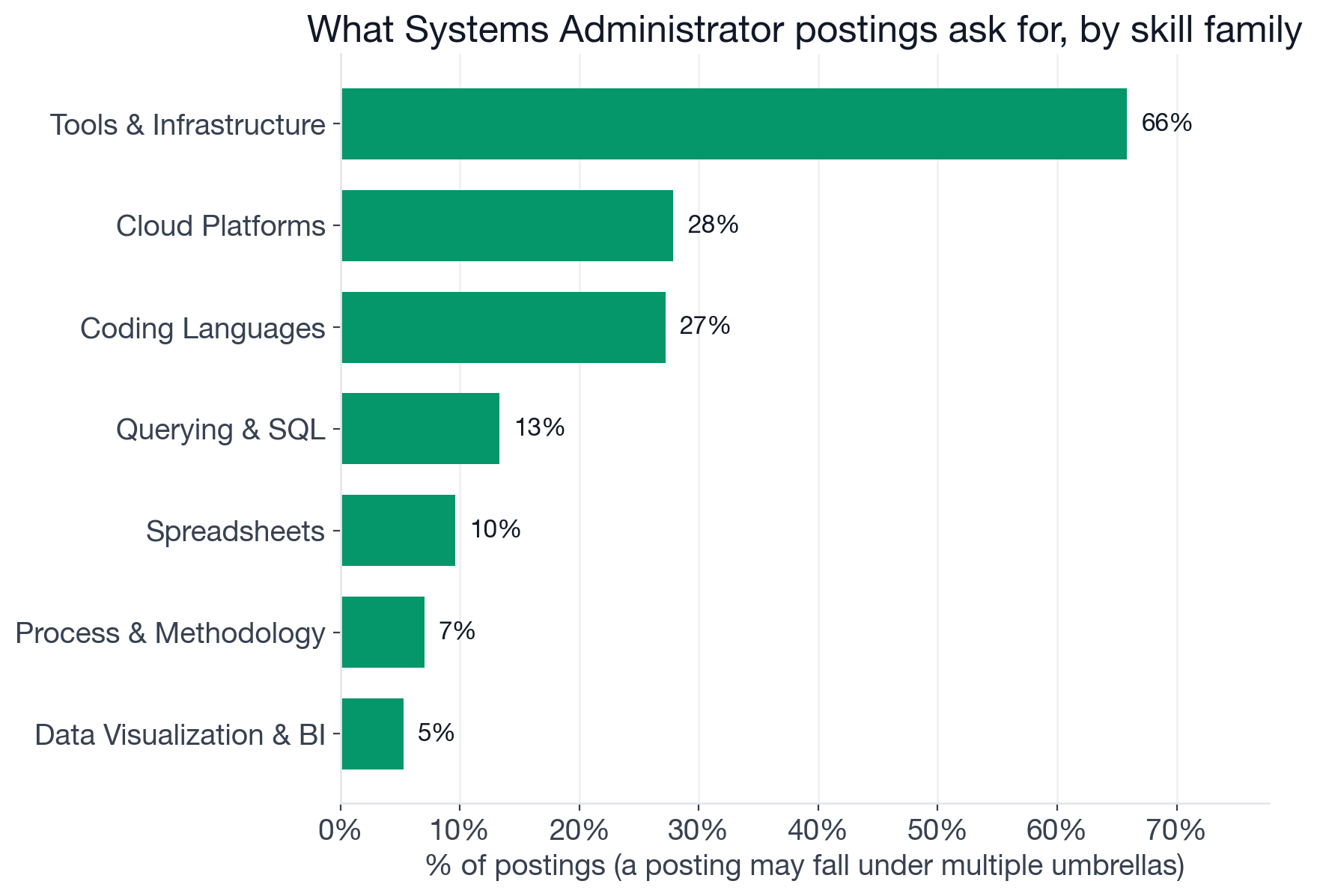
Share of Systems Administrator postings that ask for at least one skill in each family. A posting mentioning both VMware and Windows Server counts once under the Windows/Enterprise family.
The "Other" umbrella, which captures the Windows and on-premises enterprise IT cluster (Windows, VMware, Active Directory, PowerShell, Windows Server, Virtualization), appears in 77% of postings. That sounds like a table-stakes category until you look inside: no individual skill inside it exceeds 33%. The family as a whole is nearly universal; any single member of it is optional.
Tools and Infrastructure (Monitoring, Linux, Automation, Ansible, Kubernetes, Docker, Terraform) covers 66% of postings and represents the operational toolkit. Cloud Platforms reach 28%, split unevenly between Azure (22%) and AWS (15%), with Google Cloud at just 4%. Coding Languages (Python, Bash, TypeScript) covers 27% of postings, while Querying and SQL sits at 13%, together signaling that a meaningful slice of postings now ask for scripting or data fluency on top of traditional admin skills.
The Machine Learning and AI family stands at 2.1% of postings (91 of 4,387), one of the lowest explicit-AI rates of any technical role. That figure measures Systems Administrators being hired specifically to manage or integrate AI platforms. It does not capture ambient AI usage. According to JetBrains' 2025 Developer Ecosystem Survey, 85% of technical professionals use AI tools regularly, with ChatGPT and GitHub Copilot being the most common. For sysadmins, that ambient layer lives in the exact skills postings do list: scripting (AI-assisted PowerShell, Bash, and Python snippet generation) and monitoring (AIOps integrations in Datadog, Splunk, and Grafana). The tooling is real and spreading across enterprise infrastructure teams; postings just do not list it because most employers treat it as a baseline competency, not a stated requirement.
What Are the Three Tiers of Systems Administrator Skills?
Drill into individual skills and three bands emerge: a common tier (20-50% of postings), a differentiator tier (5-20%), and nothing in the table-stakes zone above 50%. That last point matters: every other technical role analyzed on this board has at least one skill that a majority of postings require. Systems Administrator has none. The role's skill profile is genuinely fragmented.
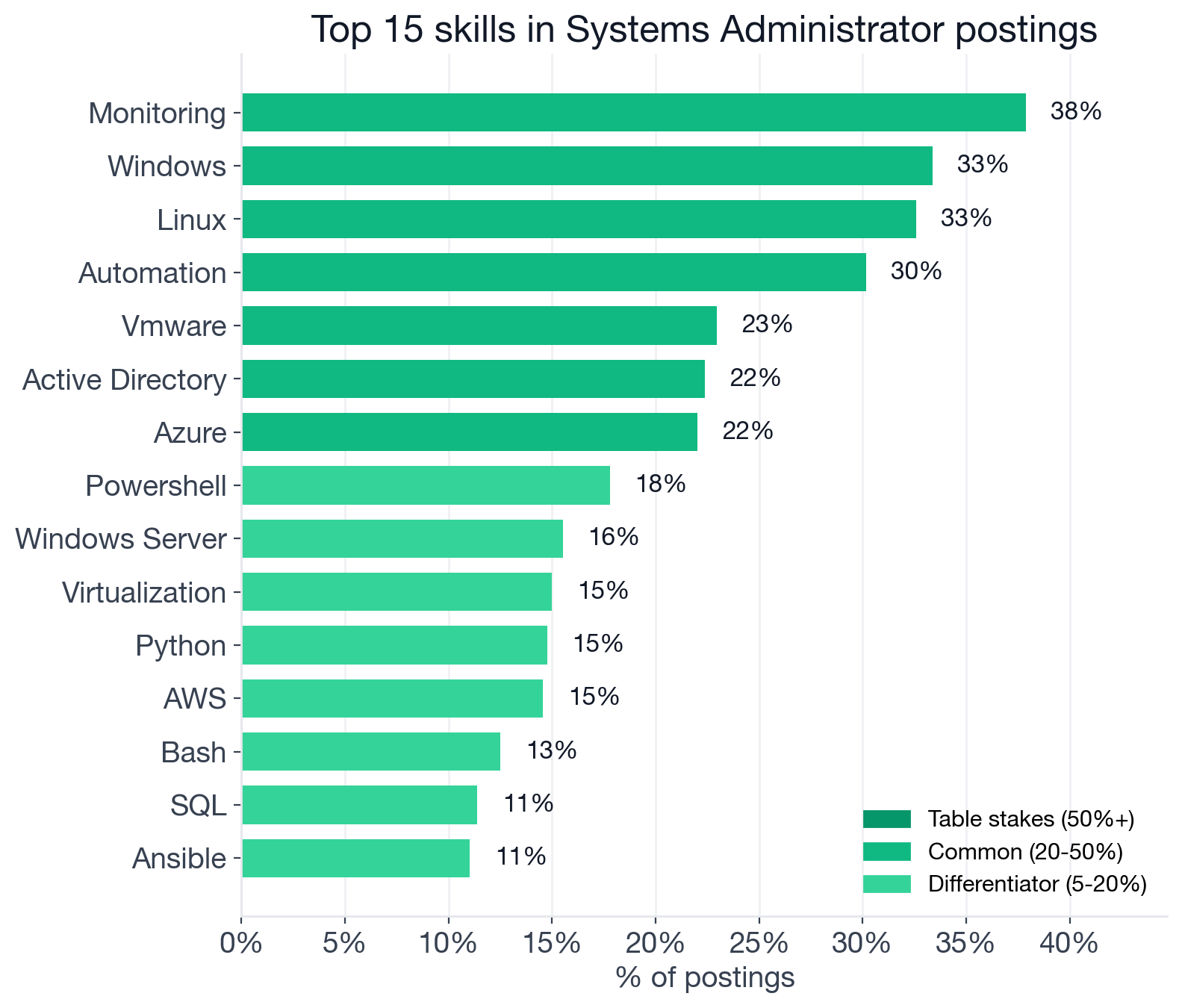
Top individual Systems Administrator skills by posting frequency. Skills appearing in 20-50% of postings are the common tier; 5-20% are differentiators. No skill clears the 50% mark that would indicate a universal requirement.
Common Tier (20-50% of postings)
These appear in a meaningful but not overwhelming share of listings. A candidate without any of these would stand out, but no single one is a filter most employers apply.
- Monitoring: 38% (Systems Administrator + Monitoring openings)
- Windows: 33%
- Linux: 33% (Linux-focused Systems Administrator openings)
- Automation: 30%
- VMware: 23%
- Active Directory: 22%
- Azure: 22%
The common tier tells you this is a broad operations role. Linux and Windows are nearly tied, reflecting that many shops run mixed environments. Monitoring (Datadog, Nagios, Prometheus, Splunk, and similar platforms collapsed together) is the single most common requirement, which makes sense: a sysadmin's primary output is keeping systems running, and you cannot do that without visibility.
Differentiator Tier (5-20% of postings)
These appear in a meaningful minority of listings and are where the salary story really lives.
- PowerShell: 18%
- Windows Server: 16%
- Virtualization: 15%
- Python: 15%
- AWS: 15%
- Bash: 13%
- SQL: 11%
- Ansible: 11% (a configuration management and automation tool that applies changes to fleets of servers from a single playbook)
- Excel: 10%
- Backups: 9%
- TypeScript: 9% (primarily in cloud-native automation and DevOps-adjacent roles; uncommon in traditional server administration)
- Kubernetes: 7%
- CI/CD: 7%
- Docker: 6%
- Terraform: 6% (an infrastructure-as-code tool that provisions cloud resources via declarative configuration files)
The differentiator tier contains two very different kinds of skills. PowerShell, Windows Server, and Virtualization signal the traditional enterprise admin archetype. Python, Bash, AWS, Ansible, Docker, Kubernetes, and Terraform signal the modern ops archetype. Both clusters appear in the same 5-20% band but lead to very different salary outcomes.
Which Skills Pay More Than the $107,500 Baseline?
All salary numbers below are restricted to US postings only, where wage-transparency laws produce consistent disclosure, so they are directly comparable. These figures cover base salary only: equity, bonuses, RSUs, and sign-on are not disclosed in job postings. Total compensation at well-funded or publicly traded employers runs meaningfully higher than the numbers here.
The overall median US base salary for Systems Administrator postings is $107,500 (n=1,211 postings with disclosed salary data).
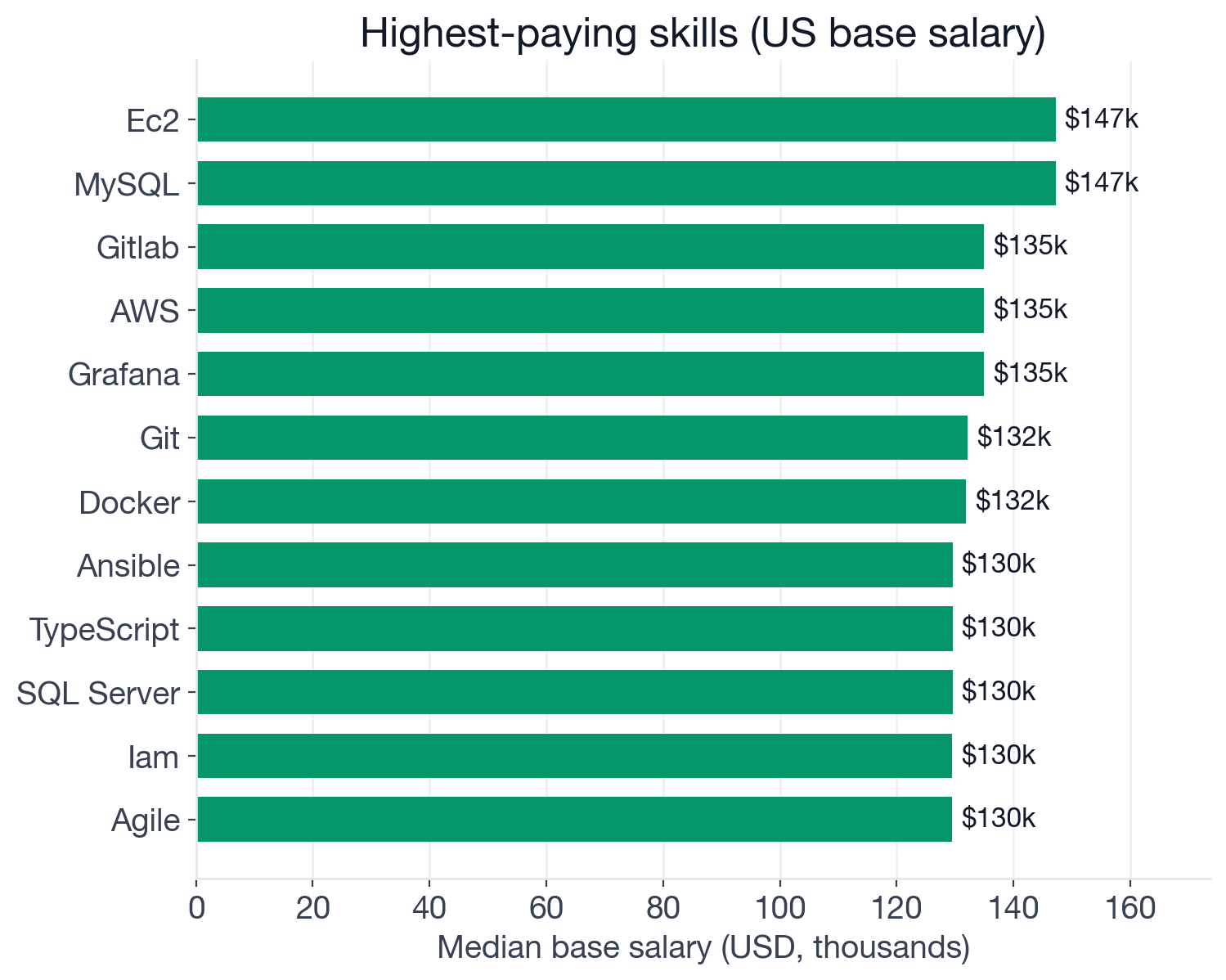
Median US base salary in USD for postings that mention each skill, among Systems Administrator postings with structured salary data (US only, n=1,211).
The salary premium is a story about two different kinds of work, not just individual tools. Cloud and DevOps-adjacent skills command a tier of $19-28K above baseline:
| Skill | Median US salary | Premium above baseline |
|---|---|---|
| AWS | $135,000 | +$27,500 (n=197) |
| Docker | $131,900 | +$24,400 (n=82) |
| Ansible | $129,600 | +$22,100 (n=166) |
| Terraform | $128,300 | +$20,800 (n=63) |
| Kubernetes | $127,500 | +$20,000 (n=105) |
| CI/CD | $126,800 | +$19,300 (n=68) |
A second tier, the Linux and scripting cluster, adds $9-13K:
| Skill | Median US salary | Premium above baseline |
|---|---|---|
| Python | $120,000 | +$12,500 (n=207) |
| Linux | $119,600 | +$12,100 (n=467) |
| Automation | $116,700 | +$9,200 (n=397) |
| Bash | $116,700 | +$9,200 (n=177) |
The most common skills in the role, those in the Windows and on-premises enterprise cluster, sit near or below the role median:
| Skill | Median US salary | vs. baseline |
|---|---|---|
| Monitoring | $114,300 | +$6,800 |
| VMware | $111,900 | +$4,400 |
| PowerShell | $110,000 | +$2,500 |
| Azure | $110,000 | +$2,500 |
| Windows | $109,100 | +$1,600 |
| Active Directory | $103,100 | -$4,400 |
| Windows Server | $103,100 | -$4,400 |
The pattern is the reverse of what frequency would suggest. Azure appears in 22% of postings but pays only $2,500 above baseline. Active Directory appears in 22% of postings and pays below baseline. These are the skills that define the traditional enterprise IT market, where the work is well understood, hiring pools are deep, and premium pay is harder to justify.
The DevOps-tier skills (Ansible, Terraform, Docker, Kubernetes) appear in 6-11% of postings but add $19-28K. Small footprint, outsized compensation. A candidate who can deploy infrastructure as code, manage containers, and run CI/CD pipelines is competing in a smaller but better-paid slice of the Systems Administrator market.
Two Skill Stacks Tell Two Different Stories
The co-occurrence data, which measures how often two skills appear in the same posting, confirms what the salary data implies: the Systems Administrator market has two dominant skill clusters, and they do not overlap much.
| Skill pair | Appears together in | Lift |
|---|---|---|
| Bash + Python | 9% of postings | 4.87 |
| Virtualization + VMware | 10.7% of postings | 3.10 |
| Active Directory + Windows Server | 10.3% of postings | 2.97 |
| AWS + Azure | 9.0% of postings | 2.80 |
| Ansible + Linux | 9.2% of postings | 2.55 |
| VMware + Windows Server | 9.0% of postings | 2.53 |
| Automation + Python | 10.3% of postings | 2.32 |
Lift greater than 1 means the pair appears together more often than their individual frequencies would predict by chance. Lift 4.87 means if a posting mentions Bash, it is 4.87x more likely than baseline to also mention Python.
The scripting archetype: Bash and Python have the highest lift in the entire dataset at 4.87. In isolation, Bash appears in 13% of postings and Python in 15%; by chance alone, about 2% of postings would mention both. Instead, 9% do. The implication is direct: postings that ask for Bash are almost certainly building or maintaining automation-heavy environments where scripting fluency in both shell and Python is expected as a package. Ansible plus Linux (lift 2.55) and Automation plus Python (lift 2.32) reinforce the same picture.
The Windows shop archetype: Active Directory and Windows Server appear together with lift 2.97, and Virtualization with VMware hits lift 3.10. These are deeply correlated pairs because they define the same environment: enterprise Active Directory forests running on VMware-virtualized Windows Server infrastructure. The AWS plus Azure pair (lift 2.80) is interesting here too: multi-cloud postings, where an organization runs Azure for identity and Microsoft workloads but AWS for certain applications, appear more often than chance would predict.
The two archetypes rarely mix. A posting that emphasizes Bash, Python, and Ansible is unlikely to also lean on VMware and Active Directory, and vice versa. If you are early in a sysadmin career and trying to steer toward higher pay, the pairing data is fairly clear: move toward the scripting cluster, not the Windows administration cluster.
Who Hires at What Seniority Level?
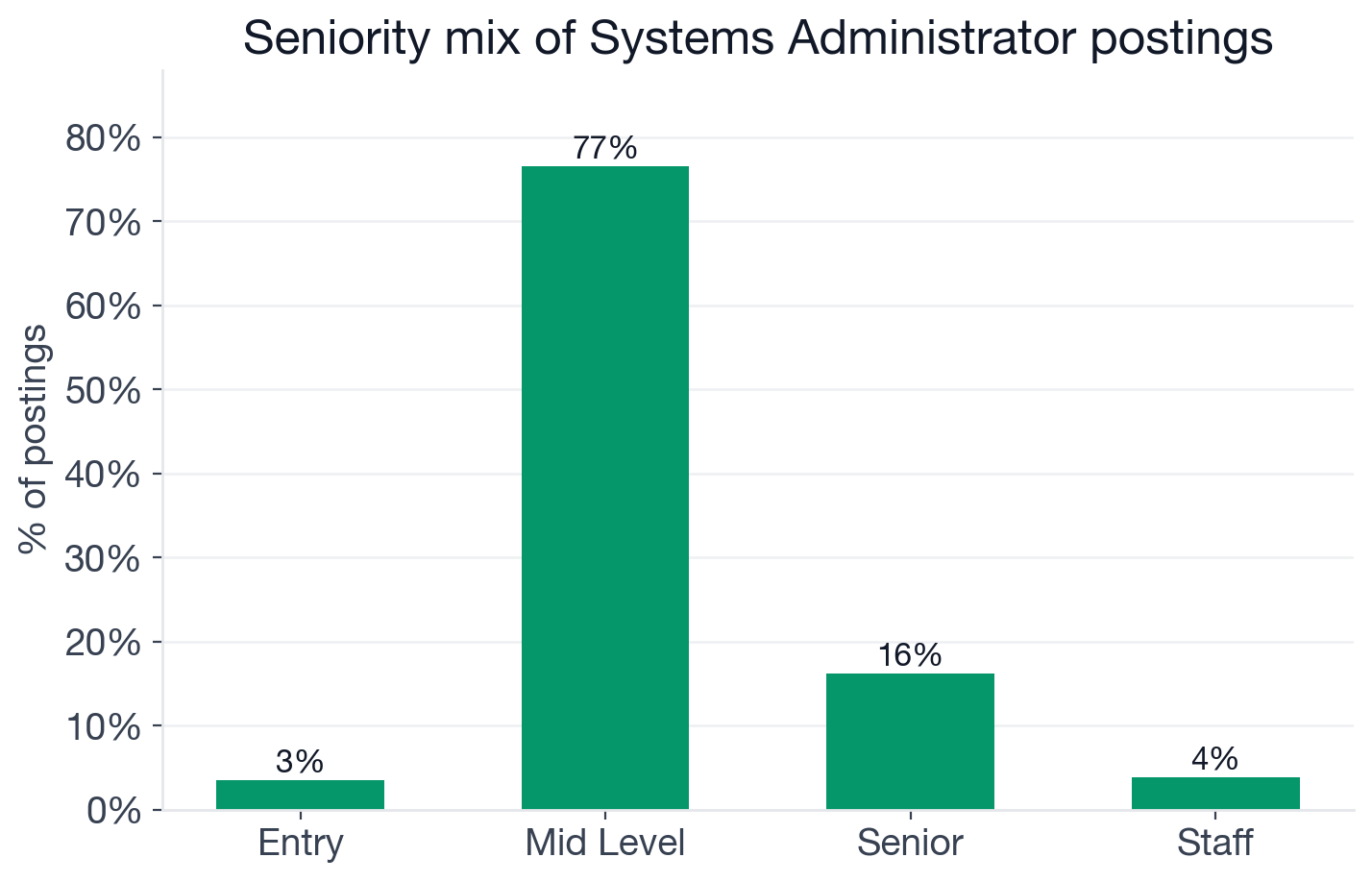
Seniority distribution of Systems Administrator postings. Postings without an explicit seniority signal default to mid-level.
- Mid-level: 76.5% (3,358 postings)
- Senior: 16.2% (709 postings)
- Staff / Lead: 3.8% (167 postings)
- Entry: 3.5% (153 postings)
The mid-level concentration is striking. For comparison, our analysis of Data Engineer postings shows 52% mid-level with a 45% senior-and-above tier. Systems Administrator at 76.5% mid-level, with seniors at just 16%, suggests the role's career ceiling is lower, or more likely, that the people who advance to senior infrastructure roles shift to different titles: Systems Engineer, Infrastructure Architect, DevOps Engineer, or Cloud Engineer. "Senior Systems Administrator" is a real posting (709 of them), but it is not where the top of the seniority ladder lives in this field.
Entry-level is just 3.5%, comparable to the notoriously tight Data Engineer entry gate. IT helpdesk, help desk technician, and junior IT support roles are the standard pipeline into Systems Administration. CompTIA A+ and Network+, Microsoft Certified systems credentials, and entry-level AWS or Azure certifications are the most common ways candidates signal readiness in lieu of direct sysadmin experience. Senior Systems Administrator openings typically ask for one or more of the differentiator-tier skills alongside the common foundation.
Where Are the Jobs, and How On-Site Are They?
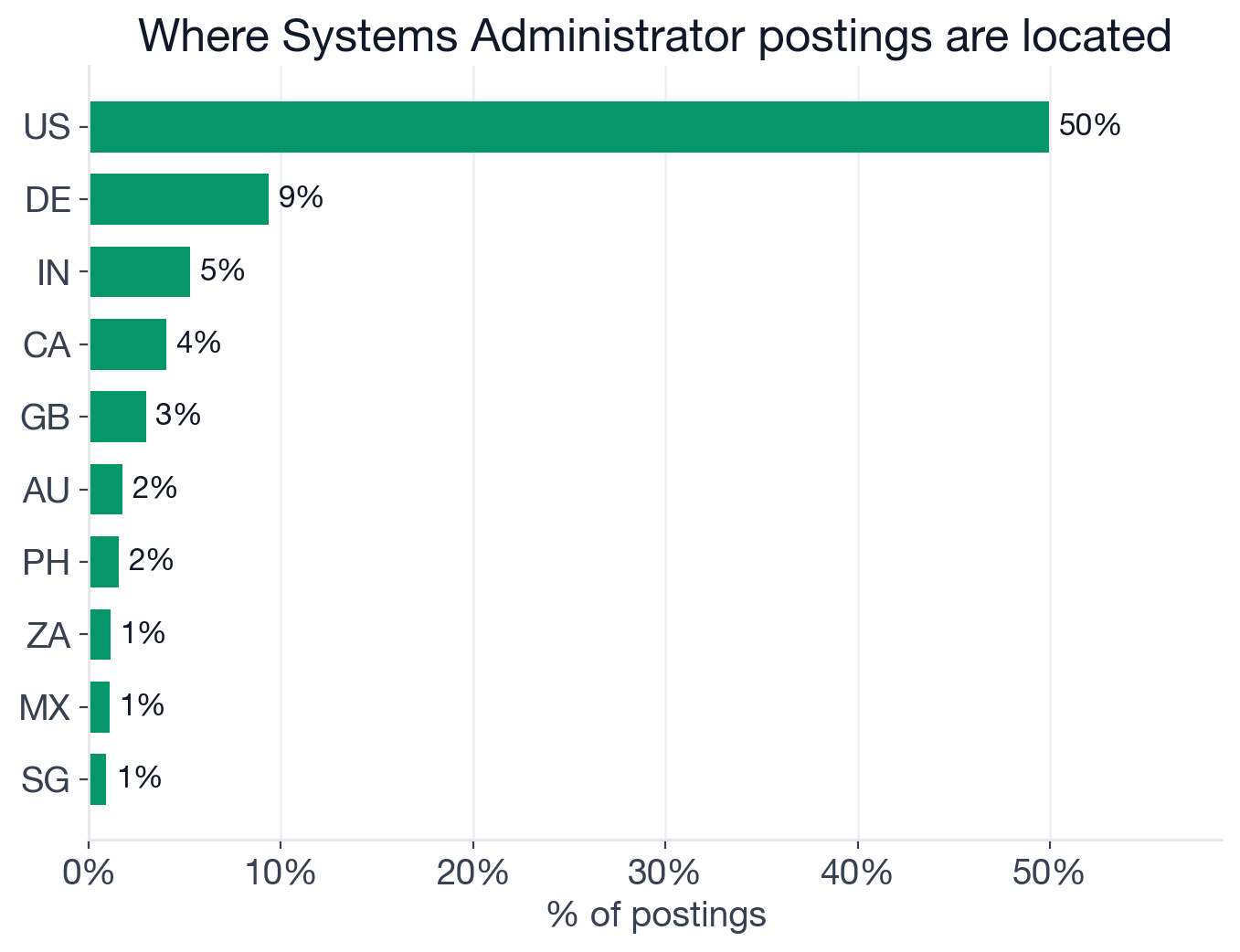
Top countries by share of Systems Administrator postings.
The United States accounts for just under half of all postings at 49.9% (2,191 of 4,387), making it by far the dominant single market. Germany is a distant second at 9.4%, reflecting the scale of corporate IT operations in Europe's largest economy. India is third at 5.3%, a much smaller share than in Data Engineer or Software Engineer hiring, which likely reflects that Systems Administrator roles in India are less often captured by the global job boards feeding this analysis. Canada (4%) and the UK (3%) round out the top five.
For US-focused candidates, the data is most directly applicable, since salary figures above are US-only and the employer roster below skews heavily toward US-based or US-contracted work. Browse US-based Systems Administrator openings for the most comparable set of listings.
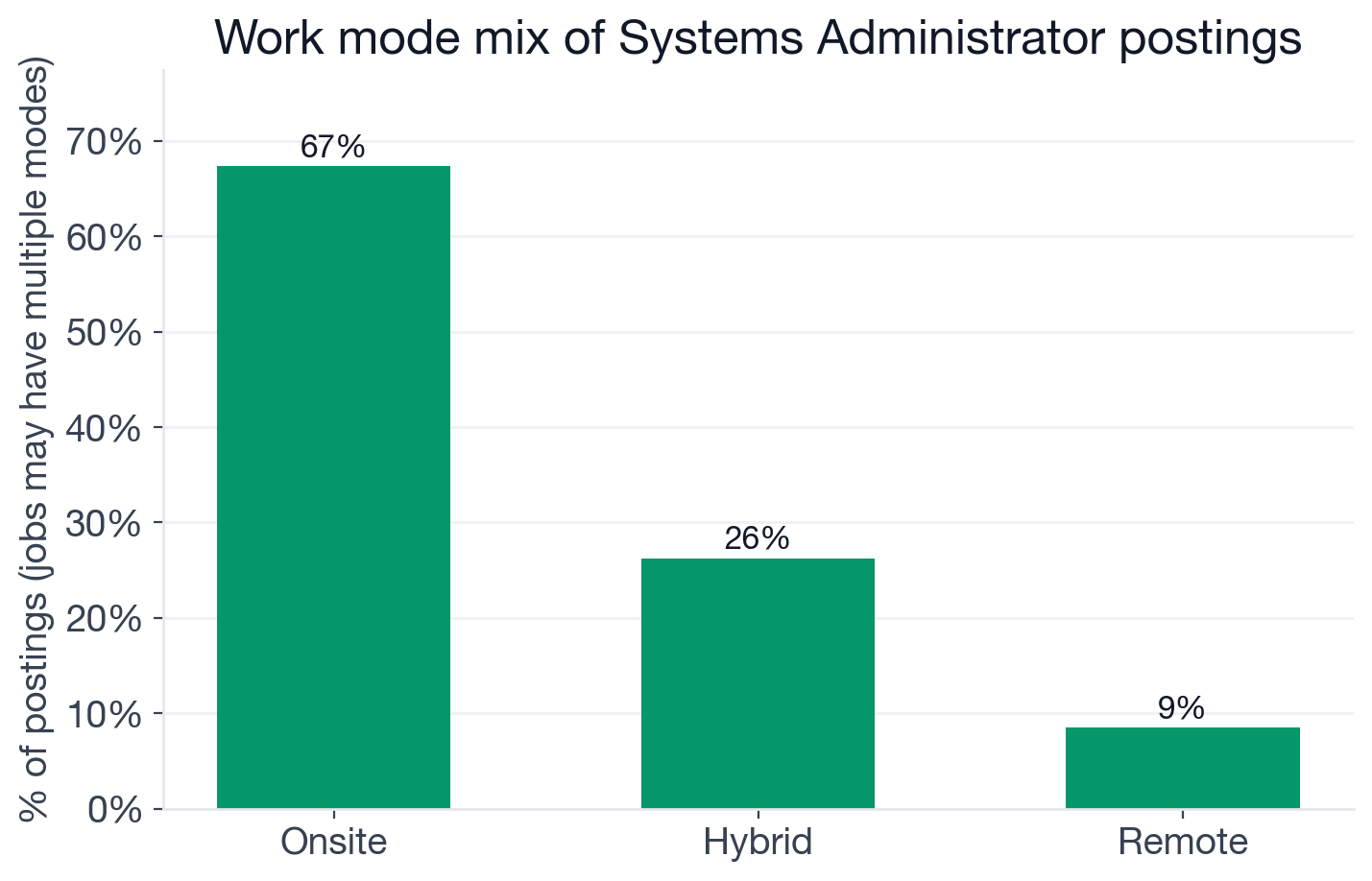
Share of Systems Administrator postings tagged with each work mode.
The remote picture is blunt: this is not a remote-friendly role. Only 8.5% of postings are fully remote (373 of 4,387), while 67.4% require on-site work. The physical nature of the job explains it. Server rooms, hardware replacements, network closet maintenance, tape backup handling, and data center operations cannot be done from a laptop at home. Even roles that are technically cloud-heavy still often require physical presence for hardware lifecycle management, security compliance, or facilities work. Hybrid is available in about 26% of postings, mostly at organizations that have migrated the majority of their estate to cloud and no longer need a body in the building five days a week.
Who's Hiring Systems Administrators in 2026?
Defense contractors and government IT services firms anchor the top of the market by a wide margin. Among employers with genuine distinct openings (excluding staffing agencies and recruiting firms from the count), the list is heavily weighted toward the public sector and defense:
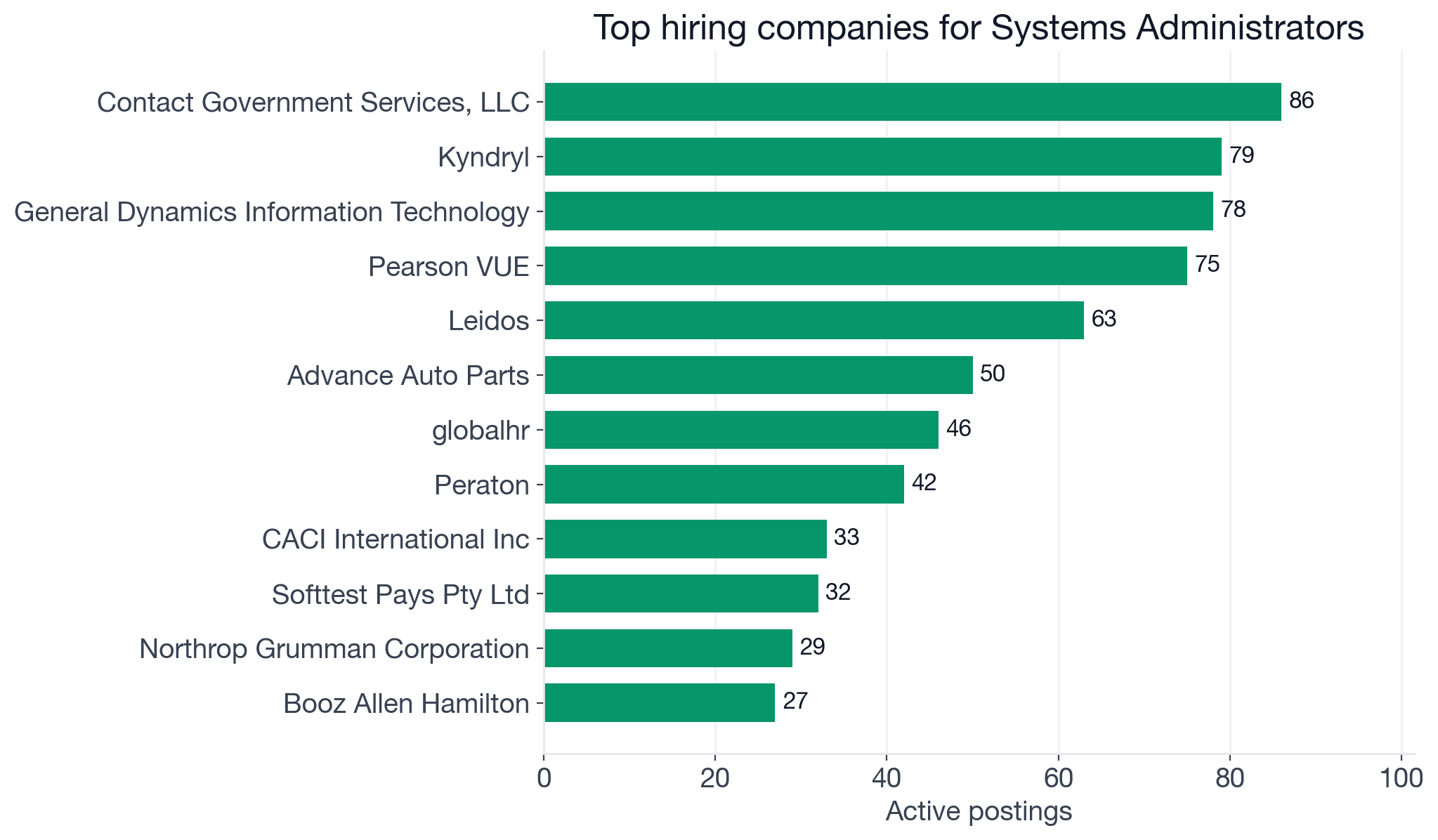
Top companies by active Systems Administrator postings. Staffing agencies and recruiting firms excluded.
| Company | Active postings | Sector |
|---|---|---|
| Contact Government Services | 86 | Government IT services |
| Kyndryl | 79 | IT services (IBM spinoff) |
| General Dynamics IT | 78 | Defense/government IT |
| Pearson VUE | 75 | Education/testing |
| Leidos | 63 | Defense/government IT |
| Advance Auto Parts | 50 | Retail |
| Peraton | 42 | Defense/government IT |
| CACI International | 33 | Defense/government IT |
| Northrop Grumman | 29 | Defense |
| Booz Allen Hamilton | 27 | Government consulting |
| IQVIA | 24 | Healthcare data/pharma |
| PricewaterhouseCoopers | 20 | Professional services |
Six of the top twelve employers are defense contractors or government IT firms. That concentration is a real feature of Systems Administrator hiring, not a data artifact. Government agencies, the military, and defense contractors run enormous Windows Server and Active Directory environments, typically on-premises, subject to strict compliance and security clearance requirements. These roles are stable and consistently staffed, which is why firms like General Dynamics IT, Leidos, Peraton, CACI, and Booz Allen Hamilton appear across multiple tech roles in this market.
Kyndryl (the IT infrastructure services company spun out of IBM) is the largest commercial employer on the list, reflecting the managed-services model: many enterprises outsource server and infrastructure operations rather than staffing them directly. Pearson VUE's presence likely reflects the certification testing infrastructure it operates across its global testing center network. Some postings in this dataset may include test-center administrator roles (exam proctors) rather than IT infrastructure positions, so its count may be a modest overestimate.
Outside defense and services, the roster spans retail (Advance Auto Parts), healthcare data (IQVIA), and professional services (PwC), pointing to demand across every sector that runs substantial on-premises or hybrid infrastructure.
How to Use This in Your Job Search
Know which track you are targeting. The salary data draws a clear line between the traditional Windows shop track (Active Directory, VMware, Windows Server, PowerShell) and the modern ops track (AWS, Linux, Ansible, Docker, Terraform, Python). The traditional track is higher-volume, more entry-accessible, and pays near the $107,500 baseline. The modern track is smaller, more competitive, and pays $20-28K more. Neither is wrong, but treating them as the same job when preparing for interviews or choosing certifications is a mistake.
Build toward automation if compensation is the priority. The Bash plus Python pairing (lift 4.87) is the clearest signal in the data: postings that ask for one almost always ask for the other. Adding Ansible alongside Linux or Terraform alongside AWS compounds the salary effect. Browse Systems Administrator openings that ask for Ansible to see what the modern ops track looks like in practice.
Drill the interview topics for your track. Windows-focused interviews tend to emphasize Active Directory structure, Group Policy management, domain architecture, and Windows Server administration. Linux and DevOps-adjacent interviews tend to go deeper on scripting, configuration management, infrastructure as code, and container orchestration. Our question bank covers both sides, including Linux administration, networking fundamentals, and cloud infrastructure topics. AI mock interviews let you practice system design and operational scenario questions under realistic conditions before you sit across from a hiring manager.
Factor in on-site requirements early. With 67% of postings requiring on-site presence, remote-first candidates will find this market genuinely constraining. The fully remote slice (8.5%) skews toward cloud-heavy shops; a strong AWS or Linux background opens more of that subset.
Use the job board filtered by skill to narrow your search. Browse Systems Administrator openings on the InterviewStack.io job board and combine filters to match your stack: Systems Administrator + Linux or Systems Administrator + AWS each surface a meaningfully different set of employers and salary ranges.
FAQ
Q. What skills do companies want for Systems Administrator roles in 2026?
No single skill appears in more than 38% of Systems Administrator postings, reflecting a fragmented market. The most common skills are Monitoring (38%), Windows (33%), Linux (33%), and Automation (30%). Azure is the most common cloud at 22%, AWS at 15%. The differentiator tier (5-20% of postings) includes PowerShell, Ansible, Python, Docker, Terraform, and Kubernetes. Cloud and DevOps-adjacent skills in that tier carry the largest salary premiums: Ansible, Docker, Terraform, and Kubernetes each add $20-24K above the $107,500 baseline in US postings, while PowerShell adds $2,500 and Python adds $12,500.
Q. What is the median salary for a Systems Administrator in 2026?
The median US base salary for Systems Administrator postings with disclosed compensation is $107,500 (n=1,211 postings as of June 2026). That figure covers base salary only; equity, bonuses, and sign-on are excluded. AWS-mentioning roles pay $135,000 at the median; Azure-mentioning roles pay $110,000, just $2,500 above the overall baseline.
Q. Which Systems Administrator skills pay the highest salary premium?
Cloud and DevOps-adjacent skills carry the largest premiums in US postings. AWS adds $27,500 above the $107,500 baseline ($135,000 median), Docker adds $24,400 ($131,900), Ansible adds $22,100 ($129,600), Terraform adds $20,800 ($128,300), and Kubernetes adds $20,000 ($127,500). By contrast, Windows ($109,100), Active Directory ($103,100), and Windows Server ($103,100) cluster at or below the role baseline.
Q. Is Systems Administrator a good role to break into in 2026?
It is not an easy entry point. Only 3.5% of Systems Administrator postings are explicitly entry-level (153 of 4,387), comparable to the tight entry gate in Data Engineer hiring. The overwhelming majority (76.5%) target mid-level candidates. IT helpdesk and junior IT support are the most common stepping-stone roles, with CompTIA A+, Microsoft certifications, or an entry-level AWS certification helping candidates clear initial filters without direct sysadmin experience.
Q. How remote-friendly is Systems Administrator work in 2026?
Systems Administrator is one of the least remote-friendly tech roles in the current market. Only 8.5% of postings offer fully remote work; 67.4% require on-site presence. The on-site requirement reflects the physical nature of the work: server rooms, hardware maintenance, network infrastructure, and data centers require direct access. Hybrid arrangements cover 26.3% of postings.
Q. Should a Systems Administrator prioritize AWS or Azure?
For job volume, Azure has the edge: it appears in 22% of postings vs 15% for AWS. For salary, AWS wins decisively in US postings: $135,000 median vs $110,000 for Azure-mentioning roles, a $25,000 gap. The AWS ecosystem correlates with Linux, Docker, Ansible, and Terraform roles, which all carry salary premiums of $20K or more. Azure roles more frequently involve Active Directory, Windows Server, and VMware, which cluster at or below the role baseline.
Q. Which companies hire the most Systems Administrators in 2026?
Defense contractors and government IT services firms dominate the top of the market: General Dynamics IT, Leidos, Peraton, CACI International, Northrop Grumman, and Booz Allen Hamilton are all among the top employers by active openings. IT services firms like Kyndryl anchor the commercial side. Outside government and defense, the market spans retail (Advance Auto Parts), healthcare data (IQVIA), and professional services (PricewaterhouseCoopers).
Where to Start
The Systems Administrator market in 2026 splits cleanly at the cloud. The Windows and VMware track is broader, more accessible, and concentrated in enterprise IT and government. The Linux and automation track is narrower, harder to enter, and pays $20-28K more. If you are already in a traditional admin role and wondering why your salary has plateaued, the skill pairs data points at the answer: the move from VMware-and-AD to Ansible-and-AWS is the same move other infrastructure professionals have been making for years, just reachable from a different starting point. Start with Linux fluency, add Bash and Python scripting, then layer in one automation or cloud credential before applying to the next tier of openings.
Topics
Ready to practice?
Put what you've learned into practice with AI mock interviews and structured preparation guides.