
The Language Is the Same. The Work Isn't.
Open a Backend Developer posting and a Frontend Developer posting side by side and you will find JavaScript, TypeScript, CI/CD, and Git in both. They read like cousins. But measure the skill overlap on the top-30 lists and you get a Jaccard coefficient of 0.30, meaning 3 in 10 skills transfer between the two roles. The other 7 point in entirely different directions: Backend points toward cloud infrastructure, distributed systems, and message queues; Frontend points toward browser rendering, design systems, and component frameworks. We looked at 6,358 Backend Developer and 5,542 Frontend Developer active postings on the InterviewStack.io job board as of June 2026 to map where the two paths converge and where they split.
Key Findings
- Backend Developer median US base salary is $169,000 (n=545 US postings with disclosed salary data); Frontend Developer is $129,300 (n=621), a $39,700 gap (30.7%). The FD median is a blended figure: retail store-associate postings (same concentration noted below) depress the aggregate; software-focused FD roles carry higher medians, e.g. TypeScript at $175,000.
- Jaccard skill overlap between the two roles is 30%, despite both using JavaScript and TypeScript as shared programming languages.
- Frontend Developer has a 23.3% entry-level share (1,290 of 5,542 postings) vs Backend Developer's 2.2% (141 of 6,358), roughly 10x more accessible for new developers.
- Backend is meaningfully more remote-friendly: 30% of Backend postings are tagged remote vs 19% for Frontend (63% of Frontend postings are onsite vs 48% for Backend).
- Backend-exclusive skills are infrastructure: Kubernetes (33%), Docker (31%), PostgreSQL (30%), microservices (28%), distributed systems (27%), Kafka (21%). Frontend-exclusive skills are browser-layer: React (42%), CSS (32%), HTML (24%).
- AI-building premiums appear in Backend postings: Generative AI ($195,000 median, n=29) and LLMs ($192,500, n=37) each carry a $23-26K premium over the $169K Backend baseline. No equivalent AI-building premium surfaces in Frontend postings.
- Backend has 6,358 active postings; Frontend has 5,542. Backend is slightly larger (1.15x) but skews far more senior.
| Backend Developer | Frontend Developer | |
|---|---|---|
| Median US base salary | $169,000 | $129,300 |
| Active postings | 6,358 | 5,542 |
| Most-demanded skill | AWS (42%) | JavaScript (43%) |
| Remote share | 30% | 19% |
| Entry-level share | 2.2% | 23.3% |
| Skill overlap (Jaccard) | 30% shared | n/a |
What Do Backend Developers and Frontend Developers Actually Build?
A Backend Developer builds the services that power an application from behind the scenes: API servers, microservices, relational databases, message queues, and the infrastructure those systems run on. Day-to-day work is writing service logic in Python, Java, or Go; designing schemas in PostgreSQL; deploying containers through Kubernetes; keeping distributed systems observable under production load. The primary stakeholders are other engineers, not end users.
A Frontend Developer builds what users see and interact with: the interface rendered in the browser. Day-to-day work is building components in React or Angular, writing TypeScript for event handling and state management, styling with CSS, wiring up APIs designed by someone else, and tuning performance for real users on real devices. The primary stakeholders include designers, product managers, and the end user.
The exclusive skill lists make the divide concrete. Backend exclusives: Kubernetes (33%), Docker (31%), PostgreSQL (30%), microservices (28%), distributed systems (27%), Kafka (a message-streaming platform, 21%). Frontend exclusives: React (42%), CSS (32%), HTML (24%), user experience (21%), Angular (18%). Same programming languages; entirely different things to build with them.
Where Do the Skill Sets Converge and Split?
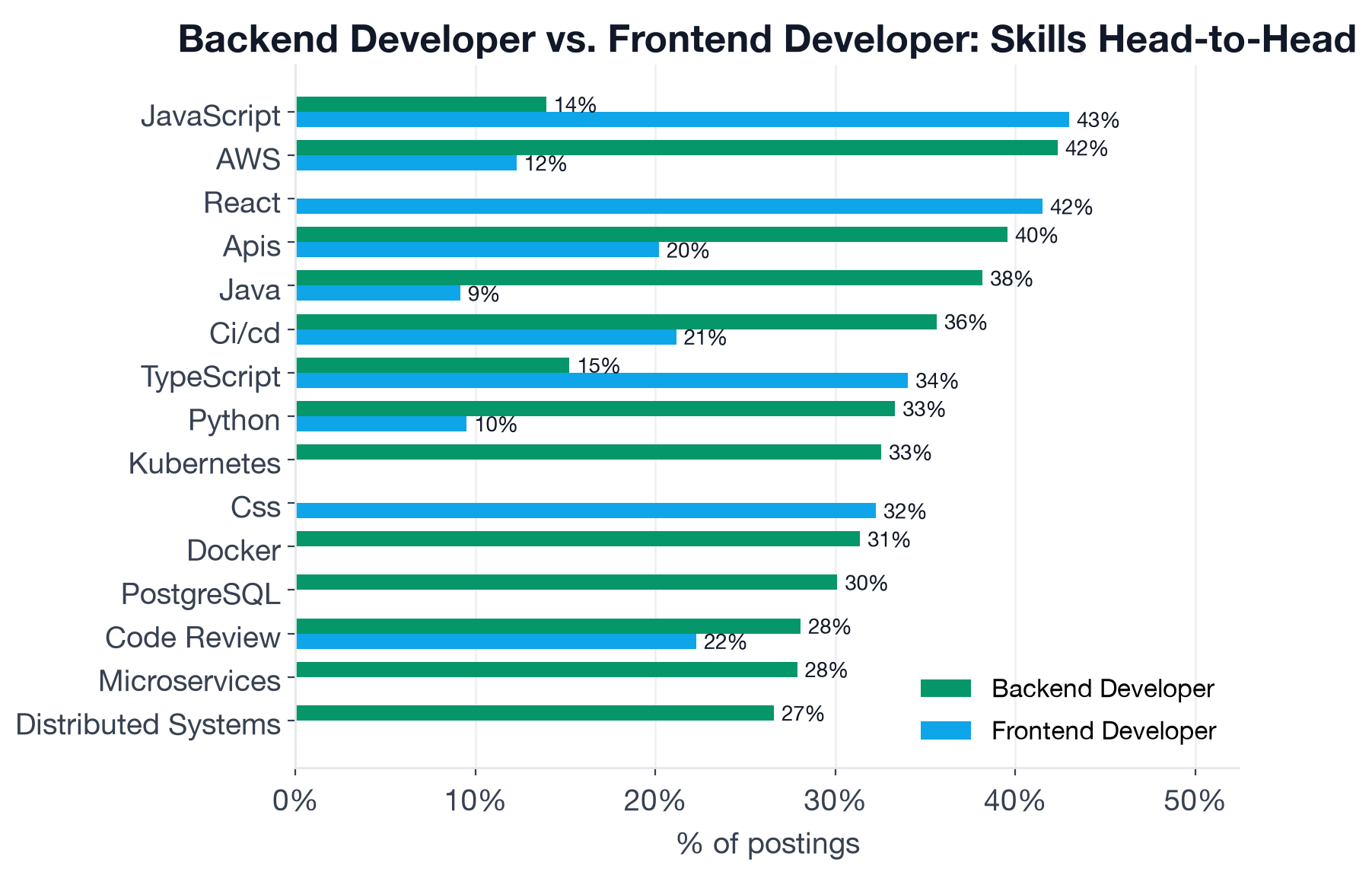
Grouped bar chart comparing Backend Developer (green) and Frontend Developer (blue) frequencies across shared and role-specific skills. Shared skills show different weights; exclusive skills show the structural divide.
Both roles share APIs (40% Backend / 20% Frontend), CI/CD (36% / 21%), Code Review (28% / 22%), Git, and Agile at broadly comparable rates. JavaScript (14% Backend / 43% Frontend) and TypeScript (15% / 34%) appear in both, but Frontend leans on them far more heavily. A backend engineer's JavaScript is mostly Node.js API logic; a frontend engineer's JavaScript is mostly component rendering, event handling, and state management.
AWS is the sharpest signal in the shared layer: 42% of Backend postings mention it, but only 12% of Frontend postings do. Backend engineers manage the cloud infrastructure that serves the APIs. Frontend engineers consume those APIs without needing to know how they are deployed.
The roles share a programming language foundation. They do not share a job description.
Which Pays More, and What Drives the Gap?
Among US postings (where wage-transparency laws produce consistent disclosure), the median Backend Developer base salary is $169,000 (n=545) and the median Frontend Developer base salary is $129,300 (n=621). These are base salaries only; equity, bonuses, RSUs, and sign-on are not captured in posting data, so total comp at top employers is higher for both roles.
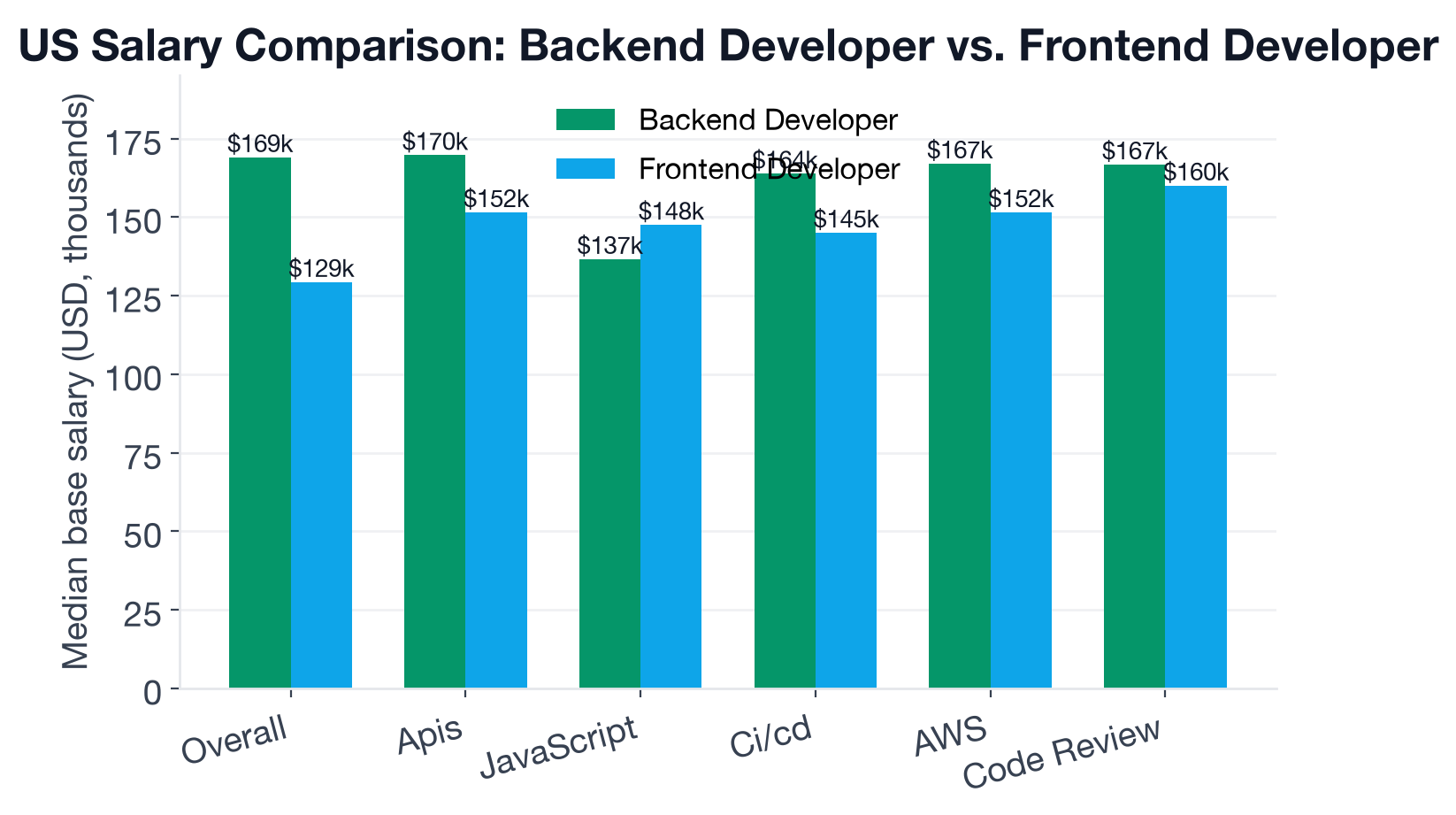
Median US base salary in USD for Backend Developer and Frontend Developer postings, overall and for selected shared skills. US postings only.
The $39,700 gap has three explanations. The first is the seniority mix: Backend's distribution is 97.8% mid-level or above, which mechanically lifts the median. The second is a tier of AI-building premiums that has no equivalent in Frontend posting data. Backend postings that mention Generative AI median at $195,000, a $26,000 premium over the $169K baseline. LLMs (large language models) median at $192,500, a $23,500 premium. These are engineering roles building AI-powered APIs, retrieval pipelines, and inference services, not roles using AI tools to write code faster.
The third is dataset composition. The same retail employer concentration that inflates Frontend's entry-level count also depresses its aggregate salary: approximately 29% of salary-disclosing Frontend postings list "Customer Service" as a required skill (median $39,500, n=181), reflecting store-associate compensation from grocery and retail chains, not software developer pay. Developers comparing the two roles should treat the $129,300 Frontend median as a blended figure. The software-developer slice of Frontend demand sits considerably higher, as the skill-specific medians confirm: TypeScript ($175,000, n=209), Design Systems ($175,000, n=93), Next.js ($175,000, n=57), and GraphQL ($176,300, n=44), each roughly $45–47K above the blended aggregate.
That ambient productivity layer applies to both roles. Industry surveys consistently show a large majority of developers now use AI tools regularly at work. Frontend engineers are often seen using Cursor and GitHub Copilot for component generation, while backend engineers tend toward multi-file coding assistants for repository-spanning work. The difference is what appears in job descriptions: Backend's AI-building skills get stated and priced; Frontend's AI tool use is assumed.
For Frontend developers, the skills that most move salary above the $129,300 baseline are architecture signals: TypeScript ($175,000, n=209), Design Systems ($175,000, n=93), Next.js ($175,000, n=57), and GraphQL ($176,300, n=44) each carry premiums of $45-47K. A senior Frontend engineer building at the architecture level can close much of the gap to Backend's median. Browse TypeScript-required Frontend openings to see what that tier looks like in the live market.
For Backend, the top salary drivers beyond the baseline are observability and distributed systems expertise: Distributed Systems ($185,500, n=189) and Observability ($185,500, n=141) add roughly $16,500 to the Backend median. Generative AI and LLMs sit above that. See AWS-required Backend openings for the highest-volume segment of the market.
Which Is Easier to Break Into?
Backend Developer's seniority distribution leaves almost no room for newcomers: mid-level 42.5%, senior 42.7%, staff 12.6%, entry-level just 2.2% (141 of 6,358 postings). Companies expect production API, database, or infrastructure experience before hiring. The full-stack to backend comparison covers how full-stack experience can serve as a stepping stone.
Frontend Developer is a different story. The entry-level share is 23.3% (1,290 of 5,542 postings), roughly 10x more accessible for career starters. It is worth noting that one large retail employer accounts for a significant concentration of Frontend Developer postings, which inflates the entry-level figure somewhat. Adjusting for that concentration, the realistic entry-level share is likely in the 15-18% range, still far above Backend's 2.2%. The DevOps vs Frontend comparison explored the same entry-level dynamic in a different pairing.
Remote access divides the two roles. Backend is 30% remote and 48% onsite. Frontend is 19% remote and 63% onsite. A developer who wants location flexibility will find more of it on the backend side. Frontend's onsite skew partly reflects its strong presence in retail and consumer-product companies, where co-location with design and product teams is standard practice. The United States makes up 40% of Frontend postings (vs 18% for Backend), which also concentrates many of those roles in cities with dense onsite cultures.
Which Should You Choose?
Choose Backend Developer if:
- Your work preference is building services that other developers consume: APIs, databases, microservices, and the infrastructure underneath them.
- You have production experience in any of Python, Java, Go, or Node.js with database or cloud work attached.
- Remote flexibility matters: 30% of Backend roles are fully remote vs 19% for Frontend.
- You are mid-career and ready to invest in the skills the 97.8% non-entry market expects: distributed systems, containerization, cloud platforms.
Choose Frontend Developer if:
- You want to build what users see and interact with: components, interfaces, responsive design, and browser performance.
- You are entering the field: 23% of Frontend Developer postings are entry-level vs 2% for Backend.
- You want to reach employability faster and build toward architecture-level skills (TypeScript, Next.js, Design Systems, GraphQL) that push compensation to $175K+.
- You prefer working closely with design and product teams on user-visible features.
How to Use This in Your Job Search
The InterviewStack.io job board lets you filter by role, skill, seniority, and work mode. Browse Backend Developer openings filtered by your cloud or language stack, or filter Frontend Developer openings by framework to see where demand concentrates in your target segment.
Before you apply, drilling the right topics matters more than breadth. The question bank covers system design, distributed systems, algorithms, and web-specific topics for both roles. AI mock interviews let you practice full technical rounds under realistic conditions with on-demand feedback. For foundational skill-building, interactive courses cover algorithms, system design, SQL, and web development across both tracks.
FAQ
Q. What is the salary difference between Backend Developer and Frontend Developer in 2026?
The median US base salary for Backend Developer is $169,000 (n=545 postings with disclosed salary data) vs $129,300 for Frontend Developer (n=621), a $39,700 gap. These are base salaries only; equity and bonuses are not reflected in posting data. Backend postings that mention Generative AI show a median of $195,000 and LLMs at $192,500, adding a $23-26K premium on top of the $169K role baseline. Note: the $129,300 FD median is a blended figure; roughly 29% of salary-disclosing FD postings belong to retail store-associate positions (the same employer concentration discussed in the entry-level section), which depresses the aggregate below what software-focused FD roles pay. Skill-specific medians for TypeScript, Design Systems, and Next.js each reach $175,000, and GraphQL reaches $176,300.
Q. Which role is easier to break into as a new developer in 2026?
Frontend Developer has a 23.3% entry-level share (1,290 of 5,542 active postings) versus 2.2% for Backend Developer (141 of 6,358). Career changers and new graduates are far more likely to find an entry-level role on the frontend side.
Q. What skills do Backend Developers and Frontend Developers share?
JavaScript, TypeScript, CI/CD, APIs, Code Review, Agile, and Git appear in both roles' active postings. The Jaccard similarity on their top-30 skill sets is 30%. JavaScript and TypeScript are shared but weighted differently: JavaScript is 43% for Frontend vs 14% for Backend; TypeScript is 34% for Frontend vs 15% for Backend.
Q. What is the biggest skill difference between Backend and Frontend Developers?
Backend Developers are expected to know infrastructure tools: Kubernetes (33%), Docker (31%), PostgreSQL (30%), microservices (28%), distributed systems (27%), Kafka (21%). Frontend Developers are expected to know browser-layer tools: React (42%), CSS (32%), HTML (24%), user experience (21%), Angular (18%). The roles share a language foundation but build entirely different things with it.
Q. Which role has more remote job opportunities in 2026?
Backend Developer is more remote-friendly: 30% of Backend postings are tagged remote, versus 19% for Frontend Developer, with Backend showing 48% onsite vs 63% for Frontend. Backend's remote advantage reflects its server-side nature; Frontend's onsite skew reflects its concentration in retail and consumer-facing industries.
Q. Which role has more active job postings in 2026?
Backend Developer has 6,358 active postings vs Frontend Developer's 5,542, a 1.15x ratio. Backend postings skew heavily toward mid-level and senior (97.8% non-entry), while Frontend includes a 23.3% entry-level tier.
Which Path to Build From
Backend Developer and Frontend Developer are complementary halves of the same application stack. The $39,700 salary gap is real, but it reflects the seniority distribution and an emerging AI-building premium in backend work, not a verdict on which path is more valuable. Frontend is where most web development careers start; backend is where many advance. The skills that move salary on each side reward depth over breadth: architecture-level TypeScript and Design Systems on the frontend, distributed systems and observability tooling on the backend. Pick the work you actually want to do. Browse Backend Developer and Frontend Developer openings to see what the market is actively hiring in your target stack.
Topics
Ready to practice?
Put what you've learned into practice with AI mock interviews and structured preparation guides.