
The Stack That Doesn't Pay for Itself
Full-Stack Developer is, by definition, the role that covers more ground: frontend, backend, databases, APIs, sometimes infrastructure. The intuition is that doing more should earn more. The data says otherwise.
Backend Developer earns a median $170,000 US base salary vs. $142,000 for Full-Stack, a $28,000 gap on a nearly identical pool of open jobs. We looked at every active posting on the InterviewStack.io job board as of June 2026, 6,491 Full-Stack Developer postings and 6,346 Backend Developer postings, with skills and salary extracted from descriptions. The two role markets are operating at different seniority levels: Backend Developer postings are 54% senior or staff, while Full-Stack sits at 38%. Same hiring volume, very different depth expectations.
Key Findings
- Full-Stack Developer has 6,491 active postings; Backend Developer has 6,346, a 1.02x volume ratio (essentially equal).
- Backend Developer earns a median $170,000 US base salary vs. $142,000 for Full-Stack Developer, a $28,000 (20%) gap.
- The two roles share a 58% Jaccard overlap: AWS, APIs, CI/CD, Java, Python, and Docker appear in both.
- Backend Developer is 54% senior/staff level vs. Full-Stack at 38%, the single biggest driver of the salary gap.
- React (51%) and TypeScript (43%) define Full-Stack; Distributed Systems (26%) and Kafka (21%) define Backend.
- LLM skills are the top AI/LLM salary signal in both roles: $183,800 for Full-Stack (+29% over baseline) and $201,300 for Backend (+18%); Rust tops Backend's full list at $203,300 (n=39).
- Work mode is nearly identical: roughly 28-30% remote, 25-27% hybrid, 49-51% onsite for both.
- Entry-level is thin in both: 2.6% Full-Stack, 2.3% Backend.
| Full-Stack Developer | Backend Developer | |
|---|---|---|
| Median US base salary | $142,000 | $170,000 |
| Active postings | 6,491 | 6,346 |
| Senior + Staff share | 38% | 54% |
| Remote share | 28% | 30% |
| Entry-level share | 2.6% | 2.3% |
| Skill overlap (Jaccard) | 58% shared | (see Full-Stack column) |
What Does Each Role Actually Do?
Full-Stack Developers own the entire web product surface: from the component a user clicks (React, Angular) through the API layer it calls (Node.js, Express) to the database that stores the result. A typical week involves building features that touch all three layers in a single pull request, working closely with product and design. They bridge the visible and invisible parts of the product, often shipping roadmap items faster than a team with strict front/back specialization.
Backend Developers own what users never see but always depend on: distributed services, data pipelines, API contracts, and infrastructure that handle load, reliability, and scale under production traffic. A typical week involves schema design, query optimization, service-to-service communication (Kafka, gRPC), and capacity planning. The output typically goes to frontend or mobile teams who render what the backend computes. The job is less about shipping features and more about ensuring those features survive contact with production.
What Skills Do Both Roles Share?
Both roles converge heavily on cloud infrastructure, APIs, and delivery practices. The top five shared skills appear in over 30% of both roles' postings:
- AWS: 39% (Full-Stack) and 42% (Backend)
- APIs: 36% and 40%
- CI/CD: 38% and 35%
- Java: 33% and 38%
- Python: 31% and 33%
Docker (29% and 31%), SQL (31% and 26%), and Code Review (30% and 28%) round out the shared backbone.
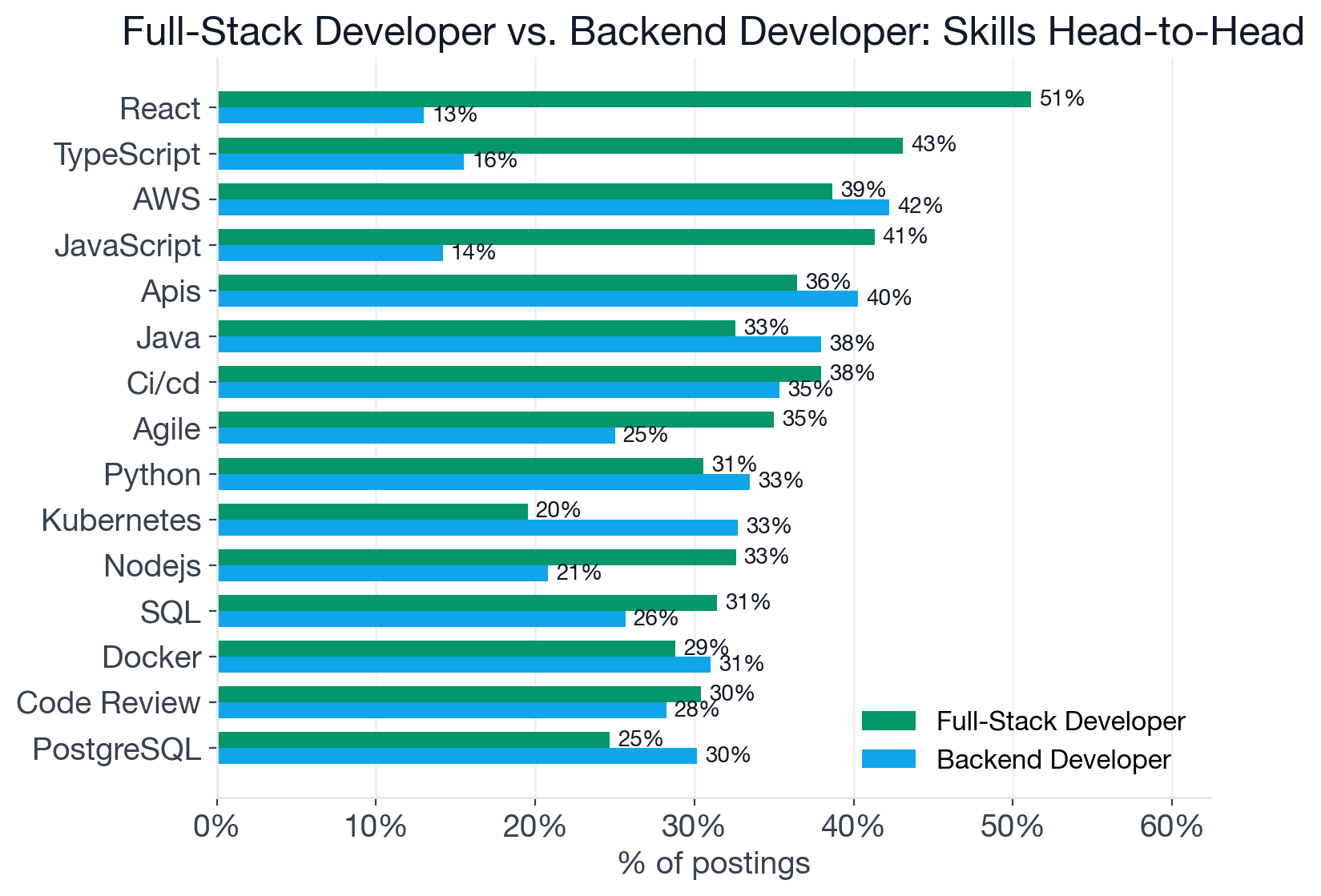
Top skills for Full-Stack Developer (emerald) and Backend Developer (blue), sorted by combined frequency.
The practical implication: with 58% skill overlap, roughly 3 in 5 skills transfer directly if you switch between these roles. Cloud, APIs, and delivery practices are industry infrastructure at this point, not differentiators.
TypeScript sits in the shared list but tells an asymmetric story: 43% of Full-Stack postings list it vs. 16% of Backend postings. Full-Stack treats TypeScript as near-table-stakes; Backend treats it as optional. This aligns with the GitHub Octoverse 2025 finding that TypeScript overtook Python and JavaScript as the most-used language on GitHub, growth driven by full-stack tooling where types make AI code generation safer and more reviewable.
Where the Two Roles Diverge
The exclusive skills reveal what each role actually spends its time on.
Full-Stack exclusives split between browser-side and Microsoft-stack skills: Angular (28% of Full-Stack postings), CSS (18%), C# (16%), HTML (16%), and User Experience (15%). Angular, CSS, and HTML signal that you will work in the browser and collaborate closely with design. C# (16%) reflects the .NET full-stack ecosystem, where a single developer owns both ASP.NET APIs and frontend layers. Angular remains the starkest signal: it appears in more than 1 in 4 Full-Stack postings and is nearly absent from Backend listings.
Backend exclusives cluster at the reliability and systems layer: Distributed Systems (26%), Kafka (21%, the open-source event streaming platform for async service communication between microservices), Observability (20%), NoSQL (16%), and Spring (15%). Distributed Systems alone appears in more than 1 in 4 Backend postings. These signal that you will own systems that cannot fall over, and you will understand why they might.
Browse Backend Developer roles requiring Distributed Systems or Full-Stack Developer roles requiring React to see what the divergence looks like in actual job listings.
The hiring signal is clean: Full-Stack employers ask "can you own the product experience?" Backend employers ask "can you own the system under that experience?"
Which Pays More: Full-Stack or Backend Developer?
All figures below are US base salary only. Equity, bonuses, and sign-on are not disclosed in job postings, so total compensation at top employers runs meaningfully higher than these numbers.
Backend Developer earns $28,000 more at the median ($170,000 vs. $142,000 across 546 and 827 US postings with salary disclosed). The gap is not structural to the work itself; it reflects the seniority concentration. A Backend Developer hiring market that is 54% senior/staff pulls the median up. If you normalized for seniority, the gap would narrow.
Both roles share the same top AI/LLM pay signal: LLM skills push Full-Stack median to $183,800 (+$41,800, a 29% premium) and Backend median to $201,300 (+$31,300, 18%). Rust edges LLM as Backend's single top-earning skill overall at $203,300 (+$33,300), a signal that low-level systems depth commands its own distinct premium. The relative boost from LLM skills is larger for Full-Stack, but Backend's higher floor means the absolute ceiling is higher regardless.
Beyond AI, the pay drivers follow the nature of the work:
| Skill | Role | Median US Salary | Premium Over Baseline |
|---|---|---|---|
| Rust | Backend | $203,300 | +$33,300 |
| Distributed Systems | Backend | $189,000 | +$19,000 |
| Observability | Backend | $187,500 | +$17,500 |
| Go | Backend | $180,300 | +$10,300 |
| Observability | Full-Stack | $172,500 | +$30,500 |
| Distributed Systems | Full-Stack | $172,400 | +$30,400 |
| Next.js | Full-Stack | $166,300 | +$24,300 |
| Kafka | Full-Stack | $161,000 | +$19,000 |
The pattern: Full-Stack earns its biggest relative premiums when it reaches into systems depth (Observability, Distributed Systems, Kafka). The skills that pay the most for Full-Stack are the ones that push it into Backend territory.
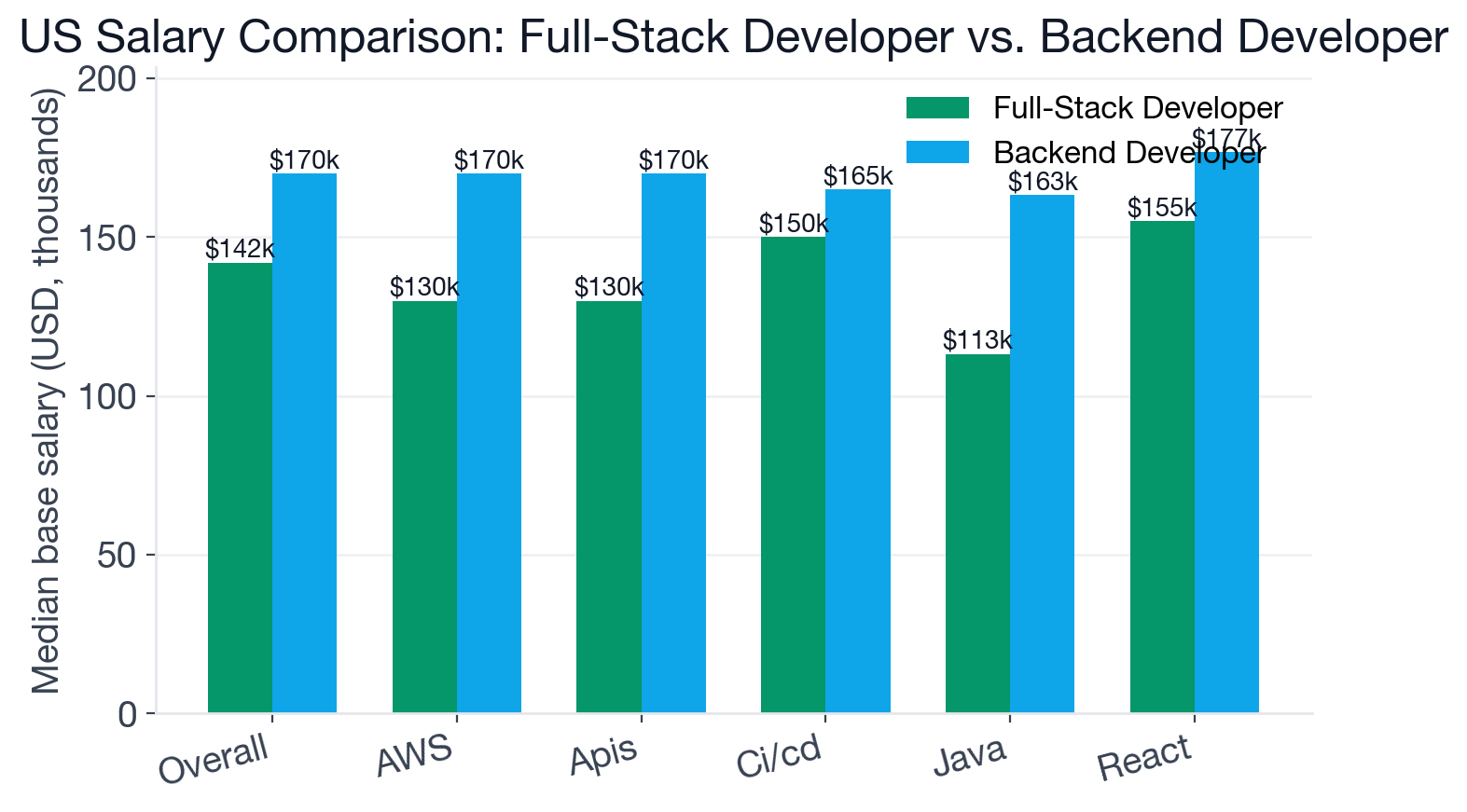
Median US base salary for each role overall and for selected shared skills. Equity and bonus not included.
Which Has More Jobs, and How Hard Is It to Break In?
Volume is virtually identical: 6,491 Full-Stack vs. 6,346 Backend active postings. Neither role dominates the market.
Entry is thin for both. Just 2.6% of Full-Stack postings and 2.3% of Backend postings are explicitly entry-level. Both roles expect you to arrive with production experience.
The difference shows up in mid-to-senior distribution. Full-Stack is 59% mid-level, 30% senior, 8% staff. Backend is 43% mid-level, 41% senior, 13% staff. Full-Stack keeps more headcount at mid-level; Backend concentrates at the senior end. For career progression, that means Backend's ceiling is more visible in the job market, but Full-Stack offers a wider mid-level band to land in first.
Geography: Full-Stack has proportionally more US postings (25% of total) vs. Backend (18%). Backend's global spread includes stronger EU presence: Poland (3.2%) and Portugal (2.2%) rank higher in the Backend country mix than in Full-Stack. Germany, by contrast, is proportionally stronger in Full-Stack (5.9% vs. 4.3% for Backend). For US-focused job seekers, Full-Stack offers a larger domestic pool. For those open to Polish or Portuguese markets, Backend opens more doors.
Work mode is nearly identical for both: roughly 28-30% remote and 25-27% hybrid. Remote share is not a meaningful differentiator between these titles.
Which Should You Choose?
Choose Full-Stack Developer if you:
- Want to ship visible product features end-to-end, from UI to API to database in a single role
- Prefer variety over narrow specialization: a typical week touches React, Node.js, and SQL
- Are targeting US-based companies specifically (proportionally more US postings at 25% vs. 18%)
- Want the largest relative salary bump from AI skills (+29% with LLM skills vs. +18% for Backend)
- Are at mid-level and want a wider hiring band (59% of Full-Stack postings are mid-level)
Choose Backend Developer if you:
- Want to specialize in systems reliability, distributed architecture, and scale
- Are investing toward senior or staff depth (54% of Backend postings are senior or staff level)
- Are comfortable building your stack around Java, Distributed Systems, Kafka, and observability tooling
- Want the higher salary floor ($170,000 vs. $142,000) and can commit to the depth that earns it
- Are open to international markets, including strong Backend hiring in Poland and Portugal
Use the AI mock interview tool to practice the system design and coding questions specific to your target role before you apply. The question bank has dedicated tracks for Backend systems topics and Full-Stack interview rounds; our interactive courses cover the foundations for each if you need to close skill gaps first.
FAQ
Q. What is the salary difference between Full-Stack Developer and Backend Developer in 2026?
Backend Developers earn a median $170,000 US base salary vs. $142,000 for Full-Stack Developers, a $28,000 (20%) gap on nearly equal job volume (6,346 vs. 6,491 active postings). The gap reflects Backend's stronger senior/staff concentration: 54% of Backend Developer postings are senior or staff level vs. 38% for Full-Stack.
Q. How much skill overlap is there between Full-Stack and Backend Developers?
The two roles share a 58% Jaccard overlap on their top-30 skill sets. Core shared skills include AWS (39% Full-Stack, 42% Backend), APIs (36%, 40%), CI/CD (38%, 35%), Java (33%, 38%), Python (31%, 33%), and Docker (29%, 31%).
Q. Which role is easier to break into at the entry level?
Both roles are similarly thin at entry level: 2.6% of Full-Stack Developer postings are entry-level vs. 2.3% for Backend Developer. Neither role is a strong entry pathway. Backend skews more senior overall (54% senior/staff vs. 38%), making it harder to enter than Full-Stack Developer on average.
Q. What exclusive skills distinguish Backend Developers from Full-Stack Developers?
Backend Developers exclusively demand Distributed Systems (26% of postings), Kafka (21%), Observability (20%), NoSQL (16%), Spring (15%), and Redis (13%). Full-Stack Developers exclusively demand Angular (28%), CSS (18%), C# (16%), HTML (16%), and User Experience skills (15%). Full-Stack's top browser-side exclusives are Angular, CSS, and HTML; C# (16%) reflects the .NET full-stack ecosystem. Backend's exclusives are reliability and scale tools.
Q. Do Full-Stack and Backend Developers use AI tools at similar rates?
Job postings for both roles rarely list AI tools in their top required skills, but developer surveys show near-universal ambient use of AI coding tools. Both roles treat tools like GitHub Copilot and Claude Code as baseline expectations, not differentiators.
Q. Which role has more remote work options?
The two roles are nearly identical on work mode: Backend Developer is 30% remote and 27% hybrid vs. Full-Stack Developer at 28% remote and 25% hybrid. Onsite is the plurality for both. If remote work is a decision factor, role does not meaningfully differentiate here.
Where to Focus Your Stack
The $28,000 salary gap between these roles is real, but it is the product of a seniority difference, not evidence that one role is categorically better work. Backend's higher median reflects a hiring market concentrated at the senior end; Full-Stack's lower median reflects a wider mid-level band. For most developers, the choice comes down to a single question: do you want to own the product surface your users interact with, or the systems that keep it alive under load?
Browse live Full-Stack Developer openings or Backend Developer openings on InterviewStack.io to see what's hiring in your target market right now. If you're still mapping your options, the Full-Stack vs. Software Engineer comparison and the Full-Stack vs. DevOps breakdown cover adjacent decision points worth reading together.
Topics
Ready to practice?
Put what you've learned into practice with AI mock interviews and structured preparation guides.