
2.37x the Postings. The Same 2% Chance at Entry.
Backend Developer postings outnumber Mobile Developer postings 2.37 to 1 on the InterviewStack.io job board right now, 6,813 active listings versus 2,877, filtered to roles that pass our quality gate. The natural assumption is that the bigger market is also the easier one to break into. It isn't. Entry-level share for both roles sits at almost exactly the same sliver: 2.1% for Backend Developer, 2.2% for Mobile Developer. More postings does not mean more doors at the bottom; it mostly means more doors higher up the ladder.
That's the real story here, not the modest 6.67% pay gap between the two. Backend Developer skews meaningfully more senior (52.1% of postings are senior or staff level, versus 37.4% for Mobile Developer), while Mobile Developer is the more mid-level-heavy title (60.4% of its postings). If you're comparing these two roles as a next step, the honest question isn't "which pays more" or "which has more jobs." It's "which one is actually hiring at your level."
| Backend Developer | Mobile Developer | |
|---|---|---|
| Active postings | 6,813 | 2,877 |
| Median US base salary | $164,700 | $154,400 |
| Top skill | Java (39.3%) | Android (60.7%) |
| Entry-level share | 2.1% | 2.2% |
| Senior + staff share | 52.1% | 37.4% |
| Skill overlap (Jaccard) | 25% shared (pairwise) | 25% shared (pairwise) |
Key Findings
- Backend Developer postings outnumber Mobile Developer postings 2.37x (6,813 vs. 2,877).
- Entry-level share is nearly identical: 2.1% Backend Developer vs. 2.2% Mobile Developer.
- Backend Developer's median US base salary is $164,700, a $10,300 (6.67%) premium over Mobile Developer's $154,400.
- 52.1% of Backend Developer postings are senior or staff level, versus 37.4% for Mobile Developer.
- Skill overlap (Jaccard, top-30 sets) is 25%; the shared core is generic engineering practice (Java, CI/CD, Code Review, APIs), not platform tooling.
- Android (60.7%) and iOS (57.1%) alone define most of the Mobile Developer skill set; no single Backend Developer skill clears 40%.
- Neither role's top-30 skill list carries an explicit AI or ML skill, but developer surveys put overall AI-tool adoption at 84-85% (Stack Overflow 2025), and rare Generative AI mentions add a $32,800 premium to Backend Developer pay ($29,500 for LLM mentions).
A Day in Backend Looks Nothing Like a Day in Mobile
A Backend Developer's week is mostly about systems that other systems depend on: designing APIs, keeping services up under load, and making sure a database schema change doesn't take down three other teams' code at 2 a.m. The output is usually invisible to end users but load-bearing for the whole product, uptime, latency, data consistency. That's why AWS, Kubernetes, and distributed-systems concepts show up so heavily here, they're the tools of keeping something running at scale, not building a single feature.
A Mobile Developer's week is closer to the user. Ship a screen, fix a rendering glitch on one device model, get a release through app-store review, watch crash analytics after launch. The audience is a person tapping a phone, not another service calling an API, so accessibility, UX polish, and platform-specific quirks (a UI pattern that behaves differently on Android 12 versus 14) matter more than distributed-systems theory. That difference in audience is why the two skill sets diverge so sharply once you look past the shared engineering basics.
Which Skills Do Both Roles Actually Share?
Both roles lean on the same generalist engineering habits: Java shows up in 39.3% of Backend Developer postings and 22.5% of Mobile Developer postings, CI/CD in 33.7% and 28.0%, Code Review in 26.4% and 32.9%, and APIs in 36.8% and 22.6%. Agile process (26.0% / 24.7%) and Git (17.7% / 27.4%) round out the overlap.
None of that is platform-specific. It's the baseline competence every engineering job expects: version control, code review discipline, some exposure to Agile delivery, and comfort working with or designing an API contract. If you already have this foundation, moving between the two roles means relearning the platform, not relearning how to be an engineer. TypeScript (13.9% / 22.8%) and JavaScript (14.6% / 19.0%) also show up on both sides, reflecting how much cross-platform mobile tooling (React Native) and backend-for-frontend work now share a language.
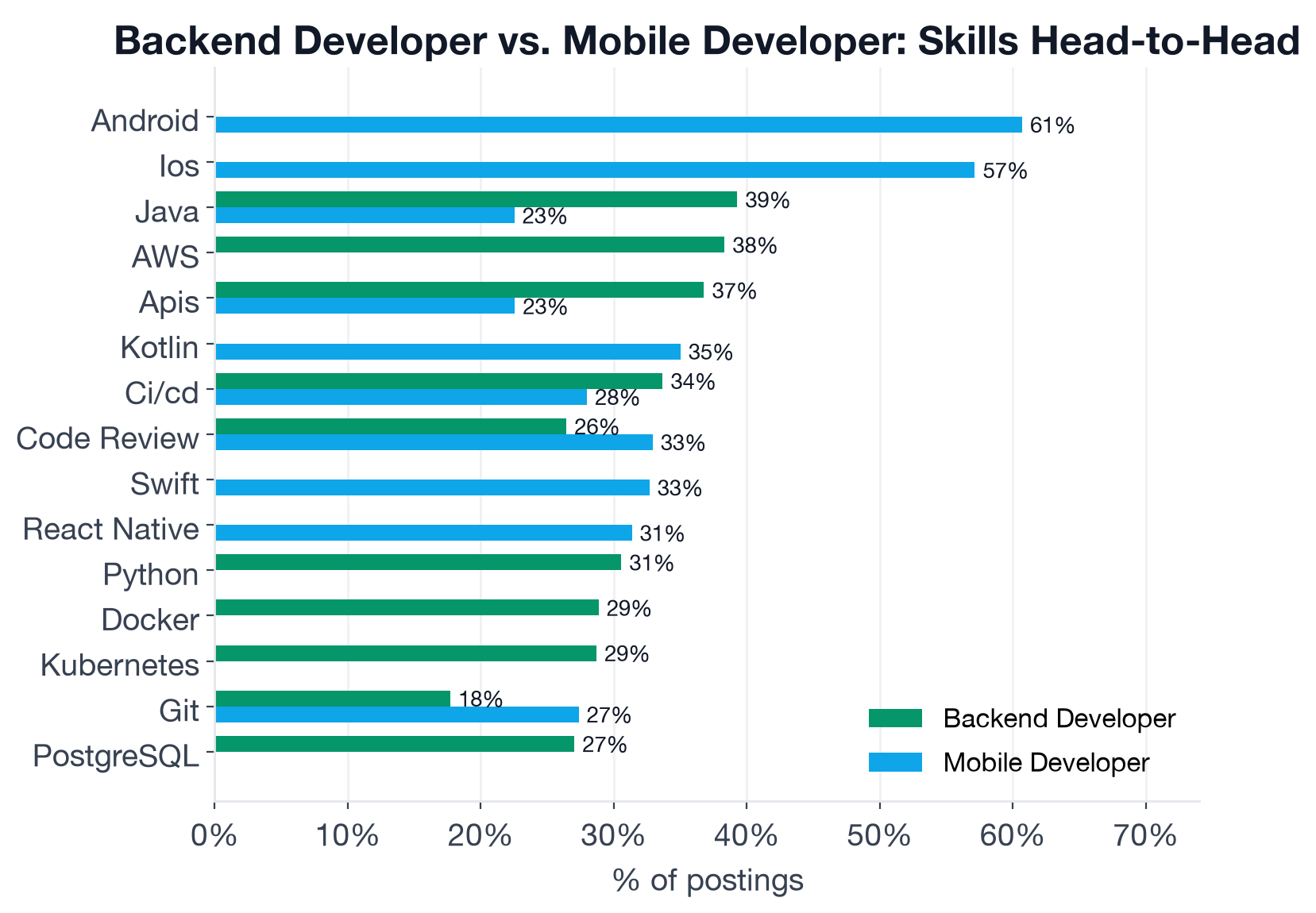 The shared skills cluster around generalist engineering practice; everything past that splits by platform.
Where the Two Skill Stacks Split
Backend Developer's differentiators are almost entirely infrastructure: AWS (38.3%), Python (30.6%), Docker (28.9%), Kubernetes (28.7%), PostgreSQL (27.0%), Microservices (27.0%), SQL (26.6%), Distributed Systems (24.2%), and Kafka (20.4%). This is a scale-and-reliability skill set, the tools for keeping a system alive under load rather than shipping a single feature.
Mobile Developer's differentiators are the platforms themselves: Android (60.7%) and iOS (57.1%) alone define the bulk of the role, with Kotlin (35.0%), Swift (32.7%), and React Native (31.4%) close behind. No Backend Developer skill comes close to that level of concentration, the highest is AWS at 38.3%. That's a real structural difference: Backend Developer work is broad (many possible valid stacks), while Mobile Developer work is narrow and often binary (you're building for one platform, or maintaining a cross-platform layer over both).
Neither role's top-30 skill list contains an explicit AI or ML skill, which on its face suggests AI has barely touched either job. That's misleading. Developer surveys (Stack Overflow's 2025 survey, GitHub Octoverse, JetBrains) consistently put overall AI-tool adoption at 84-85% of developers, with roughly half using an assistant daily. What the postings can't see is which tools people reach for: industry surveys report mobile developers spreading across a notably fragmented set of assistants (no single tool clearing 30% of usage), while developers doing heavier multi-file backend work reportedly consolidate more around agentic coding tools. Treat the specific percentages as directional (they come from a secondary industry aggregator, not a primary survey broken out by job title), but the shape holds: both jobs assume AI-assisted coding now; they just reach for different tools because backend refactors touch more files than a mobile UI tweak does.
Which Role Pays More?
Backend Developer, by $10,300 (6.67%) at the median: $164,700 versus $154,400 in US postings. These are base salaries only, equity, bonus, and sign-on aren't disclosed in postings, so total comp at top employers runs higher than either number.
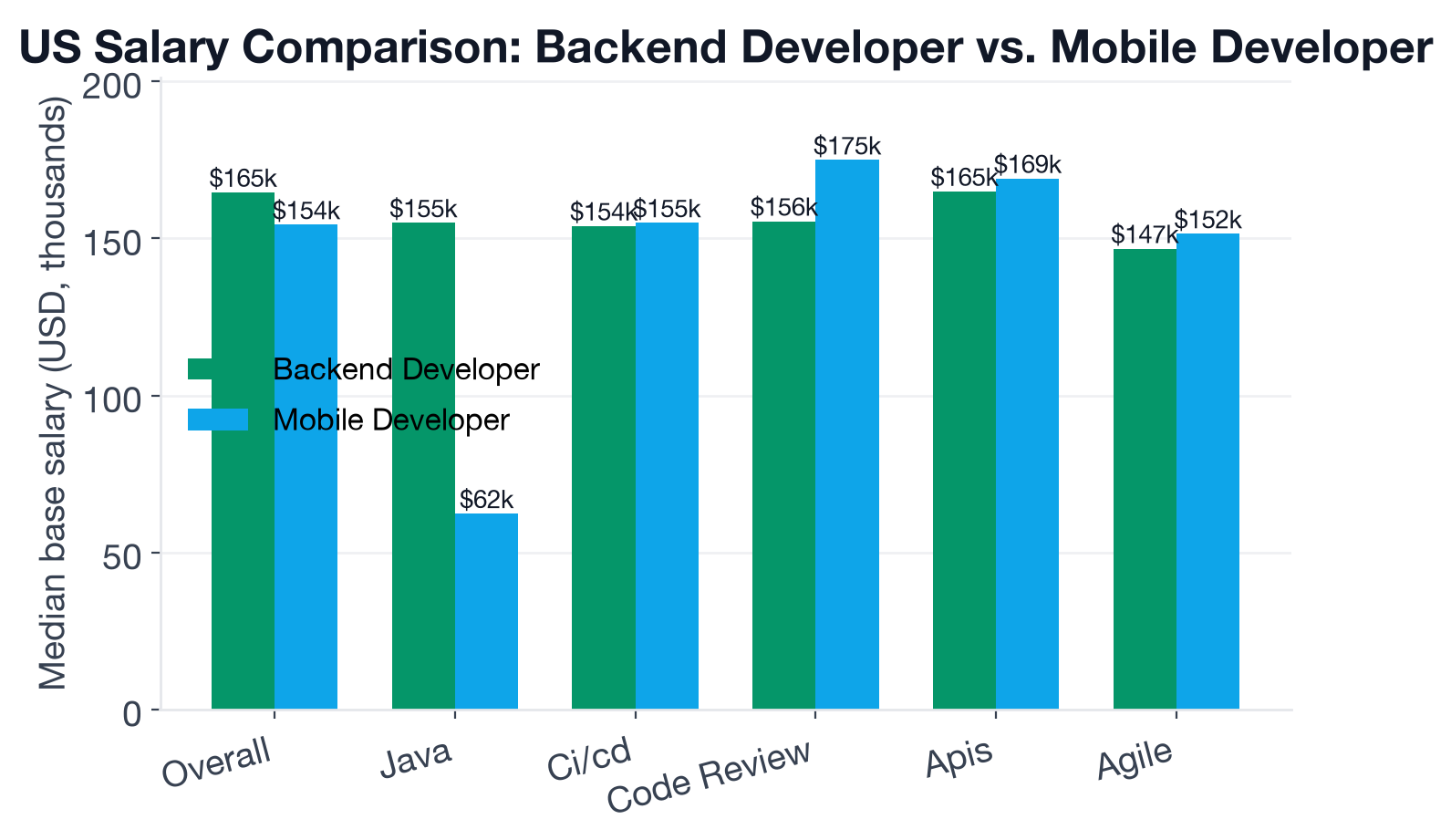 The overall gap is modest; the wider spreads show up skill by skill, not role by role.
That gap is smaller than it looks once you check where the money actually goes. In both roles, the skill that defines the job title pays at or below that role's own baseline. Backend Developer's own core skills sit close to flat or negative: SQL (-$22,300), CI/CD (-$10,700), Java (-$9,700), Kafka (-$5,200), Docker (-$700). Mobile Developer's platform staples do the same: Kotlin (-$12,100), iOS (-$4,400), Android (-$3,700), Swift (-$2,100).
The real premiums sit one layer up, in specialization rather than the core stack:
| Backend Developer premium skill | Premium over $164,700 baseline | Sample size |
|---|---|---|
| Generative AI | +$32,800 | 40 |
| LLMs | +$29,500 | 40 |
| User Experience | +$26,100 | 44 |
| Prometheus | +$24,900 | 25 |
| Grafana | +$21,700 | 30 |
| System Design | +$20,800 | 71 |
| Mobile Developer premium skill | Premium over $154,400 baseline | Sample size |
|---|---|---|
| Observability | +$45,600 | 33 |
| Prototyping | +$45,600 | 25 |
| Jetpack Compose | +$40,600 | 57 |
| Concurrency | +$35,600 | 29 |
| User Experience | +$30,600 | 74 |
| A/B Testing | +$30,600 | 25 |
Notably, User Experience is a premium skill in both roles. It's a common, expected skill in Mobile Developer postings (22.9% frequency) and a rarer but still lucrative one in Backend Developer postings, where it doesn't even crack the top 30 by frequency but pays $26,100 above baseline when it's explicitly asked for. A handful of Mobile Developer skills that report the exact same salary figure ($62,400 across Java, RESTful APIs, Performance Optimization, Excel, SQLite, Git, and API Integration) look like a data artifact from a shared low-pay posting cluster rather than a genuine per-skill signal, and were excluded from the table above; the same goes for MVVM and Android Development, which report an identical sample size (n=108) at implausibly low medians. The LLMs figure above is also worth a caveat: the dataset tracks "LLMs" (plural, n=40) separately from a near-duplicate "Llms" entry (n=41, $185,000 median), a $9,200 split that's almost certainly a singular/plural normalization artifact rather than two distinct skills, so treat the exact premium as directional rather than precise.
Which Market Is Easier to Break Into?
Neither, if you're measuring by entry-level share alone: 2.1% for Backend Developer versus 2.2% for Mobile Developer, a difference too small to act on. Backend Developer's 2.37x volume advantage (6,813 vs. 2,877 postings) means more absolute openings at every level, but proportionally, both roles gatekeep the entry rung about as tightly.
Where the roles actually diverge is what's above entry. Backend Developer is the more senior-loaded title: 52.1% of its postings are senior or staff level, against 37.4% for Mobile Developer, which instead concentrates 60.4% of its postings at mid-level. Read plainly: Backend Developer has more total jobs and a bigger senior ceiling; Mobile Developer has a narrower band of experience it's actually hiring for. Work mode is close to a wash between the two (Backend: 49.9% onsite, 27.2% hybrid, 26.5% remote; Mobile: 49.6% onsite, 22.7% hybrid, 29.3% remote; some postings carry more than one work-mode tag, so these don't sum to 100%), so flexibility isn't the differentiator here either.
Backend Developer or Mobile Developer: Which Should You Choose?
Choose Backend Developer if you:
- Want to work on systems that other services depend on (APIs, data stores, distributed infrastructure) rather than a single user-facing surface
- Already have exposure to AWS, Docker, Kubernetes, or SQL-heavy data work, since those anchor the exclusive skill set
- Want the bigger overall market and a real path to senior and staff-level roles once you clear the entry rung
Choose Mobile Developer if you:
- Want your work to be immediately visible to end users, a shipped screen or a fixed crash, rather than an invisible reliability win
- Already know Kotlin, Swift, or React Native, or you're comfortable committing to one platform ecosystem
- Are fine with a market concentrated in mid-level roles rather than a large senior ladder
Whichever you pick, the entry bar is comparably tight for both, so plan to be deliberate about how you break in. Practicing with AI mock interviews against role-specific scenarios, or drilling system-design and platform-specific questions in the question bank, is a more reliable lever than hoping volume alone gets you an offer.
FAQ
Q. Which pays more, Backend Developer or Mobile Developer?
Backend Developer, by $10,300 (6.67%) at the median US base salary: $164,700 versus $154,400 for Mobile Developer. Equity, bonus, and sign-on are not disclosed in postings, so total comp at top employers runs higher than both figures.
Q. Is it easier to break into Backend Developer or Mobile Developer?
Neither has a real edge at entry. Entry-level share is nearly identical: 2.1% of Backend Developer postings versus 2.2% of Mobile Developer postings. Backend Developer has 2.37x more total openings, but that volume doesn't translate into a wider door at the bottom.
Q. How much skill overlap is there between Backend Developer and Mobile Developer?
The Jaccard overlap coefficient on top-30 skill sets is 0.25 (25%), a modest overlap. The shared core is generic engineering practice (Java, CI/CD, Code Review, APIs, Agile, Git), not platform-specific tooling.
Q. Do Backend Developer and Mobile Developer jobs require AI skills?
Neither role's top 30 skills by frequency include an explicit AI or ML skill, so job postings alone understate AI's role. Developer surveys, including the Stack Overflow 2025 Developer Survey, put overall AI-tool usage at 84-85% and rising, and rare mentions of Generative AI in Backend postings carry a $32,800 salary premium (LLM mentions add $29,500) even though they barely register in frequency.
Q. Which role has more job openings?
Backend Developer, with 6,813 active postings analyzed versus 2,877 for Mobile Developer, a 2.37x volume advantage.
Q. What's the top-paying skill for each role?
For Backend Developer, Generative AI leads at a $197,500 median US base salary (n=40), a $32,800 premium over the role's baseline. For Mobile Developer, Observability and Prototyping tie at $200,000 (n=33 and n=25), a $45,600 premium, though both are thin samples relative to the platform staples.
Q. Is Backend Developer more senior than Mobile Developer?
Yes. 52.1% of Backend Developer postings are senior or staff level versus 37.4% for Mobile Developer, even though entry-level share is nearly identical between the two roles. Mobile Developer postings skew heavily mid-level (60.4%) instead.
The Volume Doesn't Buy You the Entry
Backend Developer is the bigger, more senior-loaded market; Mobile Developer is the narrower, more mid-level one. Neither is the easier place to start, and the pay gap between them is smaller than the seniority gap suggests. Decide on the kind of work you want to do (infrastructure that other services rely on, or a product surface users touch directly), not on which one has more listings. Browse current Backend Developer openings or Mobile Developer openings on InterviewStack.io, or compare either against a related path in our Backend Developer and Mobile Developer skills breakdowns.
Topics
Ready to practice?
Put what you've learned into practice with AI mock interviews and structured preparation guides.