
Applied Scientist Hiring Skews to Both Ends While BI Analyst Clusters in the Middle
Applied Scientist looks like the harder role to break into: the title reads more advanced, the skill list leans on deep learning and reinforcement learning, and the median pay runs $57,500 higher. But look at where postings actually land by seniority, and that assumption doesn't hold. Across every active Business Intelligence Analyst and Applied Scientist posting on the InterviewStack.io job board as of August 2026 (2,666 and 1,729 listings), Applied Scientist has both a higher entry-level share (6.6% vs. 4.9%) and a much higher staff-level share (17.6% vs. 9.9%) than Business Intelligence Analyst, which clusters tightly around one rung instead: 63.5% of its postings are mid-level, versus 53.8% for Applied Scientist. One role hires more at both the entry door and the senior ceiling; the other hires overwhelmingly for the same seat.
| Business Intelligence Analyst | Applied Scientist | |
|---|---|---|
| Median US base salary | $129,800 | $187,300 |
| Active postings analyzed | 2,666 | 1,729 |
| Top skill | Data Visualization (68.5%) | Python (64.8%) |
| Entry-level share | 4.9% | 6.6% |
| Staff-level share | 9.9% | 17.6% |
Skill overlap: 18% Jaccard similarity across the two roles' top-30 skill lists, a single aggregate measure of the two lists together, not a per-role figure.
Key Findings
- Applied Scientist pays a $57,500 (44.3%) premium over Business Intelligence Analyst's median US base salary ($187,300 vs. $129,800).
- The two roles share just an 18% Jaccard skill overlap across their top-30 skill lists.
- SQL appears in 65.7% of Business Intelligence Analyst postings but only 9.1% of Applied Scientist ones; Machine Learning runs the reverse, 64.7% for Applied Scientist vs. 9.7% for BI Analyst.
- Applied Scientist postings carry a higher entry-level share (6.6%) than Business Intelligence Analyst (4.9%), despite the role's advanced-sounding title.
- Applied Scientist also carries nearly double the staff-level share (17.6% vs. 9.9%), skewing hiring toward both ends of seniority at once.
- Business Intelligence Analyst posts more active openings overall (2,666 vs. 1,729, a 1.54x volume edge).
- Power BI, BI Analyst's third most common skill (59.6% of postings), actually prices $3,400 below the role's own median salary.
- Generative AI and LLMs each appear in roughly 1 in 5 Applied Scientist postings (20.5% and 19.9%) and in neither of Business Intelligence Analyst's top-30 skills.
A note on data quality: Job title classifiers aren't perfect. This dataset's Business Intelligence Analyst sample includes a notable share of adjacent-but-different roles: government/defense intelligence analysts (a title-matching quirk from the word "intelligence," not actual BI work, e.g. "Imagery Intelligence Analyst" and "All Source Intelligence Analyst"), HR/people analytics, manufacturing planning analysts, and a few executive titles like "Chief Analytics Officer" that don't reflect individual-contributor BI Analyst hiring. This run skewed more contaminated than typical for this classifier. The skill and salary figures above are stable, both track closely with prior snapshots of this role, but the seniority percentages should be read as directional rather than precise. Applied Scientist's sample carries a smaller version of the same issue: some "Scientist" titles pull in non-ML research roles (biology, environmental science, clinical research) that share the job title but not the work.
The Dashboard Job and the Production Model Job
A Business Intelligence Analyst spends the week turning transactional data into something a VP can act on: building and maintaining Power BI or Tableau dashboards, writing the SQL behind them, and translating a stakeholder's vague question ("why did conversion drop in March?") into a specific, trackable metric. The output is a report, a dashboard refresh, or a recommendation handed to a decision-maker, not a model.
An Applied Scientist spends the week closer to the model itself: framing a problem in machine learning terms, training and evaluating models in Python, and shipping something that runs in production, a ranking system, a fraud classifier, a recommendation engine. The exclusive skill lists bear this out. Algorithms, Deep Learning, and Reinforcement Learning belong to Applied Scientist; Data Visualization, Power BI, and Tableau belong to Business Intelligence Analyst.
Which Skills Genuinely Transfer Between the Two Roles?
Nine skills clear the 5% frequency threshold in both roles' top-30 lists, but only four of them are genuinely comparable in how often they show up. Statistics (19.5% BI Analyst vs. 28.9% Applied Scientist), Data Science (18.0% vs. 23.3%), Monitoring (12.4% vs. 13.2%), and AWS (11.0% vs. 11.8%) all sit at roughly similar rates on both sides. Someone who already has these skills won't have to relearn them switching roles.
The other five "shared" skills are really two different skill sets wearing the same five labels. SQL sits in 65.7% of BI Analyst postings and only 9.1% of Applied Scientist ones; Python and Machine Learning run the opposite way (40.1%/64.8% and 9.7%/64.7%). Data Pipelines and Automation follow the BI-leaning pattern too. Each pair clears 5% in both roles' top-30 lists, which is enough to count as "shared" by frequency, but the actual day-to-day use is almost entirely one-sided.
| Skill | BI Analyst | Applied Scientist |
|---|---|---|
| Statistics | 19.5% | 28.9% |
| Data Science | 18.0% | 23.3% |
| Monitoring | 12.4% | 13.2% |
| AWS | 11.0% | 11.8% |
| SQL | 65.7% | 9.1% |
| Python | 40.1% | 64.8% |
| Machine Learning | 9.7% | 64.7% |
| Data Pipelines | 29.2% | 8.2% |
| Automation | 21.7% | 9.6% |
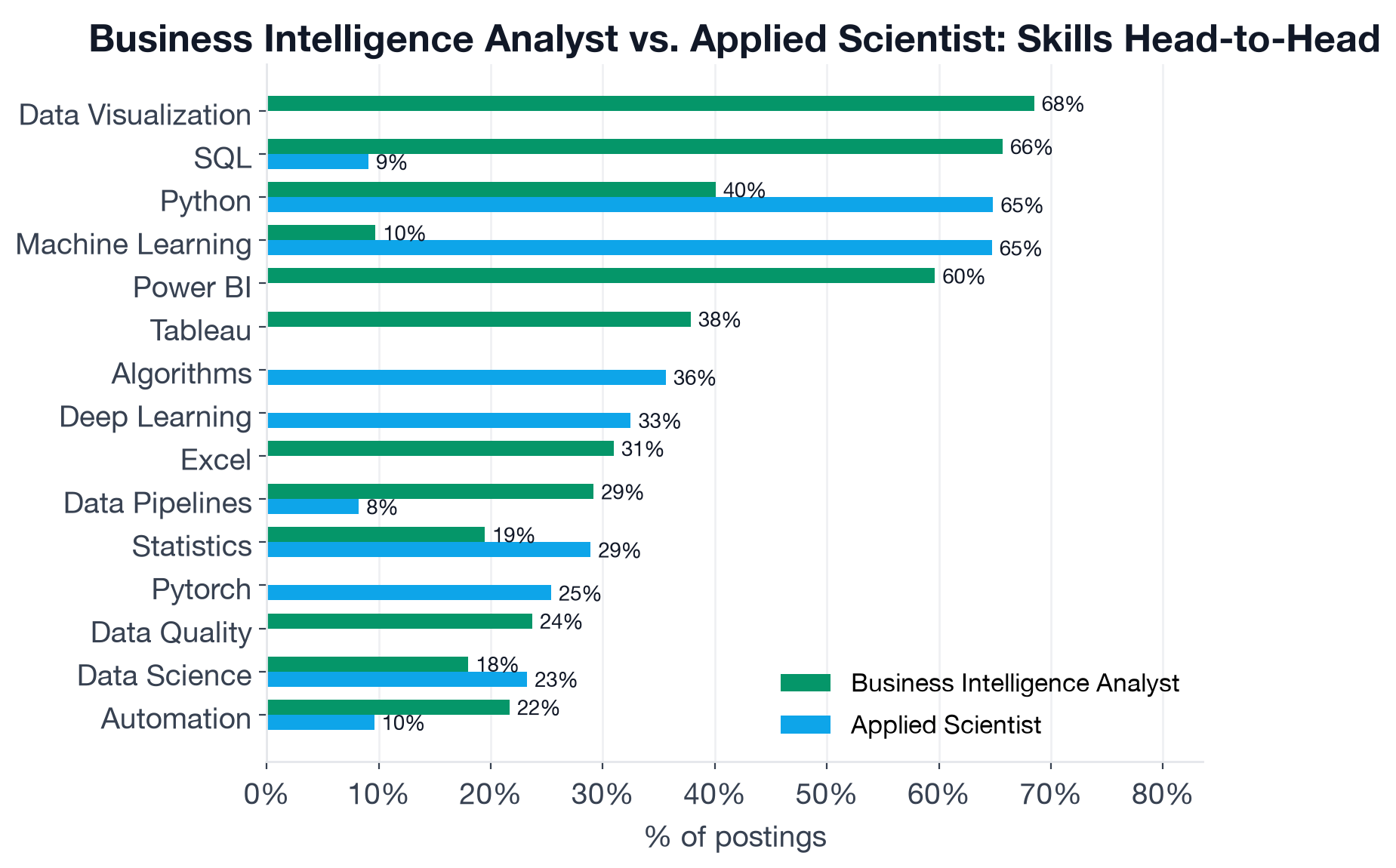 BI Analyst's top skills cluster around reporting tools; Applied Scientist's cluster around Python and machine learning, with almost no shared ground in the top ranks.
The Reporting Stack vs. the Modeling Stack
Where Business Intelligence Analyst pulls away, it pulls toward reporting infrastructure: Data Visualization (68.5%), Power BI (59.6%), Tableau (37.8%), Excel (31.0%), and Data Quality (23.7%) round out its top exclusive skills. This is a role built around a small, consistent set of visualization platforms.
Applied Scientist pulls toward the model-building stack instead: Algorithms (35.6%), Deep Learning (32.5%), PyTorch (25.4%), Generative AI (20.5%), and LLMs (19.9%). Generative AI and LLMs alone show up in roughly 1 in 5 Applied Scientist postings; neither appears anywhere in Business Intelligence Analyst's top-30 skills, and Machine Learning itself clears only 9.7% there.
That gap measures who's explicitly hired to build AI systems, not who uses AI day to day. Power BI is retiring its legacy Q&A interface for Copilot-driven conversational analytics by the end of 2026, so most Business Intelligence Analysts will soon be querying data through a generative-AI layer regardless of what any posting requires. Broader developer-tooling surveys put general AI-tool usage at 84-85% among technical professionals in 2025 (Stack Overflow, JetBrains), the ambient floor both roles are converging toward even though only one is explicitly hired to build the AI itself.
Which Role Pays More, and Why?
Among US postings, where wage-transparency laws produce the most consistent salary disclosure, the median Applied Scientist base salary is $187,300 (n=670) versus $129,800 for Business Intelligence Analyst (n=554), a $57,500 gap, 44.3% above BI Analyst's own baseline. Equity, bonus, and sign-on aren't disclosed in postings, so total compensation at senior levels runs higher than either figure on both sides.
Neither role's own defining skills carry the biggest premium, though. Business Intelligence Analyst's core reporting stack actually prices at or below its own baseline: Power BI sits $3,400 below median (n=254), Excel $14,800 below (n=134). The single highest premium in BI Analyst's own salary data isn't a reporting skill, or even a skill on the role's top-30 list at all: Airflow (a workflow-orchestration tool for scheduling data pipelines) adds $35,600 (n=26). Among BI Analyst's own top-30 skills, dbt (a SQL transformation tool that runs inside the data warehouse) tops the list at $28,700 (n=71), and Machine Learning itself, rare as it is in BI postings, adds $23,000 when it appears (n=74).
Applied Scientist's exclusive skills don't move together as one tidy band, and the biggest premiums aren't the ones usually highlighted for frequency. Model Training tops the list at $19,500 above baseline (n=77), and a separate LLM-tagged skill entry (the dataset splits language-model skills across several near-identical tags) adds $19,000 (n=102), both well ahead of Large Language Models at $12,800 (n=107). Generative AI adds $10,200 (n=176), PyTorch $9,900 (n=176), Reinforcement Learning $9,600 (n=119), and Deep Learning $9,300 (n=235): a real spread, not a tight band, with the top premium here worth more than double the bottom one. The single highest-paid skill in either dataset isn't on either role's top-30 list at all: JAX (Google's array-computing and autodiff library, used for large-scale model training) prices at $231,900 (n=50), $44,600 above Applied Scientist's own baseline.
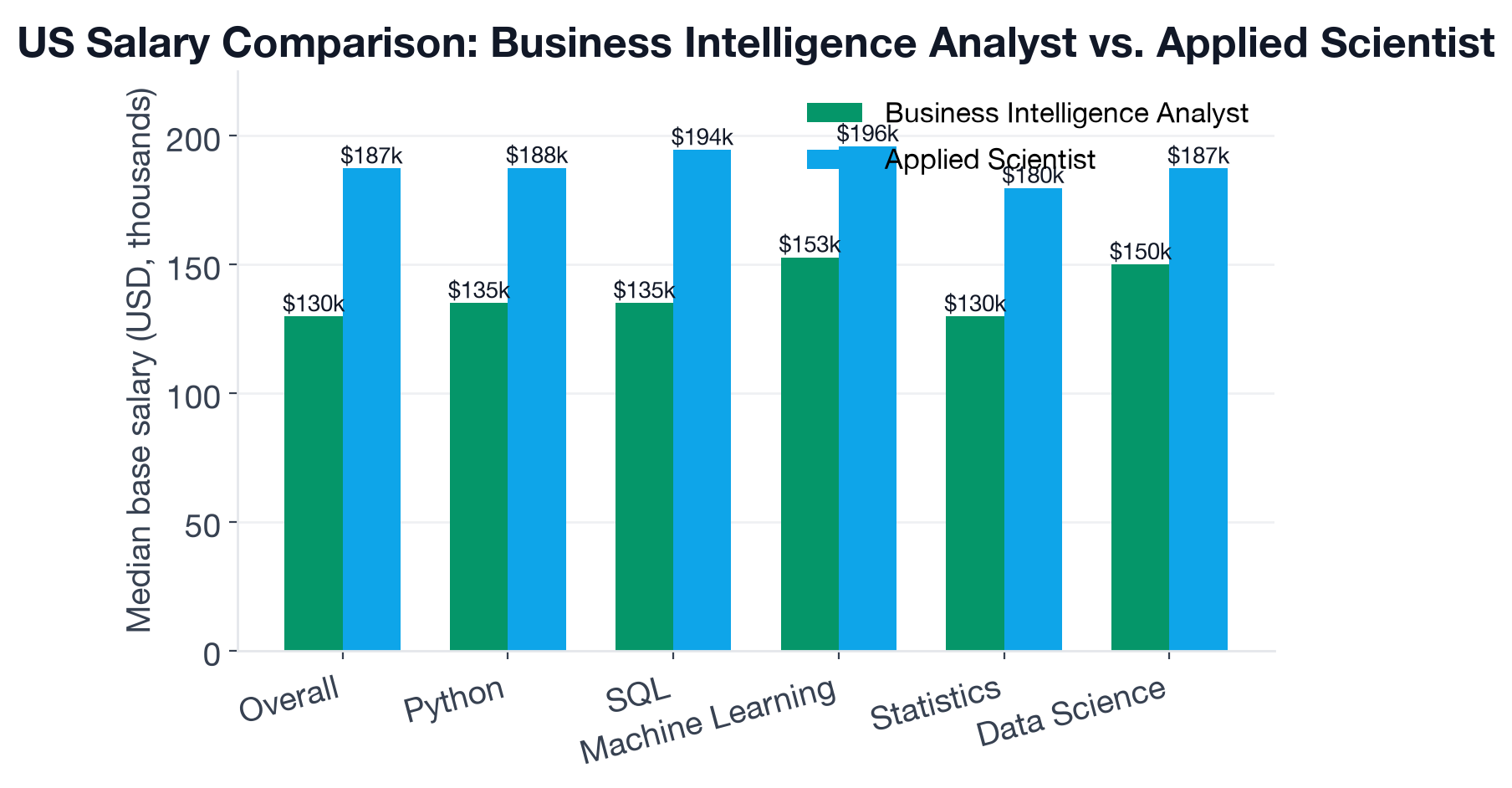 Neither role's core defining skills carry its biggest salary premium: BI Analyst's reporting stack prices at or below baseline, and Applied Scientist's highest premiums sit in model-training and LLM-tagged skills rather than its most frequent tools.
Which Role Has More Openings, and Where?
Business Intelligence Analyst posts more active openings overall: 2,666 vs. 1,729 for Applied Scientist, a 1.54x volume edge. The two roles also hire in different places. Applied Scientist skews far more US-concentrated (55.6% of postings vs. 33.9% for BI Analyst), and Amazon alone accounts for 12.6% of Applied Scientist postings in this dataset, reflecting how central the title is to Amazon's ML organization. BI Analyst postings spread more broadly, with meaningful volume in India and Brazil, and smaller pockets in the Philippines and Mexico. Work mode looks similar on both sides: onsite is the plurality for both (52.6% BI Analyst, 57.6% Applied Scientist), and remote share is close (15.2% vs. 16.3%).
Choosing Between the Two Paths
Choose Business Intelligence Analyst if you:
- Want to work close to business stakeholders, translating questions into dashboards and metrics rather than models
- Already know SQL and a visualization tool (Power BI, Tableau) and want a role where that foundation is immediately marketable
- Want more open positions to apply to today (2,666 vs. 1,729) and a broader geographic spread of opportunities
Choose Applied Scientist if you:
- Want to build and ship machine learning models, not just report on outcomes
- Are early in your career and assumed the "advanced" title meant a harder door in: entry-level share is actually higher here (6.6% vs. 4.9%)
- Want the higher pay ceiling and are willing to invest in Python, deep learning, and a production ML stack to get there
How to Use This in Your Job Search
If you're deciding between these two paths, browse current Business Intelligence Analyst openings and current Applied Scientist openings to see what's active now. For BI Analyst roles, filter on dbt postings, the highest-paying skill within the role's own top-30 list, or Power BI roles if you already have that foundation. For Applied Scientist roles, filter on PyTorch or Generative AI postings to target production ML work specifically.
From there, practice with AI mock interviews tailored to the role, and drill the underlying concepts, SQL and dashboard design for BI Analyst, statistics and model evaluation for Applied Scientist, in our interactive courses or the question bank. For a deeper per-role breakdown, see our full skills analyses of Business Intelligence Analyst and Applied Scientist.
FAQ
Q. What is the salary difference between Business Intelligence Analyst and Applied Scientist?
Applied Scientist pays a median $187,300 US base salary versus $129,800 for Business Intelligence Analyst, a $57,500 gap (44.3% above BI Analyst's baseline). Both figures are base salary only; equity, bonus, and sign-on aren't disclosed in postings.
Q. How much skill overlap do the two roles share?
Just 18% (Jaccard similarity) across their top-30 skill lists. Only four skills, Statistics, Data Science, Monitoring, and AWS, appear at genuinely comparable frequency in both roles. Skills like SQL, Python, and Machine Learning technically clear the threshold in both roles' top-30 lists but run in opposite directions: SQL is common for BI Analyst and rare for Applied Scientist, and Machine Learning is the reverse.
Q. Is Applied Scientist harder to break into than Business Intelligence Analyst?
Not by entry-level share. Applied Scientist postings are actually 6.6% entry-level versus 4.9% for Business Intelligence Analyst. Applied Scientist also has a much higher staff-level share (17.6% vs. 9.9%), so its hiring skews toward both ends of seniority, while Business Intelligence Analyst hiring concentrates in the middle (63.5% mid-level).
Q. Do the two roles use the same tools?
No. Business Intelligence Analyst's top exclusive skills are reporting tools: Data Visualization (68.5%), Power BI (59.6%), Tableau (37.8%), and Excel (31.0%). Applied Scientist's are model-building tools: Algorithms (35.6%), Deep Learning (32.5%), PyTorch (25.4%), and Generative AI (20.5%).
Q. Which role has more job openings?
Business Intelligence Analyst, by 1.54x: 2,666 active postings versus 1,729 for Applied Scientist as of August 2026. Applied Scientist is also far more US-concentrated (55.6% of postings vs. 33.9% for BI Analyst).
Q. Do Applied Scientist postings require AI skills?
About 1 in 5 explicitly do: Generative AI appears in 20.5% of Applied Scientist postings and LLMs in 19.9%, versus effectively none of Business Intelligence Analyst's top-30 skills. That's the explicit build-AI bar, not total AI usage; ambient AI tools like Power BI Copilot and coding assistants are used far more broadly across both roles than job postings alone show.
Q. Which skills add the biggest salary premium for each role?
For Business Intelligence Analyst, the single biggest premium isn't a reporting skill at all: Airflow, outside the role's top-30 list, adds $35,600 over the role's $129,800 baseline (n=26). Among BI Analyst's own top-30 skills, dbt tops the list at $28,700; the role's own core tools like Power BI actually price below baseline. For Applied Scientist, Generative AI adds $10,200 over its $187,300 baseline, and JAX, a specialized skill outside either role's top-30 list, is the single highest-paid skill in the dataset at $231,900.
Different Work, Not Different Levels
Business Intelligence Analyst and Applied Scientist aren't two rungs on the same ladder. They're different jobs that happen to touch the same data. BI Analyst offers more open roles, broader geography, and an immediately marketable path if you already know SQL and a visualization tool. Applied Scientist pays $57,500 more at the median and, despite its advanced-sounding title, actually opens slightly more entry-level doors; its real barrier is depth in Python and machine learning, not seniority. Browse live Business Intelligence Analyst postings or Applied Scientist postings to see what's hiring today.
Topics
Ready to practice?
Put what you've learned into practice with AI mock interviews and structured preparation guides.