
CCNP Doesn't Spread Evenly Across Infrastructure Roles
Cisco's CCNP certification does not spread evenly across the infrastructure roles that could plausibly ask for it. Over the last 90 days, 757 of 11,580 active postings across Network Engineer, Systems Administrator, Systems Engineer, and Cloud Engineer roles on the InterviewStack.io job board mentioned CCNP, a 6.5% overall rate. But that 6.5% figure hides almost everything interesting: Network Engineer postings mention CCNP in 24.7% of listings, a rate roughly 42 times higher than Cloud Engineer's 0.6%, and Network Engineer alone accounts for 85% of every CCNP mention in the dataset.
That concentration lines up with what the exam itself actually covers. CCNP (Enterprise) tests advanced routing and switching protocols, BGP and OSPF chief among them, core Network Engineer work, not a general infrastructure skill the other three roles would reach for. What follows is where that demand actually lands, whether employers treat CCNP as a hard requirement, what the pay comparison looks like once you control for seniority, and who's actually hiring for it.
Key Findings
- CCNP appears in 6.5% of postings across the four-role scope, 757 of 11,580 analyzed over 90 days.
- Network Engineer postings mention CCNP at 24.7%, accounting for 85% of every CCNP mention, while Cloud Engineer postings mention it in just 0.6%, roughly a 42-times gap.
- Of the 479 postings clear enough to classify, 83.3% list CCNP as preferred and 16.7% require it outright, roughly 1 in 6.
- Postings mentioning CCNP advertise a median US base salary of $135,000 versus $131,000 without it (+3.1% overall), but that edge is +6.1% at mid-level, reverses to -8.2% at senior, and returns to roughly flat (+0.9%) at staff.
- CACI International, Leidos, Peraton, General Dynamics IT, and Booz Allen Hamilton, all federal contractors, account for 78.8% of the top employer mentions in this data.
- CCNA (Cisco's tier below CCNP) co-occurs in half of CCNP-mentioning postings (50.3%); CCIE (the tier above) co-occurs in 28.9%.
Network Engineer Absorbs Nearly All of CCNP's Demand
The four roles in this scope are all plausible candidates for a routing-and-switching credential. Network engineering, systems administration, systems engineering, and cloud engineering all touch networking to some degree, but the data doesn't treat them as equally plausible. Network Engineer postings mention CCNP at a rate roughly 13 to 42 times higher than the other three roles individually.
| Role | Postings analyzed | Mention CCNP | Mention rate |
|---|---|---|---|
| Network Engineer | 2,611 | 646 | 24.7% |
| Systems Engineer | 3,621 | 70 | 1.9% |
| Systems Administrator | 2,776 | 26 | 0.9% |
| Cloud Engineer | 2,572 | 15 | 0.6% |
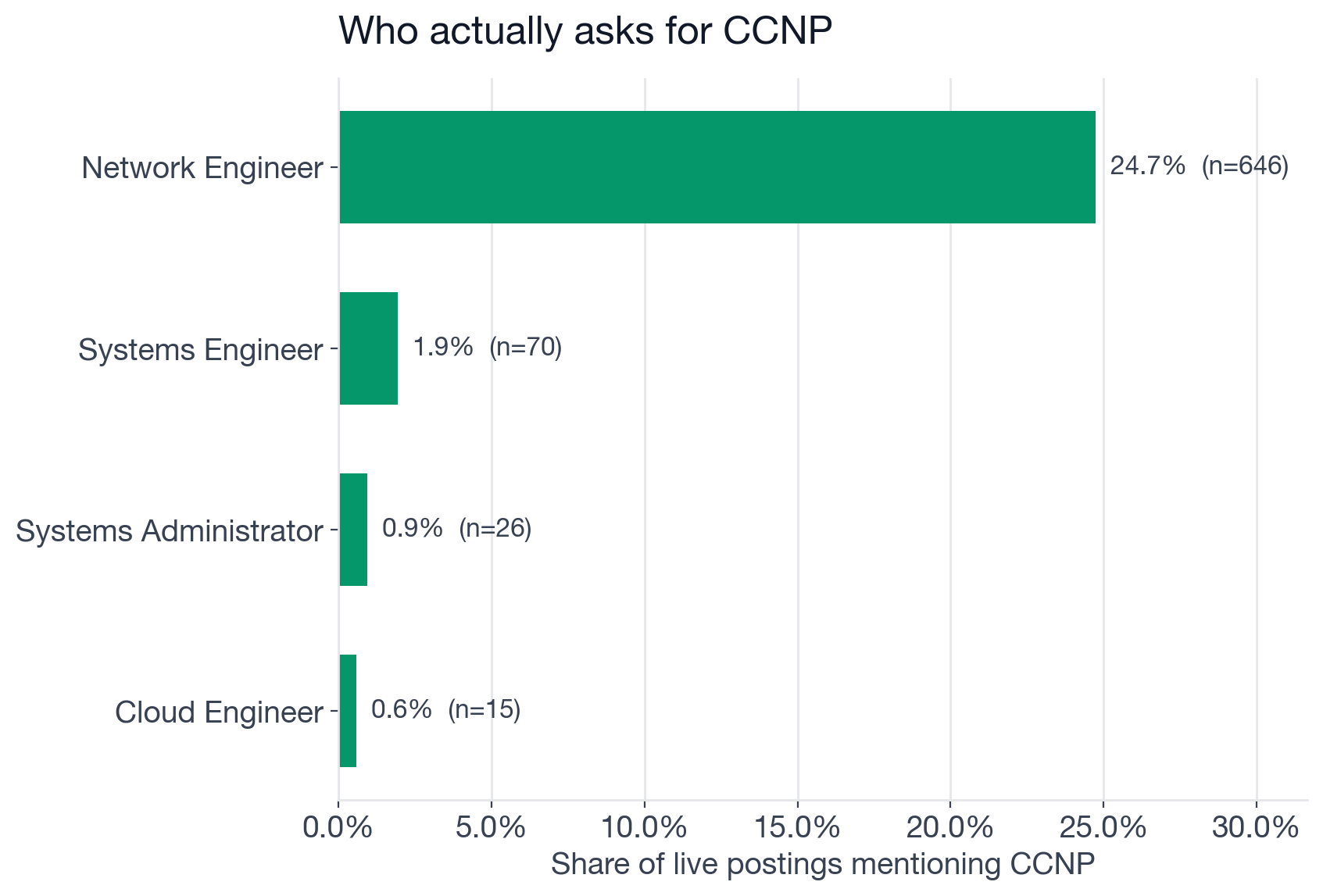 Network Engineer postings mention CCNP at 24.7%, a rate roughly 13 to 42 times higher than the other three roles in this four-role scope.
The concentration doesn't track pay. Network Engineer's own baseline pay ($130,000 median, non-CCNP postings) sits in the middle of the four roles, above Systems Administrator's $112,000 but below Systems Engineer's $142,400 and Cloud Engineer's $149,500. Whatever is pulling CCNP toward Network Engineer, it isn't chasing the highest-paying role in scope, it's chasing the role whose day-to-day work the exam actually tests. If you're not applying to Network Engineer roles specifically, CCNP is a minor signal at best: just 0.6% of Cloud Engineer postings mention it at all.
Is CCNP Actually Required, or Just Preferred?
Of the 757 postings that mention CCNP, 479 (63.3%) use clear required-or-preferred language; the rest, 278 mentions (36.7%), reference the cert without specifying either way, often inside an open-ended list of acceptable certifications. Within that classified group, 16.7% call CCNP required and 83.3% call it preferred, roughly a 1-in-6 split.
The practical read: holding CCNP clears the preferred bar in the large majority of postings that state a clear position, but it rarely gates a candidate out on its own. Employers appear to treat hands-on routing and switching competency, whether demonstrated through CCNP or through equivalent experience, as more important than the credential itself.
The Small CCNP Pay Edge Disappears at the Senior Level
All salary figures here are advertised US base pay only, on the subset of postings that disclose it; equity, bonus, and any clearance premiums aren't part of job-posting data. The comparison baseline throughout is other postings in the same four-role scope that don't mention CCNP, not the broader job market.
Postings mentioning CCNP advertise a median $135,000 against $131,000 for non-CCNP postings in the same roles, a 3.1% edge overall. That number is real, but thin, and it does not hold steady by seniority level.
| Level | With CCNP (median) | Without CCNP (median) | Gap |
|---|---|---|---|
| Entry | Not reportable (n=4) | $80,000 | n/a |
| Mid-level | $130,000 | $122,500 | +6.1% |
| Senior | $137,650 | $150,000 | -8.2% |
| Staff | $163,900 | $162,500 | +0.9% |
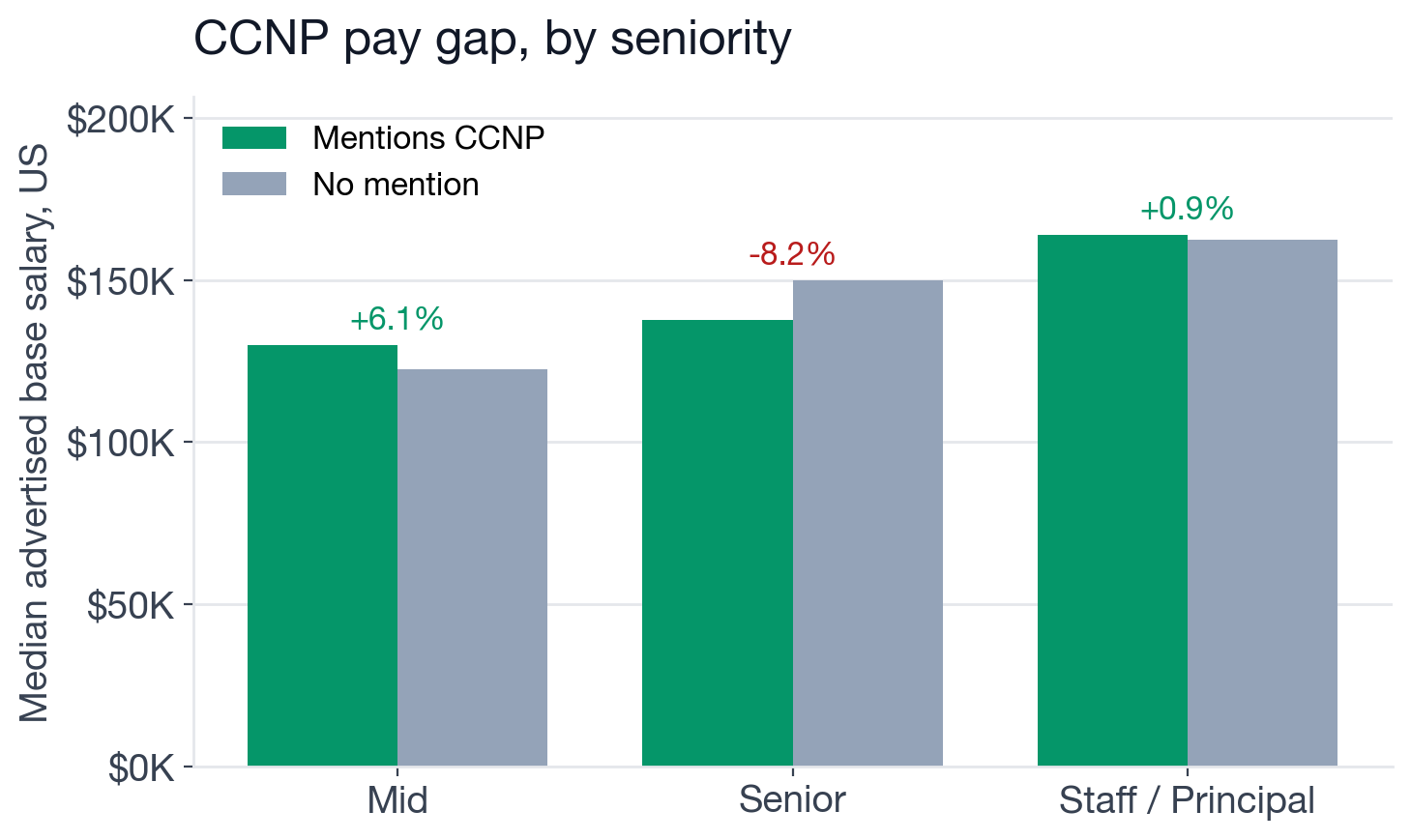 The CCNP pay comparison is positive at mid-level, negative at senior, and close to flat at staff, US base salary, same four-role scope.
The premium lives almost entirely at mid-level. At senior, the relationship flips: senior postings that mention CCNP actually pay 8.2% less than senior postings that don't. At staff, the two groups are close to identical, a 0.9% difference that's effectively a wash.
Worth noting: CCNP-mentioning postings actually skew more senior overall than non-CCNP postings in this scope (32.4% senior versus 22.1%, mean seniority level 1.52 versus 1.39). That skew would be expected to pull the aggregate down, toward the segment where CCNP underperforms, not up. That the aggregate stays positive despite this suggests the mid-level premium is a real pattern in this data, not an artifact of which postings happen to disclose salary. Still, this is a correlation between postings, not proof of what the certificate itself is worth: senior postings ask for senior candidates, and what a posting pays is shaped by far more than one line item on a requirements list.
Federal Contractors and Cisco Itself Drive Most CCNP Demand
The employers asking for CCNP most often aren't a cross-section of the networking-hiring market. They're concentrated in one segment of it, plus one notable exception.
| Employer | Postings mentioning CCNP |
|---|---|
| CACI International | 87 |
| Leidos | 49 |
| Peraton | 45 |
| General Dynamics IT | 26 |
| Booz Allen Hamilton | 24 |
| Cisco | 12 |
| Astreya | 9 |
| Abacus Technology | 8 |
| Mirantis | 7 |
| C3EL | 6 |
| Entarian | 5 |
| Ericsson | 5 |
| Kyndryl | 5 |
| Myriad360 | 5 |
Five federal contractors, CACI International, Leidos, Peraton, General Dynamics IT, and Booz Allen Hamilton, account for 78.8% of the top employer mentions in this data (231 of 293). It's a pattern that recurs across the networking and security certifications in this series: large government and defense contractors run some of the country's biggest enterprise and mission networks, and CCNP's routing-and-switching skill set is directly load-bearing for that work.
Cisco itself also shows up as a direct employer (12 mentions combined across two label variants for the same company in the underlying data), a reminder that the vendor issuing the certification is also a working consumer of it, hiring CCNP holders into its own network engineering roles.
What Else Shows Up Alongside a CCNP Requirement?
CCNA, the tier directly below CCNP on Cisco's own certification path, appears in half of all CCNP-mentioning postings (50.3%). CCIE, the tier above, appears in 28.9%, suggesting CCNP often sits in a range where either the associate credential below it or the expert credential above it is also acceptable to the employer. Security certifications show up often too: CompTIA Security+ in 24.3% of CCNP postings and CISSP in 14.8%, consistent with the security-compliance overlap visible in the govcon-heavy employer roster above.
| Certification | Co-occurs with CCNP |
|---|---|
| CCNA | 50.3% |
| CCIE | 28.9% |
| CompTIA Security+ | 24.3% |
| CISSP | 14.8% |
| Juniper JNCIA | 9.5% |
| Palo Alto PCNSE | 9.5% |
| CompTIA Network+ | 8.7% |
On the skills side, the postings read close to the CCNP Enterprise exam blueprint. BGP (50.6%) and OSPF (45.3%), the two core routing protocols the exam tests in depth, lead alongside Firewalls (50.3%) and Network Security (38.4%). Automation shows up in 38.7% of CCNP-mentioning postings, a reminder that modern network engineering increasingly runs through Python- and Ansible-driven configuration rather than CLI work alone.
Deciding What CCNP Is Actually Worth to Your Search
If you're deciding whether CCNP is worth the study time, the data points hard at one variable: role. It's a strong, relevant signal if you're targeting Network Engineer postings specifically, where it shows up in roughly 1 in 4 listings and the pay edge, while thin overall, still shows up clearly at mid-level. For Systems Administrator, Systems Engineer, or Cloud Engineer roles, it's a much smaller factor, and your time may be better spent on skills those postings ask for directly. Our breakdown of Network Engineer skills companies want in 2026 covers the fuller skill stack beyond this one certification, and our CCNA demand and pay analysis covers the tier most CCNP postings also mention.
Drill the routing, switching, and troubleshooting fundamentals CCNP covers with InterviewStack's Question Bank, organized by topic. If you want to build the underlying networking and automation concepts before the exam or the interview, InterviewStack's interactive courses cover networking and cloud fundamentals. Once you have a target role in mind, run a mock interview against it to see where the gaps actually are.
To see current openings, browse active postings across all four roles in this scope or filter down to Network Engineer specifically.
FAQ
Q. How many active postings mention CCNP in 2026?
757 of 11,580 active postings analyzed across four roles, Network Engineer, Systems Administrator, Systems Engineer, and Cloud Engineer, on the InterviewStack.io job board mention CCNP, about 6.5% of the scope, over a 90-day window.
Q. Which role actually asks for CCNP?
Network Engineer, overwhelmingly. CCNP appears in 24.7% of Network Engineer postings (646 of 2,611), and Network Engineer alone accounts for 85% of every CCNP mention across the four roles. The other three roles barely register: Systems Engineer at 1.9%, Systems Administrator at 0.9%, and Cloud Engineer at just 0.6%.
Q. Is CCNP usually required or just preferred?
Preferred, in most cases where postings specify one. Of the 479 postings clear enough to classify, 83.3% list CCNP as preferred and 16.7% require it outright, roughly 1 in 6. Another 278 mentions, about 37% of all CCNP references, use phrasing too ambiguous to classify.
Q. Do postings that ask for CCNP pay more than postings that don't?
Only slightly overall, and not consistently by level. Postings mentioning CCNP advertise a median US base salary of $135,000 versus $131,000 for non-CCNP postings in the same roles, a 3.1% edge. Split by seniority, that edge is +6.1% at mid-level, reverses to -8.2% at senior, and comes back to roughly flat, +0.9%, at staff.
Q. Why does the CCNP pay comparison reverse at the senior level?
The data doesn't fully explain it. CCNP-mentioning postings actually skew more senior overall than non-CCNP postings (32.4% senior versus 22.1%), which would be expected to pull the aggregate down toward the underperforming senior segment, not up. That the aggregate is still positive despite this suggests the mid-level premium is a real pattern in this data, not an artifact of which postings happen to disclose salary, but it's a correlation between postings, not proof of what the certificate itself is worth.
Q. Who is hiring for CCNP most often?
Federal contractors dominate the roster: CACI International, Leidos, Peraton, General Dynamics IT, and Booz Allen Hamilton together account for 78.8% of the top employer mentions in this data. Cisco itself also appears as a direct employer, hiring CCNP holders for its own network engineering roles.
Q. Is CCNP worth pursuing if you're not targeting a Network Engineer role?
Probably not as a priority. CCNP demand is concentrated almost entirely in Network Engineer postings; Systems Administrator, Systems Engineer, and Cloud Engineer postings ask for it rarely enough that it's unlikely to move a hiring decision for those roles specifically. Most CCNP holders pair it with CCNA (50.3% of CCNP-mentioning postings also ask for it) or CCIE (28.9%), reflecting where it sits on Cisco's own certification ladder.
CCNP Is Built for One Job, and the Market Agrees
CCNP is a professional-level routing and switching credential, and the postings data treats it exactly that way: heavily concentrated in Network Engineer roles, mostly preferred rather than required, and carrying a real but modest pay signal that shows up at mid-level and fades by staff. That's not a knock on the certification, it's a sign the exam and the role it targets are well aligned. If Network Engineer is where you're headed, CCNP is worth the study time. If it isn't, the data says look elsewhere first.
Topics
Ready to practice?
Put what you've learned into practice with AI mock interviews and structured preparation guides.