
CKA's Busiest Employer Builds AI Data Centers, Not Government Systems
Federal contractors have shown up at or near the top of the employer list for most certifications we've profiled in this series, from CompTIA Security+ to CISSP to AWS Solutions Architect. CKA (Certified Kubernetes Administrator) breaks that pattern. Its single biggest employer by posting count is Crusoe Energy Systems, a company known for building GPU data-center infrastructure for AI workloads, not a defense contractor.
We looked at every active posting across DevOps Engineer, Site Reliability Engineer (SRE), Cloud Engineer, and Systems Engineer roles on the InterviewStack.io job board over the trailing 90 days, 11,196 postings in total, and searched for CKA mentions. Just 227 of them, about 2.0%, name the certification at all. That's a thin slice. But who's asking for it, and in which role, tells a sharper story than the raw rate does.
Key Findings
- CKA appears in 2.0% of postings (227 of 11,196) across the four scoped infrastructure roles over the trailing 90 days.
- Crusoe Energy Systems, an AI infrastructure company, is the single largest employer by CKA-mentioning postings (14), ahead of every federal contractor in the dataset.
- Federal contractors account for about 43% of mentions among the top-ranked employers, real, but not dominant the way they've been for security certifications.
- DevOps Engineer postings carry 62.6% of all CKA mentions despite being only 43.7% of postings in scope, a mention rate nearly 4x Systems Engineer's.
- CKA is almost never a hard requirement: 92.9% of classified mentions call it preferred, only 7.1% (about 1 in 14) call it required.
- Postings that mention CKA advertise a median US base salary of $151,625 versus $146,950 for postings that don't, a 3.2% gap that narrows to 0.6% at senior level.
- CKAD, CKA's companion exam, co-occurs in 47.6% of CKA-mentioning postings; Terraform, AWS, and CI/CD each appear in 70%+ of them.
Federal Contractors Show Up for CKA, But an AI Infrastructure Firm Leads It
CACI International (10 mentions), Booz Allen Hamilton (9), Peraton (4), Northrop Grumman (4), and MetroStar (3) are all present in the CKA employer list, names that have anchored the top of the employer list for many certifications we've covered in this series. Together they account for 30 of the 69 mentions among the top 11 employers we can identify, about 43%. That's a real presence, but it's a minority share, and none of them individually outranks the top employer.
That top spot belongs to Crusoe Energy Systems, with 14 CKA-mentioning postings, 1.4 times CACI's count and 6.2% of every CKA mention in the full 227-posting dataset. Crusoe builds and operates GPU data centers for AI training and inference, the kind of infrastructure where Kubernetes is the standard way to orchestrate compute clusters at scale. Its presence at the top of a Kubernetes-certification employer list isn't surprising once you think about what the role actually involves, but it's a different kind of demand than the federal-compliance-driven hiring (DoD credential requirements) that tends to dominate security-adjacent certifications. Worth keeping in view: these are small absolute counts (the list tops out at 14 postings) and Crusoe's lead over CACI is just 4 postings, so this is a directional read on who's hiring, not a landslide.
The rest of the list splits across cloud and infrastructure vendors (BETSOL, 6 mentions; Point Wild, 6), a European aerospace-and-defense group (Thales Group, 5), a global telecom (Vodafone, 5), and a bank (HSBC, 3). It's a mixed roster: some compliance-driven government work, some regulated-enterprise infrastructure, and a genuine AI-compute employer at the very top.
| Rank | Company | CKA-mentioning postings |
|---|---|---|
| 1 | Crusoe Energy Systems | 14 |
| 2 | CACI International | 10 |
| 3 | Booz Allen Hamilton | 9 |
| 4 | BETSOL | 6 |
| 5 | Point Wild | 6 |
| 6 | Thales Group | 5 |
| 7 | Vodafone | 5 |
| 8 | Peraton | 4 |
| 9 | Northrop Grumman | 4 |
| 10 | HSBC | 3 |
| 11 | MetroStar | 3 |
How Concentrated Is CKA Demand Across These Four Roles?
CKA isn't spread evenly across the role scope. It clusters hard in DevOps Engineer postings, is present but weaker in Cloud Engineer, and is nearly absent from generic Systems Engineer listings, even though Systems Engineer is the second-largest role by posting volume in this dataset, behind only DevOps Engineer.
DevOps Engineer makes up 43.7% of the 11,196 postings scanned but carries 62.6% of all 227 CKA mentions, a mention rate of 2.90%, nearly four times Systems Engineer's 0.73% and about 1.3 times Cloud Engineer's 2.22%. Systems Engineer, despite being 33.0% of postings in scope, contributes just 11.9% of mentions. (Site Reliability Engineer is part of the same role scope, but no SRE postings matched the production filter in this 90-day window, so the breakdown below covers the three roles that did.)
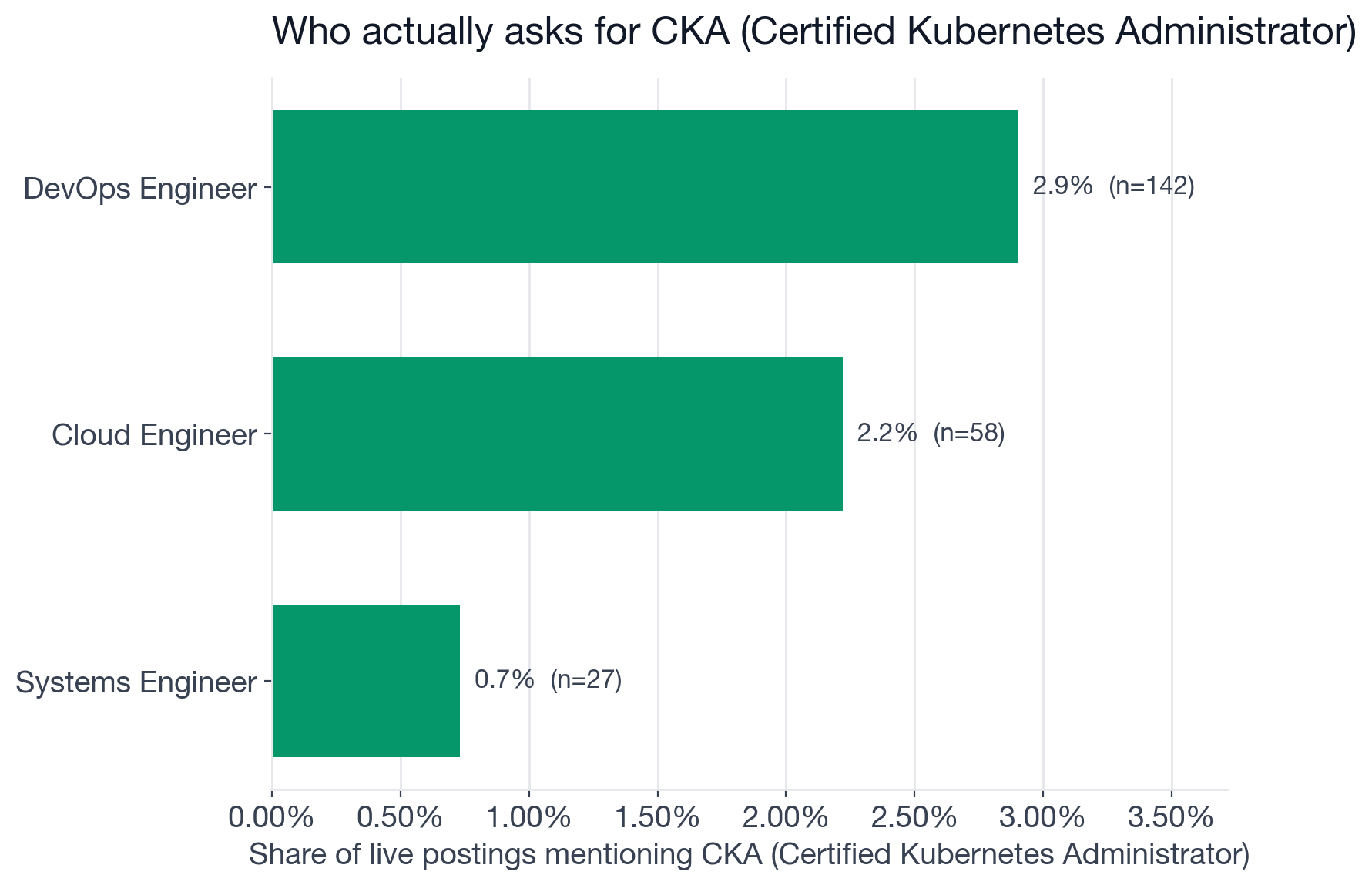 DevOps Engineer postings mention CKA at nearly four times the rate of Systems Engineer postings (2.90% vs. 0.73%).
| Role | Postings in scope | Mentioning CKA | Mention rate | Share of all CKA mentions |
|---|---|---|---|---|
| DevOps Engineer | 4,892 | 142 | 2.90% | 62.6% |
| Cloud Engineer | 2,612 | 58 | 2.22% | 25.6% |
| Systems Engineer | 3,692 | 27 | 0.73% | 11.9% |
That concentration lines up with how the job is actually scoped. DevOps Engineer postings usually own the pipeline that ships containers into a live cluster, and CKA is the credential built specifically for administering that cluster: RBAC, networking, storage, troubleshooting a broken control plane. Systems Engineer postings, by contrast, more often describe generalist infrastructure work where Kubernetes may or may not be in the stack at all, which is consistent with the near-absence of CKA there.
How Rarely Is CKA Actually Required?
Of the 227 CKA mentions, 99 use wording clear enough to classify as required or preferred; the other 128 (56.4%) don't specify either way. Among the 99 that are classified, 92 (92.9%) say preferred and only 7 (7.1%, about 1 in 14) say required.
That's a strikingly low required rate for a hands-on infrastructure certification. Employers treat CKA the way they treat most hands-on infrastructure certifications: a credible signal that you already know how to run a cluster, not a gate that blocks your application if you don't have it. Since more than half of all mentions don't specify wording at all, the true required rate could sit somewhere else, but the classified evidence points firmly toward "nice to have," not "must have."
| Signal | Share of classified mentions (n=99) |
|---|---|
| Preferred | 92.9% (92) |
| Required | 7.1% (7) |
Unspecified mentions (128 of 227, 56.4% of all CKA mentions) are excluded from the split above and can't be assumed to lean either way.
The CKA Pay Edge Fades to Nothing by Senior Level
Postings that mention CKA advertise a median US base salary of $151,625 (n=78) versus $146,950 (n=3,291) for postings in the same four-role scope that don't, a 3.2% gap. That's a real number, but it's not the same story at every level, and the aggregate is a weak proxy for what an individual candidate should expect.
Broken out by seniority, the premium is concentrated at mid-level: $142,166 versus $135,000, a 5.3% gap (n=41 with-cert). At senior level, it nearly vanishes: $160,000 versus $159,000, just 0.6% (n=31 with-cert). Entry-level has zero CKA-mentioning postings with reportable salary, and staff-level has only 6, both below the sample floor needed to report a comparison.
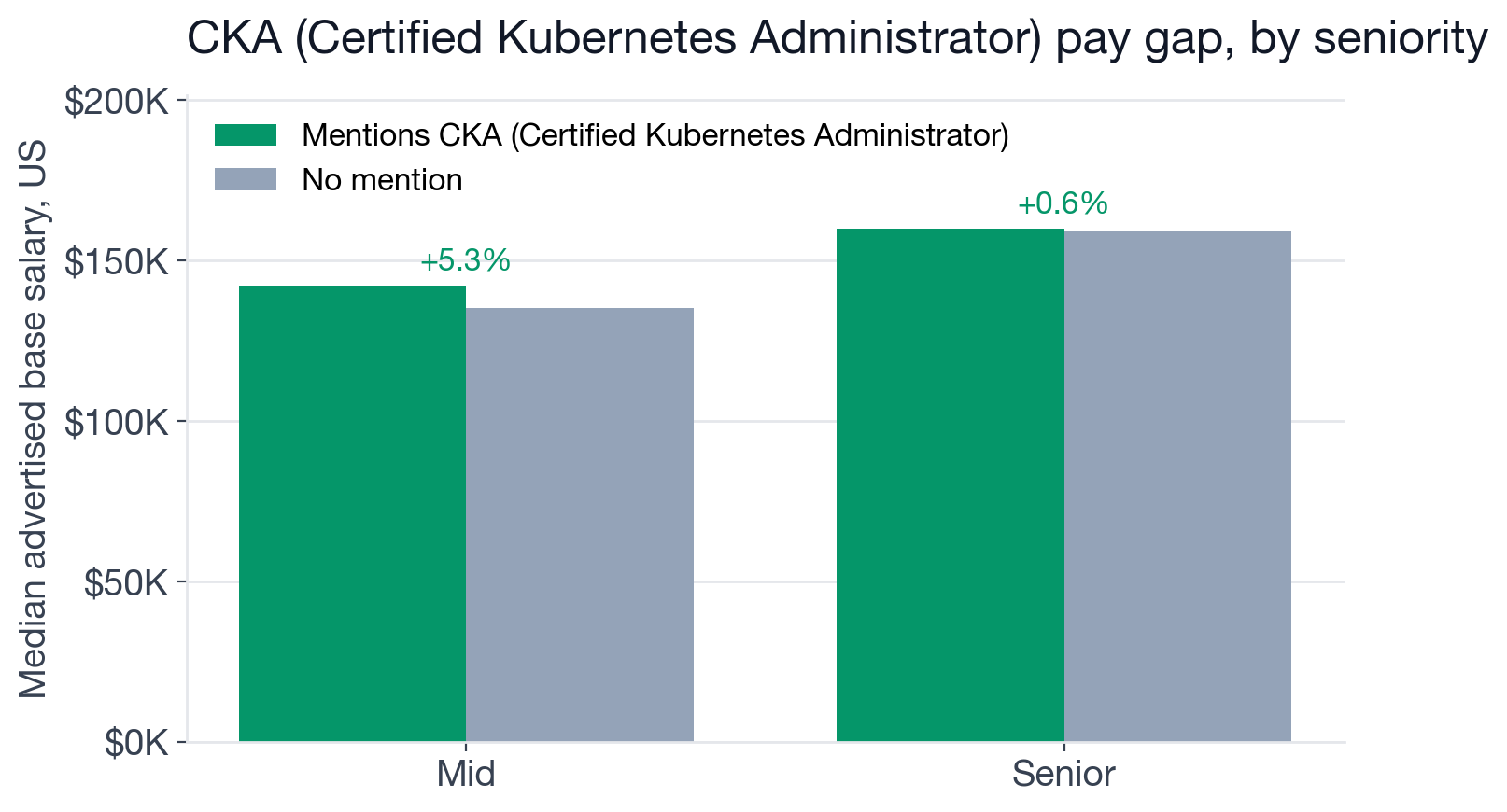 The CKA premium is a mid-career signal (+5.3%) that narrows to near-parity by senior level (+0.6%); entry and staff samples are too thin to report.
| Level | With CKA (median US base) | Without CKA (median US base) | Gap |
|---|---|---|---|
| Entry | Not reportable (n=0) | $105,250 | n/a |
| Mid-level | $142,166 | $135,000 | +5.3% |
| Senior | $160,000 | $159,000 | +0.6% |
| Staff | Not reportable (n=6) | $178,100 | n/a |
| All levels (aggregate) | $151,625 | $146,950 | +3.2% |
Part of the modest aggregate gap reflects composition, not certification value on its own: CKA-mentioning postings skew slightly more senior than the rest of the scope (senior and staff levels combine for 47.6% of CKA postings, versus 40.6% of postings that don't mention it), and senior work simply pays more regardless of certification. That mix effect nudges the blended average up a little. One caveat on the seniority figures themselves: level is inferred from title keywords, and a posting with no explicit level word (roughly half of the titles in our sample) defaults to mid-level, which compresses the measured spread, so the true seniority skew between CKA and non-CKA postings could be somewhat larger or smaller than these percentages show. The more useful number is still the level-by-level one: worth something real at mid-career, close to noise once you're already senior. As with every certification we cover, this describes a correlation in what employers pay for these postings, not a causal claim about what the credential itself is worth.
What Rounds Out a CKA Holder's Toolkit?
CKA rarely shows up alone. CKAD (Certified Kubernetes Application Developer), CKA's companion exam aimed at developers building on top of a cluster rather than administering it, co-occurs in 47.6% of CKA-mentioning postings, by far the most common paired credential. Security-adjacent certifications (CompTIA Security+, CISSP, CCSP combined) appear in 25.6% of CKA mentions, likely a footprint of the federal-contractor and regulated-enterprise share of the employer list. Cloud-vendor associate and expert certs (AWS Solutions Architect Associate, Azure AZ-104, Azure AZ-305 combined) show up in 18.9%, and Red Hat credentials (RHCE, RHCSA combined) in 10.6%. These grouped figures are sums of each certification's individually reported co-occurrence rate, not a deduplicated count: some federal postings list security certifications as interchangeable alternatives (for example, "Security+ or CISSP or CCSP"), so the true share of postings touched by at least one is likely somewhat lower than the raw sum.
| Co-occurring certification | Share of CKA-mentioning postings |
|---|---|
| CKAD | 47.6% |
| CompTIA Security+ | 14.5% |
| CISSP | 8.8% |
| AWS Solutions Architect Associate | 7.9% |
| RHCE | 6.6% |
| Azure AZ-104 | 6.2% |
On the skills side, Kubernetes itself appears in 98.2% of CKA-mentioning postings, unsurprising for a Kubernetes exam, but the rest of the stack is worth reading closely. Terraform (74.4%), AWS (70.9%), and CI/CD (70.5%) each clear 70%, and all three major public clouds show up meaningfully: AWS at 70.9%, Azure at 50.7%, Google Cloud at 38.3%. That spread confirms Kubernetes' role as a cross-cloud abstraction layer rather than a single-vendor skill. Interestingly, plain Docker sits lower, at 45.8%, well behind the orchestration and infrastructure-as-code tooling (Terraform, Helm at 41.9%, the Kubernetes package manager for templating and deploying applications, and GitOps at 36.6%, the practice of managing infrastructure changes through Git-based pull requests instead of manual deploys) that CKA-adjacent postings actually emphasize.
| Skill | Share of CKA-mentioning postings |
|---|---|
| Kubernetes | 98.2% |
| Terraform | 74.4% |
| AWS | 70.9% |
| CI/CD | 70.5% |
| Automation | 68.7% |
| Monitoring | 58.1% |
| Infrastructure as Code | 57.7% |
| Python | 55.9% |
If you're building toward a CKA-adjacent posting, Terraform and CI/CD pipeline experience matter close to as much as the Kubernetes fundamentals themselves. Our interactive courses cover infrastructure-as-code and CI/CD foundations if either is a gap, and the Question Bank has focused drilling on Kubernetes and cloud-infrastructure topics if you want to test what you already know before scheduling the exam.
If DevOps Engineer Is Your Target, Here's What This Means
If you're deciding whether to sit the CKA exam, the data points toward a specific answer rather than a blanket one. It's worth real money at mid-level and worth pursuing if you're targeting DevOps Engineer roles specifically, where demand concentrates and the mention rate is highest. It's a weaker bet if your target is a generalist Systems Engineer track, where it barely registers.
Before you commit study time, browse current DevOps Engineer and Cloud Engineer openings that mention Kubernetes to see how the certification is actually being asked for in postings hiring right now. If you already hold CKA or are close to the exam, practice with AI mock interviews focused on cluster troubleshooting and infrastructure scenarios before you apply. For the broader skill picture beyond this one certification, our DevOps Engineer skills breakdown and Cloud Engineer skills breakdown cover what else shows up in these postings.
FAQ
Q. How many DevOps, cloud, and systems postings actually mention the CKA certification in 2026?
About 2.0% of postings (227 of 11,196) across DevOps Engineer, Cloud Engineer, and Systems Engineer roles on the InterviewStack.io job board mentioned the CKA (Certified Kubernetes Administrator) certification in the last 90 days. Site Reliability Engineer is part of the same role scope but had no matching postings in this window, so the figure reflects the three roles that did.
Q. Is the CKA certification required or just preferred?
Almost never required. Among the 99 CKA mentions with clear required-or-preferred wording, 92.9% call it preferred and only 7.1%, about 1 in 14, call it required. More than half of all 227 mentions (56.4%) don't specify either way, so the true required rate could be higher or lower than 7.1%.
Q. Who hires the most for CKA in 2026?
Crusoe Energy Systems, a company best known for building GPU data-center infrastructure for AI workloads, tops the employer list with 14 CKA-mentioning postings, more than any single federal contractor in this dataset. Federal contractors including CACI International, Booz Allen Hamilton, Peraton, Northrop Grumman, and MetroStar together account for about 43% of mentions among the top-ranked employers, but none of them individually outranks Crusoe.
Q. Does having CKA increase your salary?
Postings that mention CKA advertise a median US base salary of $151,625, versus $146,950 for postings in the same role scope that don't mention it, a 3.2% gap. That gap is a real 5.3% at mid-level but narrows to just 0.6% at senior level, so the honest read is a modest mid-career premium that fades as you climb, not a fixed dollar value the certificate itself pays.
Q. Which role sees the most CKA demand?
DevOps Engineer. It makes up 43.7% of postings in this scope but 62.6% of all CKA mentions, a mention rate nearly four times Systems Engineer's and about 1.3 times Cloud Engineer's. Systems Engineer, despite being the second-largest role by posting volume in this scope (behind only DevOps Engineer), accounts for just 11.9% of mentions.
Q. What other certifications and skills usually appear alongside CKA?
CKAD (Certified Kubernetes Application Developer), CKA's companion exam for developers rather than administrators, appears in 47.6% of CKA-mentioning postings. Terraform (74.4%), AWS (70.9%), and CI/CD (70.5%) are the most common accompanying skills, and all three major clouds show up in the mix (AWS, Azure, Google Cloud), reflecting Kubernetes' role as a cross-cloud abstraction layer.
Q. Is CKA worth pursuing in 2026?
It depends on the role you're targeting. CKA shows up in a small slice of postings overall (about 2%) and is rarely a hard requirement, but demand concentrates heavily in DevOps Engineer postings and among employers running large-scale infrastructure, including AI infrastructure providers like Crusoe Energy Systems. For a DevOps-focused, infrastructure-heavy path, it's a credible signal. For a generalist Systems Engineer track, the data doesn't show much payoff.
CKA Signals You Can Run Kubernetes, Not That You're in High Demand
The clearest read on CKA in 2026 is that it's a narrow, competent-practitioner credential, not a broad career booster. It shows up in a small share of postings, is almost never a hard requirement, and its salary edge is concentrated at mid-career rather than guaranteed at every level. But where it does matter, DevOps Engineer roles, and at employers like Crusoe Energy Systems that build AI infrastructure rather than run government IT, it's a real, specific signal that you can operate a cluster under pressure. Whether it's worth the study time comes down to whether that's the role you're actually chasing.
Topics
Ready to practice?
Put what you've learned into practice with AI mock interviews and structured preparation guides.