
DevOps Engineering Has Quietly Split into Three Pay Tiers
The hiring market treats "DevOps Engineer" as one job. The salary market treats it as three. At the top: engineers who own reliability work, setting service-level objectives, running observability platforms, leading incident response. At the bottom: engineers whose resumes center on Windows Server and PowerShell. In the middle: the cloud-native core that most job descriptions describe (CI/CD, Kubernetes, Terraform, AWS).
We looked at 7,523 active DevOps Engineer postings on the InterviewStack.io job board as of June 2026, with skills extracted and synonyms collapsed. The salary slice covers 1,151 US postings where compensation was disclosed, base only.
The distance between the top tier and the bottom is $58,400 in median US base salary: from $160,000 at the SLO/SLI end to $101,600 at the PowerShell end. SLO/SLI skills (service-level objectives and indicators, the backbone of reliability engineering) sit at the top; PowerShell anchors the bottom. Same job title. Very different market signals.
Key Findings
- 7,523 active DevOps Engineer postings analyzed on the InterviewStack.io job board, June 2026.
- Five table-stakes skills each appear in more than half of all postings: CI/CD (67%), automation (58%), Kubernetes (56%), AWS (54%), and Python (53%). Terraform is just at the 50% threshold.
- Median US base salary is $129,400 (n=1,151 postings with US salary disclosed). Equity and bonuses are not captured in posted data.
- SLO/SLI skills correlate with a $160,000 US median, $30,600 above the baseline. OpenTelemetry sits at $156,900, Incident Response at $150,000, and Observability at $145,000.
- PowerShell correlates with a $101,600 US median, $27,800 below baseline. Windows ($107,700) and Azure DevOps ($111,300) signal the same discount.
- Only 1.9% of postings are explicitly entry-level, roughly 146 of 7,523. Mid-level dominates at 56%, senior at 30%, staff at 12%.
- Kubernetes and Terraform co-occur in 39% of postings with a lift of 1.40. Docker and Kubernetes pair in 33% of postings (lift 1.54), the highest lift among independent tool-stack pairs in the data.
- 23% of postings are remote, 34% hybrid, 42% onsite. The US accounts for 29% of global posting volume.
What Skill Families Define a DevOps Engineer in 2026?
Group individual skills into the higher-level families they belong to and the role's actual shape emerges as layers: you are expected to speak automation tooling, cloud infrastructure, and programming fluency at the same time.
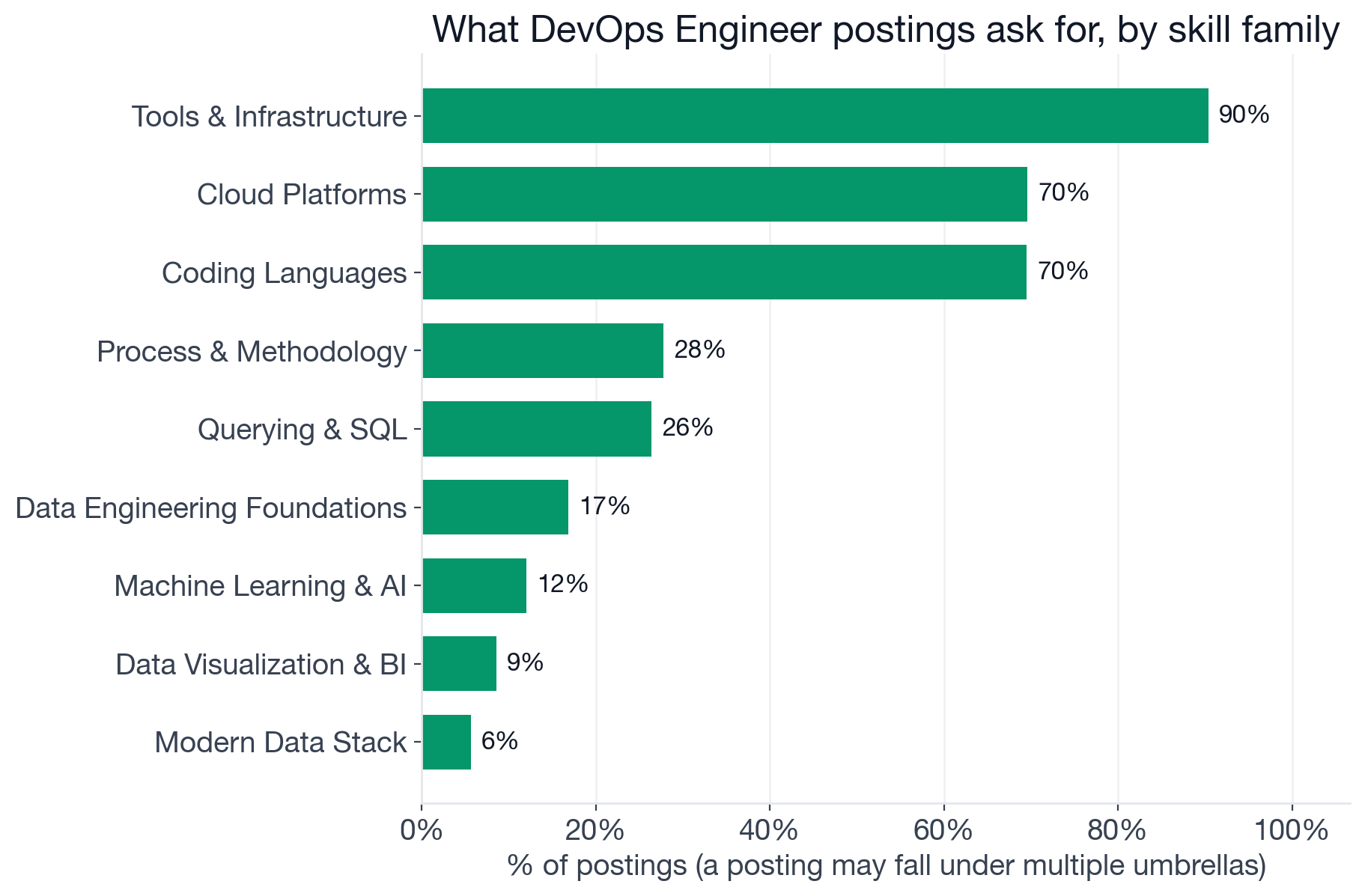
Share of DevOps Engineer postings that ask for at least one skill in each family. A posting that mentions both AWS and Azure counts once under Cloud Platforms. Process & Methodology (28%) and Querying & SQL (26%) are included for completeness; both are cross-role expectations rather than DevOps-specific distinguishers and are not analyzed further here.
The families that actually define the role:
Tools and Infrastructure (90%): Kubernetes, Terraform, Docker, monitoring, Linux, Ansible, and Git. This is where the day-to-day work lives.
DevOps toolchain and practices (95%): CI/CD, infrastructure as code, observability, Jenkins, Grafana, and Prometheus. These are the automation and pipeline concepts unique to the DevOps discipline. This family's near-universal presence (found in 95% of postings) reflects how deeply operationalized DevOps has become as an expectation.
Cloud Platforms (70%): AWS (54%), Azure (39%), and Google Cloud (24%) each carry significant share. Seven in ten postings name at least one cloud platform, which is the baseline for most cloud-native environments.
Coding Languages (70%): Python (53%), Bash (27%), Java (15%), TypeScript (12%). Python is now treated as a first-class DevOps language: automation scripts, infrastructure testing, and tooling glue are all expected to be written in it.
Machine Learning and AI (12%): The slice explicitly hiring for AI infrastructure work: MLOps pipeline management, LLM deployment, generative AI platform engineering. Small by posting count but highest-paying by salary.
The Three Tiers of Individual DevOps Skills
Drill into individual skills and three tiers emerge based on how broadly they appear across active postings.
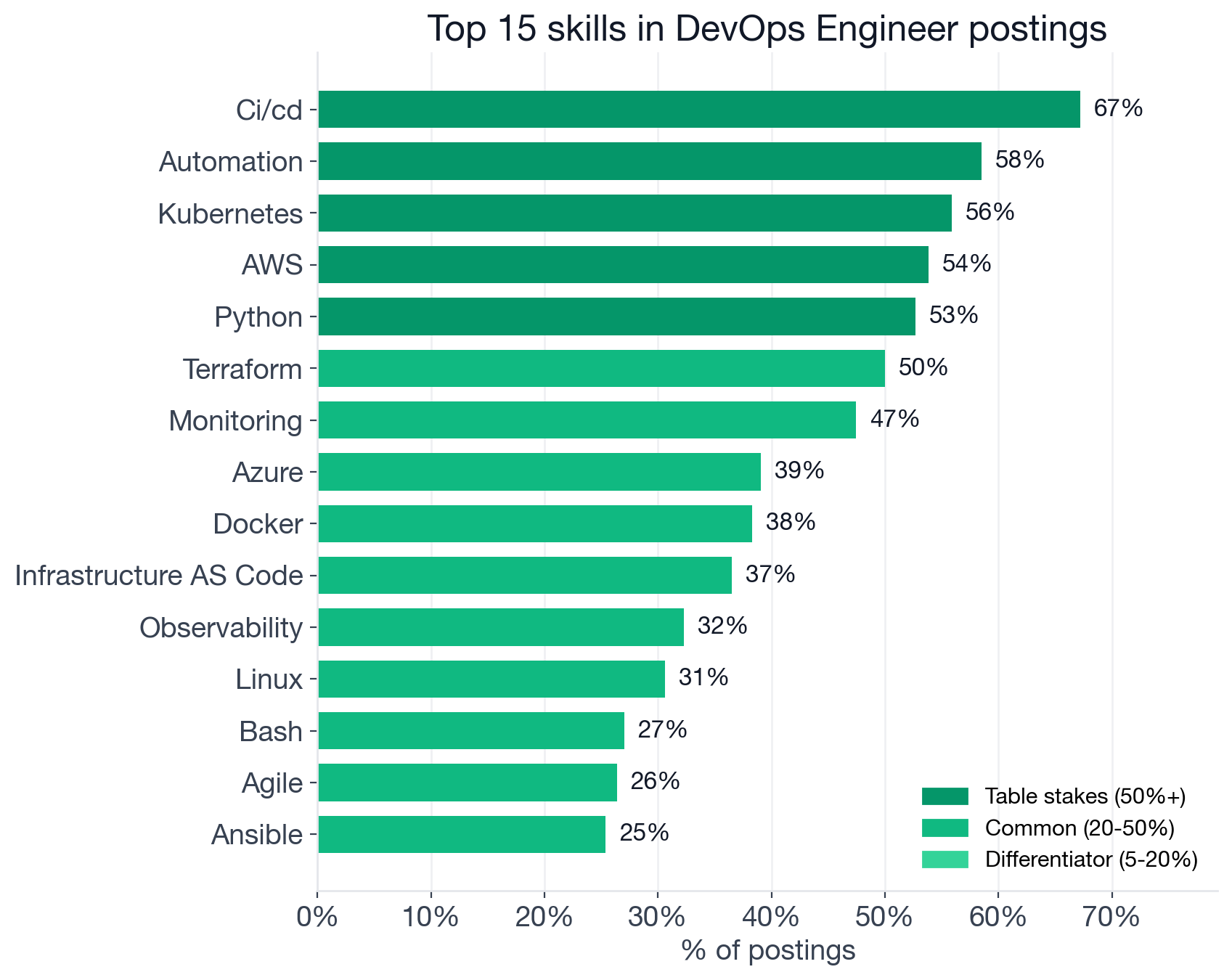
Frequency of individual skills across 7,523 active DevOps Engineer postings, June 2026. Skills at 50%+ qualify as table stakes.
Table stakes (50%+, five skills): CI/CD, automation, Kubernetes, AWS, and Python. These appear on the majority of job descriptions. Missing two or more of them is a meaningful gap, not a stylistic choice. Terraform sits just below at 49.99% and functions as a de facto sixth table-stakes skill in cloud-native environments.
Common (20-50%, seventeen skills): Terraform, monitoring, Azure, Docker, infrastructure as code, observability, Linux, Bash, Agile, Ansible, Jenkins, GitHub, Google Cloud, Grafana, scalability, Git, and GitLab. A competitive mid-level or senior profile would hold most of these. They are expected, not differentiating.
Differentiators (5-20%): Prometheus, GitHub Actions, Helm (a Kubernetes package manager), Incident Response, Datadog (a cloud monitoring and observability platform), ArgoCD (a GitOps continuous deployment controller), GitOps, EKS, and more. These appear in fewer postings, but they carry the largest salary implications for the engineers who have them.
The key insight across all three tiers: the path to a higher salary doesn't run through collecting more common skills. It runs through mastering the differentiators in the reliability and observability cluster.
Which Skills Break You Above $145,000?
All salary figures in this section are US base salary only. Equity and bonuses, which are standard at tech and financial services employers, are not captured in posted compensation data. Among US postings with disclosed salary, the median base is $129,400.
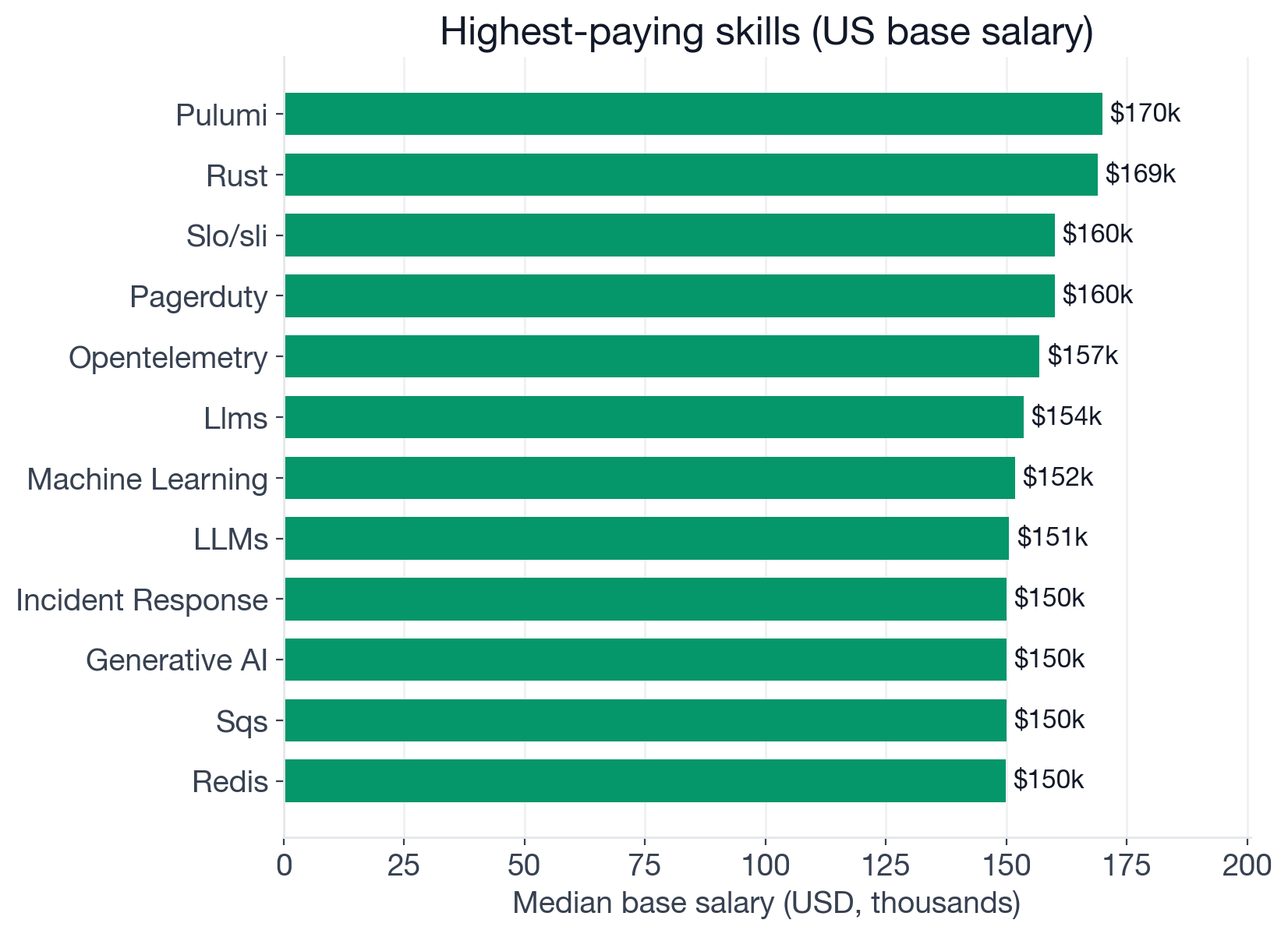
Median US base salary by skill, DevOps Engineer postings, June 2026. Skills with fewer than 25 US salary observations are excluded.
Two specialist tools sit at the very top of the full dataset: Pulumi ($170,000, n=35) and Rust ($169,000, n=28). Both clear the 25-observation threshold, and both signal compensation at the frontier of cloud infrastructure tooling. Because they appear in under 1% of active postings, they are not a realistic planning target for most DevOps careers, but worth knowing if your current stack includes either. The analysis below focuses on the skills that appear frequently enough to carry labor-market weight.
The premium structure breaks into four distinct bands:
The reliability and observability tier ($15-31K above baseline):
- SLO/SLI: $160,000 (+$30,600)
- OpenTelemetry (the open-source observability framework): $156,900 (+$27,500)
- Incident Response: $150,000 (+$20,600)
- Observability: $145,000 (+$15,600)
- GitHub Actions: $145,000 (+$15,600)
For SLO/SLI, OpenTelemetry, Incident Response, and Observability, the pattern is consistent: these represent the SRE discipline that large-scale services depend on to stay up. Engineers who instrument systems, define reliability targets, and own incident processes are not just wielding tools, they are owning an outcome. Companies that run at scale pay a premium to hire engineers who make reliability a first-class concern. GitHub Actions is the exception in this salary band: it is a CI/CD automation platform, not a reliability discipline. Its salary premium more plausibly reflects that GitHub Actions is the default pipeline choice at modern, higher-paying tech employers rather than signaling SRE expertise.
The AI infrastructure tier ($20-22K above baseline):
- Machine Learning: $151,800 (+$22,400)
- Generative AI: $150,000 (+$20,600)
About 12% of DevOps Engineer postings explicitly require ML or AI skills. These are roles building MLOps pipelines, deploying LLM serving infrastructure, or maintaining AI platform tooling. That 12% is not the full picture of how AI touches the role, though.
The JetBrains Developer Ecosystem Survey 2025 found 85% of engineers using AI tools regularly, and the DORA State of DevOps 2025 found 90% of tech professionals using AI in their daily development work. That ambient layer looks like: Copilot for writing Terraform, ChatGPT for debugging Kubernetes errors, AI-assisted pipeline configuration. The 12% posting figure measures who is hired specifically to build AI systems. The ambient baseline now applies to virtually every DevOps engineer regardless of what the job description says.
If you want to target the AI infrastructure tier, filter DevOps Engineer postings for machine learning skills to see what is actively available. For a deeper look at how AI is reshaping the role day-to-day, how AI is changing DevOps Engineering in 2026 covers the full picture.
The cloud-native core (near baseline, $0-4K above):
- Terraform: $133,100 (+$3,700)
- Kubernetes: $133,100 (+$3,700)
- AWS: $131,800 (+$2,400)
- CI/CD: $130,000 (+$600)
- Python: $130,000 (+$600)
These are the table-stakes skills. They barely move the salary needle above the baseline because every qualified candidate already has them. Knowing Kubernetes and Terraform is the floor for a competitive DevOps profile, not a salary lever. Deepening these skills is the right move early in your career; counting on them to grow your salary at the senior level is not.
The legacy and Windows track ($18-28K below baseline):
- Azure DevOps: $111,300 (-$18,100)
- Windows: $107,700 (-$21,700)
- PowerShell: $101,600 (-$27,800)
The Windows-centric DevOps stack consistently signals a different, lower-paying market: on-premise enterprise environments, government IT, legacy application support. If your current profile is PowerShell-heavy, the salary data is clear about the direction of travel. Adding cloud-native skills (specifically in the observability and GitOps space) is the highest-leverage move for increasing your market rate.
The Core Skill Combinations in 2026
Individual skills tell you what to learn. Skill pairs tell you what combinations employers actually hire for together and which pairs appear more frequently than chance alone would predict.
| Pair | Share of Postings | Lift |
|---|---|---|
| Docker + Kubernetes | 32.9% | 1.54 |
| Infrastructure as Code + Terraform | 31.2% | 1.71 |
| Kubernetes + Terraform | 39.2% | 1.40 |
| AWS + Infrastructure as Code | 27.7% | 1.41 |
| AWS + Terraform | 37.4% | 1.39 |
| CI/CD + Terraform | 42.5% | 1.26 |
| CI/CD + Docker | 32.1% | 1.25 |
| CI/CD + Kubernetes | 45.6% | 1.21 |
Lift above 1.0 means a pair appears together more often than chance. The highest-lift combination outside of definitional pairs is Docker plus Kubernetes at 1.54: if a posting asks for Kubernetes, it is 54% more likely than average to also ask for Docker. This is the containerization stack, Docker packages and Kubernetes orchestrates, which has become the default application delivery model.
Kubernetes plus Terraform (lift 1.40) is the cloud-native infrastructure stack: you provision the cluster with Terraform and run workloads on it with Kubernetes. AWS plus Terraform (1.39) and AWS plus IaC (1.41) follow the same pattern for AWS-first shops.
CI/CD plus Terraform (lift 1.26) signals the pipeline-as-code discipline, where infrastructure changes flow through the same review and automation process as application code. For DevOps Engineer roles with Terraform skills, this combination appears in 42% of active postings.
How Hard Is It to Break In as a DevOps Engineer?
Very hard, and the numbers make this concrete. Entry-level DevOps postings represent 1.9% of the market, roughly 146 of 7,523 analyzed. That is lower than Data Engineering (3% entry-level) and considerably lower than Data Analyst (8% entry-level). DevOps is a discipline where companies assume prior infrastructure experience; the expectation is usually two to four years working with Linux systems, CI/CD pipelines, or cloud platforms before you'd qualify for a junior-to-mid DevOps role.
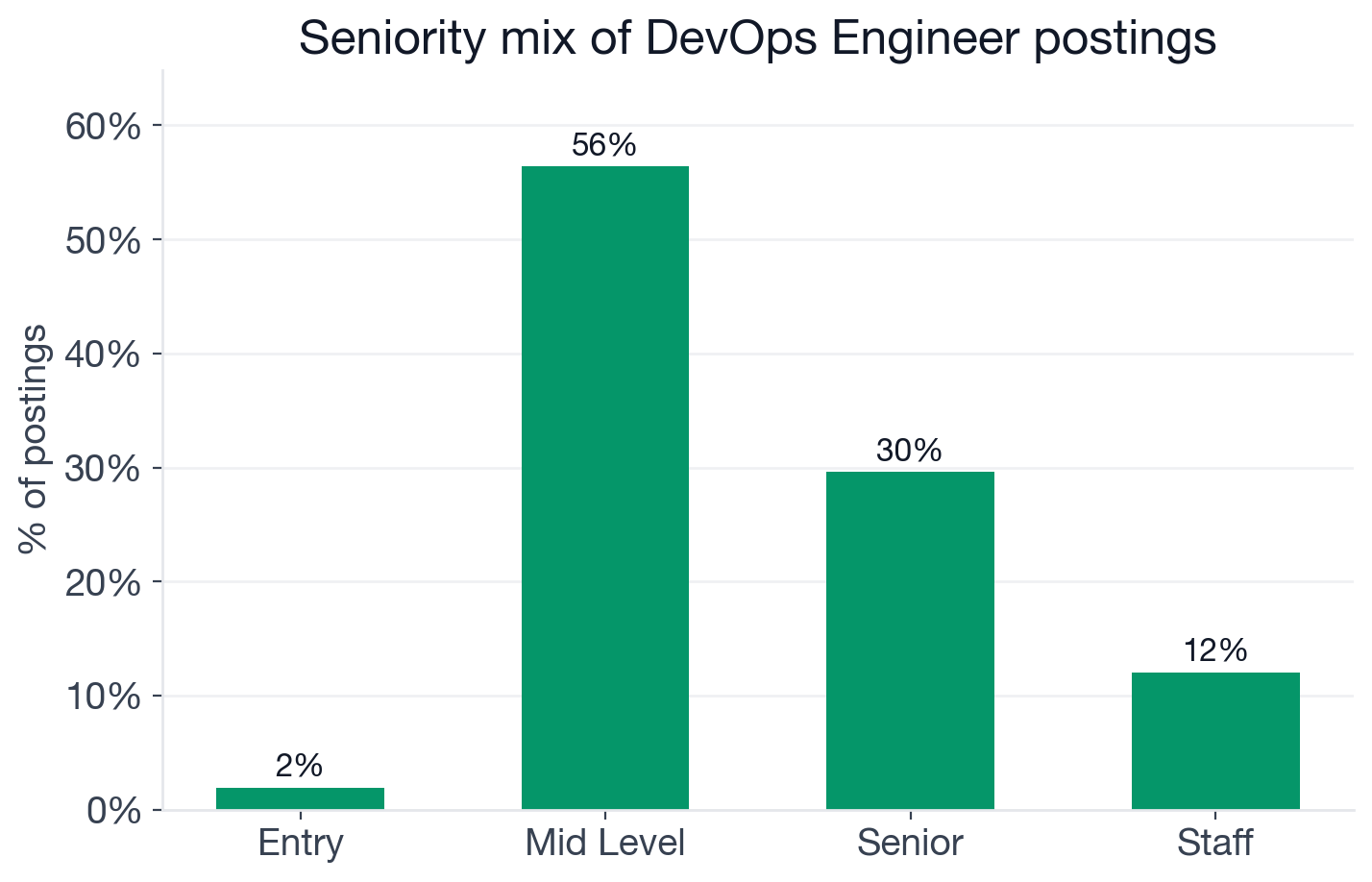
Seniority distribution across 7,523 active DevOps Engineer postings, June 2026. Seniority is inferred from job title keywords; postings without an explicit signal default to mid-level.
Mid-level dominates at 56%, senior at 30%, and staff at 12%. The 12% staff share is worth noting: platform engineering and SRE work at scale represent a substantial fraction of what the market wants. Those roles typically require deep expertise in reliability or security domains, which maps directly to the premium skills identified in the salary section.
The practical path in: systems administration, junior platform engineering, or software development with strong infrastructure exposure. Building reps on Linux, learning one cloud platform (AWS and Azure are both solid starting points), and contributing to open-source CI/CD pipelines gets you to the entry bar. From there, the DevOps Engineer job board filtered to entry and junior-level postings shows what the market is actually posting. If you are deciding between adjacent roles, Backend Developer vs. DevOps Engineer and Software Engineer vs. DevOps Engineer break down how the skill sets diverge.
Where Are the Jobs, and How Remote Are They?
The US accounts for 29% of active postings, the largest single market. India is second at 14%, noticeably smaller than its share in data engineering roles where India approaches the US. The UK (4.2%), Germany (3.5%), Canada (3.2%), and Australia (2.9%) round out the top markets.
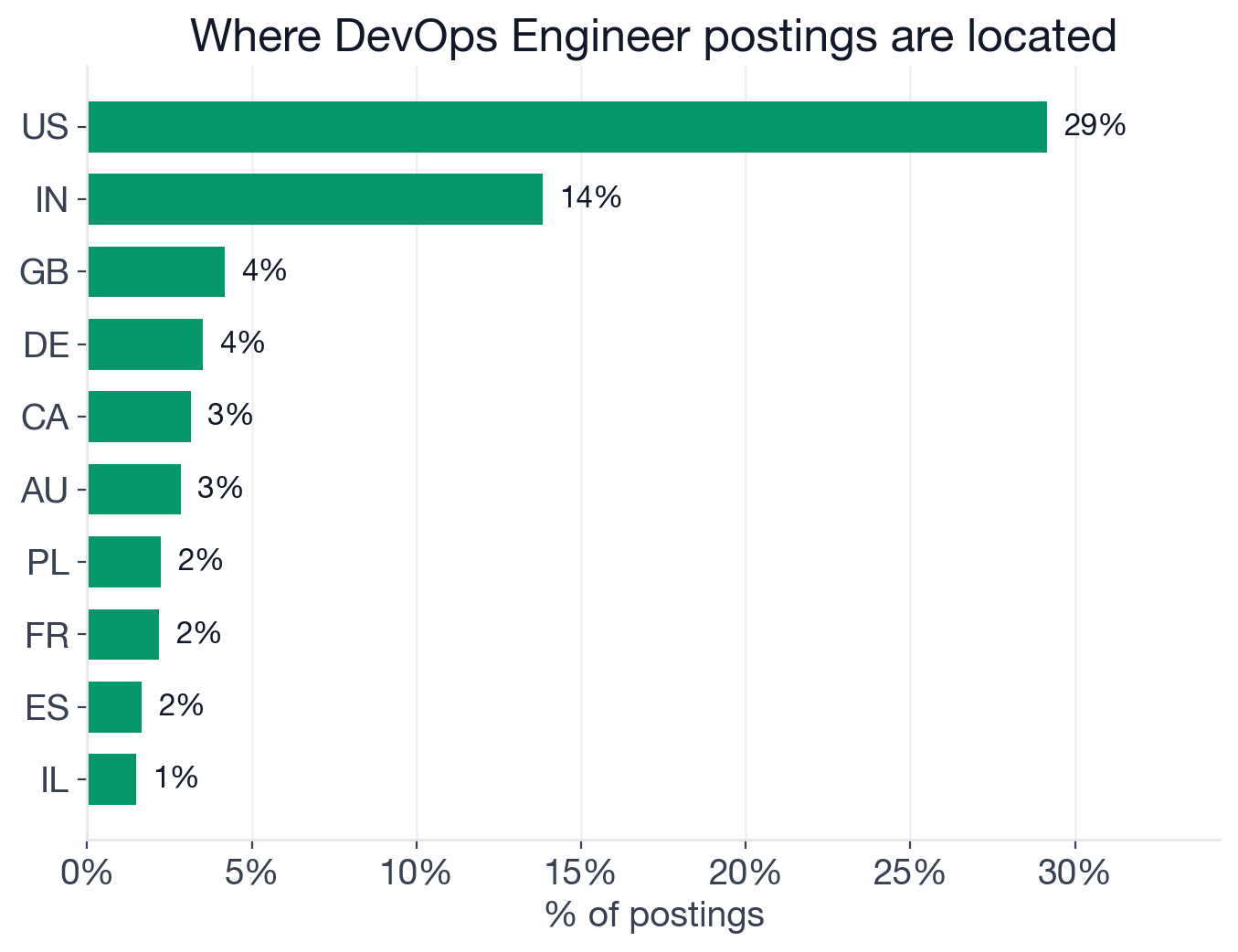
Geographic distribution of 7,523 active DevOps Engineer postings. "Unknown" includes postings where the work location was not disclosed.
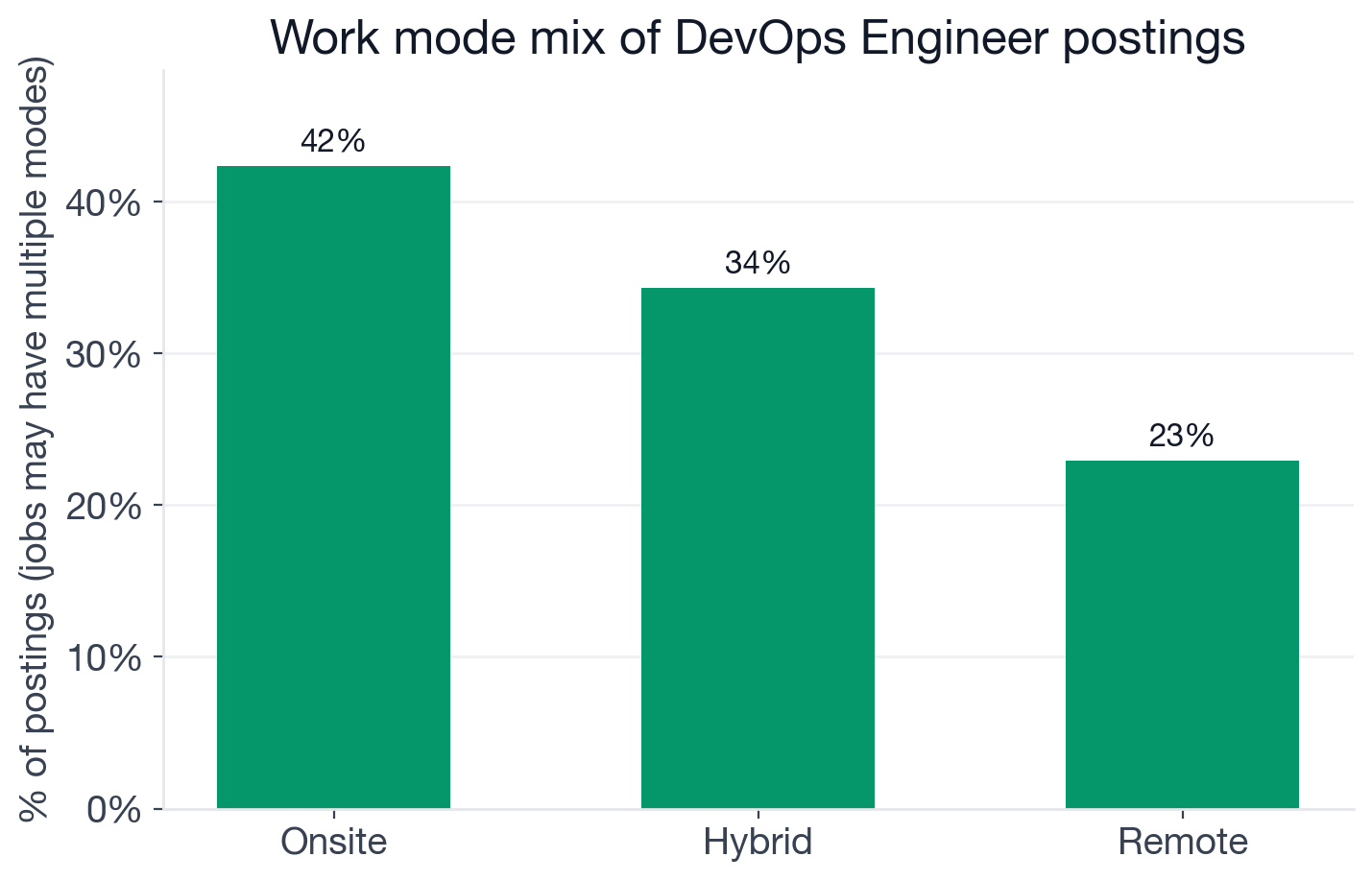
Work mode distribution across DevOps Engineer postings with a disclosed work mode.
Remote is available in 23% of postings, hybrid in 34%, and onsite in 42%. The infrastructure-intensive nature of the role keeps onsite rates higher than for pure software development. Financial services and defense employers, both significant hirers, tend toward hybrid and onsite more than tech-product startups do.
Remote availability is not uniform across skill types. Postings that list cloud-native skills like Kubernetes and Terraform skew more heavily toward remote and hybrid than Windows-centric postings, which tend to reflect on-premise environments where physical proximity matters more.
Who Is Hiring DevOps Engineers?
Among direct employers (staffing and placement firms appear prominently in raw posting counts but are excluded here since their listings represent contractor placement rather than their own headcount), the roster is dominated by consulting, defense, and financial services: Accenture (110 active postings), Thales (76), Deutsche Telekom IT Solutions Slovakia (52), PricewaterhouseCoopers (51), ING (50), Booz Allen Hamilton (49), Barclays (49), Leidos (38), London Stock Exchange Group (36), and SAP (31). Note: "Thales" and "Thales Group" appear as separate entries in the source data; combined they total 127 postings, making Thales the largest identifiable direct employer in this dataset.
That concentration reflects something real about where DevOps Engineering demand concentrates. Large enterprises modernizing legacy infrastructure, financial institutions moving workloads to cloud, and defense contractors requiring infrastructure automation at scale are among the most consistent explicit hirers. The most cloud-native product companies tend to fold DevOps responsibilities into senior engineering roles rather than posting a distinct "DevOps Engineer" title.
The consulting and professional services firms (Accenture, PwC, Booz Allen) are hiring for client-facing DevOps work, which means exposure across industries and toolchains but also a consulting work model. Financial services firms (ING, Barclays, LSEG) tend toward hybrid arrangements and value security and compliance experience heavily. Defense contractors (Thales, Booz Allen, Leidos) often require security clearance eligibility, which narrows the candidate pool but also reduces competition for cleared roles.
How to Use This in Your Job Search
The salary data draws a clear roadmap. If you are already in the cloud-native core (CI/CD, Kubernetes, Terraform, AWS), the marginal return on adding more of the same is low. The skills that add $10,000 to $30,000 to your salary median are the reliability and observability layer: SLO/SLI definitions, OpenTelemetry instrumentation, incident response ownership. These require production exposure to systems that actually break, not just certifications.
If your current stack is Windows-centric, the direction of travel is equally clear. PowerShell and Azure DevOps correlate with below-market rates, and that gap is $18,000 to $28,000. Adding a cloud-native foundation (Linux, one cloud platform, Terraform basics) through side projects or a role transition is the first move toward the $129,400 median.
For interview prep, the question bank at InterviewStack.io covers Kubernetes architecture, CI/CD design patterns, Terraform state management, and observability concepts. Use AI mock interviews to drill incident response scenarios and infrastructure design questions, which show up frequently in senior DevOps interview rounds. Browse active DevOps Engineer openings to see which skill combinations are actively hiring right now.
For skill-building toward the reliability tier, interactive courses at InterviewStack.io cover cloud infrastructure, distributed systems, and system design foundations that map directly to what senior DevOps and SRE interviews test.
FAQ
Q. What skills do companies require from DevOps Engineers in 2026?
Five skills are table stakes, each appearing in more than half of active postings: CI/CD (67%), automation (58%), Kubernetes (56%), AWS (54%), and Python (53%). The common tier (20-50%) adds Terraform, monitoring, Azure, Docker, infrastructure as code, Linux, Bash, and observability. Differentiators in the 5-20% range include Prometheus, GitHub Actions, Helm, ArgoCD, GitOps, and Datadog.
Q. What is the median DevOps Engineer salary in 2026?
The median US base salary across 1,151 DevOps Engineer postings with disclosed US compensation is $129,400. That figure covers base pay only; equity and bonuses, which are common at tech and finance employers, are not captured in posted salary data.
Q. Which DevOps skills pay the highest salary premium in 2026?
Among widely-used DevOps skills, reliability engineering signals lead the salary premium list. SLO/SLI (service-level objective and indicator tracking) shows a median of $160,000 among US postings, about $30,600 above the $129,400 baseline. OpenTelemetry ($156,900), Machine Learning ($151,800), Incident Response ($150,000), and Observability ($145,000) follow. At the other end, PowerShell ($101,600) and Windows ($107,700) sit $22-28K below the baseline.
Q. How hard is it to break into DevOps Engineering as a beginner?
Very hard. Only 1.9% of DevOps Engineer postings are explicitly entry-level (roughly 146 of 7,523 analyzed). Mid-level roles dominate at 56%, senior at 30%, and staff-level at 12%. The practical route in is through adjacent roles: systems administrator, junior platform engineer, or software developer with infrastructure exposure.
Q. Is DevOps Engineer a remote-friendly role in 2026?
More than average, but not fully distributed. About 23% of DevOps Engineer postings are explicitly remote, 34% hybrid, and 42% onsite. Infrastructure-intensive work and security requirements keep onsite rates higher than for pure software development roles.
Q. What is the dominant DevOps skill stack in 2026?
The core stack is Kubernetes plus Terraform, co-occurring in 39% of postings with a lift of 1.40. Docker and Kubernetes pair in 33% (lift 1.54), and CI/CD plus Terraform appear together in 42% (lift 1.26). The five table-stakes skills: CI/CD (67%), automation (58%), Kubernetes (56%), AWS (54%), and Python (53%) each appear in more than half of active postings, with Terraform just at the 50% threshold.
Q. What role do AI tools play in DevOps Engineering in 2026?
There are two layers. About 12% of DevOps Engineer postings explicitly require AI or ML skills, covering roles that build MLOps pipelines or deploy LLM infrastructure. Separately, developer surveys from JetBrains and DORA show 85-90% of engineers now use AI tools regularly for tasks like Terraform authoring, pipeline debugging, and runbook drafting. One layer measures who builds AI systems; the other is a baseline expectation across the field.
Where to Take This
The core DevOps stack (CI/CD, Kubernetes, Terraform, AWS, Python) is now the minimum viable profile for mid-level roles. What separates the top third of the market from the middle is the reliability layer: observability ownership, SLO management, incident response discipline. Those skills are not just certifications; they are earned by running systems in production at scale. Start with the cloud-native core, reach a mid-level role, then move toward the reliability tier deliberately. That is where the $30,000 premium lives.
Topics
Ready to practice?
Put what you've learned into practice with AI mock interviews and structured preparation guides.