
Software Engineer or DevOps Engineer: What the Data Says
The salary gap between these two roles is the most counterintuitive number in the comparison: just $7,500. Software Engineers earn a median $140,000 US base salary versus $132,500 for DevOps Engineers, a 5.7% premium small enough that a well-chosen specialization on either side erases it. What is not close is the volume: 48,435 Software Engineer postings versus 7,434 for DevOps Engineer on the InterviewStack.io job board as of May 2026, a 6.5x ratio. The choice between these careers is not about chasing a salary gap. It is about what kind of work you want to spend your days doing.
| Software Engineer | DevOps Engineer | |
|---|---|---|
| Median US base salary | $140,000 (n=10,875) | $132,500 (n=1,138) |
| Active postings | 48,435 | 7,434 |
| Top skill | Python (32%) | CI/CD (65%) |
| Entry-level share | 4% | 2% |
| Remote share | 18% | 23% |
| Skill overlap (Jaccard) | 36% | 36% |
Key Findings
- Median US base salary is $140,000 for Software Engineer (n=10,875) versus $132,500 for DevOps Engineer (n=1,138), a $7,500 (5.7%) premium.
- Software Engineer has 48,435 active postings versus 7,434 for DevOps Engineer, a 6.5x volume advantage, making it one of the largest single-role markets in tech.
- The two roles share 36% of their top-30 skill sets (Jaccard), dominated by CI/CD, Python, AWS, Kubernetes, Docker, monitoring, and observability.
- Entry-level access is narrow on both sides: 4% for Software Engineer (1,914 postings) and 2% for DevOps Engineer (150 postings).
- DevOps Engineer is more remote-friendly: 23% remote versus 18% for Software Engineer, and 34% hybrid versus 27%.
- Specialist premiums are steeper in DevOps relative to baseline: Pulumi adds $32.5K above the DevOps median (n=38, treat as directional given small sample); Rust adds $24.2K above the Software Engineer median.
What Does Each Role Actually Do?
Software Engineer builds the product. The week is writing application services in Python, Java, JavaScript, or TypeScript; designing REST APIs that users or downstream services consume; working with PostgreSQL, MySQL, or NoSQL databases; and shipping features through code review and CI/CD pipelines. The exclusive-skill profile confirms the application-development stack: APIs (20%), JavaScript (18%), TypeScript (17%), React (15%), Microservices (11%), Distributed Systems (11%). The output is functionality an end user or another service actually uses.
DevOps Engineer builds the platform the product runs on. The work is defining cloud infrastructure with Terraform (an infrastructure-as-code tool, present in 47% of DevOps postings), managing Kubernetes clusters, building CI/CD pipelines with Jenkins or GitHub Actions, and running observability stacks with Prometheus and Grafana. The exclusive-skill list reads like an operations playbook: Infrastructure as Code (36%), Bash (27%), Jenkins (26%), Ansible (24%), Prometheus (20%), Grafana (20%). The output is a reliable, automated platform that software engineers deploy to. Think of Software Engineer as writing the code that ships; DevOps as building the conveyor belt and runway it ships on.
What Skills Do Both Roles Require?
Both roles share a modern cloud-and-automation core. CI/CD, Python, AWS, automation, Kubernetes, monitoring, Docker, Azure, and Linux all appear in both top-30 skill lists, giving the 36% Jaccard overlap its practical meaning: an engineer coming from either side already has a real foundation for the other.
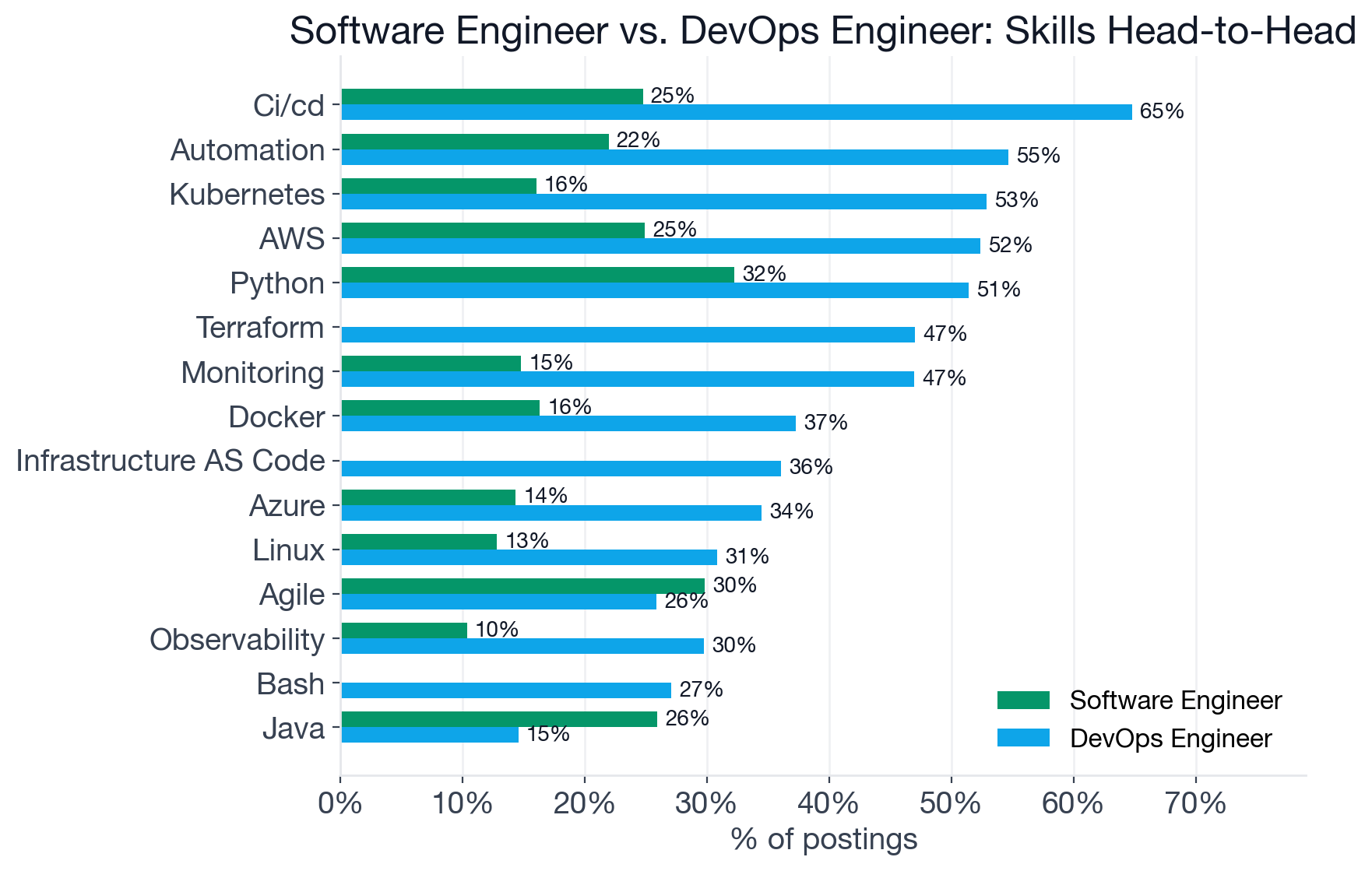
Share of postings asking for each skill: Software Engineer (n=48,435) vs DevOps Engineer (n=7,434). Skills drawn from the union of each role's top-30 lists.
The weights are not symmetric. CI/CD sits in 65% of DevOps postings but only 25% of Software Engineer ones. Kubernetes is at 53% versus 16%. AWS is at 52% versus 25%. These shared skills are the DevOps engineer's primary surface; for the Software Engineer, they are supporting infrastructure. Building the Kubernetes cluster and writing the application that runs inside it are genuinely different jobs, even though they require some of the same vocabulary.
Where Do the Roles Diverge?
Exclusive to Software Engineer
The Software Engineer exclusives are the application-development and language stack:
- APIs: 20% (Software Engineer + APIs openings)
- JavaScript: 18%
- TypeScript: 17%
- Debugging: 16%
- React: 15%
- C++: 12%
- C#: 12%
- Microservices: 11%
- Distributed Systems: 11% (Software Engineer + Distributed Systems openings)
- PostgreSQL: 10%
This cluster describes a role that lives inside code: designing service boundaries, writing frontend and backend logic, modeling data, and debugging production issues at the application layer. The presence of Microservices and Distributed Systems at 11% each signals that even generalist Software Engineer postings expect reasoning about consistency, latency, and partial failure as routine work.
Exclusive to DevOps Engineer
The DevOps exclusives are the infrastructure-as-code, CI, and observability stack:
- Terraform: 47% (DevOps + Terraform openings)
- Infrastructure as Code: 36%
- Bash: 27%
- Jenkins: 26%
- Ansible: 24% (configuration management tool for automating server setup and state)
- GitLab: 20%
- Prometheus: 20%
- Grafana: 20%
- GitHub Actions: 18%
- Containerization: 17%
Platform engineering assumes infrastructure is defined in repeatable text, not clicked through a console (IaC at 36%). The presence of Jenkins, GitHub Actions, and GitLab in the same exclusive list signals that DevOps engineers are expected to be portable across CI vendors. Prometheus and Grafana at 20% each mean a substantial share of postings want someone who can stand up an observability stack from scratch.
Note: Several staffing and consulting agencies (Softtest Pays Pty Ltd, PradeepIT, Boardroom Appointments, and others) rank among the most active DevOps posters in this dataset. Agency postings tend to use broad, catch-all skill lists, which may moderately inflate frequencies for generalist tools such as Jenkins and Ansible relative to what direct-hire postings alone would show.
Which Pays More?
Among US postings with disclosed base salary, Software Engineer leads at $140,000 (n=10,875) versus $132,500 for DevOps Engineer (n=1,138), a $7,500 gap. These figures are restricted to US postings only and represent base salary. Equity, bonuses, RSUs, and sign-on are not disclosed in postings and are not in this dataset, so total compensation at top employers is meaningfully higher for both roles.
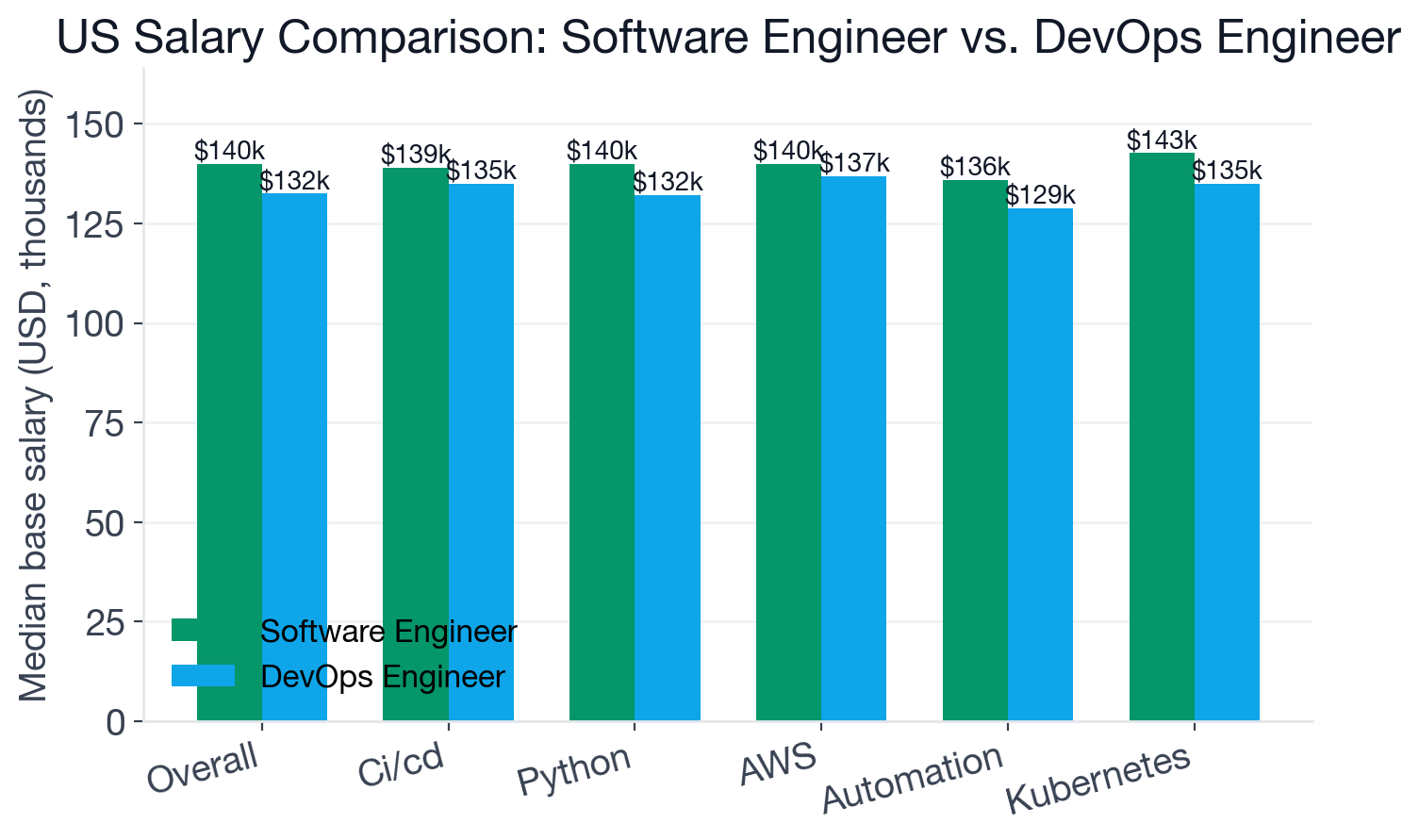
Median US base salary for postings that mention each skill, restricted to US postings with structured salary data.
The 5.7% headline gap is small enough that skill specialization more than erases it. For Software Engineers, Rust clears $164,200 (n=587, a $24.2K premium over the $140K baseline); Distributed Systems and Observability both reach $159,200, about $19.2K above baseline. For DevOps, the premiums are steeper relative to the lower floor: Pulumi (a multi-language infrastructure-as-code platform) leads at $165,000 (n=38, treat as directional given the small sample); OpenTelemetry (an open-source observability standard for traces, metrics, and logs) reaches $160,000 (n=58, +$27.5K above the DevOps baseline); PagerDuty (an incident management platform) also hits $160,000 (n=26, small sample). Datadog sits at $150,000 (+$17.5K, n=96). A DevOps engineer with Pulumi or OpenTelemetry expertise earns at or above the Software Engineer median.
Which Has More Job Openings?
Software Engineer is one of the largest single-role markets in tech: 48,435 active postings versus 7,434 for DevOps, a 6.5x gap. The DevOps figure captures DevOps Engineer, DevSecOps, platform engineering, and adjacent infrastructure titles that the role classifier matched: the 7,434 reflects the full matched set, which includes a small share of adjacent roles. The practical implication extends beyond raw count.
Entry-level access sits at 4% for Software Engineer (1,914 postings) versus 2% for DevOps (150 postings). In absolute terms, Software Engineer has nearly 13 times as many explicitly junior openings. The seniority mix is otherwise similar: both roles are mid-heavy (52% for Software Engineer, 57% for DevOps), with senior tiers near 30% on each side.
Geography and work mode differ more sharply. Software Engineer is more US-concentrated at 38% US and 19% India, with additional volume in Canada (4%), UK (3%), and Germany (3%). DevOps Engineer is more globally distributed at 29% US and 13% India, with proportionally stronger European representation: UK (4%), Germany (4%), France (2%), and Israel (2%) each claim a larger share of DevOps postings than they do of Software Engineer's. The work-mode split is the clearest difference: DevOps is more remote-friendly at 23% remote and 34% hybrid versus 18% remote and 27% hybrid for Software Engineer, with onsite at 49% versus 59%. Platform teams tend to be the most distributed function in tech, with incident-response needs partially offset by the async-first culture of infrastructure work.
Which Should You Choose?
Choose Software Engineer if you:
- Want to build the product itself: write application code, design APIs, model data, and ship features that users or downstream services consume.
- Prefer a language-depth career in Python, Java, TypeScript, or C++, working with microservices, distributed systems, and databases as daily design problems.
- Want the largest job market in tech, a marginally more accessible entry path, and a salary ceiling that rewards systems, AI, and observability specializations.
Choose DevOps Engineer if you:
- Want to build and operate the platform: Terraform-managed infrastructure, Kubernetes clusters, CI/CD pipelines, and observability stacks that benefit every engineering team.
- Are comfortable at the shell, in YAML, and inside Linux, and prefer automation work whose output multiplies across dozens of downstream teams.
- Want a more remote-friendly and hybrid-heavy role with a globally distributed market, and the ability to earn at the Software Engineer median or above by specializing in Pulumi, Datadog, or OpenTelemetry.
If the choice is close, the convergence zone is informative: the highest-paying specialties on both sides (observability, distributed systems, AI tooling) land in the same salary range. Our interactive courses cover systems, cloud, and engineering fundamentals for both tracks; the question bank lets you drill API design, Kubernetes, CI/CD pipelines, and distributed systems; and AI mock interviews put you under realistic onsite conditions for either path. For a deeper dive into the Software Engineer skill set, see our Software Engineer skills analysis. For a comparison that stays entirely on the infrastructure side, see Backend Developer vs DevOps Engineer.
FAQ
Q. What's the salary difference between Software Engineer and DevOps Engineer in 2026?
The median US base salary is $140,000 for Software Engineer (n=10,875) versus $132,500 for DevOps Engineer (n=1,138), a $7,500 (5.7%) premium for the Software Engineer role. Both figures are base only and exclude equity, RSUs, and bonuses, so total comp at top employers runs meaningfully higher for both.
Q. How much do Software Engineer and DevOps Engineer skills overlap?
About 36% (Jaccard similarity on each role's top-30 skills). Both roles share CI/CD, Python, AWS, automation, Kubernetes, monitoring, Docker, Azure, and Linux. The overlap is real but asymmetric: DevOps demands these shared skills in 31-65% of postings while Software Engineer asks for them at 13-32%. The same tools mean a different job depending on which side of the wire you are on.
Q. Which role has more job openings in 2026?
Software Engineer is far larger: 48,435 active postings versus 7,434 for DevOps Engineer on the InterviewStack.io job board in May 2026, a 6.5x volume ratio. Software Engineer is one of the largest single-role markets in tech; DevOps is a healthy but much more concentrated specialty.
Q. Which role is easier to break into at the entry level?
Software Engineer is marginally more accessible: about 4% of postings (1,914 of 48,435) are explicitly entry-level versus 2% for DevOps Engineer (150 of 7,434). Neither is easy; both overwhelmingly expect production experience. The absolute number of entry openings skews heavily toward Software Engineer given the volume advantage.
Q. Should I become a Software Engineer or a DevOps Engineer in 2026?
Choose Software Engineer if you want to write application code, design APIs, and ship features users see, with the largest job market in tech and a clearer entry path. Choose DevOps Engineer if you want to build and maintain the infrastructure everyone ships on: Terraform-managed cloud, Kubernetes clusters, CI/CD pipelines, and observability stacks, with a more remote-friendly work mix and outsized premiums for specialists.
Q. Which skills command the biggest salary premium in each role?
For Software Engineer, among widely cited application-development and systems engineering skills (n≥500), Rust leads at $164,200 (+$24.2K above the $140,000 baseline); Distributed Systems and Observability each reach $159,200 (+$19.2K, both n>1,400). For DevOps Engineer, the premiums are steeper relative to the lower baseline: Pulumi ($165,000, +$32.5K above $132,500; small sample, n=38, treat as directional), OpenTelemetry ($160,000, +$27.5K), PagerDuty ($160,000, +$27.5K; small sample, n=26), and Datadog ($150,000, +$17.5K).
Q. Where are the jobs and how remote-friendly is each role?
Software Engineer is more US-concentrated: 38% US, 19% India, with Canada, UK, and Germany rounding out the top five. DevOps Engineer is more globally distributed at 29% US, 13% India, with proportionally stronger European representation in UK, Germany, France, and Israel. DevOps is noticeably more remote-friendly: 23% of DevOps postings are remote versus 18% for Software Engineer, and 34% are hybrid versus 27%.
Final Thoughts
Software Engineer and DevOps Engineer share a cloud-and-automation core but represent genuinely different careers. Software Engineers write the product; DevOps Engineers build the platform it runs on. The salary difference is too small to drive the decision at just 5.7%, and a well-chosen specialization on either side closes the gap entirely. Software Engineer is the larger market by a wide margin and has a more accessible entry path. DevOps is more remote-friendly, more globally distributed, and pays outsized premiums for infrastructure specialists. Browse live Software Engineer postings or DevOps Engineer postings on InterviewStack.io to see what is open today.
Topics
Ready to practice?
Put what you've learned into practice with AI mock interviews and structured preparation guides.