
The Cloud Architect Cloud Storage Interview Wants a Pattern, Not a Vendor Name
You're a few minutes into a mid-level Cloud Architect interview, and the interviewer has just described a media-processing platform that ingests user-uploaded videos and images, runs them through asynchronous transcoding and thumbnail generation, serves the processed assets globally, and has to hold some of that data for seven years for compliance. The product team expects volume to grow fast over the next year, and finance wants the storage bill under control without slowing anything down for users.
This walkthrough runs on the real interview package InterviewStack.io's AI interviewer uses for a mid-level Cloud Architect interview on cloud storage services and trade-offs, the same blueprint scored by the Cloud Architect question bank if you want to drill the underlying concepts first.
It's tempting to answer with a product catalog: object storage for the uploads, a managed database for the metadata, done. But this interview's scoring explicitly excludes provider-specific API trivia and memorizing individual cloud SKU names, and it rewards choosing a storage paradigm, object, block, or file, because the access pattern demands it, not because it's a familiar product name. A candidate who reaches for one object storage bucket to solve every part of this platform, or narrates a tour of vendor products without saying why, is behind before the first follow-up lands.
Key Findings
- 100 rubric points split 30/30/20/20 across Interviewer Objectives Alignment, Level-Specific Expectations, Technical Proficiency, and Communication and Problem Solving, so 60 of 100 points ride on framing and judgment, not vendor trivia.
- The interview runs 30 minutes across 4 phases: 0-7 min on workload framing, 7-20 min (13 minutes) on core storage architecture, 20-27 min on resilience and optimization, and 27-30 min on wrap-up.
- Phase 2 alone carries 5 of the interview's 14 checklist items, more than any other single phase, across its 13 minutes.
- One follow-up asks you to separate storage choices across four distinct data classes in the same platform: raw uploads, transcoding scratch space, shared application state, and long-term compliance retention.
- Compliance retention is fixed at 7 years in the scenario, a constraint the Phase 2 checklist expects you to separate from the hot-serving path, not delete or shortcut for a lower bill.
- 4 skill areas sit outside this interview's scope entirely, including provider-specific SKU trivia and infrastructure-as-code syntax.
- 14 checklist items span all 4 phases, and only 2 of them arrive in the last 3 minutes, when you're expected to synthesize, not introduce new ideas.
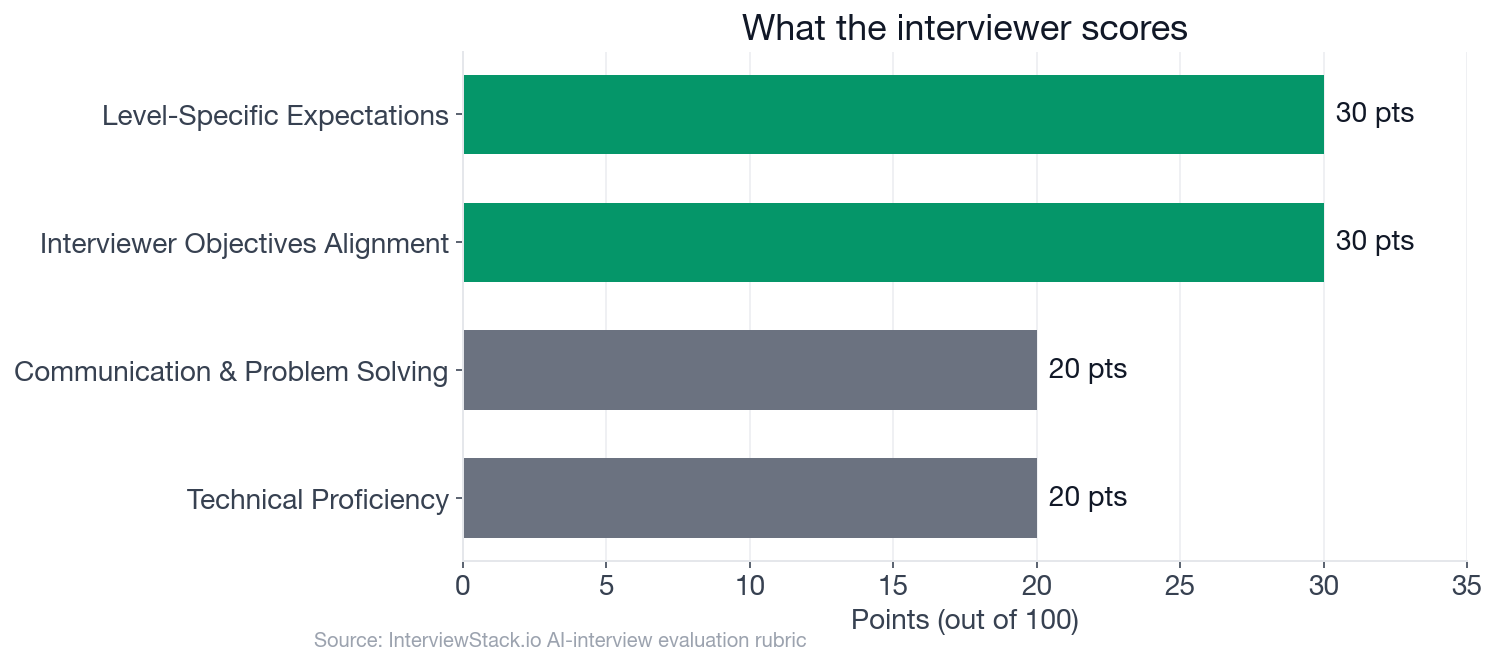
Framing and mid-level judgment, the top two dimensions, are worth more than Technical Proficiency and Communication combined (60 vs. 40 points).
What Is the Interviewer Actually Testing in This Scenario?
Here's the question as it appears in the live blueprint:
The interview question
You are reviewing the storage design for a new media-processing platform at a large tech company. The platform ingests user-uploaded videos and images, stores originals, runs asynchronous transcoding and thumbnail generation, serves processed assets globally through downstream services, and retains some data for compliance for 7 years. The product team expects rapid growth over the next 12 months, and finance has asked engineering to control storage cost without hurting user-facing performance.
How would you design the storage layer for this platform, and what trade-offs would drive your choices?
The interviewer is checking whether you can choose between object, block, and file storage for each part of this platform, reason about durability, availability, consistency, latency, throughput, and cost trade-offs, map access patterns to lifecycle needs, and surface operational concerns like backup, replication, archival, and recovery, before landing on a pragmatic mid-level design with clear assumptions and fallback options.
Four Follow-Ups, Four Data Classes That Don't Share a Bucket
The candidate below, Rafael, is dramatized to show where mid-level answers commonly lose points, not a transcript of a real session. These four follow-ups move from splitting the data by class, to the concurrency problem in shared state, to trimming the bill without breaking the compliance clock, to recovering when something goes wrong.
Turn 1: Splitting the Data by Class
Interviewer: "How would you separate storage choices for raw uploads, transcoding scratch space, shared application state, and long-term compliance retention?"
Turn 2: The Metadata Race
Interviewer: "What consistency or concurrency issues could show up if multiple processing workers touch the same asset metadata or intermediate files?"
Turn 3: The Bill Can't Touch the Compliance Clock
Interviewer: "If leadership asks for a lower storage bill, where would you apply lifecycle, tiering, or archival policies, and what product impact would you call out?"
Turn 4: Getting It Back
Interviewer: "How would your design change if a subset of assets must be recovered quickly after accidental deletion or a regional outage?"
Why Isn't Spotting These Mistakes on the Page Enough?
Every mistake above is easy to catch here, the rubric line is basically printed next to it. Live, there is no rubric line. You get 30 minutes, an interviewer who follows up the moment your answer defaults to a vendor name or skips a data class, and a checklist you cannot see. Recognizing the one-bucket mistake while reading an article is a different skill from catching yourself reaching for a single storage answer mid-sentence, with the clock running. The only way to build that instinct is reps in the AI mock interview itself.
How Does the 30-Minute Clock Actually Split?
The chart below maps how the interview's 14 checklist items are distributed across framing, core architecture, resilience, and wrap-up.
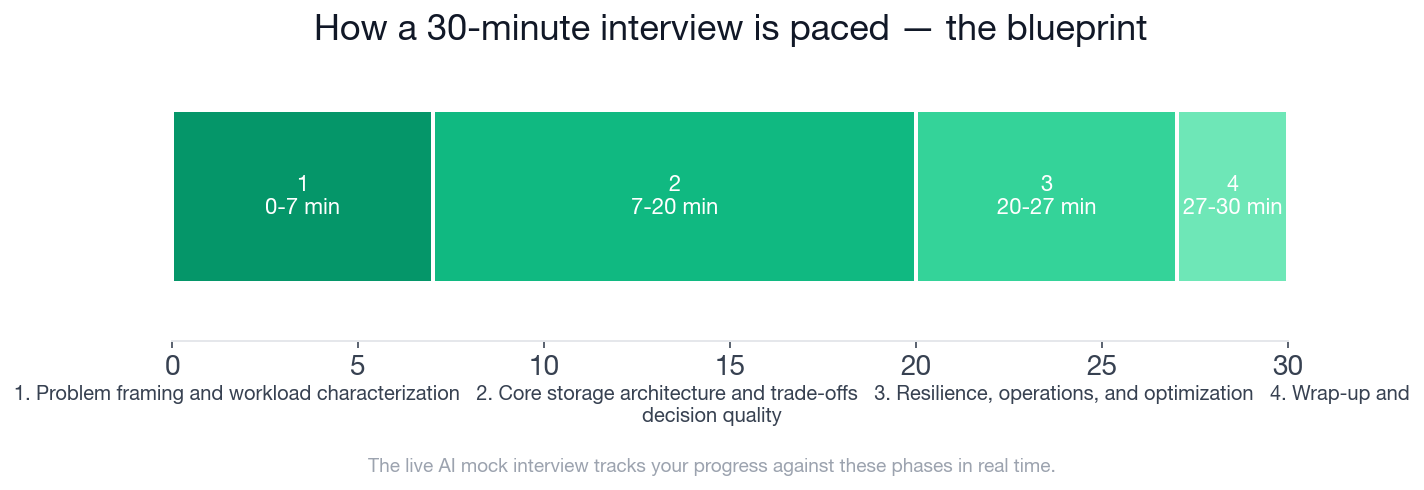
Phase 2, core storage architecture and trade-offs, is both the longest phase and carries the most checklist items: 13 minutes covering 5 of the interview's 14 checklist items, more than any other single phase.
This is the blueprint a strong candidate hits, phase by phase, and the exact structure the AI mock interview tracks you against while you're answering, not after:
- ✓Asks or states assumptions about object sizes, read/write frequency, growth, geographic access, and recovery expectations
- ✓Distinguishes user-facing paths from background processing paths
- ✓Identifies that different data classes in the same product likely need different storage backends or tiers
- ✓Places durable originals and processed media in object storage and justifies using high durability, scalability, and lower cost per GB
- ✓Uses block storage for low-latency transient worker volumes, local processing, or attached databases where appropriate, and notes attachment/per-instance limitations
- ✓Uses file storage only if there is a real need for shared filesystem semantics across workers or legacy tooling, and explains the operational and cost trade-off
- ✓Calls out lifecycle tiers for old or infrequently accessed assets and separates compliance retention from hot serving needs
- ✓Mentions deletion protection, versioning, snapshots, replication, or backup strategy for accidental loss and disaster scenarios
- ✓Identifies metrics such as storage growth, request latency, throughput, error rates, retrieval time from colder tiers, and cost by bucket/volume/workload
- ✓Explains at least one recovery approach for accidental deletion, corruption, or regional failure
- ✓Describes a sensible policy for archival and retrieval that balances compliance and restore-time expectations
- ✓Adjusts design when prompted about scale or budget rather than defending the initial answer rigidly
- ✓Summarizes the final storage split clearly by workload
- ✓Names the top 2-3 trade-offs or risks and how they would validate them in production
Take This Design Into a Real Interview
Reading the four mistakes above is the easy part. The AI mock interview for Cloud Architect cloud storage asks this scenario, follows up based on what you actually propose, and scores you across all four rubric dimensions the moment the 30 minutes end. That's the only way to find out whether you would actually separate the four data classes live, not on a re-read of this post. For focused drilling first, the question bank for cloud storage services and trade-offs covers paradigm selection, lifecycle policy, and recovery planning with worked answers. The InterviewStack.io preparation guide maps this topic into the broader Cloud Architect prep path, and the Cloud Architect anti-patterns walkthrough covers the same role in a different scenario.
FAQ
Q. What does a mid-level Cloud Architect cloud storage interview test?
The interview runs 30 minutes across 4 phases: problem framing and workload characterization (0-7 min), core storage architecture and trade-offs (7-20 min), resilience, operations, and optimization (20-27 min), and wrap-up and decision quality (27-30 min). The rubric weights Interviewer Objectives Alignment and Level-Specific Expectations at 30 points each, so framing and judgment account for 60 of 100 points, with Technical Proficiency and Communication and Problem Solving worth 20 each.
Q. Do I need to name a specific cloud vendor's storage product to score well?
No. This interview explicitly excludes provider-specific API trivia and memorization of individual cloud SKU names from its scope. The rubric rewards selecting a storage paradigm, object, block, or file, based on access pattern and workload semantics, not naming a vendor's specific product.
Q. How many distinct data classes does the interview scenario actually require you to separate?
At least four: raw user uploads, transcoding scratch space, shared application state used by processing workers, and long-term compliance retention. One follow-up explicitly asks how you would separate storage choices across exactly these four classes, and the Phase 2 checklist expects a different backend or tier for each rather than one storage decision for the whole platform.
Q. What mistake does this interview's checklist penalize most directly?
Treating the platform as one storage decision, usually one object storage bucket for everything, instead of mapping each data class to the paradigm that fits its access pattern. That gap directly costs the Phase 2 checklist items for using block storage on transient worker volumes and for deletion protection, versioning, or lifecycle policy, all called out explicitly in the same phase's checklist.
Q. How should I prepare for a Cloud Architect cloud storage interview?
Practice separating a scenario's data by access pattern and lifecycle before naming any storage technology, reasoning about durability, latency, throughput, and cost trade-offs across object, block, and file storage, and describing lifecycle tiering, backup, and recovery approaches without defaulting to vendor-specific trivia. The InterviewStack.io AI mock interview for Cloud Architect cloud storage tracks you against the live blueprint in real time.
Q. What is the scoring rubric for this Cloud Architect interview?
Four dimensions totaling 100 points: Interviewer Objectives Alignment (30 points), Level-Specific Expectations (30 points), Technical Proficiency (20 points), and Communication and Problem Solving (20 points). The two highest-weighted dimensions reward workload-to-storage mapping and trade-off reasoning, not memorized vendor terminology.
Q. Does this interview require deep database query tuning or infrastructure-as-code syntax?
No. The blueprint explicitly excludes deep database query optimization unrelated to storage selection, application-layer video codec algorithm design, and infrastructure-as-code or CI/CD pipeline implementation details. The focus stays on storage paradigm selection, lifecycle management, and operational trade-offs.
The Pattern Outlives the Product
Vendors rename their storage products every few years; object, block, and file storage do not stop meaning what they mean. Candidates who score well here reason from access pattern to paradigm first, then reach for a specific product only to execute the trade-off they already justified. That ordering, pattern before product, is exactly what reps in a live interview build.
Topics
Ready to practice?
Put what you've learned into practice with AI mock interviews and structured preparation guides.