
Doubling peak traffic is the easy part of this interview. The points leak somewhere quieter: a candidate who is fluent in Kubernetes, load balancers, and replicas gets asked one question about a half-broken availability zone and realizes the design never said what happens to the surviving two. This is a mid-level Cloud Architect scaling interview built on a real InterviewStack.io AI mock interview blueprint, with a 99.95% target that leaves roughly 22 minutes of downtime a month. The answers below are illustrative, not a transcript of any real person or company.
Key Findings
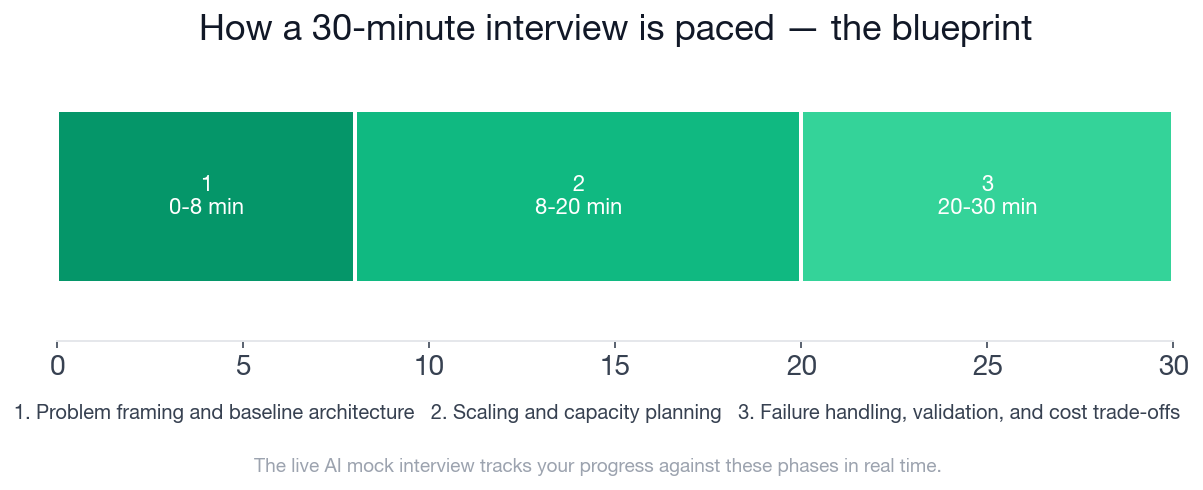
- The interview runs 30 minutes across 3 phases: 0-8, 8-20, and 20-30.
- Scoring is out of 100 points; Interviewer Objectives Alignment and Level-Specific Expectations are worth 30 each.
- The scenario starts at 18,000 requests per second and peaks at 45,000, with peak expected to double to 90,000 within 12 months.
- The availability target is 99.95%, and the platform spans 3 availability zones.
- The first phase expects 2-4 clarifying questions before any design is drawn.
- The middle phase is the longest at 12 minutes and carries 6 checklist items.
- The last phase requires at least 2 validation methods, such as load testing and a failover drill.
Where Do Good Candidates Lose Points Without Noticing?
Not on tools. Naming HPA, Cluster Autoscaler, and Kafka is table stakes. Points go when an answer skips assumptions, treats a stateful tier like a stateless one, or reaches for multi-region because it sounds senior.
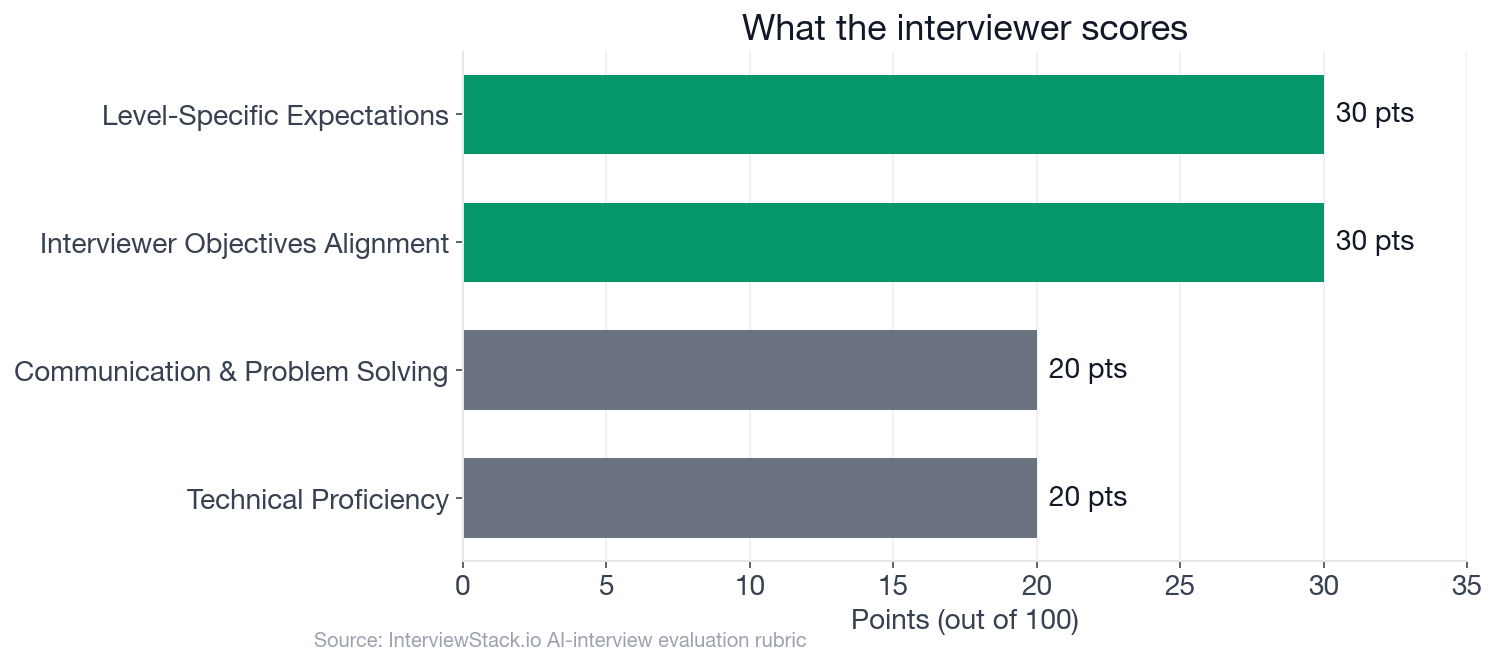
Level-specific expectations and objectives alignment together make up 60 of the 100 points, so how you reason about trade-offs outweighs how many products you can name.
The Scenario: What Is the Interviewer Asking You to Structure?
The interview question
A consumer-facing API platform runs on Kubernetes in one AWS region across 3 availability zones. It serves mobile and web traffic for account, catalog, and checkout workflows. Today it averages 18,000 requests per second and peaks at 45,000 requests per second during promotions. Leadership expects peak traffic to double within 12 months, and the platform has a 99.95% availability target. The current stack includes stateless API services behind load balancers, Redis for caching, Kafka for asynchronous events, and a PostgreSQL primary with read replicas.
How would you evolve this platform's architecture and operating model so it can scale to the projected demand and stay highly available during failures and traffic spikes?
The interviewer is probing whether you can turn a growth figure into scaling and redundancy decisions, choose between horizontal and vertical options, find the stateful bottleneck, and name the signals that warn you before the SLO breaks. The bar is a sound single-region, multi-AZ design with operational complexity a small team can run.
How a Cloud Architect Capacity Planning Interview Plays Out, Turn by Turn
Our candidate, Tomás, has prepared well. Here is where a common answer slips.
Turn 1: Autoscaling signals and oscillation
Interviewer: "What signals would you use to drive autoscaling for the API tier and the Kubernetes cluster, and how would you avoid slow scale-outs or oscillation during a flash sale?"
Turn 2: Rough sizing with assumptions
Interviewer: "How would you decide where to add headroom in this system, and can you walk me through rough sizing for application replicas, node capacity, and cache or database read capacity?"
Turn 3: Partial zone failure
Interviewer: "If one availability zone starts failing partially rather than going fully down, how should traffic management and failover behave at the load balancer and service level?"
Turn 4: Proving it before launch
Interviewer: "How would you validate that your proposed scaling and failover design actually works before a major promotion event?"
Why Isn't Reading This Walkthrough Enough?
Spotting these mistakes on the page is easy. Avoiding them live is the real skill, with a timer running and a follow-up you did not rehearse. You will not remember to state your sizing assumptions when the interviewer asks about replica lag instead. That habit comes from repetition, which is why the AI mock interview exists.
What Does the Full Blueprint Look Like?
This is the blueprint a strong candidate hits across the 30 minutes, and the exact checklist the AI mock interview tracks you against in real time.
- ✓Asks 2-4 useful clarifying questions about traffic shape, latency sensitivity, read/write mix, deployment constraints, or RTO/RPO expectations.
- ✓Separates stateless services from stateful dependencies and identifies likely bottlenecks in API, database, cache, and messaging layers.
- ✓Proposes a multi-AZ baseline with redundancy across at least compute, load balancing, and data access paths.
- ✓Keeps the initial design appropriately scoped for a mid-level architect instead of jumping immediately to globally distributed active-active.
- ✓Describes API tier scaling using concrete metrics such as CPU, memory, in-flight requests, request rate, latency, or queue depth rather than vague 'auto-scale on load' language.
- ✓Mentions Kubernetes concepts appropriately, such as HPA for pods, Cluster Autoscaler for nodes, resource requests/limits, pod disruption concerns, and uneven bin-packing or node shortages.
- ✓Addresses warm capacity or pre-scaling for known promotions, including scheduled scaling, cooldown tuning, or spare headroom to absorb bursts.
- ✓Provides rough sizing logic for replicas or nodes using assumptions tied to peak traffic, per-instance throughput, or safety margin.
- ✓Explains load balancing behavior with at least one meaningful trade-off such as L4 vs L7, least-connections vs round-robin, health checks, session affinity, or connection draining.
- ✓Discusses at least one scaling approach for PostgreSQL, Redis, or Kafka and notes relevant bottlenecks such as replica lag, hot keys, partition imbalance, connection limits, or storage IOPS.
- ✓Explains what happens during an AZ impairment and how traffic shifts safely without causing overload elsewhere.
- ✓Identifies observability needed to detect saturation before outage, such as latency, error rate, CPU throttling, memory pressure, queue lag, connection pool exhaustion, replica lag, cache hit rate, or disk/IOPS saturation.
- ✓Suggests at least two validation methods such as load testing, stress testing, soak testing, failover drills, or chaos experiments tied to the proposed design.
- ✓Makes a grounded cost recommendation, for example mixing reserved and on-demand capacity, careful use of spot for fault-tolerant workloads, or choosing managed services where team bandwidth is limited.
- ✓Shows awareness of over-engineering risks and states when multi-region failover is or is not justified for this scenario.
Run This Interview Live
Start the AI mock interview for this scenario and get scored against the same rubric, with follow-ups that adapt to what you actually say. Then drill the underlying topics in the Infrastructure Scaling question bank, browse Cloud Architect openings, or see company preparation guides. The cloud migration strategy walkthrough covers a neighboring Cloud Architect scenario.
FAQ
Q. What does a Cloud Architect capacity planning interview test?
It tests whether you can turn a growth figure into concrete scaling and redundancy decisions. In this blueprint that means 30 minutes across 3 phases: framing and baseline (0-8), scaling and capacity (8-20), and failure handling, validation, and cost (20-30).
Q. How is a mid-level Cloud Architect answer scored?
Out of 100 points: Interviewer Objectives Alignment 30, Level-Specific Expectations 30, Technical Proficiency 20, and Communication & Problem Solving 20. Trade-off reasoning and stated assumptions carry more weight than naming tools.
Q. Do I need multi-region design to pass at mid level?
No. The bar is a sound single-region, multi-AZ design first. Jumping straight to globally distributed active-active is a named red flag, and you should state when multi-region is or is not justified.
Q. How should I size capacity in an interview?
Start from peak traffic, divide by a measured or assumed per-replica throughput, then add an explicit safety margin and say which assumptions you made. The interviewer wants rough numbers with visible logic, not exact figures.
Q. Which signals predict saturation before an SLO breach?
Latency, error rate, CPU throttling, memory pressure, queue lag, connection pool exhaustion, replica lag, cache hit rate, and disk or IOPS saturation. Pick the ones tied to the tier you are scaling.
Q. How many validation methods should I name?
At least two, tied to your design: for example load or stress testing before the promotion plus a failover drill or chaos experiment for the zone-failure path.
Q. Can I practice this exact scenario?
Yes. The AI mock interview runs this blueprint live, asks unscripted follow-ups, and tracks you against the same phase checklist.
Your Next Rep
The design that scales to 90,000 requests per second is not the one that wins this interview. The one that states its assumptions and survives a half-broken zone does. Run it once live, read your feedback, and run it again.
Topics
Ready to practice?
Put what you've learned into practice with AI mock interviews and structured preparation guides.