
C++ Is a Default in Embedded and Games, and a Bonus Almost Everywhere Else
C++ appeared in 11,357 of the 159,143 active postings on the InterviewStack.io job board in the 90 days to November 25, 2026: 7.1%, or about 1 posting in 14, spread across 38 of the 39 roles we track. That share was flat across the window (8.5%, 7.3% and 6.7% by 30-day bucket, a drift of under two points), so this snapshot does not show a clear rise or fall (older windows only include postings still active, which under-counts churned ones, so this is not a reliable trend). Among US postings that disclose pay, those naming C++ advertise about 11% more base pay than those without it, in the same role and at the same level, with a handful of exceptions covered below.
That is the short answer. The useful part is the shape underneath it. C++ is not evenly wanted. Roughly 2 in 5 Embedded Developer postings name it, while for most roles it is a rounding error. Half of all C++ demand sits under one title, Software Engineer, where it is named in about 1 posting in 7. The counts come from the skills extracted from each posting, so they measure how often employers write C++ down, not how many people use it at work.
Key Findings
- 11,357 of 159,143 active postings (7.1%) name C++, across 38 of 39 roles (90 days to Nov 25, 2026).
- Software Engineer is 54% of all C++ postings (6,153), yet only 15% of Software Engineer postings name C++.
- C++ is standard for Embedded Developer (42% of postings) and Game Developer (51%, only 76 postings), and rare in data and product roles (under 3%).
- Of the 3,296 mentions with nearby required/preferred wording, 22% say required and 78% say preferred.
- Postings naming C++ advertise about 11% more US base pay than those without it in the same role and level (33 of 42 groups higher, 4 lower).
- Rust is the strongest pairing: 14.7% of C++ postings name it against 2.1% of all postings (7.0x lift).
- Amazon has 1,531 distinct openings naming C++, five times the next employer (Google, 306).
Which Roles Ask for C++?
C++ demand comes from two different places: a large general pool of Software Engineer postings, and a small set of roles where it is the working language.
| Role | Postings naming C++ | Share of that role's postings | Share of all C++ postings |
|---|---|---|---|
| Software Engineer | 6,153 | 15% | 54% |
| Embedded Developer | 1,108 | 42% | 10% |
| Applied Scientist | 483 | 33% | 4% |
| Engineering Manager | 377 | 5% | 3% |
| Systems Engineer | 371 | 8% | 3% |
| Machine Learning Engineer | 319 | 7% | 3% |
| Cybersecurity Engineer | 294 | 6% | 3% |
| Research Scientist | 182 | 18% | 2% |
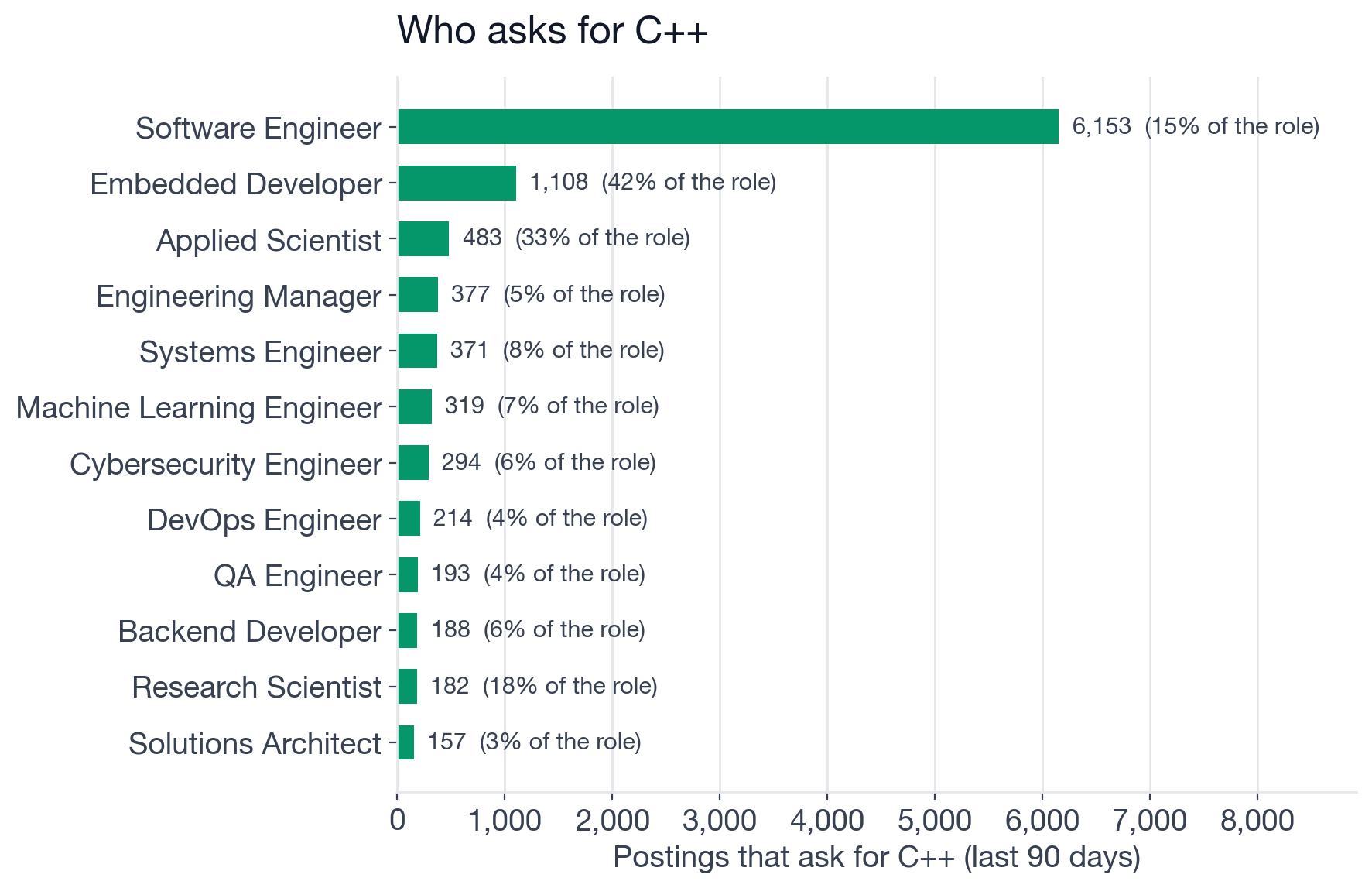
The chart shows two different questions. By volume, the Software Engineer bar dwarfs everything. By share of the role, Embedded Developer and Applied Scientist stand out: if you want to work as an Embedded Developer or Applied Scientist, C++ is named in a third to over two fifths of postings. Game Developer is higher still (51%), but with only 76 postings in the window, treat it as a direction, not a precise rate.
For a Software Engineer, the reading is different. About 85% of Software Engineer postings do not name C++, so it is a specialization within the role, not a baseline. Our Software Engineer skills breakdown shows what the broader role asks for, and the Embedded Developer skills post covers the role where C++ is closest to universal.
Is C++ Required or a Nice-to-Have?
Where postings say which it is, C++ is more often a preference than a requirement: of 3,296 mentions with required or preferred wording within about 160 characters, 725 (22%) were requirements and 2,571 (78%) were preferred or bonus. We read "preferred" whenever both kinds of wording appear nearby.
Treat that split with care. It covers 3,296 of the 11,357 mentions; the remaining mentions sat in lists with no qualifying wording, or could not be found in the first part of the description. A skill that appears in a long "technologies we use" list is neither required nor preferred in any strict sense. Read it as: when an employer does say, it more often calls C++ a plus than a must. The data cannot tell us how a hiring team weighs a preferred skill.
Do Postings That Name C++ List Higher Pay?
Inside the same role and seniority level, postings that name C++ advertise higher base pay in most cases, about 11% on average. This is US advertised base pay only, from postings that disclose a range, and it excludes equity and bonus, so total compensation at the large employers below is higher than any figure here. We compared postings with and without C++ within 42 role-and-level groups (each with at least 15 salaries on both sides), which cover 90% of the C++ postings in the pay sample. Of those groups, 33 point up and 4 point down.
| Role and level | With C++ (median US base) | Without C++ | Difference |
|---|---|---|---|
| Software Engineer, entry | $96,880 | $88,400 | +9.6% |
| Software Engineer, mid-level | $169,050 | $152,500 | +10.9% |
| Software Engineer, senior | $197,750 | $178,000 | +11.1% |
| Software Engineer, staff | $245,000 | $207,600 | +18.0% |
| Embedded Developer, senior | $183,300 | $154,000 | +19.0% |
| Applied Scientist, mid-level | $168,000 | $171,150 | -1.8% |
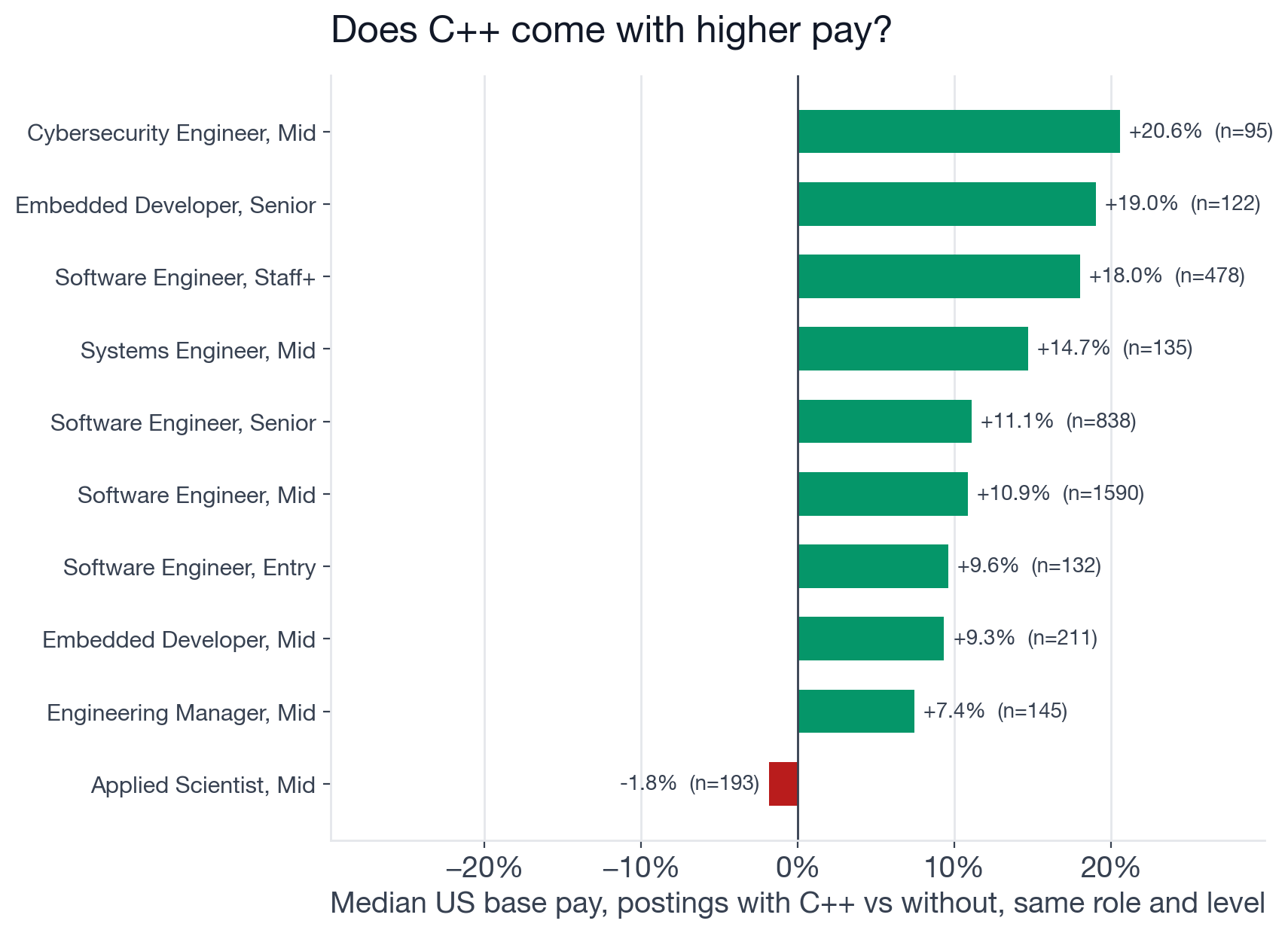
The chart is the part to read closely, because the average hides readers it does not describe. Applied Scientist mid-level postings that name C++ list slightly lower pay (-1.8%). Entry-level Embedded Developer postings list about 3.9% lower (88,450 vs 92,000 dollars, 32 and 33 salaries), and mid-level Data Engineer postings list about 2.7% lower. The gaps are also uneven in size: the Software Engineer gap widens with level, from about 10% at entry to 18% at staff. The data does not say why, and we are not going to guess.
What this does and does not show: these are advertised ranges, and the postings that name C++ come from different employers than the ones that do not (the employer mix differs, as the roster below shows). It describes what employers who ask for C++ advertise. It does not show that learning C++ would raise your pay.
What Should You Learn With C++?
Ranked by lift (how much more often a tool appears with C++ than in the corpus as a whole), the real pairings are Rust, C#, Java and Linux, not Python or AWS.
| Tool | Share of C++ postings | Share of all postings | Lift |
|---|---|---|---|
| Rust | 14.7% | 2.1% | 7.0 |
| C# | 23.2% | 6.1% | 3.8 |
| Java | 43.6% | 15.0% | 2.9 |
| Linux | 31.7% | 11.6% | 2.7 |
| PyTorch | 6.7% | 3.0% | 2.2 |
| Python | 62.7% | 34.8% | 1.8 |
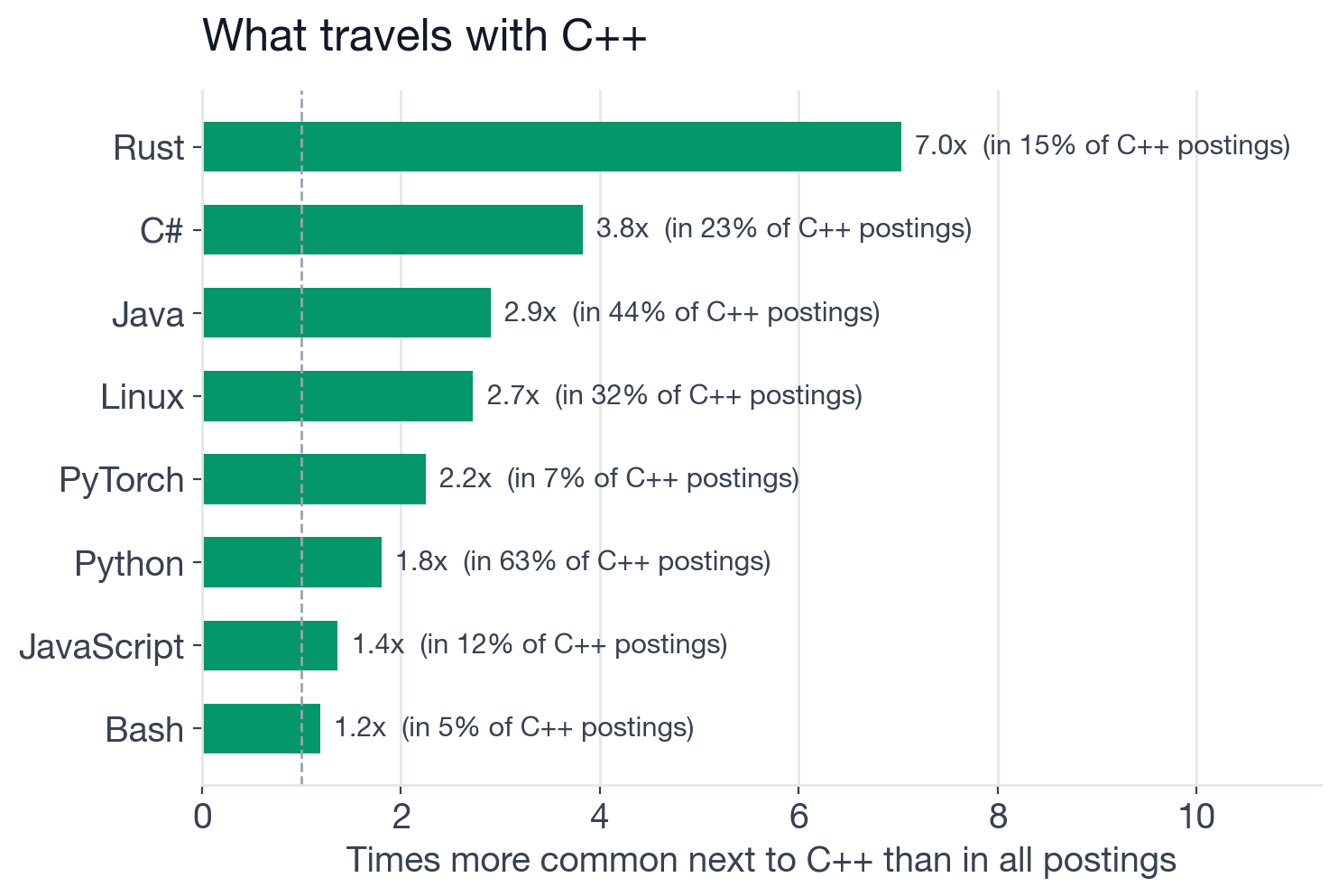
Python is in nearly two thirds of C++ postings, but it is in over a third of every posting we track, so it is a general expectation, not a C++ pairing. The same is true of AWS and SQL, which sit at or below their corpus share. Rust is the standout: it is named in 1,669 C++ postings. Linux and PyTorch reflect the two places C++ lives: operating-system and embedded work on one side, machine-learning runtimes on the other. Alongside it, the concepts that show up most are automation (28% of C++ postings), debugging (28%), code review (27%) and algorithms (22%), which describe the day-to-day work more than any tool.
If you already know C++, a second systems-adjacent language (Rust) and Linux fluency are the combinations that show up most distinctively alongside C++ in postings. This is overlap in what employers write, not evidence that either skill raises pay. Our Question Bank is a place to drill the algorithm and systems topics those roles test.
Who Posts the Most C++ Openings?
Large technology and hardware employers dominate, and one of them, Amazon, is far ahead. Ranked by distinct openings (not repeated postings of the same job):
| Employer | Distinct openings naming C++ |
|---|---|
| Amazon | 1,531 |
| 306 | |
| NVIDIA | 293 |
| Qualcomm | 285 |
| Microsoft | 244 |
| Meta | 142 |
| AMD | 128 |
| Anduril Industries | 117 |
The pattern is not a surprise to anyone in the field: cloud and big-tech platform teams, chip and silicon-software companies (NVIDIA, Qualcomm, AMD), and defense and aerospace firms (Anduril, SpaceX, Thales further down the list) are where C++ lives. Amazon's lead is large enough that it shapes the aggregate numbers on this board, which is one more reason to read the role-level shares above rather than the headline count alone. If you want the work, those three clusters are the map.
Where to Start
C++ looks most worth learning if you are aiming at embedded, game or applied-science work, where it is named in a third to a half of postings. Where employers say which it is, it is more often a stated preference than a requirement, and postings naming it advertise higher pay in most role and level groups (an association, not a promise). For a general Software Engineer path, it is a differentiator named in about 1 posting in 7, not a baseline. To see current openings, browse the job board; to test your readiness for systems-flavored interviews, try an AI mock interview, and build the surrounding fundamentals through our interactive courses.
FAQ
Q. How many job postings ask for C++ in 2026?
11,357 of 159,143 active postings on the InterviewStack.io job board (7.1%) named C++ in the 90 days to November 25, 2026. Postings in 38 of the 39 roles we track named it, and the share was flat across the three 30-day windows (8.5%, 7.3%, 6.7%).
Q. Is C++ required or just a nice-to-have in job postings?
Among the 3,296 postings where the wording near the mention shows which it is, 22% put C++ under requirements and 78% under preferred or bonus wording. The other 8,061 mentions had no nearby wording or could not be located, so the split covers a subset.
Q. Do postings that ask for C++ list higher pay?
On average yes, by about 11%, comparing US base pay in postings with and without C++ inside the same role and seniority level (42 role-and-level groups, 90% of C++ postings covered). It is not universal: 4 of the 42 groups, including mid-level Applied Scientist (-1.8%), go the other way. This is a correlation in advertised pay, not what C++ earns anyone.
Q. Which roles ask for C++ most often?
By share of the role's own postings, Game Developer (51%, from only 76 postings) and Embedded Developer (42%) lead, then Applied Scientist (33%). By volume, Software Engineer is 54% of all C++ postings, though only 15% of Software Engineer postings name C++.
Q. What should you learn alongside C++?
Rust has the strongest pairing: 14.7% of C++ postings name it against 2.1% of all postings (lift 7.0). C# (lift 3.8), Java (2.9) and Linux (2.7) follow. Python appears in 63% of C++ postings, but it appears next to nearly everything, so the lift is only 1.8.
Q. Which employers post the most C++ openings?
Amazon has the most distinct openings that name C++ (1,531), then Google (306), NVIDIA (293), Qualcomm (285) and Microsoft (244). Chip makers and defense or aerospace firms such as AMD, Anduril and SpaceX also rank in the top 15.
Topics
Ready to practice?
Put what you've learned into practice with AI mock interviews and structured preparation guides.