
How Do Customer Support Manager and Technical Support Engineer Actually Compare?
Technical Support Engineers have 50% more open roles (2,598 vs. 1,730), earn $5,000 more at the median US base salary ($75,000 vs. $70,000, base only from postings with wage disclosure), and are nearly twice as remote-friendly (23% vs. 12% remote). But Customer Support Managers are dramatically easier to break into: 1 in 5 CSM postings is explicitly entry-level, compared to just 1 in 20 for TSE. We analyzed 4,328 active postings on the InterviewStack.io job board as of May 2026 and found these roles share only 18% of their skill sets. They both have "support" in the title. They are different careers.
| Customer Support Manager | Technical Support Engineer | |
|---|---|---|
| Median US base salary | $70,000 | $75,000 |
| Active postings | 1,730 | 2,598 |
| Entry-level share | 20% | 5% |
| Remote share | 12% | 23% |
| Top skill | Excel (21%) | Windows (24%) |
| Skill overlap (Jaccard) | 18% (combined) | n/a |
Key Findings
- Technical Support Engineer has 50% more active postings than Customer Support Manager (2,598 vs. 1,730 analyzed in May 2026).
- TSEs earn a median $75,000 US base salary vs. $70,000 for CSMs (264 and 134 US postings with salary disclosed, respectively).
- The two roles share only 18% of their top-30 skill sets, one of the lowest overlaps in this comparison series.
- 20% of Customer Support Manager postings are entry-level (350 of 1,730); only 5% of TSE postings are (132 of 2,598).
- TSE is more remote-friendly: 23% of postings list remote vs. 12% for CSM; both remain majority-onsite.
- Windows (24% of TSE postings) correlates with a $58,100 median salary, $16,900 below the TSE baseline; APIs and Debugging push to $91,500 to $92,000.
- CSM hiring concentrates in retail, financial services, and BPO; TSE hiring skews toward SaaS and industrial-tech companies.
What Does Each Role Actually Do?
Customer Support Manager: This is a people-operations role. A CSM's week runs on coaching agents, reviewing queue metrics (CSAT, first-reply time, resolution rate), and designing workflows that reduce repetitive escalations. Decisions escalate toward Product and Operations, not Engineering. The defining skills are leadership, process design, and CX strategy, none of which show up reliably as resume keywords. One important context for 2026: the 2025 Salesforce State of Service report found 66% of service organizations now run AI agents, meaning most CSMs manage teams that work alongside automated routing and ticket deflection tools whether or not "AI" appears in the job description. A data note: the CSM postings in this analysis are led by Sherwin-Williams (203 postings), TD Bank (176), and Conduent (76): retail, banking, and BPO employers rather than technology companies. Salary figures, skill profiles, and entry-level rates below reflect that industry mix. Tech-sector CSM roles would likely show higher compensation and different tool requirements.
Technical Support Engineer: This is a technical debugging role that sits at the boundary between product and customer. A TSE diagnoses issues involving APIs, SQL queries, OS configurations (Windows, Linux), and cloud service credentials. They reproduce bugs, write runbooks, and build automation scripts to reduce escalation volume. The path for unresolvable issues goes to Engineering. TSEs who script in Python or write SQL queries fall squarely in the developer population: the 2025 JetBrains Developer Ecosystem Survey (24,534 respondents) found 85% of developers regularly use AI coding tools, which means Copilot and ChatGPT are baseline productivity tools for this role whether or not the posting says so.
What Skills Do Both Roles Require?
The shared foundation is narrow. Excel (21% of CSM postings, 7% of TSE), CRM software (12% CSM, 9% TSE), Monitoring (6% CSM, 16% TSE), and Salesforce (5% CSM, 8% TSE) appear in both. If you hold these four, they transfer. At 18% Jaccard overlap, though, nearly four-fifths of each role's skill set is unique to that role.
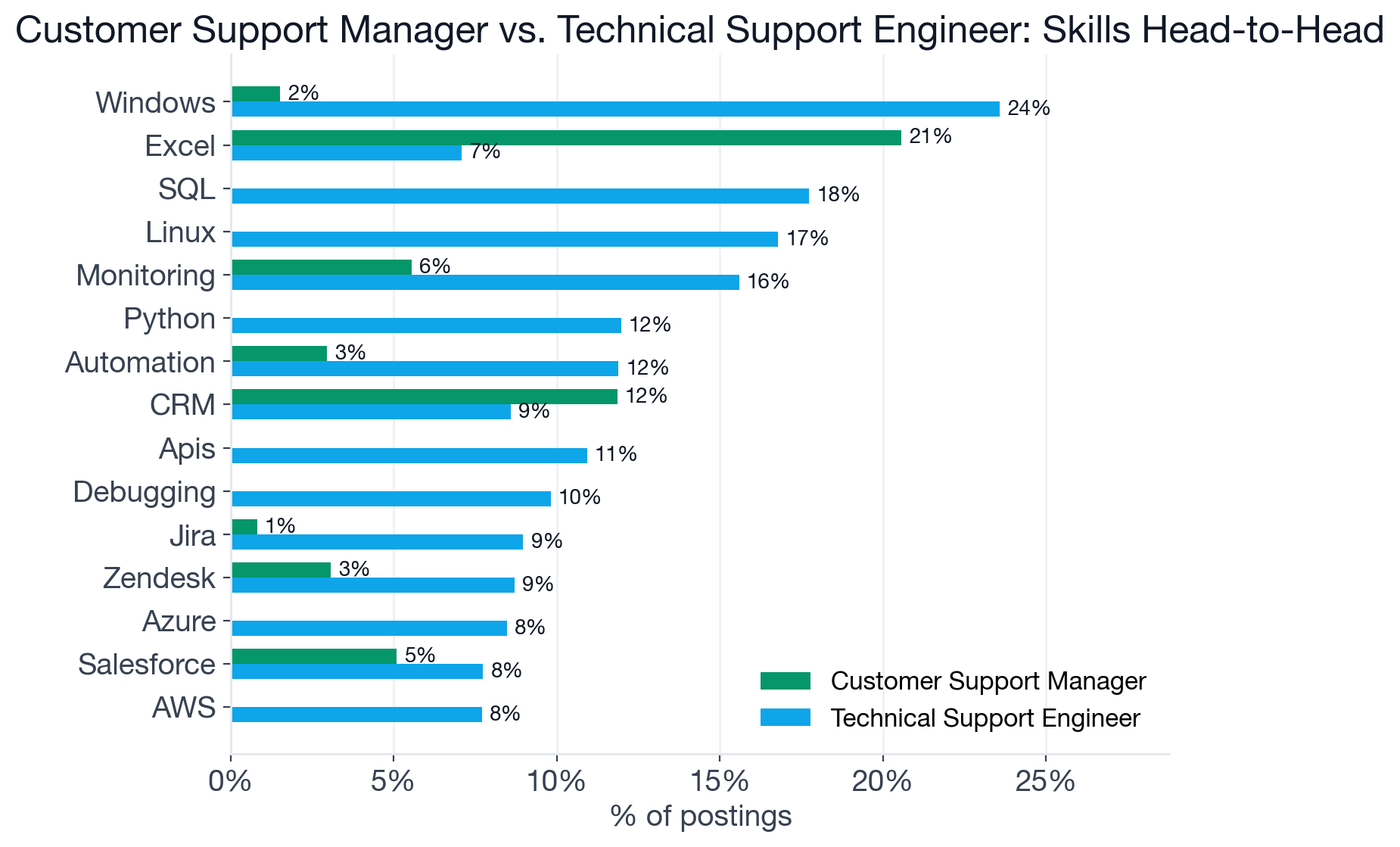
Top skills across both roles. CSM's profile is sparse above Excel and CRM; TSE builds out a full technical stack from Windows and SQL through Python, APIs, Azure, and Debugging.
The chart illustrates the asymmetry clearly: TSE has a dense, keyword-rich technical profile, while CSM's bar chart drops off quickly after the first two skills. That is not a weakness of the CSM role; it reflects that the work is measured in outcomes (team performance, CSAT scores) rather than tools.
Where Do the Roles Diverge?
Customer Support Manager's differentiators are not keyword-detectable. The analytics found no CSM skill that appears in at least 8% of CSM postings while staying below 5% in TSE postings. This is partly the nature of the role and partly a data pattern: the CSM dataset is dominated by retail, banking, and BPO employers where management competencies (coaching to performance targets, designing escalation playbooks, translating CX data into operational strategy) are articulated as outcome expectations rather than extractable tool or skill keywords. Tech-sector CSM roles, which would more often name platforms, represent a smaller share of this dataset. If you are applying for CSM roles, your impact bullets and leadership narrative will carry more weight than your skills section.
Technical Support Engineer's differentiators form a complete technical stack. The skills that appear in at least 8% of TSE postings but fewer than 5% of CSM postings span the breadth of modern IT support: Windows (24% of TSE postings), SQL (18%), Linux (17%), Python (12%), Automation (12%), APIs (11%), Debugging (10%), Jira (9%), Zendesk (9%), and Azure (9%). Each cluster signals a distinct tier of the role: desktop support (Windows, Linux, macOS), database/scripting (SQL, Python, Bash), and cloud/API work (Azure, AWS, APIs). Where you land in that hierarchy matters a great deal for salary.
Which Pays More: Customer Support Manager or Technical Support Engineer?
Technical Support Engineers earn more at the median, but the spread within TSE tells a more important story than the gap between roles.
Among US postings with salary data, the median TSE base salary is $75,000 (n=264); the median CSM base salary is $70,000 (n=134). These are US base salaries from postings with wage disclosure. Equity, bonus, and sign-on are not reflected, so total compensation at top employers runs higher than these figures.
The internal range within TSE is striking: Windows is the most-cited TSE skill at 24% of postings, yet Windows-focused TSE postings show a $58,100 median salary, $16,900 below the role baseline. These are largely helpdesk-tier roles. Move to API and scripting-focused openings and the picture inverts: APIs ($92,000, n=50), Debugging ($91,500, n=36), and Python ($90,000, n=30) each add $15,000 to $17,000 above baseline. The gap between a Windows-focused TSE and a Python/API-focused TSE is roughly $34,000 in median salary. Choosing where to develop within the TSE track matters as much as choosing the role itself.
For CSM, the only skill with sufficient US salary data is CRM (n=30, median $70,000), which sits exactly at the role baseline. There are no detectable skill premiums within the CSM salary data.
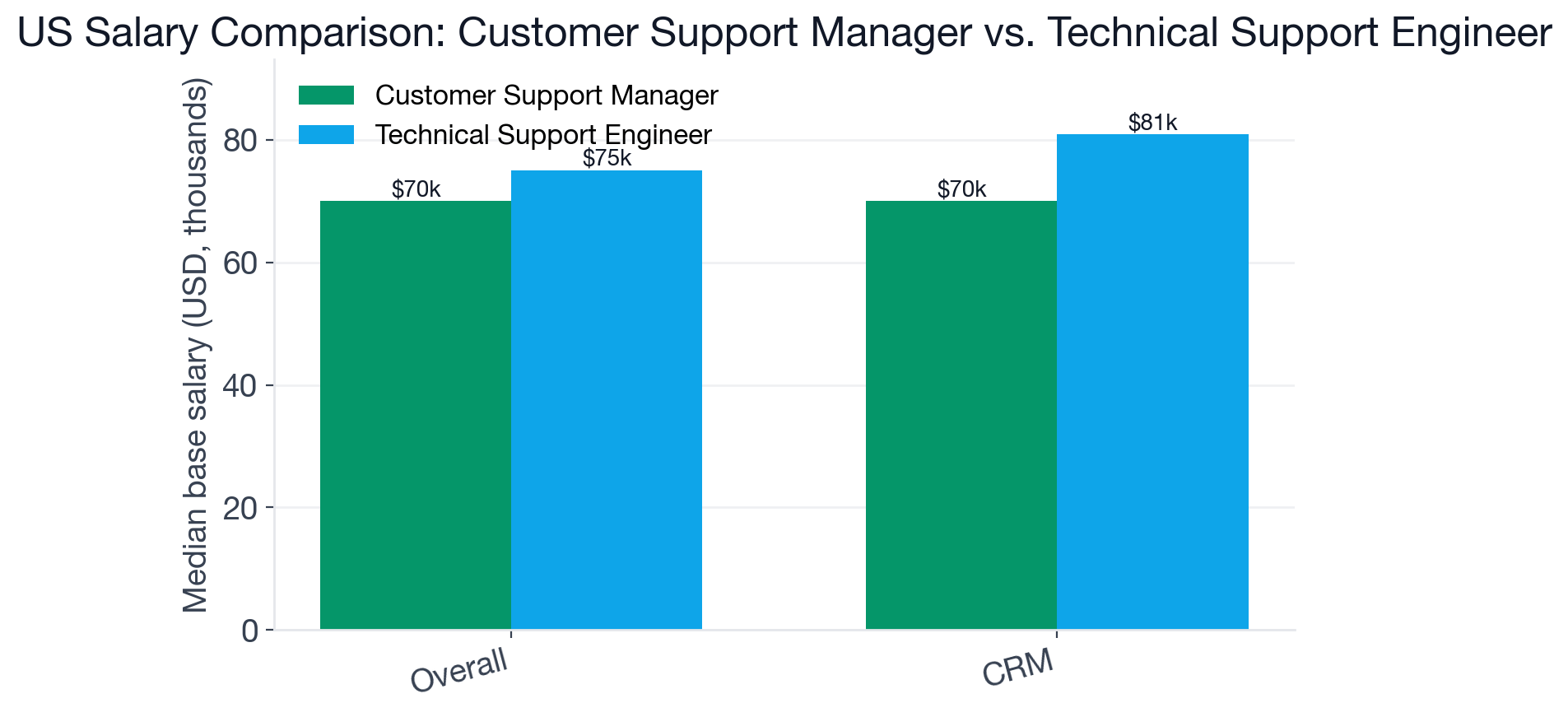
US base salary medians (skills with n≥25). TSE skill salaries range from $58,100 for Windows to $92,000 for APIs. CSM's only data point sits at the $70,000 baseline.
Which Has More Job Openings?
TSE leads by volume: 2,598 active postings vs. 1,730 for CSM. But the entry dynamics point in opposite directions.
Customer Support Manager is the more accessible career entry point. 350 of 1,730 CSM postings (20%) are explicitly entry-level, and mid-level accounts for 73% of all CSM postings. TSE is almost entirely mid-level: 82% of its 2,598 postings assume production troubleshooting experience, with only 132 (5%) categorized as entry-level. If you are switching careers without a technical background, CSM is the realistic path in; TSE typically requires demonstrated experience before a company will bet on you. Caveat: the 20% entry-level rate is shaped by the CSM dataset's industry mix: retail and BPO companies (Sherwin-Williams, Conduent, Enterprise Mobility) tend to hire customer service managers at earlier career stages than technology companies do. If you are targeting a tech-sector CSM role, treat this figure as an upper-bound estimate of accessibility rather than a universal benchmark.
Geography: CSM is heavily North American, with the US at 45% of postings and Canada at 14%. CSM in the Philippines (3%) and Malaysia (2.5%) reflects offshore support operations. TSE is more globally distributed: the US leads at 31%, followed by India (10%), the UK (5%), the Philippines (4%), and Canada (4%). SaaS companies frequently staff TSE roles across multiple time zones, which is why the geographic spread is wider and why the remote share is higher.
Which Should You Choose?
Choose Customer Support Manager if you:
- Have experience coaching or leading a team, even informally or in a non-support context
- Prefer process design and people operations over technical troubleshooting
- Are entering the support field without a deep technical background (20% entry-level)
- Are based in the US or Canada, where CSM hiring is most concentrated
- Can work primarily onsite or hybrid (only 12% of roles are remote)
Choose Technical Support Engineer if you:
- Have hands-on experience with Windows, Linux, SQL, or scripting (Python, Bash)
- Want to invest in API and Python skills to move toward the $90,000+ salary tier
- Need remote flexibility (23% remote, nearly double the CSM share)
- Are prepared for a mid-level-dominant market where entry-level roles are rare
- Are in the US, India, or UK, the top three TSE hiring markets
If your goal is breaking into tech support from a non-technical background, the realistic path starts as a customer service agent or help desk technician, not as a CSM. CSM is a management track that typically requires prior team-lead or operations experience; the 20% entry-level rate in this dataset applies to that management path and is shaped by the retail and BPO industry mix (Sherwin-Williams, Conduent, Enterprise Mobility), not by tech-sector norms. To eventually move toward TSE, build scripting skills (Python, Bash) and system-administration fundamentals (Linux, Active Directory) alongside a support-adjacent role, then use those credentials to qualify for a technical-track position.
These two roles share a category label but describe different careers. TSE is a technical debugging role with a richer, keyword-dense skill stack, a higher salary ceiling for those who invest in scripting and APIs, and more remote flexibility. CSM is a people-operations role with a dramatically more accessible management entry point, concentrated in North America, and measured in outcomes that resist keyword extraction.
Browse live Customer Support Manager openings or Technical Support Engineer openings on InterviewStack.io. To sharpen your interview readiness for either role, practice with AI mock interviews or work through the question bank for your target role before you apply. For a deeper look at the full CSM skill profile, the Customer Support Manager skills analysis covers umbrella categories, salary premiums, and the AI tooling shift in more detail.
FAQ
Q. What is the salary difference between Customer Support Manager and Technical Support Engineer in 2026?
Technical Support Engineers earn a median $75,000 US base salary vs. $70,000 for Customer Support Managers, based on 264 and 134 US postings with salary disclosed. That $5,000 gap understates the ceiling: TSEs who specialize in APIs, debugging, or Python earn $90,000 to $92,000. Equity and bonus are not reflected in posting data.
Q. Which role is easier to break into: Customer Support Manager or Technical Support Engineer?
Customer Support Manager is significantly more accessible. About 20% of CSM postings (350 of 1,730) are explicitly entry-level, versus only 5% for TSE (132 of 2,598). TSE is dominated by mid-level roles at 82% of all openings, meaning most employers expect production troubleshooting experience before hiring.
Q. What skills do Customer Support Manager and Technical Support Engineer share?
The two roles share only 18% of their top-30 skill sets (Jaccard similarity). The shared skills are thin: Excel (21% of CSM postings, 7% of TSE), CRM (12% CSM, 9% TSE), Monitoring (6% CSM, 16% TSE), and Salesforce (5% CSM, 8% TSE). These skills transfer between roles, but they are not the defining competencies of either.
Q. Does Technical Support Engineer offer more remote work than Customer Support Manager?
Yes. 23% of Technical Support Engineer postings list remote work (601 of 2,598 analyzed), compared to 12% for Customer Support Manager (212 of 1,730). Both roles remain predominantly onsite: 51% for TSE and 61% for CSM.
Q. What technical skills unlock higher salaries for Technical Support Engineers?
APIs ($92,000 median US base, n=50), Debugging ($91,500, n=36), and Python ($90,000, n=30) each add $15,000 to $17,000 above the $75,000 TSE baseline. Windows, the most-cited TSE skill at 24% of postings, is associated with a $58,100 median, $16,900 below baseline, reflecting the lower-paying helpdesk tier of the role.
Q. Which companies are hiring Customer Support Managers and Technical Support Engineers in 2026?
Customer Support Manager hiring is led by Sherwin-Williams (203 postings), TD Bank (176), and Conduent (76), with a strong retail, financial, and BPO presence. Technical Support Engineer hiring is led by Mercor (88), KLA Corporation (53), and Coupa (36), with SaaS names like Salesforce, Datadog, and Oracle in the top 15.
Topics
Ready to practice?
Put what you've learned into practice with AI mock interviews and structured preparation guides.