
A Valid Identity Doesn't Mean a Trustworthy Request
Picture a mid-level Cybersecurity Engineer interview on distributed systems security and trust. Thirty minutes, one scenario: a multi-tenant internal platform running hundreds of microservices across multiple Kubernetes clusters and two cloud regions, with a recent internal review that already found inconsistent authentication, overly broad network access between namespaces, and long-lived credentials sitting in a few deployment pipelines. A well-prepared candidate opens strong: the interview expects five distinct trust-boundary categories named in the first 8 minutes. The harder test comes later, when the interviewer hands them a service that is compromised but still holds a valid identity, and a design with no answer beyond "the certificate proves it's allowed to be there" runs out of road.
This walkthrough follows a real interview package blueprint, the same structure InterviewStack.io's AI interviewer scores against, not a generic security checklist. Every mistake below maps to a specific rubric line the interviewer is actually watching.
Key Findings
- Interviewer Objectives Alignment and Level-Specific Expectations each carry 30 of the interview's 100 rubric points, 60 total, before Technical Proficiency (20) or Communication and Problem Solving (20) factor in.
- The 30-minute interview runs across 3 phases: problem framing and trust boundaries (0-8 min), core design covering identity, authorization, and secrets (8-20 min), and operational rollout and incident containment (20-30 min).
- Phase 1's checklist names five boundary categories a candidate is expected to identify before proposing a single control: external-to-internal, service-to-service, namespace/cluster/region, tenant isolation, and CI/CD-to-runtime.
- Phase 2, the interview's longest stretch at 12 minutes, packs in 5 checklist items spanning workload identity, mutual TLS, authorization, async messaging, and secrets.
- The scenario names 3 specific gaps from a recent internal review: inconsistent service authentication, overly broad namespace network access, and long-lived credentials embedded in deployment pipelines.
- The blueprint carries 6 follow-up questions in total; this walkthrough dramatizes 4 of them, chosen for the sharpest scoring gaps.
- 4 skill areas are explicitly out of scope, including custom cryptographic protocol design and kernel exploit development, keeping the round focused on distributed-systems security architecture.
Does the Cybersecurity Engineer Distributed Systems Security and Trust Interview Reward Preparation or Judgment?
The interviewer is evaluating whether you can define trust boundaries, secure service-to-service communication, choose defensible authentication and authorization mechanisms, and reason about certificate rotation, incident containment, and developer usability, not just recite zero-trust vocabulary you memorized. Here's the exact prompt a candidate would see.
The interview question
Your team operates a multi-tenant internal platform that runs hundreds of microservices across multiple Kubernetes clusters in two cloud regions. Services communicate over gRPC and asynchronous messaging. Some services are customer-facing through an API gateway, while others are internal-only. Teams deploy frequently, and some workloads are short-lived batch jobs. The platform stores customer data in region-local databases and uses a central secrets manager.
A recent internal review found inconsistent service authentication, overly broad network access between namespaces, and long-lived credentials embedded in a few deployment pipelines. Leadership wants a security architecture update that can be rolled out incrementally without stopping product delivery.
How would you design the trust and communication security model for this platform?
Notice what the prompt does not hand you: a network diagram, or a claim about which trust model is correct. It describes a system with legitimate reasons for broad internal connectivity and legitimate reasons to distrust it anyway, then waits to see whether you reach for network location or identity first.
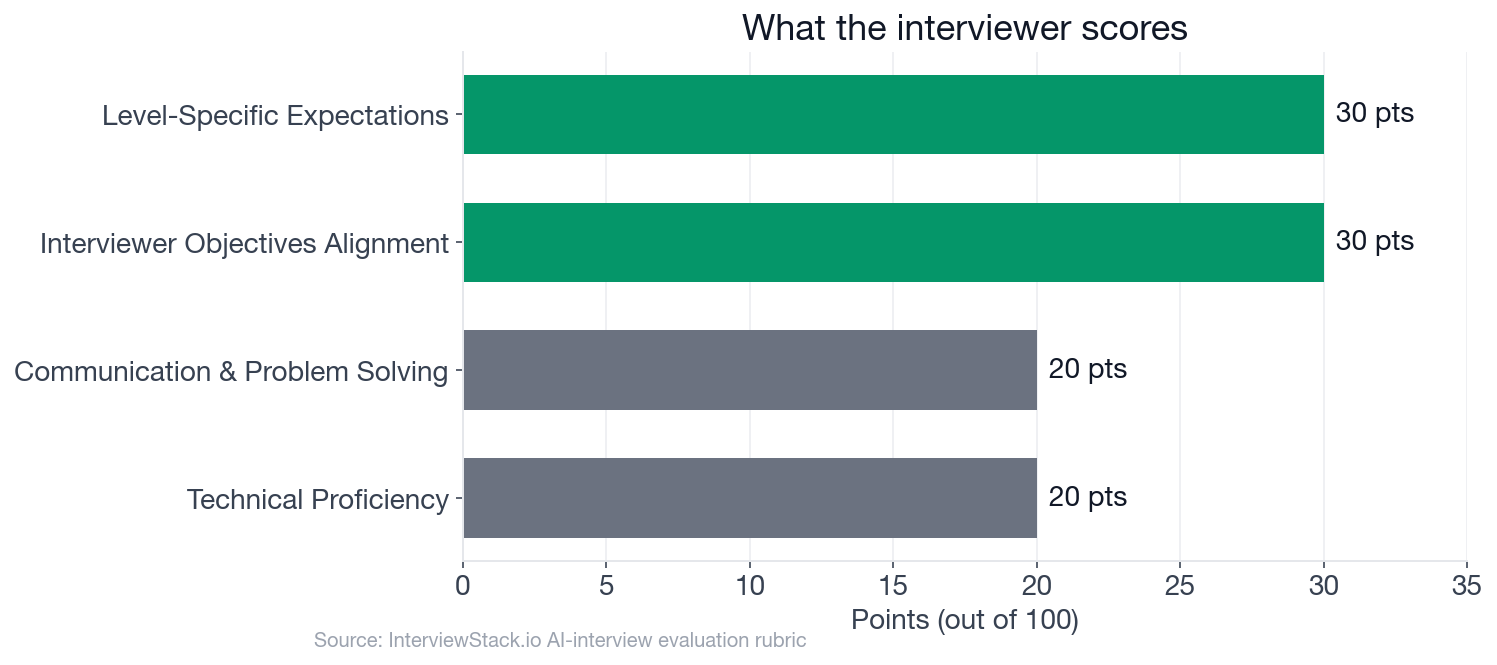
The scoring weights above matter because incident containment, the subject of Turn 3 below, is one of the concerns the interviewer explicitly evaluates, not a side question. It bears directly on Interviewer Objectives Alignment and Level-Specific Expectations, the two dimensions worth 60 of the interview's 100 points.
Four Turns Built Around the Same Blind Spot
Below are 4 of the 6 follow-up prompts from the real blueprint, chosen because they build on each other. Each one hands "Ezra," a composite stand-in for common mid-level answers, a chance to either treat a verified identity as sufficient on its own or add the layer that's missing. Watch where the gap actually opens.
Turn 1: Identity for Ephemeral Workloads
Interviewer: "How would you establish and verify service identity across clusters and regions, especially for short-lived workloads?"
Turn 2: One Certificate, Two Questions
Interviewer: "What would your approach be for authorization between services in a multi-tenant environment where some services should only act on certain tenants' behalf?"
Turn 3: A Valid Certificate, Still Compromised
Interviewer: "Suppose one service is compromised and starts calling internal dependencies with its valid identity. What controls would you put in place to limit blast radius?"
Turn 4: Flipping the Switch Cluster-Wide
Interviewer: "If we introduce mutual TLS everywhere, what operational risks or failure modes would you expect, and how would you reduce rollout risk?"
What Happens When the Interviewer Tells You the Identity Was Never Fake?
Each of Ezra's four answers looks reasonable in isolation. That's the point: on the page, with the mistake already labeled red, the fix is obvious. In a real 30-minute room, nothing is labeled. You're tracking five boundary categories, a rollout plan, and three earlier answers while the interviewer casually tells you the compromised service's identity is still valid, and reaching for "revoke the certificate" feels like the confident move, not the wrong one. Noticing that authentication was never the problem here, in real time, without a hint, is a different skill than reading a critique after the fact. That gap only closes with reps under real time pressure and unscripted follow-ups, which is exactly what a live Cybersecurity Engineer distributed systems security mock interview forces you to practice.
Three Phases, One Complete Trust Model
A strong candidate doesn't just avoid Ezra's four mistakes individually. They keep authentication and authorization as two separate, named steps the whole way through: the workload identity established in Phase 2 never quietly becomes the whole answer to blast radius in Phase 3. Below is the exact blueprint used to grade this interview, phase by phase.
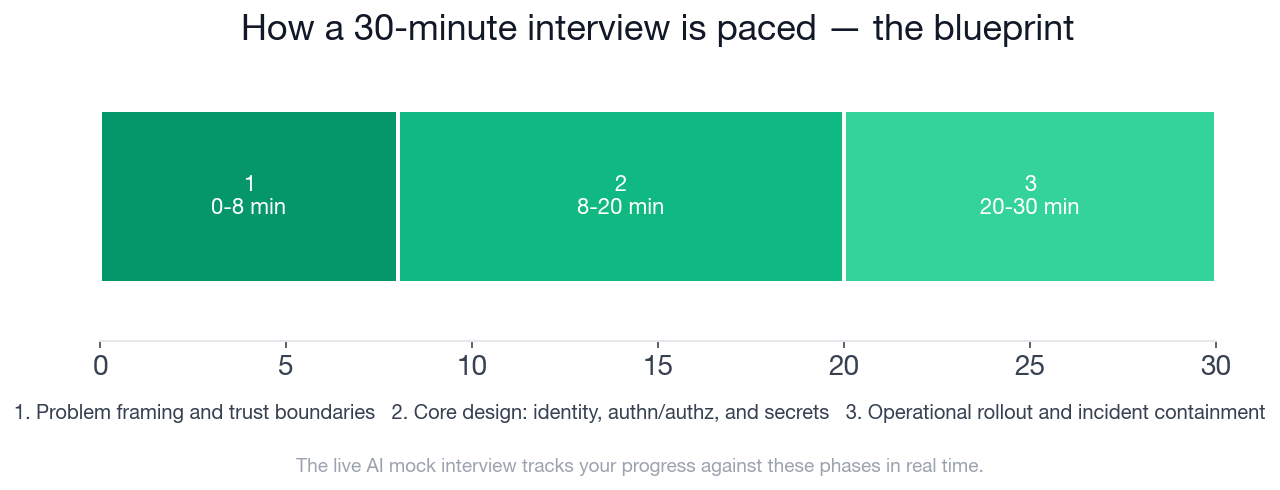
The 30-minute session is paced into three phases, from naming trust boundaries through incident containment, each with its own checklist.
- ✓Clarifies or states assumptions about service types, traffic paths, and trust domains
- ✓Identifies key boundaries such as external-to-internal, service-to-service, namespace/cluster/region, tenant isolation, and CI/CD to runtime
- ✓Moves quickly toward an identity-centric model instead of depending primarily on network ACLs
- ✓Mentions both data in transit and credential handling as first-class concerns
- ✓Proposes workload or service identities tied to platform primitives such as Kubernetes service accounts or equivalent
- ✓Uses mutual TLS or equivalent authenticated encryption for service-to-service traffic and explains certificate issuance and rotation at a practical level
- ✓Distinguishes authentication from authorization and proposes policy enforcement based on service identity, tenant scope, and least privilege
- ✓Addresses asynchronous systems by discussing message authentication, broker trust, or end-to-end identity/context propagation
- ✓Replaces long-lived static credentials with short-lived tokens, dynamic secrets, or federated access for workloads and pipelines
- ✓Suggests an incremental rollout plan, such as starting with high-value services, default-deny network segmentation, or opt-in then enforced mTLS
- ✓Mentions observability or audit signals such as certificate errors, denied authorization decisions, secret access logs, or unusual east-west traffic
- ✓Identifies compromised workload risks and proposes containment controls such as narrow service permissions, network policies, rate limits, and rapid credential revocation
- ✓Explains at least one concrete failure mode of mTLS or identity systems, such as cert expiry, trust bundle drift, or authorization misconfiguration, and a mitigation
This is the same blueprint InterviewStack.io's AI interviewer tracks in real time. Miss a checklist item and it shows up in your phase-by-phase feedback, not just a final score.
Ready to Defend This Design Under the Clock?
Reading Ezra's four mistakes is the easy 20 minutes. The Cybersecurity Engineer Distributed Systems Security and Trust AI mock interview runs you through this exact scenario for real: the interviewer adapts its follow-ups to what you actually say, tracks the blueprint above in real time, and hands you rubric-mapped feedback the moment you finish. If you want to drill the underlying concepts first, workload identity, mutual TLS, secrets management, before taking the full session, the Cybersecurity Engineer question bank covers distributed systems security questions by difficulty. If trust boundaries in a different kind of system are your weaker spot, we also walked through a Cybersecurity Engineer security fundamentals interview. And if you want to see what security teams are hiring for right now, browse current Cybersecurity Engineer openings or the broader preparation guides library.
FAQ
Q. What does the Cybersecurity Engineer Distributed Systems Security and Trust interview actually cover?
The 30-minute interview covers establishing and verifying service identity across clusters and regions (including short-lived workloads), separating authorization from authentication in a multi-tenant environment, the operational risks of rolling out mutual TLS everywhere, replacing long-lived static credentials with short-lived or federated secrets, containing a compromised service that is still using a valid identity, and securing trust decisions for asynchronous messaging across service and region boundaries. It is scored across four rubric dimensions: Interviewer Objectives Alignment (30 points), Level-Specific Expectations (30 points), Technical Proficiency (20 points), and Communication and Problem Solving (20 points).
Q. Is proving a service's identity the same as authorizing what it can do?
No, and conflating the two is one of the fastest ways to lose points in this interview. Mutual TLS and workload identity answer who is calling; a separate authorization layer, enforced by service identity, tenant scope, and least privilege, answers whether this caller should get this data. A compromised service that still holds a valid, unrevoked identity will pass authentication every time, so authorization and containment controls are what actually limit the damage.
Q. How should secrets work for CI/CD pipelines and third-party integrations in this scenario?
The interview rewards replacing long-lived static credentials, the kind a recent internal review found embedded in a few deployment pipelines, with short-lived tokens, dynamic secrets issued per pipeline run, or federated access that a third-party integration requests just before it is needed. A credential that never expires is a standing liability even if it sits in a central secrets manager, since anyone who copies it can use it indefinitely without triggering rotation.
Q. How do trust decisions work for asynchronous messaging across service and region boundaries?
A strong answer treats a message the same way it treats a synchronous request: it needs authenticated sender identity, not an assumption that anything on the internal broker is already trusted, and downstream consumers need a way to verify that identity or propagated context rather than trusting the broker itself as a stand-in for trust. This matters more, not less, once messages cross region boundaries, since the broker's network location stops being a meaningful trust signal.
Q. Is deep cryptography or PKI protocol design expected at the mid-level for this interview?
No. The interview is calibrated for a mid-level Cybersecurity Engineer (2 to 5 years of experience) and explicitly does not require inventing novel trust protocols or optimizing PKI internals. You are expected to make pragmatic, defensible choices, mutual TLS with practical certificate issuance and rotation, workload identity tied to platform primitives, and short-lived credentials, and to reason about rolling them out incrementally without stopping product delivery.
Q. How long does the AI mock interview run, and how is it scored?
It runs 30 minutes across 3 phases: problem framing and trust boundaries (0 to 8 minutes), core design covering identity, authorization, and secrets (8 to 20 minutes), and operational rollout and incident containment (20 to 30 minutes). The AI interviewer scores your answers against the same checklist used to build this walkthrough and gives phase-by-phase feedback at the end.
Q. How can I practice this exact interview?
The Cybersecurity Engineer Distributed Systems Security and Trust AI mock interview runs the same scenario with an interviewer that adapts its follow-ups to your actual answers and scores you against the blueprint above. If you want to drill specific concepts first, the Cybersecurity Engineer question bank breaks the topic down by difficulty.
Identity and Permission Are Two Different Interviews
A service making a request it has every right to make, and a compromised service with the same valid identity making a request it should never make, look identical to anything that only checks authentication. The distributed systems security interview isn't testing whether you know what mutual TLS is. It's testing whether you keep asking the second question, is this identity actually allowed to do this, after the first one already came back yes.
Topics
Ready to practice?
Put what you've learned into practice with AI mock interviews and structured preparation guides.