
The Widest Skill Fork in Data Hiring
"Data Engineer" and "AI Engineer" sound like they belong to the same career ladder. Both live in the tech stack. Both appear under the same "data and AI" umbrella on most job boards. But when you measure the actual skill sets, they are almost entirely separate disciplines.
We compared every active Data Engineer and AI Engineer posting on the InterviewStack.io job board as of June 2026: 8,123 DE postings and 4,549 AI Engineer postings. The Jaccard overlap coefficient between their top-30 skill sets is 0.28. Of the 47 distinct skills that define these two roles, only 13 appear on both lists.
SQL captures the divide in a single number. It is a table-stakes skill for Data Engineers, appearing in 71% of postings. For AI Engineers, it barely registers at 18%.
| Data Engineer | AI Engineer | |
|---|---|---|
| Median US salary (base) | $151,800 | $166,000 |
| Active postings | 8,123 | 4,549 |
| Defining skill | Data Pipelines (73%) | LLMs (42%) |
| Remote share | 21% | 23% |
| Entry-level share | 3% | 6% |
| Skill overlap (Jaccard) | 28% shared | (joint metric) |
Key Findings
- The two roles share just 28% of their top skill sets (Jaccard coefficient: 0.28, measured across 8,123 DE and 4,549 AI Engineer postings analyzed in June 2026).
- SQL appears in 71% of Data Engineer postings but only 18% of AI Engineer postings: the clearest single-skill signal of the divide.
- Python is the one true bridge, appearing in 68% of DE postings and 67% of AI Engineer postings.
- AI Engineers earn a $14,200 median US base salary premium: $166,000 vs $151,800 for Data Engineers (equity and bonus not included).
- Data Engineer postings outnumber AI Engineer postings 1.79x; AI Engineering is among the fastest-growing technical roles right now.
- Data Engineering is harder to break into: 2.6% entry-level share vs 5.6% for AI Engineering.
- Data Engineers who add LLM skills earn a median US salary of $168,800, already at or above the AI Engineer baseline of $166,000.
- 80% of data professionals now say AI tools are integral to their daily workflow (dbt Labs State of Analytics 2025), a baseline that applies to both roles equally.
What Do These Roles Actually Do?
Data Engineers build the infrastructure data flows through. On a given week, a Data Engineer is writing Python jobs to extract data from operational systems, loading it into a cloud warehouse (Snowflake, Databricks, BigQuery), modeling it with SQL and dbt (a SQL transformation framework that runs inside the warehouse), scheduling jobs with Airflow (an open-source pipeline orchestrator), and keeping everything monitored and reliable. Their output is clean, queryable data that analysts, scientists, and product teams consume downstream. Data quality and governance are explicit job accountabilities, not afterthoughts.
AI Engineers build applications that use AI. Their week centers on integrating large language models into products: writing retrieval pipelines with RAG (retrieval-augmented generation, where model responses are grounded in a searchable knowledge base), fine-tuning models on company data, composing prompt chains with LangChain (a framework for building LLM-powered workflows), and deploying AI features via APIs. Their output is AI product functionality. Vector databases, model evaluation, and LLM observability are explicit accountabilities.
The exclusive skill lists confirm this split precisely. Data Engineers need Data Quality (48%), Apache Spark (32%, a distributed processing framework for large datasets), Data Modeling (31%), and Airflow (28%). AI Engineers need LLMs (42%), RAG (40%), Generative AI (38%), and LangChain (25%). These are two different jobs.
What Skills Do Both Roles Share?
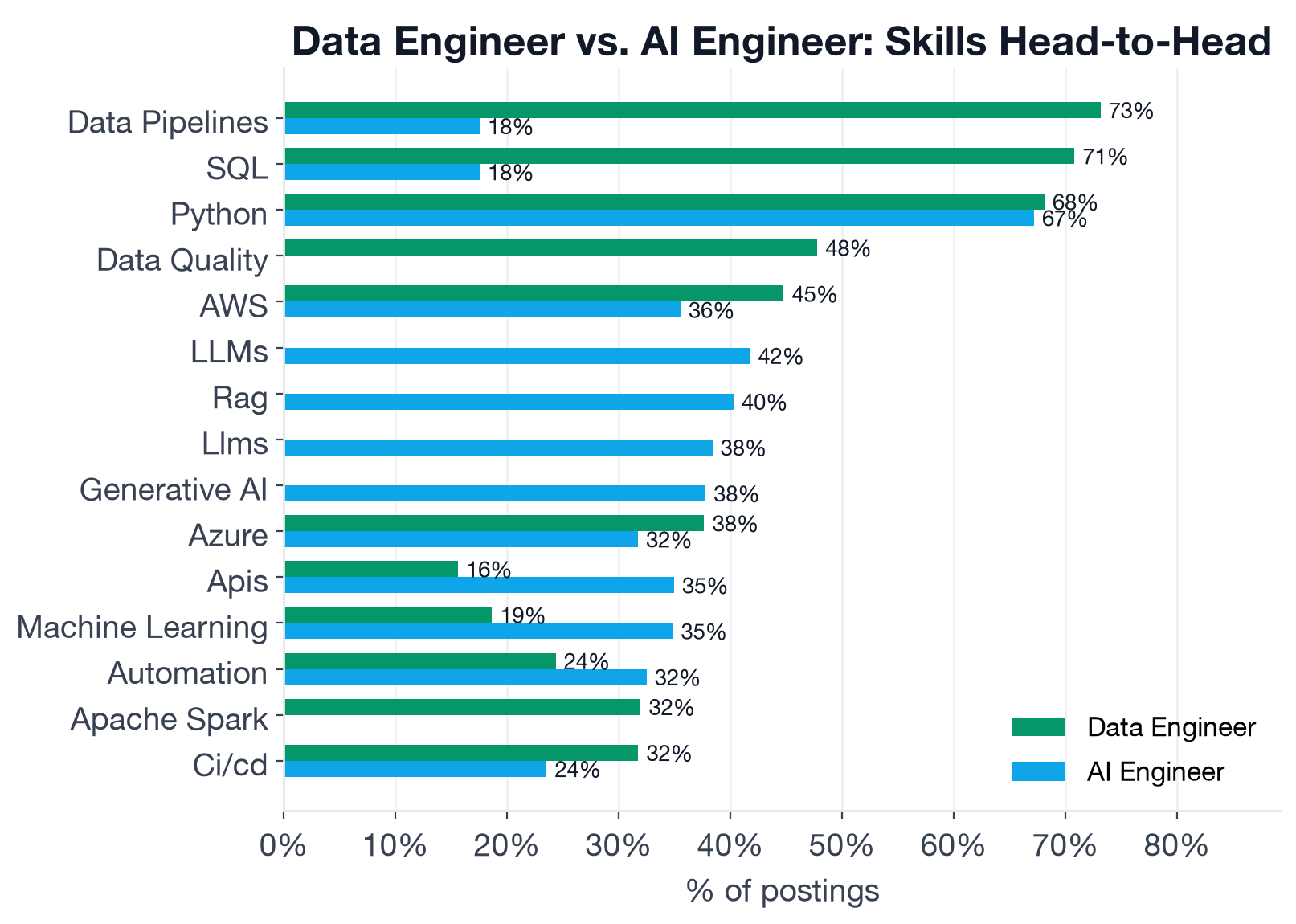
Frequency of top skills across Data Engineer (emerald) and AI Engineer (blue) postings. Skills in the center appear in both; those concentrated on one side are role-exclusive.
Both roles demand Python, which appears at essentially the same rate in both (68% DE, 67% AI Engineer). Python is the one skill where someone switching directions does not start over. Cloud platforms also appear in both stacks: AWS at 45% in DE postings and 36% in AI Engineer postings; Azure at 38% and 32%. Monitoring (30% in both) and CI/CD are shared.
The nuance is that "shared" does not mean "equal." Data Pipelines technically appears on both lists: 73% in DE postings and 18% in AI Engineer postings. SQL is the same story: 71% vs 18%. These are table stakes for one role and noise for the other. A deeper look at the Data Engineer skill stack shows how pipeline-centric the role really is.
For someone building a resume, Python and AWS are legitimately transferable between the two paths. Almost everything else requires a direction decision.
Where the Stacks Split
The exclusive skills tell the cleaner story.
Data Engineer exclusive skills (common in DE, rare in AI Engineering):
- Data Quality: 48%. DEs own the reliability and correctness of the data, not just the movement of it.
- Apache Spark: 32%. Distributed batch processing for transforming data at scale.
- Data Modeling: 31%. Designing how data is structured for downstream consumption.
- Databricks: 30%. The unified analytics platform most commonly used with Spark workloads.
- Airflow: 28%. The pipeline scheduler that orchestrates the full workflow.
AI Engineer exclusive skills (common in AI Engineering, rare in DE):
- LLMs: 42%. Large language models are the core primitive of the job.
- RAG: 40%. Grounding model outputs in a searchable knowledge base.
- Generative AI: 38%. The broader category of AI that produces content, images, and code.
- Prompt Engineering: 26%. Designing prompts that produce reliable, useful LLM outputs.
- LangChain: 25%. The framework that stitches LLM components into production workflows.
It is worth being precise about what the ambient AI layer means here. Developer surveys show that 84% of developers use AI tools regularly (Stack Overflow Developer Survey 2025) and 80% of data professionals say AI is integral to their daily workflow (dbt Labs State of Analytics 2025). GitHub Copilot, ChatGPT, and AI-assisted code generation are now baseline expectations for engineers in both roles, not stated job requirements. AI Engineers build the AI systems others use; Data Engineers use those same AI tools to build pipelines faster. The explicit LLM percentage in AI Engineer postings (42%) measures one thing: employers who need you to ship AI-powered products. The ambient tool usage layer applies equally to both sides.
Which Pays More: Data Engineer or AI Engineer in 2026?
The salary figures below are US base salary only, from postings with disclosed wage data. Equity, bonus, and sign-on are excluded; total compensation at top employers runs higher.
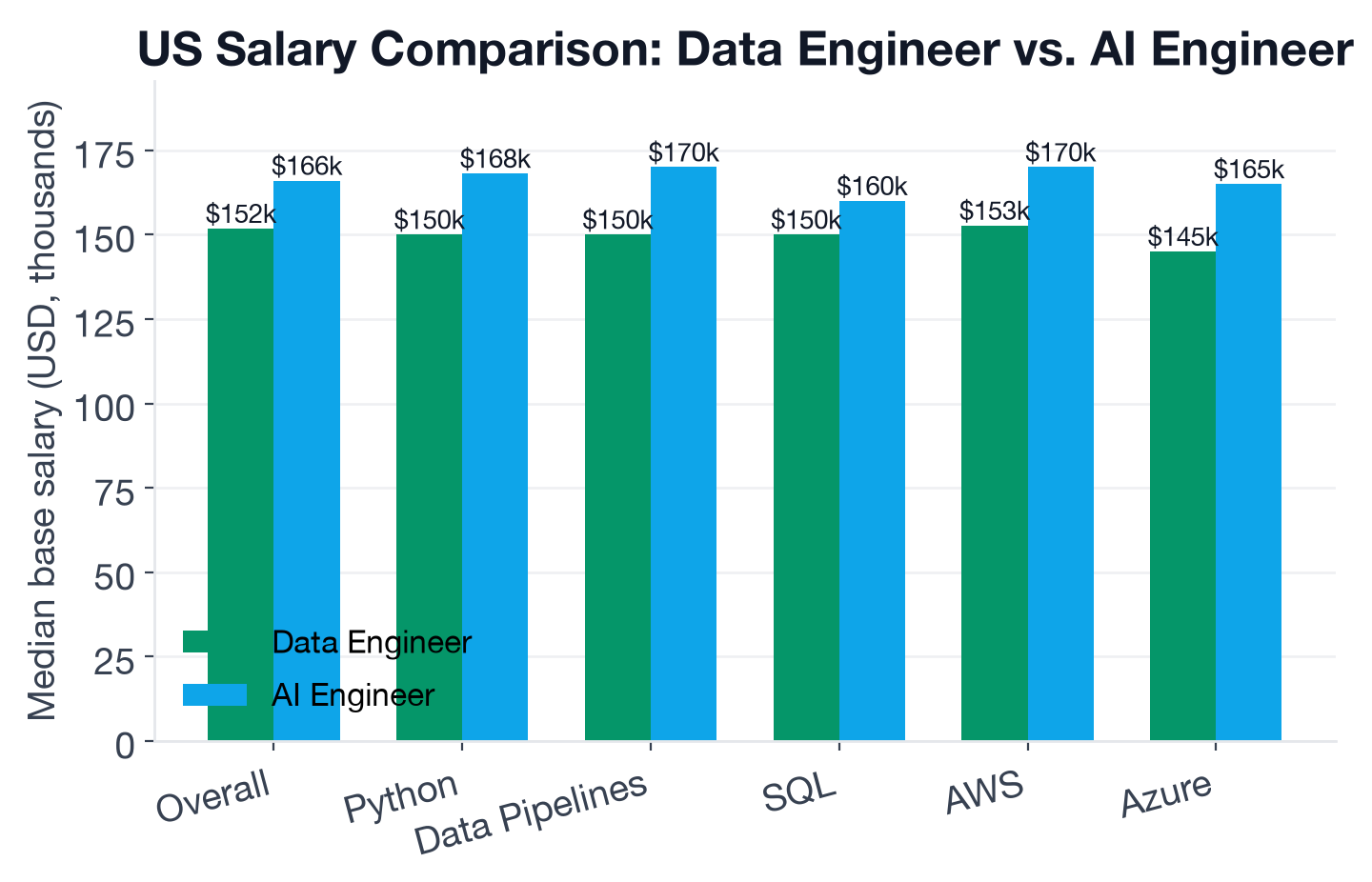
Median US base salary (USD) for Data Engineer (n=1,304) and AI Engineer (n=814) postings with disclosed wage data.
AI Engineers earn a $14,200 premium at the median: $166,000 vs $151,800 for Data Engineers. That is an 8.5% gap, meaningful but narrower than the hype around AI roles might suggest.
The more interesting salary story is in the differentiators. For AI Engineers, the biggest premiums attach to infrastructure and evaluation skills: Distributed Systems ($201,800, n=50), A/B Testing ($185,000, n=141), and MLOps ($175,500, n=107) all sit well above the $166,000 baseline. AI Engineers who can scale and evaluate models reliably earn significantly more than those who only integrate APIs.
For Data Engineers, AI-adjacent skills have started commanding real premiums. DEs whose postings list LLM skills earn $168,800 at the median (n=60); those listing RAG earn $166,500 (n=69). Both figures meet or exceed the AI Engineer median of $166,000. The "data infrastructure for AI" specialization, building the pipelines, vector stores, and feature stores that AI systems depend on, is already converging toward AI Engineer compensation without requiring a full role switch.
Which Has More Openings, and How Hard Is It to Break In?
Data Engineering is the larger market: 8,123 active postings vs 4,549 for AI Engineering, a 1.79x volume advantage. But the growth trajectories are inverted. AI Engineering is expanding faster than almost any other technical role right now. Data Engineering is larger today; AI Engineering is closing the gap.
Neither role is easy to break into without production experience, but the entry-level share differs meaningfully. Only 2.6% of Data Engineer postings are explicitly entry-level (211 of 8,123). AI Engineering sits at 5.6% (254 of 4,549): roughly twice the proportional access. The rapid growth in AI Engineering is actively creating junior roles that did not exist a year ago.
Work mode is nearly identical for both: 49% onsite, 35% hybrid, and 21-23% remote. The US is the primary market for both (30% of DE postings, 33% of AI Engineer postings), with India and Europe as significant secondary markets.
Which Should You Choose?
Choose Data Engineering if you:
- Want to specialize in data infrastructure: warehouses, pipelines, data quality, and governance
- Have strong SQL skills or are willing to build them; SQL appears in 71% of postings and is effectively required
- Want more total open positions (1.79x more) and a more established, stable market
- Are in a data-adjacent role already (analytics, backend engineering) and want to specialize in the plumbing side
- Are drawn to the modern data stack: Snowflake, dbt, and Airflow
Choose AI Engineering if you:
- Want to build products that use LLMs, generative AI, and retrieval systems
- Are Python-strong and want to apply it to LLM application development rather than data pipelines
- Want to be in the faster-growing market (AI Engineering is outpacing nearly every other technical role)
- Are open to entry-level roles: the proportional entry-floor is twice as high (5.6% vs 2.6%)
- Can invest in a new toolchain (RAG, vector databases, LangChain, prompt engineering)
If you are already a Data Engineer and AI Engineering is interesting, the transition runs through LLM tooling, not SQL abandonment. Python and cloud experience carry across; the gap is LangChain, RAG, and vector database experience. The salary data confirms the path is viable: DEs with LLM skills already earn at or above the AI Engineer baseline.
How to Use This in Your Job Search
Whichever direction fits, the preparation overlap between the two roles is real. AI mock interviews cover the system design and technical depth that both tracks require. The question bank covers data modeling, distributed systems, and ML fundamentals across both. Our interactive courses cover SQL, Python, and system design foundations. For company-specific hiring process details, preparation guides break down what individual employers actually test.
Then filter the board to your stack: current Data Engineer openings or current AI Engineer openings, both updated daily.
FAQ
Q. What skills do Data Engineers and AI Engineers share in 2026?
Python is the one true bridge: it appears in 68% of Data Engineer postings and 67% of AI Engineer postings. Cloud platforms (AWS and Azure) also appear in both stacks at lower rates. Beyond those, the overlap drops sharply. The two roles share just 28% of their top skill sets, meaning the remaining 72% is role-specific.
Q. What is the salary difference between Data Engineer and AI Engineer in 2026?
Among US postings with disclosed base salary, Data Engineers earn a median of $151,800 (n=1,304) and AI Engineers earn $166,000 (n=814), a $14,200 premium. Equity and bonus are not included. Data Engineers who add LLM or RAG skills see salaries reach $167-$169K, meeting or exceeding the AI Engineer median of $166,000.
Q. Are there more Data Engineer or AI Engineer job openings in 2026?
Data Engineer postings outnumber AI Engineer postings 1.79x: 8,123 active listings versus 4,549. AI Engineering is among the fastest-growing roles in tech right now. Data Engineering is the larger market today; AI Engineering is the faster-growing one.
Q. Is it harder to break into Data Engineering or AI Engineering?
Data Engineering is harder to enter. Only 2.6% of Data Engineer postings are explicitly entry-level (211 of 8,123). AI Engineer fares better at 5.6% entry-level (254 of 4,549). Neither role is easy to break into without relevant experience, but the proportional entry-level share is roughly twice as high in AI Engineering.
Q. What skills are unique to AI Engineers that Data Engineers lack?
Large language models (LLMs, 42%), RAG (40%), Generative AI (38%), Prompt Engineering (26%), LangChain (25%), OpenAI API (21%), and Vector Databases (20%) appear in AI Engineer postings but are virtually absent from Data Engineer job descriptions. These tools define what AI Engineers build: LLM-powered applications and AI product pipelines.
Q. Can a Data Engineer transition into AI Engineering?
Yes, with targeted upskilling. Python carries over directly, and cloud experience (AWS, Azure) transfers well. The gap is in LLM tooling: LangChain, RAG architectures, vector databases, and prompt engineering. A Data Engineer who adds those skills while keeping a Python-and-cloud foundation has the clearest transition path. The salary data supports this: DEs with LLM skills earn $168,800 at the median, already at or above the AI Engineer baseline of $166,000.
Q. How remote-friendly are Data Engineer vs AI Engineer roles in 2026?
Nearly identical. Data Engineer postings are 21% remote, 35% hybrid, and 49% onsite. AI Engineer postings are 23% remote, 35% hybrid, and 49% onsite. Neither role offers significantly more flexibility than the other.
Pick Your Track
Data Engineering and AI Engineering are separate disciplines that happen to share Python and a cloud ecosystem. The 28% skill overlap is not a gap waiting to be bridged: it reflects the distance between building data infrastructure and building AI applications. Both are strong career tracks in 2026, with healthy salaries, global demand, and real growth ahead. The decision is simpler than it looks: are you drawn to the plumbing, or the product? Browse Data Engineer postings or AI Engineer postings to see where the market is hiring right now. For adjacent comparisons, Data Engineer vs Data Scientist and AI Engineer vs Machine Learning Engineer sharpen the choices further.
Topics
Ready to practice?
Put what you've learned into practice with AI mock interviews and structured preparation guides.