
Even the Skill They Share Isn't Shared at All
Data Pipelines shows up on both roles' skill lists. That should mean something. It doesn't, not in the way you'd expect. For Data Engineers, Data Pipelines is table stakes: it appears in 71.6% of postings and pays almost exactly at the role's own $156,800 US median, because nearly three-quarters of the market already assumes you can build one. For Research Scientists, the same skill shows up in just 6.8% of postings, and when it does, it pays $238,000, a full $46,000 above that role's own $192,000 median. Same tag, opposite meaning: a commodity for one role, a rare specialist signal for the other. That $46,000 figure is built on a modest slice of the data, 43 Data Pipelines-tagged postings within Research Scientist's 538 US salary-disclosed listings, so treat the exact dollar amount as directional rather than precise; the direction and rough size of the gap is the reliable part.
That inversion is the clearest evidence of something the overall numbers already suggest: these two "data" roles barely overlap. We pulled every active Data Engineer and Research Scientist posting on the InterviewStack.io job board, 9,218 and 1,338 respectively, and measured skill overlap using Jaccard similarity across each role's top-30 skill set. The result, 0.13, ties the lowest overlap measured anywhere in this comparison series. If you're weighing a move between these two titles, the honest starting point is that you'd be changing careers, not changing floors. (A note on the dataset: the role tags aren't perfectly clean. The Data Engineer sample pulls in some Data Architect and data-operations leadership titles alongside core engineering roles; the Research Scientist sample occasionally pulls in adjacent-but-distinct disciplines like operations research and even a stray economist or legal-practice title. Neither is large enough to change the shape of this comparison, but the percentages below are directional, not laboratory-precise.)
Key Findings
- Skill overlap between the two roles is 0.13 (13% Jaccard similarity), tying the series-low measured across InterviewStack.io's role-comparison posts.
- Data Pipelines, the one nominally shared skill with the sharpest split, appears in 71.6% of Data Engineer postings but only 6.8% of Research Scientist postings, a roughly 10-to-1 gap.
- That same skill prices in opposite directions: at Data Engineer's own $155,500 median, but $238,000 (+$46,000) above Research Scientist's own median.
- Research Scientist pays a median $192,000 US base salary versus $156,800 for Data Engineer, a $35,200 gap.
- Data Engineer postings outnumber Research Scientist postings 6.9 to 1 (9,218 vs. 1,338).
- Research Scientist has a higher entry-level share (6.9%) than Data Engineer (2.6%), despite being the smaller, better-paid role.
- Research Scientist roles are far more onsite (67.6%) than Data Engineer roles (49.8%).
- Each role's defining exclusive skill, SQL for Data Engineer (68.6%) or PyTorch for Research Scientist (33.0%), earns no premium over that role's own baseline.
| Data Engineer | Research Scientist | |
|---|---|---|
| Active postings | 9,218 | 1,338 |
| Median US base salary | $156,800 | $192,000 |
| Top skill | Data Pipelines (71.6%) | Machine Learning (58.7%) |
| Entry-level share | 2.6% | 6.9% |
| Onsite share | 49.8% | 67.6% |
| Skill overlap (Jaccard) | 13% shared (pairwise) | 13% shared (pairwise) |
One Moves Data. One Trains Models on It.
A Data Engineer's job is infrastructure: building and maintaining the pipelines, warehouses, and orchestration layers that get raw data into a state other teams can use. Their exclusive cluster, SQL, Data Quality, Azure, Apache Spark, Databricks, reads like a systems-reliability job description, because that's what it is. The output is a working pipeline, not a finding.
A Research Scientist's job sits closer to the frontier: designing, training, and evaluating models, often for problems with no established playbook. Their exclusive cluster, PyTorch, Algorithms, Deep Learning, Reinforcement Learning, Large Language Models, signals a role built around experimentation, not data delivery. Titles here run from "Research Scientist (diffusion)" to "Researcher, Automated Red Teaming," skewing toward frontier AI labs more than enterprise data teams. One role hands off a pipeline; the other hands off a model checkpoint or a working prototype.
What Skills Do Data Engineer and Research Scientist Postings Actually Share?
Python is the only skill genuinely common to both: 67.2% of Data Engineer postings and 55.7% of Research Scientist postings ask for it, the one language you won't have to relearn if you switch tracks. Everything else that clears the "shared" threshold is lopsided. Machine Learning appears in both lists (20.6% Data Engineer, 58.7% Research Scientist), but its salary signal is flat either way: $159,700 for Data Engineer (barely above baseline) and exactly $192,000 for Research Scientist (exactly at baseline). It's close to assumed at each role's own prevalence level; it isn't what moves pay.
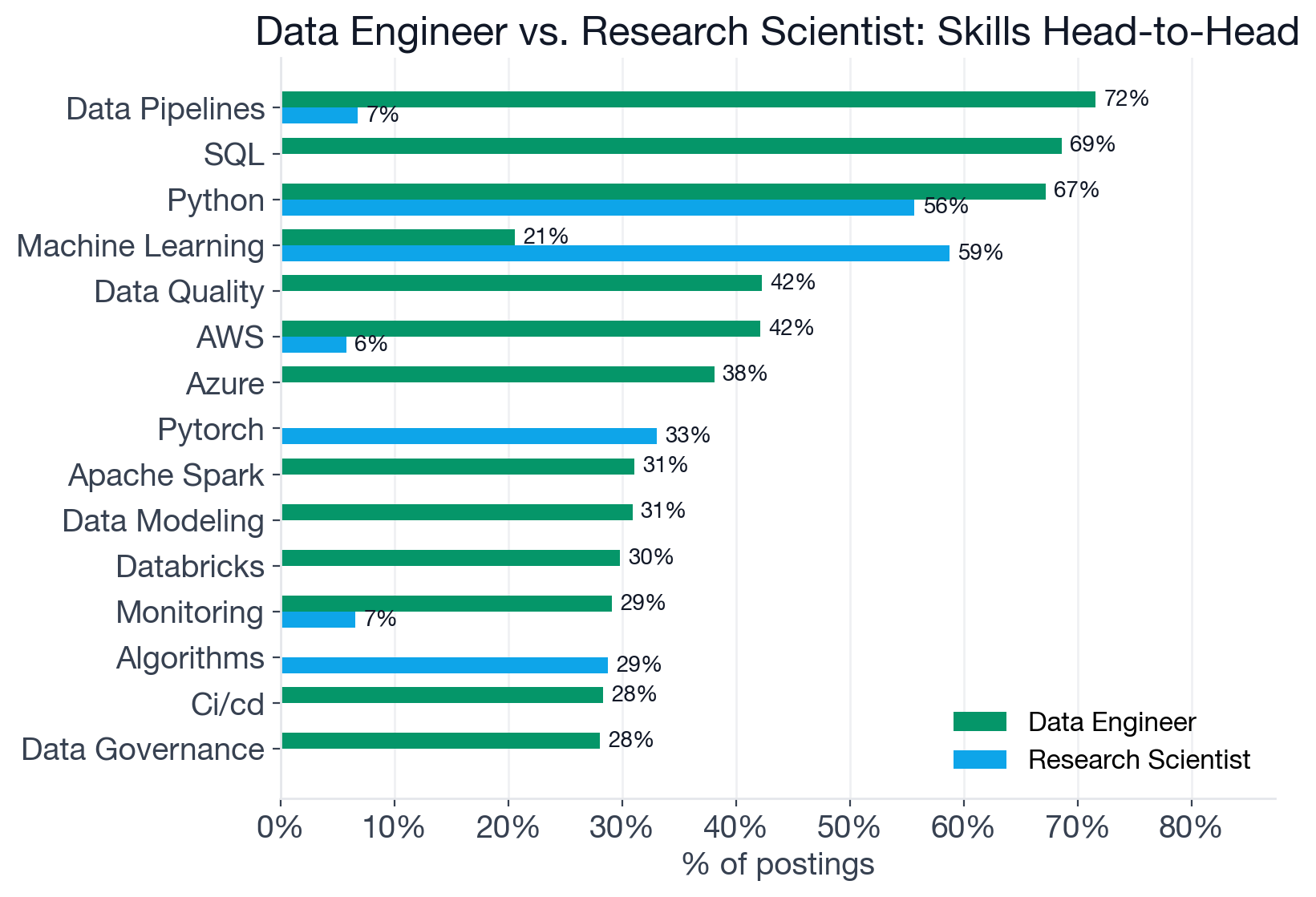 Python is the one skill both roles genuinely share at comparable frequency; everything else on the chart tilts hard toward one side.
AWS, Monitoring, Automation, and Data Science round out the nominally shared list, but each shows the same asymmetry as Data Pipelines: high in Data Engineer postings (20-42%), a fraction of that in Research Scientist postings (6-11%). Read "shared skills" as a lower bound on how differently the work is structured, not as evidence the two jobs are cousins.
Where Do the Two Roles Split Completely?
Beyond the handful of nominally shared skills, the two roles' top-30 lists diverge almost entirely. Data Engineer's exclusive cluster, SQL (68.6%), Data Quality (42.3%), Azure (38.1%), Apache Spark (31.1%), Databricks (29.8%), CI/CD (28.3%), Snowflake (27.0%), is a data-platform stack: get data in, clean it, keep it flowing. Research Scientist's exclusive cluster, PyTorch (33.0%), Algorithms (28.8%), Deep Learning (27.3%), C++ (19.6%), LLMs (18.5%), Statistics (18.0%), Reinforcement Learning (16.7%), Generative AI (13.8%), is a model-research stack: build it, train it, evaluate it.
This is where the two-layer AI story matters. Research Scientist postings name frontier AI skills explicitly at meaningfully high rates, 14-19% for Generative AI, LLMs, and Reinforcement Learning, because building AI systems is the literal job. Data Engineer postings almost never do: no Generative AI or LLM skill clears the top-30 list, and Machine Learning tops out at 20.6%. That gap is real and shouldn't be flattened. But don't read Data Engineer's near-zero explicit AI-skill rate as "Data Engineers don't use AI." The 2026 State of Data Engineering Survey (1,101 data practitioners) found 82% already use AI coding tools daily, beating the 51% daily-use rate the Stack Overflow 2025 Developer Survey reports across developers generally. The posting tells you who's hired to build AI. It doesn't tell you who's using it, and for Data Engineers, that's now most of the field. See what a live posting actually asks for: browse current Data Engineer openings or filter for roles that mention Databricks directly.
Which Role Pays More, and Why?
Research Scientist earns a median $192,000 US base salary versus $156,800 for Data Engineer, a $35,200 gap (base salary only; equity, bonus, and sign-on aren't disclosed in postings). The more useful question is which specific skills move the number inside each role.
Data Engineer's own most common skills mostly sit at or below its $156,800 baseline: SQL (-$2,300), Data Modeling (-$1,300), Azure (-$8,900), CI/CD (-$1,800). The real premiums live a layer down, in a narrower streaming and lakehouse slice: Flink (+$45,700, n=79), Iceberg (+$33,200, n=105), Distributed Systems (+$27,200, n=146), Kafka (+$14,700, n=313, the largest reliable sample here). Even a scarce, explicit AI-adjacent skill pays when it shows up: RAG (+$15,800, n=90) and LLMs (+$12,100, n=79).
Research Scientist repeats the pattern almost exactly. Its own defining skills, PyTorch, Algorithms, Deep Learning, sit at or barely above the $192,000 baseline. The lift comes from a narrower production-scale slice: Distributed Systems (+$38,000, n=34), LLMs (+$21,500, n=106), Distributed Training (+$21,500, n=33), Prototyping (+$21,000, n=81), Fine Tuning (+$18,200, n=54). In both roles, the skill that defines the job title isn't the one that pays the most; the premium sits in whatever makes the system run at scale.
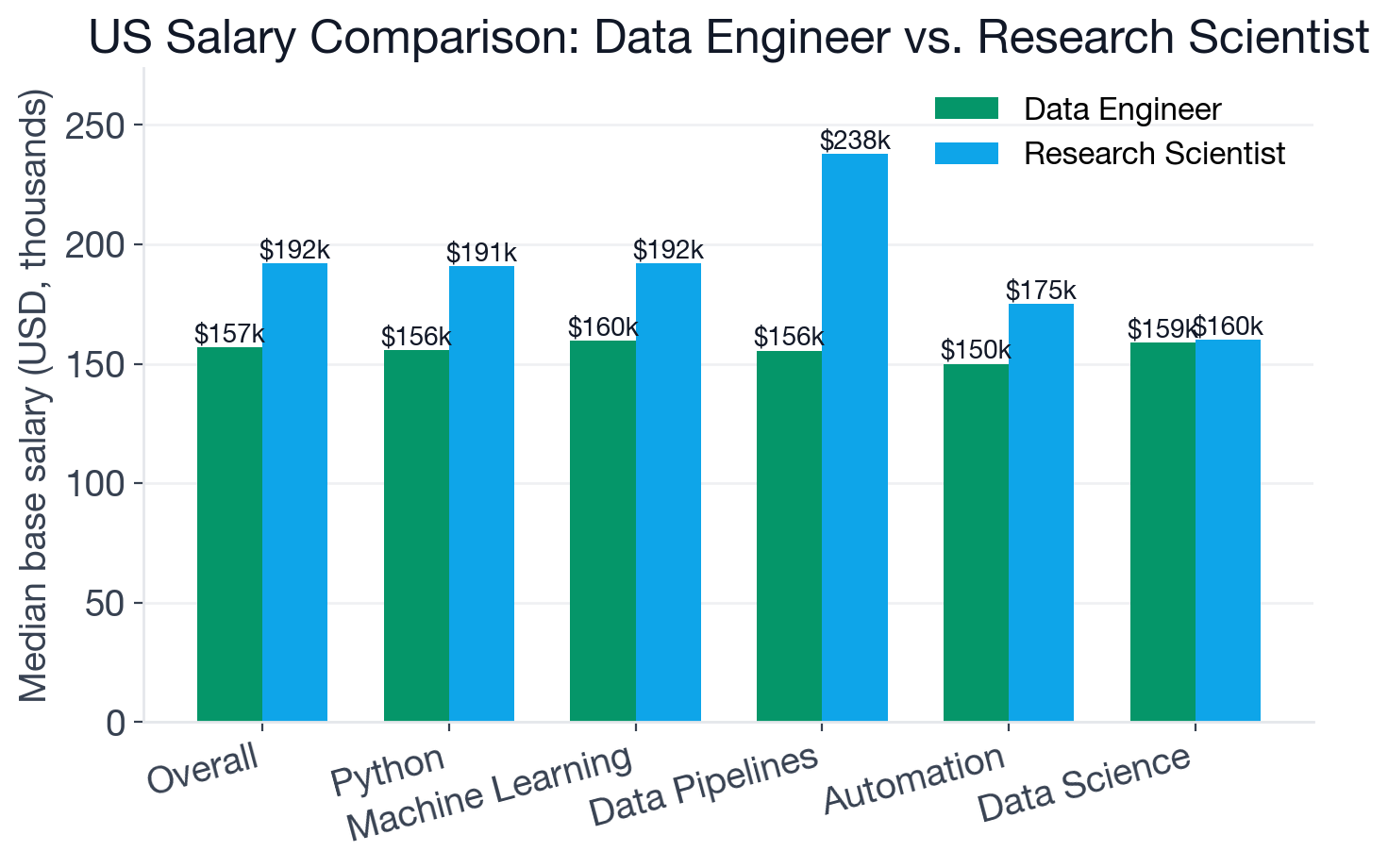 Research Scientist's higher median hides the same pattern seen in Data Engineer: the role's defining skill is rarely the highest-paid one.
Which Role Is Easier to Break Into?
Data Engineer is the far bigger market: 9,218 active postings versus 1,338 for Research Scientist, a 6.9-to-1 ratio. If raw hiring volume is your constraint, Data Engineer is the more available door.
Entry level tells a different, counterintuitive story: Research Scientist shows a 6.9% entry-level share against Data Engineer's 2.6%, meaning the smaller, higher-paid, more specialized role is somewhat more accessible to new entrants here, not less. Neither is a genuine entry-level market (both hire overwhelmingly mid-level-and-up), but don't assume "narrower and better-paid" means "harder to break into." One caveat worth naming: "entry-level" means different things on each side. Entry-level Research Scientist postings typically expect a completed PhD or a research publication record, not a lower skill bar; entry-level Data Engineer postings more often accept a bachelor's degree or bootcamp background. A higher title-based entry-level share for Research Scientist isn't the same as an easier path in.
Work arrangement cuts the other way. Data Engineer offers more flexibility: 20.1% remote and 34.6% hybrid, versus Research Scientist's 13.5% remote, 24.3% hybrid, and 67.6% onsite. The elite AI labs driving Research Scientist demand, several of the largest employers here are frontier AI companies, still run heavily in-person. Geographically, Research Scientist is far more US-concentrated (62.0%) than Data Engineer (30.0%), which spreads across a wider set of countries including India, the UK, and Canada.
Choose the Work, Not the Skill Tag
Choose Data Engineer if you:
- Want to build and operate systems (pipelines, warehouses, orchestration) rather than design experiments
- Already know SQL and cloud data tooling, or are comfortable learning them as your foundation
- Want more remote and hybrid flexibility, and a market with 6.9x more open roles to apply to
Choose Research Scientist if you:
- Want to work at the model layer: training, evaluating, and pushing on what's technically possible
- Have (or are building) depth in PyTorch, deep learning, and applied statistics, and are comfortable with heavier math and experimentation
- Can accept a smaller, more concentrated, more onsite market in exchange for a higher salary ceiling and a higher nominal entry-level share than Data Engineer's, though that bar usually means a completed PhD, not a lower skill floor
If your resume already has one role's exclusive skill cluster, don't expect much of it to transfer. Python is the one real bridge; everything else is close to a rebuild.
Put This to Work
Close the gap with practice against real conditions, not another tutorial. For Data Engineer, drill data-modeling and pipeline-design scenarios with AI mock interviews, and use the Question Bank for SQL and system-design questions. For Research Scientist, the gap is usually depth: our interactive courses covering algorithms, statistics, and ML foundations shore up fundamentals faster. Either way, check live demand first: Data Engineer openings and Research Scientist openings are both filterable by skill, seniority, and location.
FAQ
Q. How much skill overlap is there between Data Engineer and Research Scientist roles?
Very little. The Jaccard overlap on each role's top-30 skill list is 0.13 (13%), tying the lowest overlap measured across InterviewStack.io's entire role-comparison series. Only Python shows up at meaningfully high frequency in both roles.
Q. Does Data Pipelines count as a shared skill between the two roles?
It clears the shared-skill frequency threshold, but the numbers behind it tell the opposite story. Data Pipelines appears in 71.6% of Data Engineer postings versus just 6.8% of Research Scientist postings, a roughly 10-to-1 gap, and it prices in opposite directions: at Data Engineer's own median for that role, but $46,000 above Research Scientist's own median for that role.
Q. Who earns more, a Data Engineer or a Research Scientist?
Research Scientist has the higher median: $192,000 US base salary versus $156,800 for Data Engineer, a $35,200 gap. Both figures are base salary only, from US postings with disclosed pay.
Q. Which role has more job openings?
Data Engineer, by a wide margin: 9,218 active postings versus 1,338 for Research Scientist, a roughly 6.9-to-1 volume ratio in this dataset.
Q. Is it easier to break into Data Engineer or Research Scientist as an entry-level candidate?
Counterintuitively, Research Scientist shows a higher entry-level share (6.9% of postings) than Data Engineer (2.6%), despite being the smaller and higher-paid role. Both roles are still overwhelmingly mid-level-and-up hiring. But the bar differs by kind, not just degree: entry-level Research Scientist postings typically expect a completed PhD, while entry-level Data Engineer postings more often accept a bachelor's degree or bootcamp background.
Q. Do Data Engineers need AI or machine learning skills in 2026?
Explicit AI-building skills barely register in Data Engineer postings (Machine Learning at 20.6%, no Generative AI or LLM skill in the top 30). That doesn't mean Data Engineers skip AI tools day to day: a 2026 State of Data Engineering Survey found 82% of data professionals already use AI coding tools daily, above the 51% daily-use rate reported across developers generally.
Q. What's the single biggest skill difference between Data Engineer and Research Scientist postings?
SQL defines Data Engineer (68.6% of postings) and is nearly invisible in Research Scientist postings. PyTorch defines Research Scientist (33.0%) and is nearly invisible in Data Engineer postings. Neither skill, however, commands a pay premium over its own role's baseline; both are simply the price of entry.
Look Past the Skill Tags
The number that matters most here isn't the 13% overlap, it's what that overlap is made of. A skill list can technically match on paper while describing two unrelated jobs underneath, and Data Pipelines is the cleanest proof: same label, opposite frequency, opposite pay signal. If you're choosing between these two tracks, read past the tags on a job posting and into what the role actually asks you to build day to day. The title on your resume matters less than whether you're moving data or training on it.
Topics
Ready to practice?
Put what you've learned into practice with AI mock interviews and structured preparation guides.