
The Best-Paid Skill in Each Role Isn't the One in the Title
Data Scientist pays a $32,000 premium over Business Intelligence Analyst at the median, and the two roles only share 43% of their top-30 skills. On the surface that reads like a clean story: one role is the specialized, better-paid track, the other is the accessible, cheaper one. The per-skill salary data tells a messier and more useful story. Data Scientist's own signature skills, PyTorch, TensorFlow, scikit-learn, all pay at or below the role's own baseline. Meanwhile Business Intelligence Analyst's modern-stack exclusives, Looker, dbt (a SQL-based tool for transforming and modeling data inside the warehouse), Snowflake, pay so far above BI's baseline that a BI Analyst holding them lands within striking distance of Data Scientist's overall median.
We pulled every active posting for both roles from the InterviewStack.io job board as of July 2026, 7,857 Data Scientist and 2,658 Business Intelligence Analyst listings, skills extracted from descriptions with synonyms collapsed. The question worth answering isn't just "which role pays more," it's which specific skills inside each role move that number, because the title alone is a poor guide to either. Title-level classification for both roles also pulls in some adjacent postings, quant/finance-data and data-modeling titles on the Data Scientist side, market- and competitive-intelligence analyst titles on the Business Intelligence Analyst side, so read the skill and salary splits below as directional signal for each role family rather than an exact-title filter.
| Data Scientist | Business Intelligence Analyst | |
|---|---|---|
| Median US base salary | $159,000 | $127,000 |
| Active postings | 7,857 | 2,658 |
| Top skill | Python (62.0%) | SQL / Data Visualization (66.1%, tied) |
| Entry-level share | 6.5% | 5.3% |
| Remote share | 16.2% | 13.9% |
| Skill overlap (Jaccard) | 43% shared | (pairwise) |
Key Findings
- Data Scientist postings outnumber Business Intelligence Analyst postings 2.96x (7,857 vs 2,658 active listings).
- Median US base salary: $159,000 for Data Scientist (n=1,829) versus $127,000 for Business Intelligence Analyst (n=506), a $32,000 (25.2%) gap.
- SQL and Data Visualization each appear in 66.1% of BI Analyst postings (1,758 of 2,658), well above Data Scientist's 45.0% and 29.1% respectively.
- Python appears in 62.0% of Data Scientist postings versus 39.4% of BI Analyst postings, the clearest reversal in the shared skill set.
- Machine Learning shows up in 48.5% of Data Scientist postings but only 8.5% of BI Analyst postings, the sharpest fault line between the two roles.
- A/B Testing is Data Scientist's best-paid exclusive skill (+$22,500 over the role's own $159,000 baseline, n=395), well ahead of PyTorch (-$6,700) and TensorFlow (-$4,000).
- Looker is BI Analyst's best-paid exclusive skill: $150,000 median (n=57), $23,000 above BI's own $127,000 baseline and within $9,000 of Data Scientist's overall median.
- Entry-level share sits close for both roles: 6.5% Data Scientist versus 5.3% BI Analyst.
What Does Each Role Actually Do?
A Data Scientist gets handed an ambiguous business question, frames it as a measurable problem, and builds the model, experiment, or forecast that answers it, then hands the result to engineering to productionize or to leadership to act on. The work leans exploratory: querying, testing hypotheses, iterating on a model until it's good enough to trust. That tracks with the data: PyTorch, TensorFlow, and LLMs sit in Data Scientist's exclusive cluster, all tools for building and shipping models, not just reading them.
A Business Intelligence Analyst is closer to a platform owner. Instead of answering one-off questions with a model, they build and maintain the dashboards, semantic layer, and warehouse models everyone else self-serves from. Data Modeling, Snowflake, dbt, and Data Warehouse, all among BI Analyst's biggest exclusives, are plumbing and presentation, not prediction. The Data Scientist is judged on whether the model held up; the BI Analyst, on whether the dashboard still tells the truth six months from now.
Which Skills Do Both Roles Actually Require?
Both roles converge on the same five tools, but each leans on them in opposite directions. SQL, Python, Data Visualization, Machine Learning, and Statistics all clear meaningful frequency on both sides, yet none of the five is weighted the same way twice.
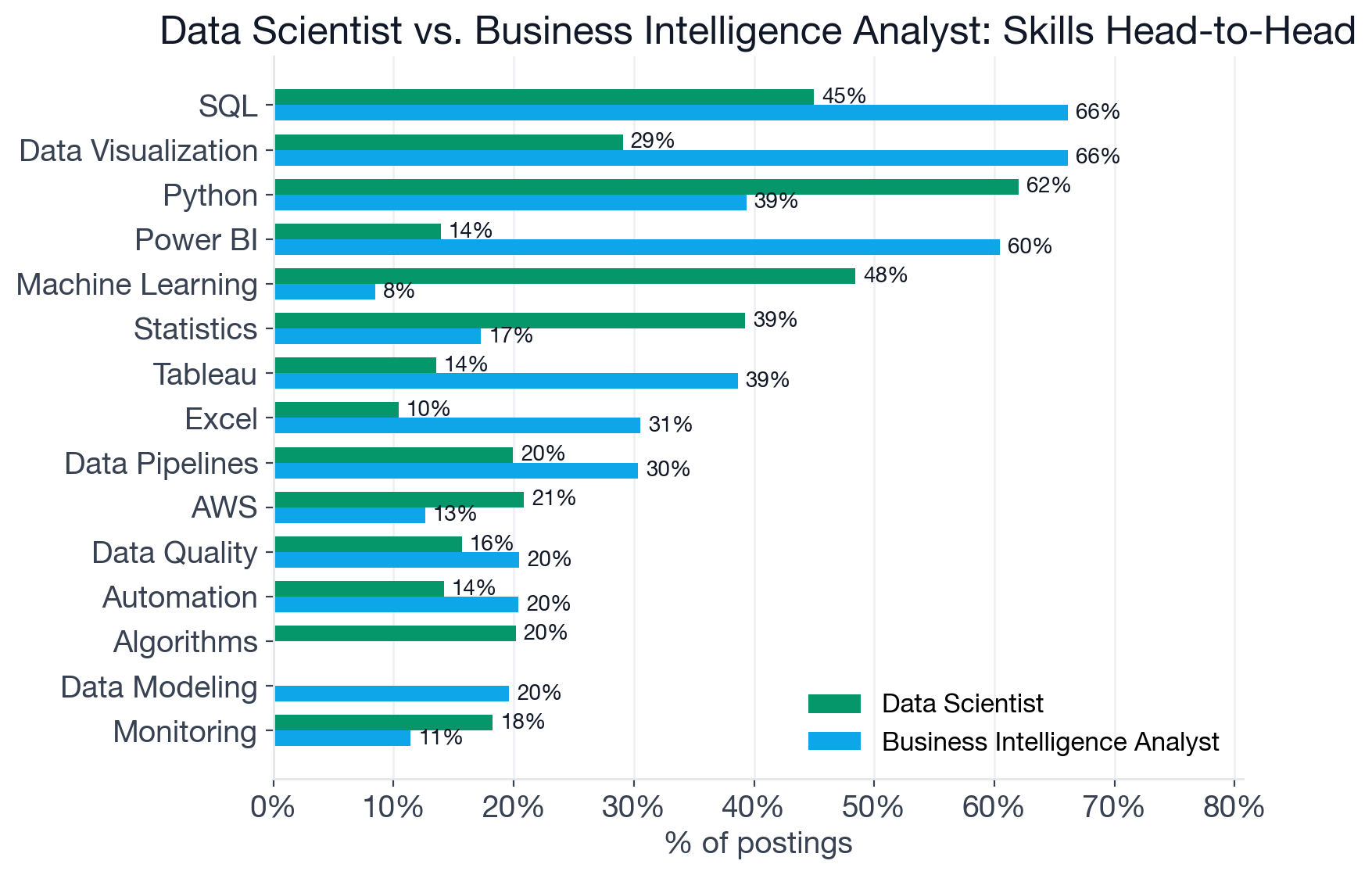
SQL and Data Visualization are more common in BI Analyst postings than in Data Scientist postings, even though Data Scientist is the more technically specialized, higher-paid role.
| Skill | Data Scientist | BI Analyst |
|---|---|---|
| SQL | 45.0% | 66.1% |
| Python | 62.0% | 39.4% |
| Data Visualization | 29.1% | 66.1% |
| Power BI | 13.9% | 60.5% |
| Machine Learning | 48.5% | 8.5% |
| Statistics | 39.3% | 17.3% |
| Tableau | 13.5% | 38.6% |
| Data Pipelines | 19.9% | 30.3% |
If you already know SQL and a visualization tool, that experience transfers cleanly into BI Analyst, where those two skills clear two-thirds of postings each. If you already know Python and have touched a modeling library, that transfers into Data Scientist instead. The two roles share a toolbox, but they don't reach for the same tools first.
Where the Two Roles Split
Only two clusters clear the exclusivity bar (meaningful frequency in one role, essentially absent in the other), and each one describes a different kind of work. Data Scientist's exclusives: Algorithms (20.2%), A/B Testing (16.4%), Generative AI (15.4%), PyTorch (12.6%), TensorFlow (12.5%), LLMs (12.3%), Google Cloud (12.2%), Deep Learning (12.0%), Apache Spark (11.1%), scikit-learn (11.0%). That's an applied-ML and generative-AI build stack, tools for training, fine-tuning, and deploying models, not just reading their output.
Business Intelligence Analyst's exclusives run the other direction: Data Modeling (19.6%), Data Science as an explicit skill tag (16.4%), Snowflake (14.3%), Looker (11.0%), dbt (9.4%), Data Warehouse (9.3%), Stakeholder Management (8.5%). Notably, "Data Science" itself is a top-30 exclusive skill for BI Analyst, evidence that employers are stapling data-science-adjacent expectations onto BI roles even without asking for Python or ML directly.
The Generative AI and LLM gap deserves a caveat: 15.4% of Data Scientist postings explicitly require it, versus effectively none of BI Analyst's, but that measures who's hired to build AI systems, not who uses AI tools day to day. Microsoft is embedding Copilot directly into Power BI and retiring the legacy Q&A visual by the end of 2026, pushing BI Analysts onto AI-assisted workflows regardless of posting language, and broader developer surveys already put ambient AI tool adoption at 84% (51% daily). Both roles are converging on "AI assumed" in daily tooling even where the hiring language diverges sharply.
Which Skills Actually Pay More: Data Scientist vs Business Intelligence Analyst?
Every figure here is scoped to US postings with base pay disclosed; equity, bonus, and sign-on aren't captured in listings, so total comp at well-funded employers runs higher than what's below.
Data Scientist carries a $159,000 median US base salary (n=1,829) against Business Intelligence Analyst's $127,000 (n=506), a $32,000 gap, 25.2% above the BI Analyst median. That's the headline number, and it's real. But it's the wrong number to use if you're deciding which specific skills to build.
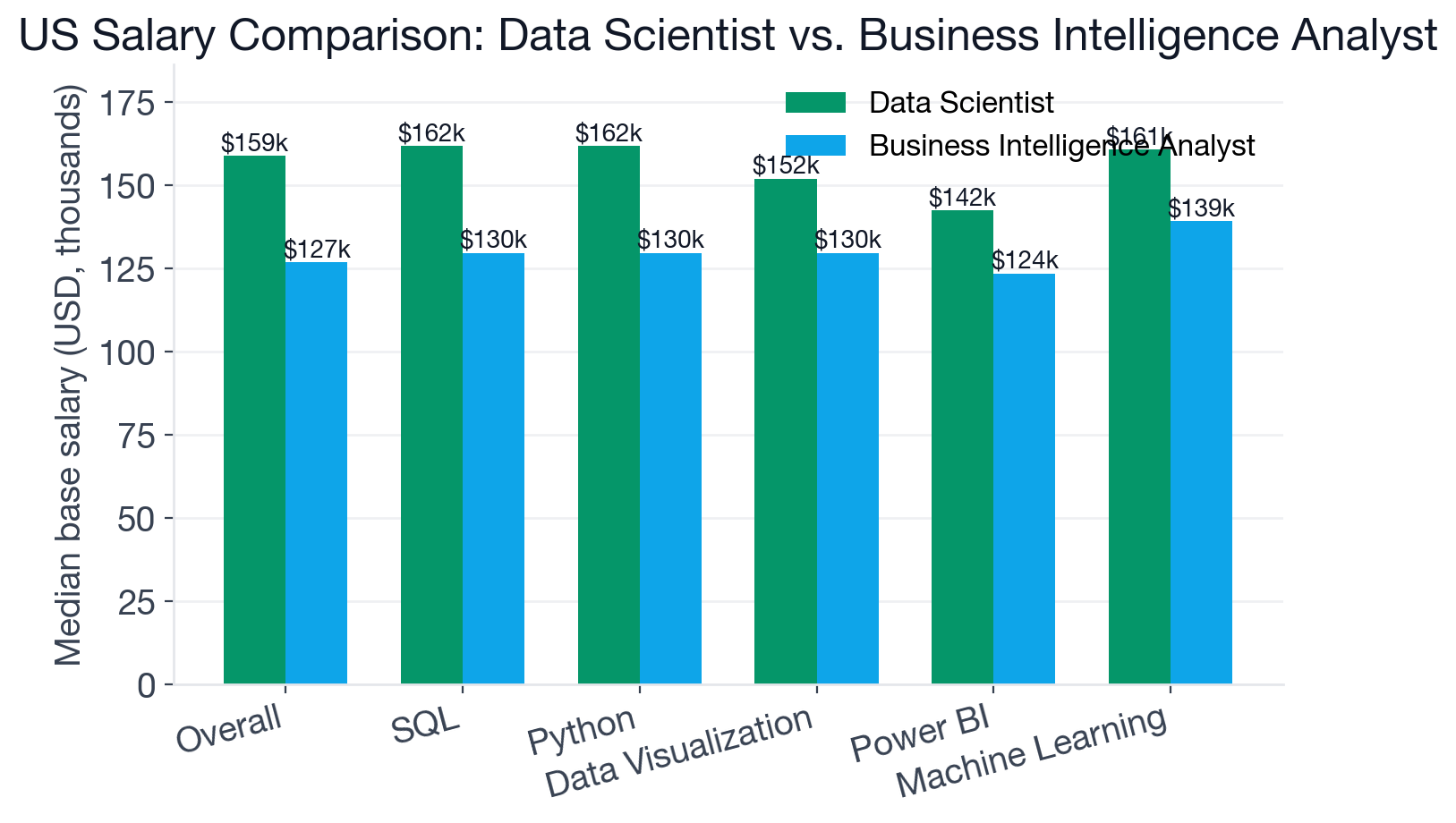
Data Scientist's median sits $32,000 above Business Intelligence Analyst's, but BI Analyst's own top-paying skills close most of that distance without leaving the role.
Inside Data Scientist's own postings, the skills most associated with the title underperform. PyTorch ($152,300, n=184) sits $6,700 below Data Scientist's own baseline; TensorFlow ($155,000, n=163) sits $4,000 below it; scikit-learn, Algorithms, and Google Cloud all sit below baseline too. The clear standout is A/B Testing, a much more analyst-flavored, decision-science skill:
Data Scientist skills paying above the $159,000 baseline
| Skill | Median US salary | Premium | Sample size |
|---|---|---|---|
| A/B Testing | $181,500 | +$22,500 | 395 |
| LLMs | $165,400 | +$6,400 | 367 |
| Deep Learning | $165,000 | +$6,000 | 181 |
| Generative AI | $165,000 | +$6,000 | 263 |
| Apache Spark | $162,000 | +$3,000 | 261 |
The LLMs figure merges two duplicate skill-tag entries in the underlying data ("llm" and "llms," the same skill split across two keys), combined and weighted by sample size.
Business Intelligence Analyst's own exclusive skills move the opposite direction, and by a lot:
Business Intelligence Analyst skills paying above the $127,000 baseline
| Skill | Median US salary | Premium | Sample size |
|---|---|---|---|
| Looker | $150,000 | +$23,000 | 57 |
| Stakeholder Management | $149,800 | +$22,800 | 30 |
| dbt | $148,600 | +$21,600 | 72 |
| Data Science (skill tag) | $145,600 | +$18,600 | 108 |
| Snowflake | $145,000 | +$18,000 | 90 |
A BI Analyst holding Looker, dbt, or Snowflake sits between $145,000 and $150,000, within $9,000 to $14,000 of Data Scientist's overall $159,000 median, without touching Python, PyTorch, or a modeling library. The $32,000 title gap is real for the median posting, but the modern-stack layer inside BI Analyst closes most of it on its own.
Who Has the Bigger Market, and Is Either Easier to Enter?
Data Scientist is the bigger, deeper market. 7,857 active postings versus 2,658 for BI Analyst, a 2.96x volume gap, and that gap shows up in absolute entry-level openings too: 514 Data Scientist postings are tagged entry-level against 141 for BI Analyst, even though the entry-level rate is close (6.5% versus 5.3%).
The bigger structural difference sits higher up the ladder, not at the bottom. Data Scientist's staff-level share (15.0%) is nearly double BI Analyst's (8.4%), while BI Analyst skews harder toward mid-level (63.5% versus 53.9%). That points to a deeper senior/staff career track on the Data Scientist side, not just a bigger entry door.
Work mode and geography track closer: onsite dominates both (56.7% versus 59.4%), remote sits at 16.2% versus 13.9%, and the US leads both on geography (38.2% versus 33.0%) with India the clear second for both (11.0% versus 11.1%).
Which Should You Choose?
Choose Data Scientist if you:
- Want the larger market and the deeper senior/staff career track: 7,857 active postings (2.96x BI Analyst) and nearly double the staff-level share (15.0% versus 8.4%).
- Want to build and ship models rather than report on their output: PyTorch, TensorFlow, LLMs, and Generative AI are all exclusive to Data Scientist postings.
- Are chasing the higher median, but plan to invest in experimentation skills specifically: A/B Testing, not the deep-learning frameworks, is the role's single biggest individual pay driver.
Choose Business Intelligence Analyst if you:
- Prefer SQL and visualization work over Python and model-building: SQL and Data Visualization each clear two-thirds of BI Analyst postings, roughly double Data Scientist's rates.
- Already have, or want to build, modern data-stack skills: Looker, dbt, and Snowflake each add $18,000 to $23,000 over BI's own baseline, closing most of the $32,000 title gap without leaving the role.
- Are fine with a smaller market and a flatter ladder in exchange for a faster path to strong pay: BI Analyst skews mid-level and has fewer staff-level openings than Data Scientist.
How to Use This in Your Job Search
Practice explaining the tradeoff behind a specific finding, "why this model, why this dashboard, what would change your recommendation," with AI mock interviews tuned to whichever title you're prepping for.
To close the real gap inside Business Intelligence Analyst, drill dbt and Snowflake questions in the Question Bank, and use our interactive courses to build applied-ML foundations if you're aiming at Data Scientist instead. Then browse live Data Scientist postings or Business Intelligence Analyst postings filtered to the skills that actually pay, and read our deeper breakdowns of Data Scientist skills and Business Intelligence Analyst skills.
FAQ
Q. What's the salary difference between Data Scientist and Business Intelligence Analyst in 2026?
Data Scientist carries a $159,000 median US base salary (n=1,829) versus Business Intelligence Analyst's $127,000 (n=506), a $32,000 (25.2%) gap. Equity, bonus, and sign-on aren't disclosed in job postings and aren't reflected in either figure.
Q. Do Data Scientist and Business Intelligence Analyst postings require the same skills?
Partially. The two roles share a 43% Jaccard overlap on their top-30 skill sets, moderate rather than high, reflecting two related but distinct disciplines rather than near-duplicate titles. SQL, Python, Data Visualization, and Machine Learning all clear meaningful frequency in both, but the weighting flips: SQL and Data Visualization each appear in 66.1% of BI Analyst postings versus 45.0% and 29.1% for Data Scientist, while Python (62.0% vs 39.4%) and Machine Learning (48.5% vs 8.5%) run the other way.
Q. Which role has more job openings in 2026?
Data Scientist, by a wide margin. There are 7,857 active Data Scientist postings versus 2,658 for Business Intelligence Analyst, a 2.96x volume advantage.
Q. Which specific skills actually pay more within each role?
The pattern inverts between roles. Data Scientist's own signature applied-ML skills (PyTorch, TensorFlow, scikit-learn, Algorithms, Google Cloud) all pay below the role's $159,000 baseline; A/B Testing is the real premium at +$22,500. Business Intelligence Analyst's modern-stack exclusives pay well above its $127,000 baseline instead: Looker (+$23,000), Stakeholder Management (+$22,800), dbt (+$21,600), and Snowflake (+$18,000) all land within $9,000 to $14,000 of Data Scientist's overall median.
Q. Is Business Intelligence Analyst harder to break into than Data Scientist?
Roughly the same, on paper. Entry-level postings make up 6.5% of Data Scientist listings versus 5.3% for BI Analyst. The bigger structural gap is higher up the ladder: 15.0% of Data Scientist postings are staff-level versus 8.4% for BI Analyst, a deeper career track on the Data Scientist side.
Q. Do these roles require AI or generative AI skills?
As an explicit hiring requirement, mostly just Data Scientist. Generative AI (15.4%) and LLMs (12.3%) are both exclusive to Data Scientist postings; neither clears meaningful frequency for Business Intelligence Analyst. That measures who's hired to build AI systems, not who uses AI tools day to day. Microsoft is embedding Copilot directly into Power BI and retiring the legacy Q&A visual by the end of 2026, pushing BI Analysts onto AI-assisted workflows regardless of what any posting states. Broader developer surveys put ambient AI tool use at 84% adoption and 51% daily use.
Q. Should I apply as a Data Scientist or a Business Intelligence Analyst?
If you want the larger market, the deeper senior/staff career ladder, and are willing to build the applied-ML and generative-AI stack, target Data Scientist. If you prefer SQL and visualization work over Python and model-building, and you already have or want to build the modern data-stack skills (dbt, Snowflake, Looker, stakeholder-facing reporting), Business Intelligence Analyst gets you most of the way to Data Scientist pay without the ML investment.
The Skill Stack Sets the Ceiling
The $32,000 gap between these two titles is real at the median, but it isn't fixed. Data Scientist's flashiest skills, the deep-learning frameworks, pay at or below the role's own baseline, while Business Intelligence Analyst's modern-stack skills pay so far above BI's baseline that they close most of the distance on their own. Whichever title ends up on the offer letter, it's the specific skill stack, not the job title, that decides where you land on either scale. Browse live Data Scientist postings or Business Intelligence Analyst postings on the InterviewStack.io job board to see which openings match the skills you already have.
Topics
Ready to practice?
Put what you've learned into practice with AI mock interviews and structured preparation guides.